JonasBezzubovas.com

Independent legal research and commentary

Category: Criminal Law and Social Justice

  • Lawyer or Solicitor? A Transatlantic Crisis of Legal Vocabulary

    Or why the simplest word isn’t always the most precise.

    When I lived in America, I noticed something rather interesting about the way people talked about the legal profession.

    They called lawyers lawyers.

    Sometimes they called them attorneys.

    But they didn’t generally distinguish between solicitors and barristers in the way we do in England and Wales.

    If someone needed legal advice, they called a lawyer.

    If someone was being prosecuted, they hired a lawyer.

    If someone threatened to sue them, they announced that their lawyer would be in touch.

    Simple.

    Back in Britain, we have a rather more elaborate vocabulary.

    You might need a solicitor.

    Or a barrister.

    Or perhaps a solicitor-advocate.

    And before you know it, a conversation about getting legal advice has turned into a small examination on the structure of the English legal profession.

    Which raises a question.

    Why does the word lawyer sound so immediately understandable, while solicitor sounds like something you ought to have studied before you’re allowed to use it?

    1. The Beautiful Simplicity of the Word Lawyer

    Let’s examine the word itself.

    Lawyer.

    It sounds like exactly what it means.

    A person who works with the law.

    You don’t need to know anything about the legal profession to appreciate the basic idea.

    Silicon Valley (HBO)

    We have gardeners who work in gardens, builders who build things and lawyers who work with the law.

    English doesn’t always make life this straightforward, so perhaps we should appreciate the occasion.

    Now consider solicitor.

    What exactly does a solicitor solicit?

    Clients?

    Advice?

    Documents?

    The word doesn’t immediately reveal the profession it describes.

    In fact, its history is rather interesting.

    Solicitor comes through French from a Latin root associated with urging, prompting or setting something in motion.

    In medieval English, it could describe someone who acted on another person’s behalf or conducted their affairs.

    That makes considerably more sense once you know the history.

    A solicitor was somebody who pursued matters for someone else.

    The trouble is that this explanation requires knowing the history.

    The word lawyer, meanwhile, simply gets on with the job.

    2. Why Britain Has Solicitors and Barristers

    England and Wales developed a legal profession with distinct roles.

    Historically, solicitors dealt extensively with clients, legal paperwork, transactions and the preparation of cases.

    Barristers specialised in advocacy, particularly in the higher courts, and in providing specialist legal opinions.

    The distinction grew out of centuries of institutional development rather than somebody sitting down one afternoon and designing the most understandable legal system imaginable.

    And the boundaries are not as rigid today as the traditional description might suggest.

    Solicitors can appear in courts and tribunals, with suitably qualified solicitor-advocates able to exercise rights of audience in higher courts.

    Barristers can, in appropriate circumstances, accept instructions directly from members of the public.

    Nevertheless, the two professions remain separately regulated and retain distinct professional identities.

    So the word solicitor does communicate something important.

    It identifies a particular legal qualification.

    It isn’t merely a more elaborate synonym for lawyer.

    And that’s where the British terminology has a genuine advantage.

    It tells us more precisely what sort of legal professional we’re dealing with.

    Assuming, of course, we already know what a solicitor is.

    3. America: Everybody’s Lawyer, Nobody’s Solicitor?

    The United States largely uses a different vocabulary.

    The words lawyer and attorney are commonly used for people licensed to practise law.

    An American lawyer might advise clients, prepare documents, negotiate settlements and represent people in court, subject to the rules governing their practice and jurisdiction.

    The familiar English division between solicitor and barrister isn’t generally how the American profession is organised.

    That doesn’t mean American lawyers all perform identical work.

    Far from it.

    They specialise in criminal defence, family law, immigration, commercial litigation, intellectual property and countless other fields.

    But their professional titles don’t usually reproduce the English solicitor-barrister distinction.

    There is, however, a lovely linguistic complication.

    America hasn’t entirely abandoned the word solicitor.

    It survives in certain official titles, most famously the Solicitor General, who represents the federal government’s interests before the United States Supreme Court.

    And in everyday American English, a solicitor might also be somebody knocking on your door trying to sell you something.

    Which could produce a rather unfortunate misunderstanding if you announced that a solicitor had arrived at your house.

    In England, you might be expecting legal advice.

    In America, you might be expecting somebody to sell you double glazing.

    4. Precision Versus Understanding

    Here’s where the question becomes more serious.

    In England and Wales, solicitor is a protected professional title.

    Someone cannot simply declare themselves a solicitor without being entitled to use that description.

    The term lawyer, however, does not have the same legally protected status.

    According to the Solicitors Regulation Authority, the word has no defined meaning in UK law and does not, by itself, guarantee that the person using it holds a regulated professional qualification.

    That is an important distinction.

    Imagine two people advertising legal assistance.

    One describes herself as a solicitor.

    The other describes himself as a lawyer.

    To somebody unfamiliar with the legal profession, both descriptions might sound equally reassuring.

    But they don’t necessarily communicate the same regulatory status.

    A solicitor’s professional standing can be checked against the relevant register.

    The generic title lawyer alone does not establish equivalent credentials.

    Suddenly, the word that seemed unnecessarily complicated has a very practical purpose.

    Solicitor is less intuitive, but more precise. Lawyer is more intuitive, but potentially less informative.

    Neither word is universally better.

    They solve different communication problems.

    5. When Professional Language Becomes a Barrier

    This reminds me of something I’ve been encountering while trying to navigate the English justice system.

    There is an enormous difference between a system being technically correct and a system being understandable to the people who need to use it.

    A court employee might know exactly what a URN is.

    A solicitor might immediately recognise the distinction between a case number and an enforcement account number.

    A barrister might understand the procedural implications of a particular court order without giving it a second thought.

    But an ordinary member of the public may not know any of those things.

    And why should they?

    Most people don’t spend their lives studying legal procedure.

    They encounter it when something has gone wrong, when a dispute arises, or when they need professional assistance.

    That is probably the worst possible moment to discover that the language itself requires an introduction.

    The legal profession needs technical vocabulary.

    Precision matters when people’s rights, liberty and property are at stake.

    But precision should not become an excuse for making explanations unnecessarily difficult.

    A good professional can use the technically correct term and then explain what it means.

    A good public service should do the same.

    6. A Software Engineer’s Perspective

    In software engineering, we spend considerable time thinking about interfaces.

    An interface is how one system communicates with another.

    And a good interface should communicate enough information for its user to understand what is happening without requiring intimate knowledge of everything underneath.

    Imagine a website with two buttons.

    One says:

    Submit.

    The other says:

    Execute asynchronous transaction persistence operation.

    Both might ultimately do the same thing.

    One tells the user what they need to know.

    The other tells the user that the developer has recently discovered a thesaurus.

    Legal terminology can present a similar problem.

    A specialist term may be perfectly accurate within the profession but confusing to somebody outside it.

    That doesn’t mean we should abolish technical language.

    It means we should design explanations around the audience.

    Perhaps lawyer is the useful public-facing category, while solicitor and barrister provide the necessary professional detail.

    We already do something similar in other industries.

    A person might describe themselves as an engineer before explaining that they specialise in software, civil engineering or electronics.

    The broad term establishes the general field.

    The specific term explains the expertise.

    Why shouldn’t legal communication work in much the same way?

    7. Should We Just Call Everybody a Lawyer?

    Not quite.

    There’s a risk in simplifying professional language too far.

    If we treated lawyer, solicitor and barrister as interchangeable, we could obscure meaningful differences in qualifications, regulation and the services someone is authorised to provide.

    And when someone is paying for legal advice, those differences matter.

    But I do think there’s a case for leading with the language people naturally understand.

    For example:

    I’m a lawyer, qualified as a solicitor in England and Wales.

    That tells somebody two useful things.

    First, the person works in the legal profession.

    Second, they hold a specific professional qualification.

    It’s understandable without sacrificing precision.

    And it doesn’t require the listener to have completed a preliminary course in English legal history.

    So, What Should We Call Them?

    Perhaps the answer depends on what we’re trying to communicate.

    If I’m discussing the legal profession generally, lawyer seems perfectly sensible.

    If I’m identifying a particular qualification in England and Wales, solicitor or barrister is more informative.

    And if I’m speaking to somebody who has never encountered the British legal system, I might use both.

    Because the purpose of language is not merely to demonstrate that the speaker understands something.

    It’s to help the listener understand it too.

    That’s a lesson that extends far beyond the legal profession.

    Our institutions accumulate specialised vocabulary over centuries.

    Sometimes that vocabulary preserves important distinctions.

    Sometimes it preserves historical accidents.

    And sometimes it simply makes ordinary people feel as though they’ve walked into a conversation that began several hundred years before they arrived.

    The best legal language should be precise enough to protect people and simple enough to help them.

    After all, a lawyer is someone who works with the law.

    A solicitor is a particular kind of lawyer.

    And explaining that distinction shouldn’t require another lawyer.

  • What Came First: The Law or the Lawyer?

    What came first: the law or the lawyer?

    The law.

    There. Mystery solved.

    Thank you for reading.

    Unfortunately, having answered the question in considerably less time than it takes to get through to the Single Justice Service, I now find myself with an entire blog post still to write.

    So perhaps we should investigate.

    Because the more interesting question isn’t simply which came first. It’s how we arrived at a world in which ordinary people may need specialist assistance just to understand the rules governing their own lives.

    Who settled disputes before lawyers existed?

    Who decided whether someone had stolen a goat?

    Who determined whether a field belonged to one farmer or another?

    And if somebody committed murder, who had the authority to decide what happened next?

    Today, we imagine justice taking place inside a courtroom, involving a judge, barristers, solicitors, evidence, witnesses and a considerable quantity of paperwork.

    But these features didn’t arrive together.

    The history of law is, in many ways, the history of societies trying to solve the same problems with increasingly elaborate machinery.

    Let’s start at the beginning.

    1. Ancient Mesopotamia: The Law Before the Lawyer

    Approximately 2000–500 BCE

    Thousands of years before anybody could qualify as a solicitor, the inhabitants of ancient Mesopotamia were already arguing about property, debts, inheritance, marriage and compensation for injuries.

    Human nature, it seems, has remained remarkably consistent.

    The famous Code of Hammurabi, produced in Babylon during the eighteenth century BCE, is one of the best-known surviving collections of ancient laws.

    It dealt with subjects ranging from commercial transactions to family obligations and physical injuries.

    But we shouldn’t imagine it functioning like a modern statute book, consulted by barristers in a courtroom.

    Ancient Mesopotamian justice operated through rulers, officials, judges, elders and local institutions. Written contracts, witnesses and sworn statements could play important roles in resolving disputes.

    There were people knowledgeable about legal practices, including scribes who prepared documents, but there was no modern profession divided into solicitors and barristers.

    If you had a dispute, you might appear before local authorities and present your account.

    You didn’t necessarily need a lawyer.

    You did, however, need to understand the social hierarchy.

    Ancient legal systems often distinguished between people according to status. The penalties and protections available to one person were not necessarily available to another.

    So although law existed, equality before the law was far from guaranteed.

    This reveals something important.

    The earliest legal systems were not simply machines for delivering justice. They were also instruments for organising society and preserving authority.

    Law came first.

    Fairness was still a work in progress.

    2. Classical Athens: The Citizens Become the Court

    Fifth and fourth centuries BCE

    Now we travel to Athens, where the ancient Greeks developed a particularly interesting approach to justice.

    Instead of relying entirely on a professional judiciary, classical Athens used large juries of citizens.

    And by large, I mean genuinely large.

    Some cases were heard by hundreds of jurors.

    Imagine trying to persuade five hundred people that your neighbour had stolen your goat.

    You would certainly want to prepare your speech.

    In Athens, litigants were generally expected to present their own cases.

    There were no barristers in the modern English sense, although professional speechwriters, known as logographers, could prepare arguments for people who could afford their services.

    In other words, you couldn’t necessarily hire somebody to stand up and argue for you, but you might hire somebody to write something impressive for you to say.

    An early version of outsourcing, perhaps.

    The system reflected Athenian ideas about citizen participation, but we must be careful with the word citizen.

    Women, enslaved people and many residents who lacked citizenship were excluded from equal participation in the political and judicial system.

    Democracy had arrived, but its membership policy was rather restrictive.

    Still, Athens gives us an interesting stage in the evolution of law.

    The people deciding cases weren’t necessarily professional legal experts.

    They were members of the civic community.

    And the people presenting arguments weren’t necessarily lawyers.

    They were the people involved in the dispute.

    That raises a question which still matters today:

    Should understanding and participating in justice be an ordinary civic responsibility, or something reserved for specialists?

    3. Ancient Rome: The Lawyer Begins to Emerge

    Approximately 200 BCE–400 CE

    Rome complicates the story.

    Which, given what Roman law eventually became, seems appropriate.

    As Roman society expanded, so did the complexity of its legal arrangements.

    There were disputes over contracts, property, inheritance, citizenship, commercial transactions and the responsibilities of public officials.

    And increasingly, people developed specialised knowledge about how those rules worked.

    Roman jurists studied and interpreted legal principles. Advocates helped people present arguments. Patrons could assist clients in navigating legal and political institutions.

    These weren’t identical to modern solicitors and barristers, but we can begin to recognise familiar professional functions.

    Somebody understands the rules.

    Somebody else has a problem.

    The person with the problem seeks assistance from the person who understands the rules.

    The legal profession begins to take shape.

    And with it comes a rather interesting development.

    The more sophisticated the law becomes, the more valuable legal expertise becomes.

    That can be a good thing.

    Specialists can challenge unfair accusations, interpret complicated rules and help people defend their rights.

    But specialisation also creates dependence.

    A system designed to organise society can gradually become difficult for ordinary members of that society to navigate without professional help.

    Rome didn’t invent that problem.

    It certainly helped demonstrate how far legal complexity could develop.

    4. Medieval London: When the City Became Its Own Legal System

    Approximately the twelfth to fifteenth centuries

    Let’s travel to London, several centuries before anybody could telephone HMCTS and spend half the morning listening to hold music.

    Medieval London was already a complicated place.

    Merchants traded goods. Landlords collected rents. Apprentices learned trades. Families argued over inheritance. People accused one another of theft, assault and other offences.

    Somebody had to settle these disputes.

    And there wasn’t one convenient institution called The Legal System into which every problem could be deposited.

    London had its own civic institutions, including the Court of Husting, whose history stretches back to the Anglo-Saxon period.

    By the Middle Ages, the City’s aldermen, sheriffs and other officials exercised important judicial and administrative responsibilities.

    The Court of Husting became particularly associated with matters involving property and inheritance.

    Other courts handled different categories of dispute.

    There were also royal courts, local customs, ecclesiastical jurisdictions and developing common-law procedures.

    If that sounds like overlapping institutional responsibilities, that’s because it was.

    Some aspects of medieval London are beginning to sound uncomfortably familiar.

    Enter Newgate and the Old Bailey

    Newgate became one of London’s most notorious prisons.

    The area around it would eventually become closely associated with the Old Bailey and the administration of criminal justice.

    But we should be careful not to imagine today’s Central Criminal Court simply transported backwards into medieval London.

    The modern building didn’t exist.

    Nor did the modern Crown Court.

    The courts, their jurisdictions and their procedures developed over centuries.

    The surviving published Old Bailey Proceedings begin in 1674, well after the medieval period.

    Nevertheless, the underlying problem remained consistent.

    London needed institutions capable of hearing accusations, settling disputes, determining guilt and enforcing judgments.

    And as the rules became more elaborate, people who understood those rules became increasingly valuable.

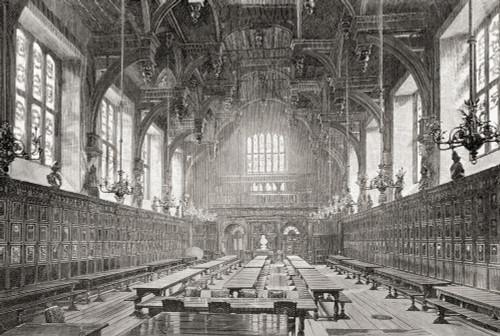
    By medieval times, England had already developed recognisable legal practitioners, and the Inns of Court became important centres of legal education and professional life.

    The lawyer had well and truly arrived.

    The law, meanwhile, was becoming a career.

    5. London Today: The Old Bailey and the Price of Complexity

    Twenty-first century

    Now let’s return to London in 2026.

    Walk along the Old Bailey in the City of London and you’ll find the Central Criminal Court, crowned by a golden figure of Justice holding her sword and scales.

    The present courthouse opened in 1907, although criminal trials in the area have a much longer history.

    In 1834, the Old Bailey was formally established as the Central Criminal Court.

    Today, serious criminal cases are heard there under an extensive framework of legislation, evidence rules, procedural safeguards and rights of appeal.

    Judges direct proceedings and interpret the law.

    Barristers present cases and challenge evidence.

    Solicitors advise clients and prepare cases.

    Juries determine questions of fact in trials where they are required.

    And defendants have legal protections that would have been unfamiliar, or entirely unavailable, in many earlier societies.

    That is progress worth recognising.

    We shouldn’t romanticise ancient courts simply because their procedures were less complicated.

    A simpler system isn’t necessarily a fairer one.

    The development of legal safeguards has helped protect people from arbitrary punishment, unreliable accusations and abuses of authority.

    But there’s an uncomfortable complication.

    Have We Made Justice Too Complicated to Navigate?

    In ancient Athens, a citizen might be expected to stand up and argue his own case.

    In medieval London, disputes could be handled by civic officials familiar with local customs.

    Today, even identifying the correct court, prosecuting authority or procedure can require specialist knowledge.

    I recently spent several hours contacting government departments in an attempt to trace historical court proceedings associated with MS90 endorsements recorded against me.

    Eventually, an enforcement team supplied account references.

    The Single Justice Service then asked for identifying information, including the prosecuting authority and offence date.

    Reasonable questions, perhaps.

    Except that those are among the details I am trying to establish.

    I am asking the system to identify the proceedings.

    The system is asking me to identify the proceedings so that it can assist.

    There’s something almost historically poetic about it.

    Thousands of years ago, people could bring disputes before elders.

    Today, I have an account reference, an email address and six questions to answer.

    And I’m still trying to find the court record.

    The Old Bailey’s Digital Irony

    Here’s something particularly interesting.

    The Old Bailey Proceedings Online provides searchable accounts of nearly 198,000 criminal trials from 1674 to 1913.

    Researchers, historians and members of the public can explore centuries of London’s criminal justice history from a computer.

    The Open University was among the institutions involved in developing this remarkable digital resource.

    Think about that.

    We can search accounts of criminal trials conducted in London during the seventeenth century.

    Yet tracing the records of a much more recent case can still involve several telephone calls, different departments and a degree of investigative persistence.

    There may be perfectly legitimate reasons for that difference, including privacy restrictions, fragmented record systems and the different purposes for which the information was collected.

    A historical public archive is not the same thing as a live court administration system.

    Nevertheless, the contrast is striking.

    It demonstrates what thoughtful digitisation can achieve.

    And it invites us to ask why navigating current administrative processes can sometimes feel more difficult than exploring the distant past.

    So, What Came First?

    The law.

    We established that at the beginning.

    But the journey from ancient Mesopotamia to the Old Bailey reveals something more interesting.

    Lawyers didn’t invent the need for justice.

    They emerged as societies developed increasingly elaborate rules, institutions and methods of resolving disputes.

    And legal specialisation brought genuine benefits.

    It created expertise, improved representation and helped develop procedures intended to protect people from unfair treatment.

    But it also contributed to a world in which understanding the law, and sometimes even locating the right part of the legal system, can become a specialist task.

    That leaves us with a question for the present.

    Have we made justice more sophisticated without always making it more accessible?

    Perhaps the next great improvement to the legal system won’t involve inventing another rule.

    Perhaps it will involve making the rules, the records and the institutions easier for ordinary people to understand.

    After all, the law existed before lawyers.

    And presumably, somewhere along the way, people managed to settle disputes without being asked to provide a case reference they were contacting the court to obtain.

    The law came first. The lawyer came later. And somewhere along the way, we invented the help desk.

  • To Study Law, or Not to Study Law?

    Wednesday, 14 October 2026

    This is where my little Shakespearean chapter comes to an end. Over the past few days, I’ve borrowed his language to make sense of the law, its delays and its peculiar relationship with ordinary human life. But today’s question deserves something more modern than a soliloquy: a spreadsheet.

    To study law, or not to study law?

    That is the question.

    And this time, I thought I might begin with some numbers.

    Act I: What Happens to Law Graduates?

    If somebody enrols on a Bachelor of Laws (LLB) course with the intention of becoming a lawyer, what are their chances of finding themselves in a legal profession after graduation?

    It’s a surprisingly difficult question to answer.

    Fortunately, the Higher Education Statistics Agency conducts a Graduate Outcomes survey, and the results are published through Discover Uni.

    The survey asks graduates what they’re doing approximately fifteen months after completing their studies.

    That isn’t the same as asking whether they’ve qualified as solicitors or barristers. Qualification can take considerably longer, and some graduates pursue further education before entering practice.

    Nevertheless, the figures provide an interesting snapshot of where people actually go after studying law.

    Here are ten university law courses we’ve been examining, arranged by the proportion of employed survey respondents working in legal professional occupations.

    University and courseEmployed respondents in legal professional occupations
    Oxford — Jurisprudence55%
    Liverpool — Law with a Year Abroad55%
    Liverpool — standard LLB48%
    Durham — Law, broader subject data48%
    Surrey — Law45%
    Exeter — LLB Law44%
    Manchester Metropolitan — Law43%
    Nottingham — Law41%
    York — Law39%
    Bristol — Law36%

    Source: Discover Uni Graduate Outcomes course data, discussed and collected in October 2026. These are ten selected course entries, not the ten highest-performing law courses nationally. Survey cohorts, sample sizes and the degree of course-specific reporting differ.

    At first glance, something stands out.

    Only two entries exceed 50%.

    And one of those, Liverpool’s Law with a Year Abroad, is a relatively small course sample. Liverpool’s standard LLB records 48%.

    Oxford reports 55%, but even that figure doesn’t mean that 55% of everybody who starts the course will eventually become a lawyer.

    It means that 55% of the employed respondents whose occupations were captured in that particular survey were classified as legal professionals fifteen months after graduating.

    That’s a much narrower claim.

    Still, it raises a question.

    If someone studies law because they want to become a lawyer, should we be concerned when fewer than half of the employed graduates in many of these courses are already working in legal professional occupations?

    Act II: Is That Actually Bad News?

    My first reaction was surprise.

    If somebody studies medicine, we might reasonably expect a strong connection between the degree and the profession.

    Law feels similar. It has its own terminology, qualifications, institutions and professional rules.

    So why don’t these figures look more like a direct pipeline into legal practice?

    Part of the answer is timing.

    Fifteen months isn’t particularly long in the legal profession.

    Someone hoping to become a solicitor may still be preparing for professional examinations, looking for qualifying work experience or completing further study.

    Someone pursuing the Bar may still be undertaking vocational training or seeking pupillage.

    And not every graduate who wants a legal career will secure their preferred opportunity immediately.

    Then there’s the question of what counts as legal employment.

    The occupational category “legal professionals” doesn’t necessarily include everyone working in a law firm, court, regulatory body or legal-support role.

    Nor does it tell us which graduates will eventually qualify.

    There’s also a fundamental statistical problem.

    A percentage of employed survey respondents is not the probability that a new student will become a lawyer.

    Those are different populations, observed at different points in their careers.

    So we shouldn’t conclude that the majority of LLB graduates have less than a fifty-fifty chance of entering the legal profession.

    The data doesn’t establish that.

    But neither should we dismiss the figures as meaningless.

    They tell us that the transition from studying law to working in a legal profession is far from instantaneous.

    And that is worth knowing before committing years of study and substantial amounts of money to a degree.

    Act III: What Is a Law Degree Actually For?

    Perhaps the mistake is assuming that an LLB has only one purpose.

    A law degree can prepare someone for legal practice, but it can also develop abilities that are useful in business, government, journalism, policy, compliance and many other fields.

    Students learn to interpret complicated texts, examine evidence, construct arguments and identify where rules apply.

    Those skills don’t suddenly become worthless when their owner takes a job outside a courtroom.

    Indeed, perhaps the better question isn’t simply how many graduates become lawyers.

    Perhaps we should ask how many are doing meaningful work, whether their education helped them obtain it, and whether they consider the degree worthwhile.

    Discover Uni includes some of those broader measures too.

    That matters because a degree can be both professional preparation and an education in its own right.

    Still, if a university markets its LLB primarily as a route into legal practice, I think students are entitled to ask about the route.

    How many graduates obtain training contracts?

    How many secure pupillage?

    How many eventually qualify?

    How long does that take?

    And how much additional education, experience and expense is required after the undergraduate degree?

    Those would be more revealing measures of the professional pathway than a single employment snapshot.

    Unfortunately, they aren’t all answered by the headline Graduate Outcomes figures.

    Act IV: Must a Great Lawyer Have Studied Law?

    The next question is almost the reverse of the first.

    If studying law doesn’t guarantee a legal career, is studying law even necessary to become an exceptional lawyer?

    Consider ten distinguished British legal figures.

    Five studied law or jurisprudence as undergraduates.

    Five approached the profession from another academic direction.

    Studied law or jurisprudenceStudied another subject first
    Baroness Brenda HaleMichael Mansfield KC — philosophy
    Lord ReedDinah Rose KC — history
    Cherie Blair KCLord Jonathan Sumption — history
    Amal ClooneyLord Michael Briggs — history
    Keir StarmerHelena Kennedy KC — law-related studies following earlier education*

    An important qualification: Helena Kennedy KC is not a clean example of someone who qualified through an unrelated university degree, so she shouldn’t be treated as evidence for that category. The fifth position remains open pending a suitably verified example.

    Even without forcing the numbers into a perfectly symmetrical comparison, the point is clear.

    Some remarkable lawyers began with law.

    Others began with history or philosophy.

    Lord Sumption became one of the country’s leading advocates and later a Supreme Court justice despite having studied history rather than law as an undergraduate.

    Michael Mansfield’s background in philosophy hardly prevented him from becoming one of Britain’s most recognisable criminal barristers.

    Meanwhile, Baroness Hale and Lord Reed demonstrate what can be achieved by people who did study law from the outset.

    The evidence doesn’t establish that one route is superior.

    We’re looking at highly successful individuals, not a representative sample of graduates.

    But it does challenge the idea that a particular undergraduate subject is a necessary ingredient of legal excellence.

    The route into a profession is not necessarily the same thing as the qualities required to excel within it.

    Act V: The Software Engineer’s Perspective

    This is where my own situation becomes relevant.

    I studied software engineering.

    At first glance, that might seem rather distant from law.

    Software engineers deal with specifications, databases, interfaces, systems and logic.

    Lawyers deal with statutes, judgments, evidence, procedures and arguments.

    But the more I encounter the legal system, the more similarities I notice.

    Both disciplines depend on rules.

    Both involve interpreting imperfect information.

    Both require an understanding of how individual decisions affect a larger system.

    And both can suffer when the system behaves exactly as designed but produces a result that doesn’t reflect the reality of the situation.

    My recent experience trying to trace an old motoring conviction has made that painfully clear.

    Different departments held different pieces of information. One system could not identify a record that another could apparently retrieve. Finding the origin of a decision became an exercise in following references between institutions.

    To a software engineer, that sounds suspiciously like a problem involving data integrity, traceability and system interfaces.

    Of course, recognising an engineering analogy doesn’t mean I understand the relevant legal principles.

    A legal process isn’t simply a badly designed computer program.

    It involves human rights, obligations, standards of proof and procedural safeguards that cannot be reduced to technical efficiency.

    But perhaps a background in engineering provides a useful perspective.

    And perhaps studying law would help me understand the parts of the problem that engineering alone cannot explain.

    My LLM: A Navigation Instrument

    I’m considering studying for a Master of Laws.

    Not because I believe another degree will automatically create a new career.

    And not because I think an LLM is equivalent to qualifying as a solicitor or barrister.

    It isn’t.

    I’m interested because my professional direction is changing, and I’m beginning to explore questions that sit between technology, law, evidence and institutional accountability.

    That feels like uncharted territory.

    Software engineering has equipped me with certain instruments: systems thinking, technical analysis and a habit of questioning how information moves between components.

    But those instruments were designed for a different landscape.

    A postgraduate law degree could give me something I don’t yet possess: a structured understanding of legal concepts, institutions and methods.

    A map, perhaps.

    Or a compass.

    Something to help me navigate a field in which I can currently identify some of the problems but don’t always know the correct legal vocabulary for describing them.

    That doesn’t make my existing education irrelevant.

    Quite the opposite.

    I suspect the combination could be more useful than either discipline on its own.

    The Final Numbers

    Let’s return to the two comparisons.

    In our selected list of ten law-course entries, only two show more than half of employed respondents working in legal professional occupations fifteen months after graduation.

    That doesn’t establish that most law graduates will never become lawyers.

    It establishes that legal education and legal employment aren’t the same milestone.

    Meanwhile, among the distinguished legal figures we’ve examined, some began by studying law and others arrived through entirely different academic disciplines.

    That doesn’t establish that a law degree offers no advantage.

    It establishes that the legal profession can benefit from more than one kind of intellectual preparation.

    I think there’s something encouraging in both findings.

    An LLB doesn’t dictate your destination.

    And a degree in another subject doesn’t necessarily close the door to law.

    As for me, I already have one degree and a particular way of looking at the world.

    I’m not proposing to discard either.

    I’m considering adding another instrument to the toolkit.

    A degree cannot guarantee where you’ll end up. But when you’re entering unfamiliar territory, learning how to navigate is a perfectly good reason to study.

    And with that, I think Shakespeare can finally take his bow.

    The next chapter will have to be written in my own words.

  • The Law Is a System, But Life Doesn’t Follow a Specification

    Blog #1 — 11 October 2026

    I’ve spent a considerable amount of time thinking about how systems work.

    In engineering, the starting point is usually a specification. We agree what something is supposed to do, define how its components interact, and establish rules that make the outcome predictable.

    A USB device works because manufacturers agree on a standard. Software communicates through protocols. Machines can be tested against known requirements.

    When something goes wrong, we can ask a relatively straightforward question: did the system behave according to its specification?

    But lately I’ve been wondering what happens when we apply that same way of thinking to human beings.

    Because the law is also a system.

    It has rules, procedures, classifications, deadlines and mechanisms for enforcement. In theory, these allow millions of people to live together under a shared framework.

    The difference is that human lives don’t arrive with specifications.

    A World That Doesn’t Follow the Rules

    An engineer can design a system around known inputs.

    A legal system has to deal with memories, intentions, misunderstandings, changing circumstances, missing information and people who don’t necessarily behave as expected.

    Two people might witness the same event and remember it differently. Someone might move house and never receive a letter. A vehicle might be registered to one person, driven by another and left in the possession of a third.

    The administrative system still needs to produce an answer.

    It needs names, dates, addresses, responsibilities and outcomes.

    But the fact that a situation can be reduced to fields in a database doesn’t mean those fields tell the whole story.

    A record can be complete according to its specification and incomplete according to reality.

    That’s where the engineering analogy begins to get interesting.

    A Mustang on Judge Judy

    I was reminded of this while watching an old episode of Judge Judy involving a Ford Mustang and a test drive that ended badly.

    What interested me wasn’t simply who damaged the car. It was the way the case exposed different layers of responsibility.

    There was the person who drove the vehicle, the person who owned it, the costs of recovering it and the question of what the car was actually worth.

    From a purely mechanical perspective, the problem seemed simple: a car had been damaged.

    But legally, the answer depended on several different questions. Who had the relevant rights? Who was responsible for particular decisions? What loss could actually be established?

    At one point, the discussion turned to the car’s surprisingly low value and the towing and impound costs.

    It struck me that the physical event and the legal consequences were not necessarily the same thing.

    A damaged car is an engineering problem.

    Determining who should pay, and how much, is a problem involving evidence, responsibility and judgment.

    The law has to turn a complicated human event into a decision that can be enforced.

    And that transformation isn’t always straightforward.

    The Difference Between a Rule and Reality

    In engineering, rules are often agreed before the system is built.

    If two components don’t implement the same protocol, they may not communicate. If a machine receives an invalid input, we can design it to reject that input.

    Human society is different.

    The law applies whether or not someone has read every relevant statute or understands every procedure.

    There are good reasons for this. A society couldn’t function if each person could choose which laws applied to them.

    But it creates an unusual relationship between the system and its users.

    We are expected to comply with rules that may be complicated, distributed across multiple institutions and difficult to understand without specialist knowledge.

    And unlike a piece of software, we cannot simply inspect the entire specification before participating.

    We’re already participating.

    When Institutions Become Components

    Modern legal administration increasingly resembles a network of interconnected systems.

    A court makes a decision. Another organisation records its consequences. An enforcement process may then act on that record.

    Each institution has its own responsibilities, procedures and data.

    From an engineering perspective, this sounds familiar. It’s a distributed system.

    And distributed systems introduce a particular problem: one component may trust information received from another without independently verifying how that information was established.

    Imagine an error entering at the beginning.

    The first institution records it. The second receives it. The third acts on it.

    By the end, several organisations may possess records that appear to support the same conclusion.

    But those records aren’t necessarily independent evidence.

    They may all be copies of the same original assumption.

    A mistake doesn’t become true because it has been replicated successfully.

    That seems obvious when talking about software.

    It becomes considerably more important when the records concern human beings.

    The Problem With Perfect Compliance

    There’s a temptation to judge a system by whether it follows its own rules.

    Did the correct form get issued? Was the record transmitted? Did the next department apply the prescribed procedure?

    Those are necessary questions.

    But they aren’t sufficient.

    An institution might follow its procedures correctly while acting on incomplete or inaccurate information.

    This doesn’t mean procedures are pointless. Quite the opposite: procedures protect people from arbitrary decisions.

    It means the quality of a system depends not only on its normal operation but also on what happens when its assumptions are challenged.

    Engineers understand this distinction.

    We test for failures. We build diagnostics. We preserve logs. We design recovery mechanisms.

    We don’t simply declare a machine reliable because it performs well when every input is correct.

    We ask what happens when something unexpected occurs.

    The legal system deserves the same scrutiny.

    Can We Engineer Better Justice?

    My first instinct when I look at administrative complexity is to ask why more of it can’t be automated.

    Why should obtaining a record take weeks? Why should the same information need to be requested from several organisations? Why should someone have to navigate telephone menus just to find out which institution holds a particular document?

    Surely technology could make these things easier.

    And perhaps it can.

    But I’ve also begun to wonder whether automation introduces a different danger.

    If a decision is wrong, making its consequences faster and more efficient isn’t necessarily an improvement.

    A system that can automatically impose a consequence should ideally be equally capable of explaining the decision, preserving its supporting evidence and providing an effective route to challenge it.

    Otherwise, we risk building systems that are exceptionally good at enforcing their conclusions and surprisingly poor at reconsidering them.

    That is not an argument against digitisation.

    It’s an argument for thinking more carefully about what we’re digitising.

    Why I’m Writing This

    These questions are no longer entirely theoretical for me.

    I’m preparing to navigate a legal and administrative process concerning records and decisions that affect me personally.

    Over the coming days, I intend to document that journey here.

    I’ll write about the records I request, the responses I receive, the procedures I encounter and the practical lessons I learn.

    Some of my assumptions may turn out to be wrong. Some apparent inconsistencies may have straightforward explanations. Others may prove more difficult to resolve.

    I’ll try to distinguish carefully between documented facts, personal recollections and unanswered questions.

    This isn’t legal advice, and I don’t intend to turn an unresolved situation into a collection of accusations.

    My hope is that a transparent account of the process might help other people facing similar circumstances.

    And perhaps, along the way, it will reveal something useful about how our institutions work.

    The Specification Is Not the Whole Story

    Engineering has taught us extraordinary things about reliability, consistency and the value of shared rules.

    But human beings are not machines.

    Our circumstances are messy. Our memories are imperfect. Our intentions aren’t always visible. And the information recorded about us isn’t always the whole truth.

    A legal system needs rules to function.

    Yet if those rules are to serve justice, the system must also have room for the unexpected, the disputed and the genuinely mistaken.

    Because a system isn’t truly reliable simply because it follows its specification.

    It must also be capable of recognising when the specification fails to describe reality.

    And, more importantly, it must know what to do next.

  • When Prison Stops Being a Deterrent: A Problem Britain Needs to Confront

    When Prison Stops Being a Deterrent: A Problem Britain Needs to Confront

    The British criminal justice system rests partly on a simple assumption: punishment discourages crime.

    For many people, the prospect of arrest, prosecution, a criminal record and imprisonment is an enormous deterrent. Losing a job, a home, relationships, freedom and reputation represents a potentially catastrophic consequence.

    But what happens when those consequences no longer frighten someone?

    This is an uncomfortable question that deserves considerably more attention in the United Kingdom.

    Prison is already dealing with persistent offending

    The problem should not be exaggerated into a claim that most offenders are indifferent to prison. The available evidence does not establish that.

    What the statistics do establish is that repeat offending remains substantial.

    Ministry of Justice figures for the April–June 2024 offender cohort recorded a proven reoffending rate of 29.6%. Approximately 25,000 proven reoffenders within that cohort were responsible for almost 131,000 proven reoffences during the measurement period. Those who reoffended averaged 5.13 proven reoffences each — the highest figure in that statistical series.

    That distinction matters.

    The challenge is not simply the number of people who reoffend. It is the concentration of repeated offending among a smaller population.

    The person with little left to lose

    For somebody with a career, mortgage, stable family life and reputation to protect, even a relatively short prison sentence can carry enormous secondary consequences.

    Another person may approach exactly the same punishment from a completely different position.

    Someone who has spent years moving between unstable accommodation, unemployment, addiction, offending and custody may perceive prison very differently. Previous imprisonment may also make the environment familiar rather than unknown.

    That does not mean such people want to go to prison. Nor should poverty, addiction or homelessness be confused with criminality.

    The narrower point is that deterrence depends partly upon what an individual believes they stand to lose.

    When conventional society has already become disconnected from someone’s life, conventional punishment can lose some of its leverage.

    Simply making prison harsher is not the obvious answer

    The instinctive response might be: if offenders aren’t sufficiently afraid of prison, make prison more severe.

    The evidence provides good reason to question that approach.

    The Sentencing Council’s review of sentencing effectiveness concluded that there is no strong evidence supporting increasingly severe sentences on the basis of general deterrence. Research on deterrence distinguishes between the severity, certainty and speed of punishment.

    This produces an important distinction for public policy.

    A hypothetical offender who believes there is only a small chance of being caught may not be greatly influenced by whether the eventual sentence is two years or three. Increasing the perceived probability that offending will actually produce consequences may matter more than continually increasing the maximum severity of those consequences.

    The objective therefore should not simply be to make people more frightened of prison.

    It should be to make persistent offending less attractive and lawful life more valuable.

    Britain’s prisons are already under considerable pressure

    This is not an abstract problem.

    There were 85,858 prisoners in England and Wales on 30 June 2026. Operational prison capacity was reported at 89,120 in June.

    Government projections published in 2025 estimated that the prison population could reach between 98,000 and 103,600 by March 2030, with a central projection of approximately 100,600.

    The prison estate therefore cannot sustainably answer every criminal-justice problem simply by demanding more imprisonment.

    Almost a quarter of prisoners were held in crowded accommodation during 2024–25.

    A system operating under those pressures must ask what it is trying to achieve with every prison place.

    Punishment and rehabilitation are not opposites

    Public debate sometimes presents two competing philosophies.

    One says offenders should be punished.

    The other says offenders should be rehabilitated.

    English and Welsh sentencing law does not actually require such a binary choice. The recognised purposes of sentencing include punishment, reducing crime including through deterrence, rehabilitation, protection of the public and reparation.

    That is sensible.

    There are offenders from whom the public genuinely needs protection, making imprisonment necessary.

    But if someone will eventually return to society, the condition in which that person returns matters enormously.

    A prisoner who leaves custody with no accommodation, no legitimate income, untreated addiction, few employable skills and the same criminal associates has been punished — but many of the circumstances associated with their offending remain.

    By contrast, someone leaving with stable accommodation, employable skills, treatment where appropriate and something meaningful to lose has acquired additional reasons not to return.

    Rehabilitation can therefore itself become a form of deterrence.

    The objective should be to create something worth losing

    Perhaps one of the most important questions in criminal justice is not:

    “How do we make prison frightening enough?”

    It is:

    “How do we make freedom valuable enough?”

    Employment matters.

    Housing matters.

    Treatment for addiction and mental illness matters.

    Family relationships matter.

    Education matters.

    The realistic probability of being caught matters.

    Effective probation and supervision matter.

    And where somebody presents a genuine danger to others, incapacitation and public protection matter.

    None of these principles requires society to excuse criminal behaviour. Understanding why punishment sometimes fails is not the same as absolving the person who committed the offence.

    Indeed, taking repeat offending seriously requires asking whether our interventions actually prevent the next victim rather than merely expressing society’s anger about the previous one.

    A criminal justice system needs more than fear

    Britain faces a difficult problem when dealing with persistent offenders for whom imprisonment has become familiar and conventional deterrents have weakened.

    But the solution cannot simply be an endless competition to devise harsher punishment.

    A functioning criminal justice system needs credible enforcement, proportionate punishment and protection of the public. It also needs credible routes back into ordinary society.

    The most successful outcome is not an offender who leaves prison terrified of returning.

    It is an offender who leaves prison with compelling reasons never to return.

    That distinction should be at the centre of Britain’s debate about prisons, sentencing and rehabilitation.

  • Can Piddlington Really Leave the UK?

    Can Piddlington Really Leave the UK?

    Can Piddington Really Leave the United Kingdom? The Law Behind the Village’s ‘Independence’ Referendum

    Residents of Piddington in Oxfordshire have voted overwhelmingly to “leave” the United Kingdom, but the legal consequences of the vote are considerably less dramatic than the headline suggests.

    In a referendum held on 15 September 2026, 312 votes were cast. Of those, 285 supported independence, 26 opposed it and one ballot was spoiled. Following the result, Piddington Parish Council chairman Tim McNally announced that the village would be known as the “Principality of Piddington”.

    The referendum was held against the backdrop of government proposals to accommodate up to 1,256 male asylum seekers at a former Ministry of Defence site near Bicester. Residents and local representatives have raised objections concerning matters including consultation, infrastructure and pedestrian access to the site. The Government, meanwhile, has said the use of former military sites forms part of its policy of reducing reliance on asylum hotels.

    But whatever its political significance, the referendum does not make Piddington an independent country.

    A parish council cannot secede from the United Kingdom

    The fundamental difficulty for the proposed “Principality” is straightforward: there is no mechanism in UK law allowing an English parish, village, town or city to unilaterally declare itself independent.

    The BBC’s explanation of the Piddington referendum similarly notes that there is no legal mechanism by which a village, town or city can declare independence from the UK, meaning Piddington’s vote is symbolic.

    Piddington Parish Council is not a sovereign legislature. It is part of the first tier of English local government.

    Modern parish councils derive their status principally from legislation including the Local Government Act 1972. Their powers concern local-government matters rather than questions of national sovereignty. The House of Commons Library describes parish and town councils as the “first tier of local government”.

    Piddington Parish Council itself lists powers covering such matters as community buildings, recreational facilities, allotments, rights of way, public conveniences, local transport initiatives and neighbourhood planning. None amounts to a power to alter the territory of the United Kingdom or remove the parish from UK jurisdiction.

    Consequently, the referendum does not remove Piddington from England, Oxfordshire or the United Kingdom.

    UK Acts of Parliament continue to apply there. Residents remain subject to the same national taxation and criminal and civil law as before. UK citizenship is unaffected, and the courts, police and public authorities retain their existing jurisdiction.

    Calling the village the “Principality of Piddington” does not alter that position.

    What about the referendum result?

    Referendums can have very different legal effects depending upon the legislation under which they are conducted.

    The UK permits local referendums on matters affecting local areas, but the existence of a referendum does not itself confer constitutional powers upon the authority organising it. Government material concerning the local-referendum regime has expressly distinguished such votes from binding decision-making, describing the policy objective as giving residents a means of influence rather than control.

    That distinction is particularly important in Piddington.

    A vote can demonstrate what participating residents want. It cannot give a parish council a power that Parliament has never conferred upon it.

    The 285 votes for independence therefore constitute a substantial democratic expression among those who voted, but they do not themselves alter Piddington’s constitutional status.

    In legal terms, Piddington was part of the United Kingdom before the referendum and remains part of the United Kingdom afterwards.

    Could Piddington ever become independent?

    This produces a more interesting constitutional question.

    Although Piddington cannot unilaterally leave the United Kingdom, it does not necessarily follow that its independence would be legally impossible under every imaginable circumstance.

    The reason is parliamentary sovereignty.

    The orthodox constitutional position is that the UK Parliament is the supreme legislative authority. Parliament describes parliamentary sovereignty as meaning that it can create or end any law, while the House of Commons Library describes Parliament as possessing the authority to “make or unmake any law”.

    Accordingly, Parliament could in principle enact primary legislation fundamentally changing Piddington’s constitutional status.

    Such an extraordinary measure would have to deal with numerous practical questions: the precise territorial boundary, nationality and citizenship, taxation, property, policing, courts, public services, highways, utilities, existing contractual obligations and the relationship between the new territory and the remainder of the UK.

    The important distinction is therefore between unilateral secession and independence authorised through UK constitutional law.

    Piddington has no legal power to accomplish the former. Parliament’s legislative sovereignty means that the latter is theoretically conceivable, although there is presently no indication that Parliament intends to enact such legislation.

    Could Piddington simply refuse to recognise UK law?

    No.

    A declaration of independence by the parish council would not deprive Parliament of legislative authority over the area. Nor would declaring Piddington a “principality” create a separate legal system.

    Residents could not, for example, stop paying UK taxes on the basis that they now lived in another country. Businesses would remain subject to applicable UK law, and criminal offences committed in Piddington would continue to fall within the ordinary criminal justice system.

    The same principle would apply to attempts to establish border controls, issue legally effective passports or disregard decisions of UK public authorities.

    Those activities require legal authority. A local declaration cannot manufacture that authority.

    Does international law change the position?

    References to the international-law principle of self-determination would not automatically transform Piddington into a sovereign state.

    Questions of self-determination and secession under international law are considerably more complicated than the proposition that any community which votes for independence thereby becomes independent.

    Most importantly for Piddington’s immediate situation, a local referendum cannot by itself disapply UK domestic law. Unless and until the UK’s constitutional arrangements were legally changed, British authorities and courts would continue to treat Piddington as UK territory.

    Recognition by other states would also be an entirely separate issue from the parish council declaring itself independent.

    What has actually changed?

    Legally, very little.

    Politically, the referendum gives campaigners a striking piece of evidence about the views expressed by participating residents and has generated national media attention for their objections to the proposed asylum accommodation site. The public consultation concerning the development was reported as running until 17 September.

    Constitutionally, however, the position remains much more mundane.

    The “Principality of Piddington” is a symbolic title rather than a new sovereign state. There is no new international border in Oxfordshire, no separate Piddington citizenship and no legal basis for the parish council to substitute its authority for that of Parliament.

    The referendum therefore matters primarily as an act of political expression rather than an exercise of constitutional power.

    Piddington has voted to leave the United Kingdom.

    Legally, it has not left at all.

    This article provides general legal and constitutional information and does not constitute legal advice.

  • Omar Benguit: The Great British Injustice

    Omar Benguit: The Great British Injustice

    Case Analysis

    The Evidential Weaknesses Surrounding the Conviction of Omar Benguit

    A review of the witness evidence, forensic gaps, retrials and continuing concerns surrounding the 2005 conviction.

    Important: Omar Benguit’s conviction remains legally valid. This article examines concerns about the strength and reliability of the evidence; it does not state that he has been judicially established to be innocent.

    Introduction

    Omar Benguit was convicted at Winchester Crown Court in January 2005 of murdering 26-year-old South Korean language student Jong-Ok Shin, known as Oki, in Bournemouth on 12 July 2002.

    Benguit has consistently denied responsibility. His case has attracted sustained concern because the conviction was obtained without forensic evidence linking him to the murder and depended heavily upon testimony from witnesses whose reliability has been challenged.

    Central question

    Was the testimonial and circumstantial evidence sufficiently reliable to establish guilt beyond reasonable doubt in the absence of an independent forensic link?

    Absence of forensic evidence

    Perhaps the most striking feature of the prosecution case was the absence of forensic evidence connecting Benguit to Shin or the murder scene.

    The murder weapon was never recovered, no eyewitness saw the attack itself, and the prosecution case was not supported by DNA, fingerprints or other scientific evidence directly placing Benguit with the victim.

    The absence of forensic evidence did not make a conviction impossible, but it made the credibility of the witnesses exceptionally important.

    Heavy dependence on a problematic principal witness

    The prosecution relied heavily on a principal witness who gave accounts placing Benguit in circumstances allegedly connected to the killing.

    However, her evidence contained serious credibility problems. She gave inconsistent statements, initially identified someone else, and admitted that parts of earlier accounts were untrue.

    “`

    Inconsistent accounts

    The witness gave differing versions of events and altered important details over time.

    False information

    Parts of her early statements were acknowledged to be false or misleading.

    Central importance

    Her evidence was not peripheral: it formed a major part of the prosecution case.

    “`

    Post-trial contradictions

    Concerns about the witness intensified after the trial when she later gave a public account that appeared materially different from her courtroom evidence.

    The Criminal Cases Review Commission later investigated new material relating to her credibility and referred Benguit’s conviction back to the Court of Appeal.

    2005 Benguit convicted after a third murder trial.
    2012 The CCRC referred the conviction back to the Court of Appeal.
    2014 The Court of Appeal upheld the conviction.
    2026 Further scrutiny of the case continues.

    Problems with supporting witnesses

    Other witnesses provided circumstantial evidence suggesting that Benguit appeared agitated, had blood on him or his clothing, wanted to change clothes, or had spoken about stabbing someone.

    These claims supported the prosecution case, but they remained witness testimony rather than physical proof of the murder.

    Why this matters:

    When a case depends heavily on multiple witnesses from a chaotic or unstable environment, the reliability, independence and consistency of those accounts become especially significant.

    Two juries previously failed to convict

    Benguit’s conviction came only after three murder trials. The first two juries were unable to reach a verdict on the murder charge.

    Two hung juries do not prove innocence. However, they demonstrate that earlier juries who heard versions of the prosecution evidence were unable to reach the level of certainty required for conviction.

    The knife evidence

    Witnesses gave evidence suggesting Benguit sometimes carried knives or had been seen sharpening one.

    Yet the murder weapon itself was never found, and no specific knife was scientifically connected to Shin’s death.

    Evidential distinction

    Evidence that a person possessed a knife is not the same as evidence that a particular knife was used by that person to commit a particular murder.

    The victim’s account

    Before her death, Shin was able to provide limited information about the attack. She reportedly described being attacked from behind by a masked man.

    That evidence was consistent with a sudden attack but did not identify Benguit.

    A possible alternative suspect

    The case has also attracted attention because convicted murderer Danilo Restivo was living in Bournemouth at the relevant time.

    The CCRC obtained evidence that it believed could have allowed the defence to raise an alternative-suspect argument. The Court of Appeal later considered and rejected that argument as insufficient to make the conviction unsafe.

    Important distinction: It would be inaccurate to state as fact that Restivo killed Shin. His involvement has been raised as an alternative-suspect theory, not established by a court.

    Why the conviction has survived

    A balanced assessment must also acknowledge that the courts have repeatedly rejected the argument that the conviction is unsafe.

    The prosecution case was cumulative. It relied on the principal witness alongside supporting testimony concerning Benguit’s movements, alleged bloodstaining, his behaviour, alleged admissions and evidence about knives.

    The Court of Appeal concluded that the jury had been entitled to assess the weaknesses in the witness evidence and nevertheless convict.

    Conclusion

    The controversy surrounding Omar Benguit’s conviction arises not from a single decisive piece of exculpatory evidence but from the cumulative fragility of the case.

    There was no forensic evidence linking him to the murder, no recovered murder weapon, no eyewitness to the stabbing, significant problems with the principal witness, and two previous juries failed to reach a guilty verdict.

    None of those points proves that Benguit did not murder Jong-Ok Shin. But together they explain why the conviction has continued to attract scrutiny.

    The key issue remains simple:

    Was a heavily witness-dependent and circumstantial case, without an independent forensic link to the victim or crime scene, sufficiently reliable to prove guilt beyond reasonable doubt?

  • Schizophrenia in Prison

    Schizophrenia in Prison

    Mental Health & Criminal Justice

    Schizophrenia in Prison: How Prevalence Compares with the General Population — and Why Women Are Especially Affected

    Severe mental illness is substantially over-represented in prisons. The disparity is particularly pronounced among women, who make up only a small proportion of the prison population but experience exceptionally high levels of mental ill-health, trauma and self-harm.

    Important note on terminology: schizophrenia and psychosis are not interchangeable terms. Schizophrenia is one cause of psychosis, while psychotic symptoms can also occur in bipolar disorder, severe depression, substance-related conditions and other illnesses. Modern prison research frequently reports psychotic disorder rather than schizophrenia alone. This report therefore distinguishes between the two wherever the evidence allows.

    The headline finding

    The gap between prisons and the wider population is substantial. In the major Office for National Statistics study of psychiatric morbidity among prisoners in England and Wales, approximately 14% of women in prison had experienced a functional psychosis during the previous year. Within the clinically interviewed group, approximately 13% were identified as having schizophrenia or a delusional disorder.

    By comparison, psychotic disorders affect well below 1% of adults living in ordinary households. The latest Adult Psychiatric Morbidity Survey for England estimates past-year psychotic disorder at approximately 0.5% of adults overall, including approximately 0.6% of women.

    14%
    Women in prison
    Functional psychosis in the previous year in the landmark England & Wales prison survey
    “`
    0.6%
    Women in the community
    Estimated past-year psychotic disorder in recent English household surveys
    13%
    Schizophrenia / delusional disorder
    Women prisoners identified in the clinical component of the ONS study
    “`

    Caution: the 14% prison figure and contemporary 0.6% community figure come from different surveys conducted in different periods. They illustrate the scale of the disparity but should not be treated as a precise like-for-like calculation of risk.

    How do prisoners compare with people outside prison?

    Population / measure Reported prevalence What the figure means
    Women in prison 14% Functional psychosis during the previous year in the landmark ONS England & Wales prison survey.
    Men on remand 10% Functional psychosis during the previous year.
    Sentenced men 7% Functional psychosis during the previous year.
    Women in the general population 0.6% Recent pooled estimate of past-year psychotic disorder among women living in private households in England.
    Adults overall in the general population 0.5% Recent pooled estimate of past-year psychotic disorder among adults in England.

    Although differences in study design prevent a simple mathematical comparison, the conclusion is difficult to miss: psychotic illness is many times more common among people in prison than among people living in the community, and historically the highest prison rates have been found among women.

    Women in prison: a particularly vulnerable population

    Women make up only a small minority of people held in prisons in England and Wales, but their mental-health needs are disproportionately high. Contemporary prison data continue to show this pattern. Recent Prison Reform Trust figures report that almost three-quarters of surveyed women in prison say that they have mental-health problems.

    Research comparing male and female prisoners has also repeatedly found higher levels of mental-health need and greater psychiatric comorbidity among women. A 2019 UK prison study, for example, found that women reported significantly higher levels of mental-health need than men and were more likely to screen positively for multiple disorders.

    Why the female prison population requires particular attention

    The issue is not simply the number of women diagnosed with a particular psychiatric condition. Women entering custody frequently have overlapping needs involving severe mental illness, depression and anxiety, substance dependence, histories of trauma and abuse, self-harm, unstable housing and disrupted family relationships. These conditions can interact, making both diagnosis and treatment more complex.

    Schizophrenia specifically

    Schizophrenia is a severe, long-term mental-health condition that can affect a person’s thoughts, perceptions, emotions and behaviour. Symptoms may include hallucinations, delusions, disorganised thinking, reduced motivation and difficulties with everyday functioning.

    The most frequently cited schizophrenia-specific evidence for female prisoners in England and Wales comes from the ONS psychiatric morbidity research. In its clinical assessment of women prisoners, approximately 13% were identified as having a schizophrenic or delusional disorder. Approximately 3% were classified specifically with schizophrenia, while the wider 13% category included other delusional disorders.

    This distinction matters. Statements such as “14% of women prisoners have schizophrenia” are not supported by this dataset. The 14% figure relates to functional psychosis as a whole, not schizophrenia alone.

    Is this still a problem today?

    The most detailed national diagnostic study of schizophrenia among women prisoners is now old, which is itself an important limitation in the evidence base. However, newer information does not suggest that serious mental illness has ceased to be a major prison-health issue.

    A recent analysis of mental-health caseloads covering around three-quarters of English prisons found that psychosis accounted for approximately 22% of the primary problems among patients on prison mental-health caseloads. This figure must not be interpreted as saying that 22% of all prisoners have psychosis: it describes people already receiving or identified for mental-health services. Nevertheless, it demonstrates the continuing demand that psychotic illness places on prison mental-health teams.

    Recent surveys have also found that approximately 74% of women in prison report having mental-health problems, compared with 56% of men surveyed. Women consequently remain a group with particularly complex health and social-care needs.

    Why is severe mental illness over-represented in prisons?

    There is no single explanation. Prison populations are not randomly selected sections of society. Many of the social and health factors associated with contact with the criminal-justice system also overlap with factors associated with poor mental health.

    • Social disadvantage: poverty, insecure housing and homelessness are disproportionately represented among people entering custody.
    • Trauma and abuse: histories of violence, neglect, domestic abuse and sexual abuse are common among women who enter the criminal-justice system.
    • Substance use: drug and alcohol dependence can coexist with schizophrenia and other psychotic disorders, complicating both symptoms and treatment.
    • Breakdown of community support: people with severe mental illness may reach the criminal-justice system after difficulties obtaining stable housing, treatment or social support.
    • Remand and crisis: prisons can receive people who are acutely mentally unwell while they are awaiting trial or assessment.
    • The prison environment itself: isolation, uncertainty, disrupted relationships, sleep difficulties and the stresses of incarceration may aggravate existing psychiatric symptoms.

    Trauma, self-harm and women

    Looking only at schizophrenia risks overlooking the broader context in which severe mental illness occurs. Women in prison are also disproportionately affected by trauma and self-harm.

    Recent prison statistics show that women account for a strikingly disproportionate share of self-harm incidents despite representing only around 4% of the prison population in England and Wales. This does not mean schizophrenia causes self-harm, but it illustrates the exceptionally high level of distress and complex need within the female estate.

    For women with psychosis or schizophrenia, these overlapping vulnerabilities can make continuity of care particularly important. A prison sentence or period on remand can interrupt housing, family support, benefits, community psychiatric care and established therapeutic relationships.

    Prison or healthcare?

    The high prevalence of severe mental illness in custody raises a fundamental question: are some people with serious psychiatric disorders being dealt with primarily through the criminal-justice system when healthcare and community-based intervention would sometimes be more appropriate?

    This is particularly relevant to women because many are imprisoned for relatively low-level or non-violent offending and because a significant proportion of the female prison population is held on remand. Prison Reform Trust research has highlighted cases in which severely mentally unwell women have entered custody while in crisis, including concerns about the historical use of prison as a place of safety.

    Effective responses therefore extend beyond providing medication after somebody arrives in prison. They include early identification, court diversion and liaison services, timely psychiatric assessment, access to psychological treatment, transfer to appropriate hospital care where necessary, safe accommodation and continuity of treatment after release.

    What should we conclude?

    The central finding is clear: severe mental illness and psychotic disorders are substantially over-represented in prisons compared with the community, and women in prison show an especially high burden of mental-health need.

    The classic national research found functional psychosis in around 14% of women prisoners and schizophrenia or delusional disorder in around 13% of the clinically assessed female sample. Contemporary population research, by contrast, places past-year psychotic disorder below 1% among women living in private households.

    The precise figures should be interpreted cautiously because diagnostic definitions and research methods have changed over time. What has not disappeared is the underlying disparity. More recent studies and prison-health data continue to find exceptionally high levels of mental illness among people in custody and greater levels of need among women.

    For policy, this suggests that schizophrenia and psychosis in prisons cannot be treated solely as issues of prison management. They are also questions of public health, social inequality, trauma, access to psychiatric services, diversion from custody and continuity of care.

    A note on UK figures

    Criminal justice and health systems differ across England and Wales, Scotland and Northern Ireland. The most robust national prison figures cited in this article relate primarily to England and Wales, while some later research is described as UK prison research. It is therefore more accurate to describe these figures by jurisdiction rather than assuming a single prevalence rate applies uniformly to every prison in the United Kingdom.

    Sources and further reading

    1. Office for National Statistics / O’Brien et al. — Psychiatric Morbidity among Women Prisoners in England and Wales. Landmark national research measuring psychosis, schizophrenia, personality disorder and other psychiatric morbidity among women prisoners.
    2. NHS England Digital. — Adult Psychiatric Morbidity Survey: Survey of Mental Health and Wellbeing, England, 2023/24 — Chapter 12: Psychotic Disorder.
    3. Tyler, N., Miles, H. L., Karadag, B. & Rogers, G. (2019). — An updated picture of the mental health needs of male and female prisoners in the UK: prevalence, comorbidity, and gender differences. Social Psychiatry and Psychiatric Epidemiology, 54, 1143–1152. DOI: 10.1007/s00127-019-01690-1.
    4. Prison Reform Trust. — Health in Prison. Current overview of mental-health needs within prisons in England and Wales.
    5. Durcan, G. / Centre for Mental Health (2023). — Prison mental health services in England, 2023: Prison and young offender institution mental health needs analysis.
    6. Prison Reform Trust (2025–2026). — Publications concerning women in prison, remand, mental health, self-harm and approaches to reducing women’s imprisonment.
    Editorial note: This article discusses population-level research and should not be used to infer that criminal behaviour is characteristic of people with schizophrenia. The great majority of people experiencing mental illness are not prisoners, and diagnosis alone does not determine an individual’s risk or behaviour.
  • The Human Radius of Murder: From Atlanta to London and Lithuania

    The Human Radius of Murder: From Atlanta to London and Lithuania

    Longform Documentary Essay

    The Human Radius of Murder

    How two murders in Atlanta rippled across families, countries, and twenty years of memory.


    I n August 2004, my family moved from the United Kingdom to Atlanta, Georgia. A few months later, my father found work for an old childhood friend from Lithuania: Rolandas Milinavičius.

    At the time, there was no reason for me to believe that name would stay with me for the next twenty years.

    Milinavičius owned a business exporting American cars to the Middle East. My father worked loading vehicles into shipping containers—often alone, often in the suffocating Georgia heat. Their friendship slowly became a business relationship, and their business relationship slowly became something much darker.

    Five Cars Instead of Three

    My father approached container loading differently. Trained as a carpenter in Britain, he built timber frameworks that secured vehicles tightly enough to fit five cars where others managed only three.

    The journey to Jordan or Saudi Arabia was nearly 7,000 miles. Most containers arrived with dented panels and shattered bumpers. His arrived without a scratch.

    “Who packed these containers? Give this man a call.”

    Eventually, my father left Milinavičius and built his own warehouse. It was an enormous gamble—$50,000 a month in rent before paying a single employee—but it worked. Some months the business earned more than Milinavičius had ever imagined.

    ● ● ●

    Inga and Martynas

    Two people remained working for Rolandas.

    Inga Bandzevičiūtė-Contreras. Martynas Simokaitis.

    Before they became victims in a murder case, they were simply young Lithuanian immigrants trying to build lives in America.

    According to my father, he offered both of them jobs at his new company. They wanted to leave, but they couldn’t. Their employer owed them months of wages, and walking away meant abandoning money they had already earned.

    They weren’t trapped by loyalty.

    They were trapped by debt.

    Years later, I discovered that contemporary Lithuanian reporting described the same financial desperation: unpaid wages, borrowed money, and two young people trying desperately to earn enough to visit their families back home. (Public reporting supports the financial conflict, while my father’s offer of employment comes from our family’s recollection.)

    Martynas and Inga
    Martynas Simokaitis and Inga Bandzevičiūtė-Contreras were preparing to return to Lithuania in the summer of 2007.

    They Were Going Home

    This is the detail I find hardest to forget.

    Both of them were planning to go home.

    Martynas hadn’t seen Lithuania in seven years. The relatives who had raised him were waiting for him in Kybartai. Inga’s mother was waiting in Kaunas. Both had tickets in their future.

    They were waiting at the airport.

    Instead, they received ashes.
    ● ● ●

    July 26, 2007

    On a Thursday morning in East Point, Georgia, Inga and Martynas went to work at RM Auto International. They never came home.

    Surveillance cameras recorded three people entering the building: Rolandas Milinavičius, Inga, and Martynas. Only one person was recorded leaving.

    Two days later, Milinavičius surrendered to police. In 2008, a Fulton County jury convicted him of two counts of malice murder and he received two consecutive life sentences.

    The Question That Stayed With Me

    “How long does a murder last?”

    The Radius

    Most true crime stories end with the verdict.

    Two victims. One murderer. A sentence. Fade to black.

    But murder doesn’t end when the courtroom empties. It continues in birthdays where someone is missing. In parents who instinctively reach for the phone. In children who grow up carrying a surname they never chose.

    It reaches old friends, business partners, investigators, journalists—and sometimes children standing quietly near the edge of the story, who grow into adults still thinking about the people at its centre.

    A murder happens in a room.

    Its consequences do not stay there.

    They cross oceans. They enter homes the killer has never seen. They survive prison sentences and court appeals. They become memories carried by people who were never listed as victims in a legal document.


    Perhaps the question isn’t why Rolandas Milinavičius killed Inga Bandzevičiūtė-Contreras and Martynas Simokaitis.

    Perhaps the question is simply this:

    How long does a murder last?

    As long as somebody remembers.

  • Beyond Emergency Release: What England and Wales Can Learn from Norway, Japan and Oklahoma

    Beyond Emergency Release: What England and Wales Can Learn from Norway, Japan and Oklahoma

    Policy report · Prisons & public safety

    Beyond Emergency Release: What England and Wales Can Learn from Norway, Japan and Oklahoma

    A comparative report on prison capacity, sentencing and public safety

    Prepared for publication · Evidence checked September 2026

    Executive summary

    England and Wales have repeatedly come within a few thousand places of a full prison system. Ministers have responded with accelerated release, police-cell contingencies and an urgent building programme. These measures may prevent an immediate breakdown, but they do not solve the structural problem: the number and length of custodial sentences have grown faster than the system’s safe, staffed capacity.

    Norway and Japan show that a rich democracy does not have to operate its prisons at the edge of collapse. They do not, however, offer a single model. Norway confines far fewer people and deliberately moves suitable sentences into the community, including extensive use of electronic monitoring. Its correctional philosophy treats release and reintegration as the normal destination of a sentence. Japan’s prison population has fallen sharply for different reasons, including a long decline in recorded crime and prison admissions, demographic change and the retention of an estate built for a much larger population. Japan’s prisons are orderly but often highly restrictive; low occupancy should not be mistaken for proof that every feature of the Japanese regime is humane or transferable.

    Oklahoma provides a different lesson. The state became an international symbol of very high incarceration, driven in part by punitive sentencing and drug policy, before voters and legislators pursued reforms. Its experience illustrates the danger of allowing imprisonment to become the default response and then relying on clemency, emergency powers or hurried releases once capacity and cost become politically intolerable. It is a warning about governing by pressure gauge.

    As of 27 July 2026, England and Wales held 86,267 people in prison, or about 136 per 100,000 residents. Norway held 3,019, or 54 per 100,000, at the end of July 2026. Japan held 41,232, or 33 per 100,000, in mid-2025. These figures are not simple league tables: laws, recording practices, crime patterns and demographic structures differ. But the scale of the gap is too large to dismiss. England and Wales use imprisonment much more heavily than either comparator. (World Prison Brief: England and Wales, Norway, Japan)

    Reform should not mean indiscriminate release. Serious and dangerous offenders must be confined where custody is necessary for public protection and punishment. Reform means reserving expensive prison places for those cases, reducing the use of short and ineffective custody, strengthening community sentences, making progression and release predictable, and investing in probation, treatment, housing and employment. It also means publishing a binding annual prison-demand plan so that sentencing legislation cannot quietly create more prisoners than the state can safely hold.

    This report recommends that the Government:

    1. establish a statutory prison-demand and capacity duty, with independent forecasts and a requirement that new sentencing laws identify their prison and probation consequences;
    2. create a presumption against short custodial sentences, with tightly defined judicial exceptions;
    3. expand credible, properly funded community sentences, treatment and electronic monitoring;
    4. introduce earned progression for eligible determinate sentences, with exclusions and risk controls for serious violence, sexual offending and terrorism;
    5. repair probation before transferring large volumes of work from prison;
    6. reduce unnecessary remand and recall, while improving court speed and licence decision-making;
    7. make rehabilitation operational—through purposeful activity, family contact, health care, housing and employment—not merely rhetorical;
    8. retain sufficient headroom so emergency release is exceptional rather than a recurring management tool; and
    9. evaluate reforms by reconviction, harm, compliance, victim confidence and total cost, not by prison numbers alone.

    1. The question Britain should be asking

    Public debate often begins too late. When prisons are nearly full, the apparent choice is between building cells and releasing prisoners early. Both options become politically charged: construction is presented as proof of toughness; release as proof of recklessness. Yet by the time this argument begins, the most consequential decisions have already been made—in criminal law, charging, remand, sentence lengths, release rules, recall practice and the funding of probation.

    England and Wales do not have one homogeneous “UK prison system”. Criminal justice is devolved. Scotland and Northern Ireland operate separate systems, so the immediate capacity crisis and the statistics in this report concern England and Wales unless stated otherwise.

    The prison population here stood at 86,267 on 27 July 2026. On a comparable whole-population measure that was roughly 136 people per 100,000, compared with 54 in Norway and 33 in Japan. The remand population in England and Wales was 15,386—17.9% of all prisoners. (World Prison Brief)

    The Ministry of Justice’s last five-year projection placed the March 2029 population between 95,700 and 105,200, with a central estimate of 100,800. Projections are conditional, not destiny, but they reveal the direction produced by current policy assumptions. (Ministry of Justice prison population projections)

    The House of Commons Library also records a change in the composition of the prison population: by June 2025, 48% of determinate-sentence prisoners were serving terms longer than four years, up from 36% in 2010. In September 2025, 56% of prisons were classified as crowded. (House of Commons Library) The pressure is therefore not explained simply by a sudden wave of short sentences. Longer terms, remand, recall and system delay all matter.

    This is why “crime went up” is an inadequate diagnosis. Prison population is a stock. It rises when inflows grow, outflows slow, or both. Even if the number sentenced to custody were stable, longer average time served would increase the population. Conversely, crime can fall without promptly emptying prisons when long sentences already imposed continue to run.

    2. Four systems, four different stories

    Jurisdiction Latest reported prison population Rate per 100,000 What the comparison mainly shows
    England and Wales 86,267 (27 July 2026) 136 High use of custody relative to northern European and East Asian comparators; acute shortage of usable headroom
    Norway 3,019 (31 July 2026) 54 Lower imprisonment plus structured use of community execution and reintegration
    Japan 41,232 (mid-2025) 33 Long-term population decline and spare estate capacity; not a direct endorsement of prison conditions
    Oklahoma Not directly comparable with national totals Historically among the highest-incarcerating US states Consequences of sentence and drug-policy expansion, and the value of front-end reform

    Sources and caveat: National figures are from the World Prison Brief, which compiles mainly official data. Oklahoma includes state prisons and a complex local-jail/federal landscape, so it should not be ranked mechanically against national prison systems. Dates and definitions vary. The comparison is diagnostic, not a claim that one number captures public safety or justice.

    England and Wales: a demand-management failure

    The Independent Prison Capacity Review, led by Dame Anne Owers, concluded that the crisis arose from failures to align demand and supply and called for systems that trigger preventive action, including sufficient probation and community-service capacity. (Independent Prison Capacity Review) That finding matters because it reframes overcrowding. It was not an unforeseeable natural disaster. Successive policy choices accumulated without a reliable mechanism to reconcile their consequences.

    Emergency release can be necessary when the alternative is refusing lawful admissions or holding people in police cells. But repeated emergency release has serious costs. Victims receive short notice. Probation teams inherit cases before plans are ready. Local authorities and charities scramble for accommodation. Prisoners may leave without treatment, documents, work or stable support. The result can be both less humane and less safe than a planned shorter sentence with properly funded supervision.

    Conditions inside crowded establishments also weaken the very functions invoked to justify imprisonment. The 2025–26 annual report of HM Chief Inspector of Prisons drew on 84 inspections and related visits. Its continuing scrutiny of safety, respect, purposeful activity and rehabilitation demonstrates that nominal capacity is not enough: a place requires staff, health care, education, workshops and functioning infrastructure. (HM Chief Inspector of Prisons annual report 2025–26) A cell added to a spreadsheet is not necessarily a usable, decent or rehabilitative place.

    Norway: less custody and a different use of custody

    Norway is often reduced to photographs of attractive cells. That misses the structural lesson. The system uses fewer prison places because it limits their use and executes many eligible sentences under supervision outside an institution.

    Statistics Norway recorded 3,359 people in the prison population on 1 January 2024. During that year, there were 2,977 new institutional prison sentences and 2,967 new prison sentences served through electronic monitoring—almost equal numbers. Electronic monitoring may be used for eligible unconditional sentences of up to six months or for the final six months before expected release, with offence-based exclusions. (Statistics Norway)

    That is not “letting everyone off”. It is punishment with restrictions, surveillance and enforceable conditions, delivered without the automatic disruption of housing, employment and family ties that short imprisonment causes. Norway still uses closed prisons and preventive detention for people assessed as dangerous. Its useful principle is proportionality: the restriction should not exceed what punishment and safety require.

    Norway’s low reconviction figures are frequently advertised as a single “20% recidivism rate”. Comparisons of recidivism are treacherous because countries use different follow-up periods, populations and outcomes—rearrest, reconviction or return to prison. A systematic international review found a two-year reconviction rate of 17.6% for released prisoners in Norway, but the number should not be compared casually with a differently defined English statistic. (Yukhnenko et al., 2023) The defensible lesson is not that Norwegian prisons magically produce an exact percentage. It is that normalisation, continuity of services and planned resettlement are plausible parts of a lower-custody, lower-reconviction system.

    Japan: low occupancy, but not “Norway in Asia”

    Japan held 41,232 prisoners in mid-2025, a rate of 33 per 100,000. Its prison population peaked at more than 81,000 in the mid-2000s and has since nearly halved. The present estate therefore contains substantial capacity designed for a larger population. (World Prison Brief: Japan)

    This decline reflects a wider long-term reduction in recorded offending and in people entering prison, combined with demographic change. It cannot be attributed simply to comfortable prisons or expansive community supervision. Japanese prisons have traditionally imposed strict discipline, repetitive work and detailed behavioural rules. A reform argument should not romanticise those conditions.

    Japan also faces a distinctive challenge: an ageing prison population. Older people form a growing share of admissions even as admissions among younger groups have fallen. Poverty, isolation and repeated petty theft feature in research on older prisoners. This exposes an important limit to prison policy: unused cells do not resolve the welfare failures that bring vulnerable people into custody. The lesson for Britain is to divert health and social-care needs before they become expensive penal cases, not to copy institutional rigidity.

    Oklahoma: the cost of reacting after expansion

    Oklahoma is relevant precisely because it is not Norway or Japan. It sits within a US system that divides people among state prisons, county jails and federal custody, uses different sentence structures, and has historically incarcerated at exceptionally high rates. Direct numerical comparison with England and Wales would create false precision.

    Its policy history nevertheless makes three points. First, prison growth is strongly shaped by law: felony classifications, mandatory terms, drug sentencing, parole eligibility and revocation rules. Second, high incarceration carries fiscal and human costs without guaranteeing proportionate gains in safety. Third, once prisons and jails fill, government tends to reach for back-end relief—credits, commutations, emergency release or contracts for beds—that is less coherent than changing unnecessary admissions at the front end.

    Oklahoma voters’ approval of State Question 780 in 2016, which reclassified specified low-level drug-possession and property offences, showed how a jurisdiction can reduce pressure by changing who receives a felony and prison exposure. The broader warning is applicable to England and Wales: sentencing expansion is easy to announce one offence at a time, while its cumulative prison impact remains hidden until the system reaches crisis.

    3. What comparison can—and cannot—prove

    Comparative penal policy is full of tempting but weak claims. A lower imprisonment rate does not by itself prove that a country is safer, fairer or better at rehabilitation. Recorded crime depends on reporting and classification. Conviction depends on policing and prosecution. Prison population depends on legal thresholds and sentence length. Occupancy depends on how capacity is defined. Reoffending figures depend on the measure and follow-up window.

    Norway is smaller, wealthier per head and supported by a broad welfare state. Japan has lower levels of several forms of recorded violent crime, a shrinking population and distinctive social institutions. Oklahoma is a subnational US jurisdiction. England and Wales cannot import any system wholesale.

    But comparison remains valuable when it reveals mechanisms rather than rankings. Norway demonstrates that electronic monitoring and community execution can carry a substantial share of short custodial punishment. Japan demonstrates that prison populations can fall dramatically and leave spare capacity. Oklahoma demonstrates that high incarceration is a political product that can be altered by law. Together they refute the idea that chronic near-full occupancy is an unavoidable feature of a modern democracy.

    4. Why emergency release is the wrong permanent policy

    The objection to emergency release is not that every recipient remains dangerous. Many prisoners would be released soon in any event. The objection is that the date is moved because the estate is full rather than because a transparent sentencing framework, risk assessment and resettlement plan say it should be.

    This undermines legitimacy in four directions:

    • victims can reasonably feel that the sentence announced in court did not mean what it appeared to mean;
    • prison staff lose time needed for orderly progression and release planning;
    • probation services receive sudden and unstable workloads; and
    • the public is invited to confuse a logistical emergency with a considered reform.

    Planned reform is safer than improvised release. Parliament should determine in advance what proportion of eligible sentences is custodial, what proportion can be earned through good progress, what exclusions apply, and what supervision follows. The prison service should then operate with headroom, not wait until only a few hundred places remain.

    5. A reform programme for England and Wales

    5.1 Put prison demand under statutory control

    An independent body should publish an annual ten-year forecast covering prisons, probation, courts and community treatment. Every Bill and major sentencing guideline should include independently validated estimates of its effect on:

    • prison receptions and average time served;
    • remand and recall populations;
    • probation caseload and required staffing;
    • capital and operating costs; and
    • distributional effects, including women, young adults and minority groups.

    If policy creates demand above safe capacity, ministers should be required to identify funding or an offsetting reduction. This would make the hidden cumulative effect of “tougher” individual measures visible before enactment.

    5.2 Presume against short custody

    Short prison sentences often remove a person from work, housing, treatment and family while providing too little time for meaningful intervention. Courts should retain custody where immediate confinement is necessary, but legislation should create a presumption that sentences below a defined threshold are suspended or served in the community.

    Exceptions should be explicit and reviewable—for persistent breach, significant risk, domestic abuse cases requiring protection, or other circumstances in which a community order cannot safely manage the case. A presumption is preferable to an absolute ban because it preserves judicial judgment while changing the default.

    5.3 Make community punishment credible

    A community sentence that begins months late or offers no treatment will not command judicial confidence. Reform therefore requires capacity before diversion. Courts need rapid access to pre-sentence information and a real menu of sanctions: unpaid work, curfews, exclusion zones, alcohol monitoring, drug and mental-health treatment, restorative processes where appropriate, and intensive supervision.

    Norway’s scale of electronic monitoring is instructive, but technology is not rehabilitation. A tag can enforce time and place; it cannot secure a tenancy, treat addiction or create employment. Monitoring should be proportionate, time-limited and combined with human supervision and services.

    5.4 Introduce transparent earned progression

    For eligible determinate sentences, movement through custody and into supervised release should depend partly on engagement, conduct and risk reduction. Rules must be clear at sentence, not invented during a capacity crisis. Serious violent, sexual and terrorist offences require distinct safeguards and, in appropriate cases, Parole Board scrutiny.

    Earned progression is defensible because it creates incentives and makes release preparation continuous. It is not defensible if “good behaviour” merely means passive compliance in a prison that offers no courses or work. The state must provide meaningful opportunities before it conditions progression on taking them.

    5.5 Repair probation and reduce churn

    Prison reform can fail by moving an unmanageable caseload through the gate. Probation needs stable staffing, manageable caseloads, specialist domestic-abuse and sexual-offending capacity, treatment access and timely enforcement.

    Recall should protect the public when risk materially increases, but avoidable technical breach and administrative delay should not create a revolving door. Government should publish recall reasons, time spent recalled and outcomes in sufficient detail to distinguish necessary protection from system churn.

    5.6 Reduce unnecessary remand

    Almost 18% of prisoners in England and Wales were on remand in July 2026. Some present risks that only custody can manage. Others remain because cases are delayed or because safe accommodation and supervised bail are unavailable. Investment in court capacity, bail information, supported housing and electronic monitoring can reduce unnecessary detention without weakening public protection.

    Remand reform also matters for legitimacy: people awaiting trial have not been convicted, while those awaiting sentence may ultimately receive a non-custodial disposal or a term shorter than time already served.

    5.7 Turn prisons into release institutions

    Most prisoners will return to the community. Public safety therefore depends on what happens before and after the gate. Each prisoner should have a coordinated plan covering identification, benefits, housing, physical and mental health, substance treatment, family contact, education and work. Progress should be measured, and agencies should share accountability for failures.

    The Norwegian principle of “normality”—life inside should resemble lawful life outside as far as security permits—is valuable because release requires ordinary capabilities. Responsibility, appointments, work and constructive relationships are not indulgences. They are practice for citizenship.

    5.8 Preserve genuine headroom

    Official capacity is not safe operating capacity. Cells become unavailable through maintenance, violence, segregation needs and population mix. A national reserve should therefore be defined as a percentage of usable, staffed places and protected by escalation rules. Crossing thresholds should trigger published ministerial actions well before emergency conditions.

    Construction remains necessary to replace dilapidated accommodation and meet irreducible demand. But new places should not become a licence for further sentence inflation. Capital plans must include staffing, health care and purposeful activity; otherwise Britain builds warehouses rather than functioning prisons.

    6. Public safety, victims and the strongest objections

    “Reform means dangerous people will be released”

    It should not. A serious reform plan differentiates by offence, risk and sentence type. It reserves prison for people who require confinement and applies enhanced scrutiny to high-risk release. Reducing short custody for low-risk cases can protect capacity for the people who genuinely need to be held.

    “Longer sentences deter crime”

    The certainty of detection and proportionate punishment may deter. It does not follow that every increase in sentence length produces a matching safety gain. Marginal years are expensive, may have diminishing deterrent value and can make eventual reintegration harder. Government should be required to demonstrate the expected benefit of sentence increases, not merely their symbolic force.

    “Community orders are soft”

    Poorly enforced orders are weak; well-designed ones are demanding. Restrictions, frequent reporting, treatment, work and monitoring can impose real punishment while preserving the stabilising factors that reduce offending. Breach must have swift, proportionate consequences.

    “Britain is not Norway or Japan”

    Correct—and it does not need to be. The proposal is not cultural imitation. It is to adopt tested mechanisms, adapt them to domestic law, pilot them, publish outcomes and stop policies that fail. The relevant question is not whether Britain can become Norway; it is why Britain should keep running prisons at emergency pressure when other democracies show that different equilibria are possible.

    Victims must not be an afterthought

    Predictable release rules, timely notification and clear licence conditions are essential. Victims should be told what the sentence means at the outset and informed of material changes. Restorative justice should be available only when genuinely voluntary and safe. Savings from reduced custody should partly fund victim services, because penal reform loses legitimacy if it appears to transfer every benefit to the offender while externalising harm.

    7. Measuring whether reform works

    Prison population reduction is a means, not the ultimate outcome. A public dashboard should track:

    • proven reoffending at consistent one- and two-year intervals;
    • frequency and seriousness of reoffending, not just whether any offence occurred;
    • compliance and completion for each community intervention;
    • victim satisfaction, notification and protection outcomes;
    • deaths, self-harm, violence and use of force in custody;
    • hours out of cell, education, treatment and employment;
    • housing and employment after release;
    • racial, sex and age disparities;
    • prison and probation staffing; and
    • full fiscal cost across justice, health, housing and benefits.

    Reforms should be phased and evaluated with credible comparison groups where possible. Results should be published even when disappointing. Norway’s or Japan’s headline rate cannot substitute for domestic evidence.

    Conclusion: govern the pipeline, not the panic

    England and Wales are not short of emergency ingenuity. They are short of a durable rule connecting sentencing policy to safe capacity. When that connection breaks, government alternates between expensive construction and hurried release, while staff, victims, prisoners and communities absorb the consequences.

    Norway shows the value of limiting institutional custody and making supervised alternatives ordinary. Japan shows that low occupancy can follow a sustained fall in admissions and that demographic and social policy matter to penal outcomes. Oklahoma shows how punitive laws can build a high-incarceration system—and how reform must address the front door rather than depend on relief at the back.

    The responsible reform position is neither “release everyone” nor “build forever”. It is to imprison fewer people unnecessarily, confine dangerous people safely, make every sentence intelligible, invest in supervision and reintegration, and operate with enough headroom that release dates are governed by law and risk rather than the number of empty cells on a Tuesday night.

    That is not softness. It is the harder discipline of making punishment effective, proportionate and governable.