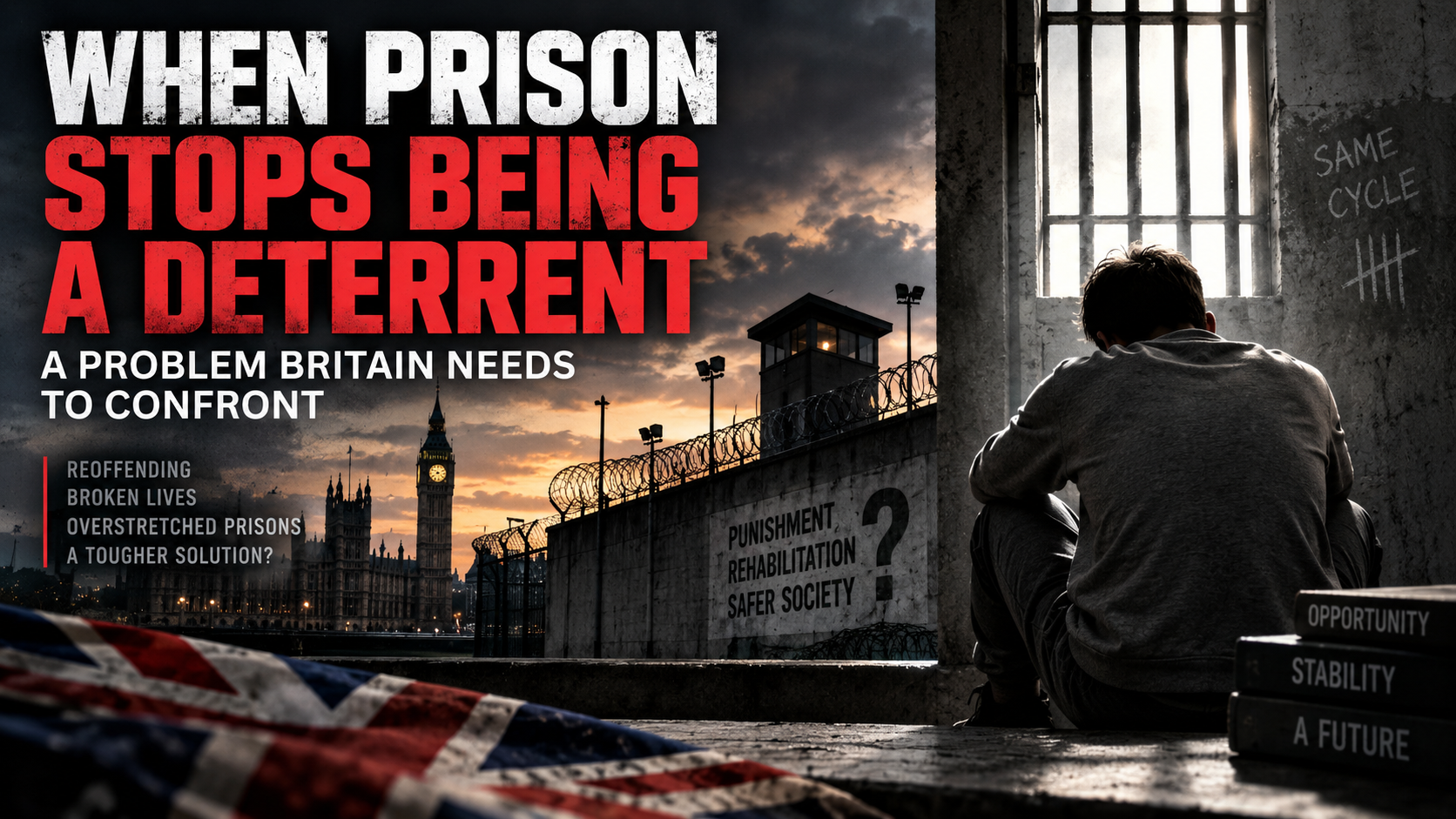
The British criminal justice system rests partly on a simple assumption: punishment discourages crime.
For many people, the prospect of arrest, prosecution, a criminal record and imprisonment is an enormous deterrent. Losing a job, a home, relationships, freedom and reputation represents a potentially catastrophic consequence.
But what happens when those consequences no longer frighten someone?
This is an uncomfortable question that deserves considerably more attention in the United Kingdom.
Prison is already dealing with persistent offending
The problem should not be exaggerated into a claim that most offenders are indifferent to prison. The available evidence does not establish that.
What the statistics do establish is that repeat offending remains substantial.
Ministry of Justice figures for the April–June 2024 offender cohort recorded a proven reoffending rate of 29.6%. Approximately 25,000 proven reoffenders within that cohort were responsible for almost 131,000 proven reoffences during the measurement period. Those who reoffended averaged 5.13 proven reoffences each — the highest figure in that statistical series.
That distinction matters.
The challenge is not simply the number of people who reoffend. It is the concentration of repeated offending among a smaller population.
The person with little left to lose
For somebody with a career, mortgage, stable family life and reputation to protect, even a relatively short prison sentence can carry enormous secondary consequences.
Another person may approach exactly the same punishment from a completely different position.
Someone who has spent years moving between unstable accommodation, unemployment, addiction, offending and custody may perceive prison very differently. Previous imprisonment may also make the environment familiar rather than unknown.
That does not mean such people want to go to prison. Nor should poverty, addiction or homelessness be confused with criminality.
The narrower point is that deterrence depends partly upon what an individual believes they stand to lose.
When conventional society has already become disconnected from someone’s life, conventional punishment can lose some of its leverage.
Simply making prison harsher is not the obvious answer
The instinctive response might be: if offenders aren’t sufficiently afraid of prison, make prison more severe.
The evidence provides good reason to question that approach.
The Sentencing Council’s review of sentencing effectiveness concluded that there is no strong evidence supporting increasingly severe sentences on the basis of general deterrence. Research on deterrence distinguishes between the severity, certainty and speed of punishment.
This produces an important distinction for public policy.
A hypothetical offender who believes there is only a small chance of being caught may not be greatly influenced by whether the eventual sentence is two years or three. Increasing the perceived probability that offending will actually produce consequences may matter more than continually increasing the maximum severity of those consequences.
The objective therefore should not simply be to make people more frightened of prison.
It should be to make persistent offending less attractive and lawful life more valuable.
Britain’s prisons are already under considerable pressure
This is not an abstract problem.
There were 85,858 prisoners in England and Wales on 30 June 2026. Operational prison capacity was reported at 89,120 in June.
Government projections published in 2025 estimated that the prison population could reach between 98,000 and 103,600 by March 2030, with a central projection of approximately 100,600.
The prison estate therefore cannot sustainably answer every criminal-justice problem simply by demanding more imprisonment.
Almost a quarter of prisoners were held in crowded accommodation during 2024–25.
A system operating under those pressures must ask what it is trying to achieve with every prison place.
Punishment and rehabilitation are not opposites
Public debate sometimes presents two competing philosophies.
One says offenders should be punished.
The other says offenders should be rehabilitated.
English and Welsh sentencing law does not actually require such a binary choice. The recognised purposes of sentencing include punishment, reducing crime including through deterrence, rehabilitation, protection of the public and reparation.
That is sensible.
There are offenders from whom the public genuinely needs protection, making imprisonment necessary.
But if someone will eventually return to society, the condition in which that person returns matters enormously.
A prisoner who leaves custody with no accommodation, no legitimate income, untreated addiction, few employable skills and the same criminal associates has been punished — but many of the circumstances associated with their offending remain.
By contrast, someone leaving with stable accommodation, employable skills, treatment where appropriate and something meaningful to lose has acquired additional reasons not to return.
Rehabilitation can therefore itself become a form of deterrence.
The objective should be to create something worth losing
Perhaps one of the most important questions in criminal justice is not:
“How do we make prison frightening enough?”
It is:
“How do we make freedom valuable enough?”
Employment matters.
Housing matters.
Treatment for addiction and mental illness matters.
Family relationships matter.
Education matters.
The realistic probability of being caught matters.
Effective probation and supervision matter.
And where somebody presents a genuine danger to others, incapacitation and public protection matter.
None of these principles requires society to excuse criminal behaviour. Understanding why punishment sometimes fails is not the same as absolving the person who committed the offence.
Indeed, taking repeat offending seriously requires asking whether our interventions actually prevent the next victim rather than merely expressing society’s anger about the previous one.
A criminal justice system needs more than fear
Britain faces a difficult problem when dealing with persistent offenders for whom imprisonment has become familiar and conventional deterrents have weakened.
But the solution cannot simply be an endless competition to devise harsher punishment.
A functioning criminal justice system needs credible enforcement, proportionate punishment and protection of the public. It also needs credible routes back into ordinary society.
The most successful outcome is not an offender who leaves prison terrified of returning.
It is an offender who leaves prison with compelling reasons never to return.
That distinction should be at the centre of Britain’s debate about prisons, sentencing and rehabilitation.
Leave a Reply