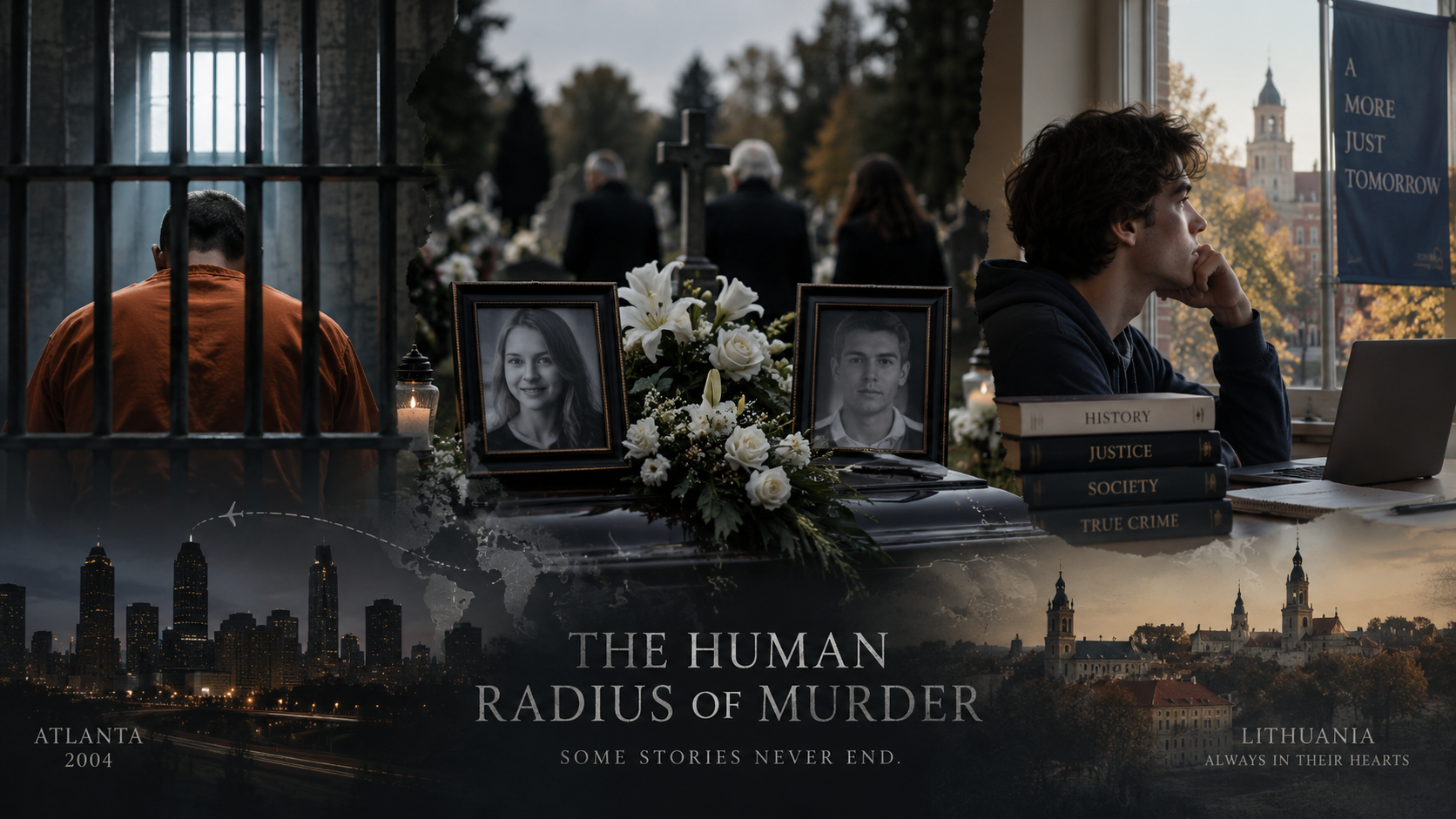
Longform Documentary Essay
The Human Radius of Murder
How two murders in Atlanta rippled across families, countries, and twenty years of memory.
I n August 2004, my family moved from the United Kingdom to Atlanta, Georgia. A few months later, my father found work for an old childhood friend from Lithuania: Rolandas Milinavičius.
At the time, there was no reason for me to believe that name would stay with me for the next twenty years.
Milinavičius owned a business exporting American cars to the Middle East. My father worked loading vehicles into shipping containers—often alone, often in the suffocating Georgia heat. Their friendship slowly became a business relationship, and their business relationship slowly became something much darker.
Five Cars Instead of Three
My father approached container loading differently. Trained as a carpenter in Britain, he built timber frameworks that secured vehicles tightly enough to fit five cars where others managed only three.
The journey to Jordan or Saudi Arabia was nearly 7,000 miles. Most containers arrived with dented panels and shattered bumpers. His arrived without a scratch.
“Who packed these containers? Give this man a call.”
Eventually, my father left Milinavičius and built his own warehouse. It was an enormous gamble—$50,000 a month in rent before paying a single employee—but it worked. Some months the business earned more than Milinavičius had ever imagined.
Inga and Martynas
Two people remained working for Rolandas.
Inga Bandzevičiūtė-Contreras. Martynas Simokaitis.
Before they became victims in a murder case, they were simply young Lithuanian immigrants trying to build lives in America.
According to my father, he offered both of them jobs at his new company. They wanted to leave, but they couldn’t. Their employer owed them months of wages, and walking away meant abandoning money they had already earned.
They weren’t trapped by loyalty.
They were trapped by debt.
Years later, I discovered that contemporary Lithuanian reporting described the same financial desperation: unpaid wages, borrowed money, and two young people trying desperately to earn enough to visit their families back home. (Public reporting supports the financial conflict, while my father’s offer of employment comes from our family’s recollection.)

They Were Going Home
This is the detail I find hardest to forget.
Both of them were planning to go home.
Martynas hadn’t seen Lithuania in seven years. The relatives who had raised him were waiting for him in Kybartai. Inga’s mother was waiting in Kaunas. Both had tickets in their future.
They were waiting at the airport.
Instead, they received ashes.
July 26, 2007
On a Thursday morning in East Point, Georgia, Inga and Martynas went to work at RM Auto International. They never came home.
Surveillance cameras recorded three people entering the building: Rolandas Milinavičius, Inga, and Martynas. Only one person was recorded leaving.
Two days later, Milinavičius surrendered to police. In 2008, a Fulton County jury convicted him of two counts of malice murder and he received two consecutive life sentences.
The Question That Stayed With Me
“How long does a murder last?”
The Radius
Most true crime stories end with the verdict.
Two victims. One murderer. A sentence. Fade to black.
But murder doesn’t end when the courtroom empties. It continues in birthdays where someone is missing. In parents who instinctively reach for the phone. In children who grow up carrying a surname they never chose.
It reaches old friends, business partners, investigators, journalists—and sometimes children standing quietly near the edge of the story, who grow into adults still thinking about the people at its centre.
A murder happens in a room.
Its consequences do not stay there.
They cross oceans. They enter homes the killer has never seen. They survive prison sentences and court appeals. They become memories carried by people who were never listed as victims in a legal document.
Perhaps the question isn’t why Rolandas Milinavičius killed Inga Bandzevičiūtė-Contreras and Martynas Simokaitis.
Perhaps the question is simply this:
How long does a murder last?
As long as somebody remembers.
Leave a Reply