Or why the simplest word isn’t always the most precise.
When I lived in America, I noticed something rather interesting about the way people talked about the legal profession.
They called lawyers lawyers.
Sometimes they called them attorneys.
But they didn’t generally distinguish between solicitors and barristers in the way we do in England and Wales.
If someone needed legal advice, they called a lawyer.
If someone was being prosecuted, they hired a lawyer.
If someone threatened to sue them, they announced that their lawyer would be in touch.
Simple.
Back in Britain, we have a rather more elaborate vocabulary.
You might need a solicitor.
Or a barrister.
Or perhaps a solicitor-advocate.
And before you know it, a conversation about getting legal advice has turned into a small examination on the structure of the English legal profession.
Which raises a question.
Why does the word lawyer sound so immediately understandable, while solicitor sounds like something you ought to have studied before you’re allowed to use it?
1. The Beautiful Simplicity of the Word Lawyer
Let’s examine the word itself.
Lawyer.
It sounds like exactly what it means.
A person who works with the law.
You don’t need to know anything about the legal profession to appreciate the basic idea.
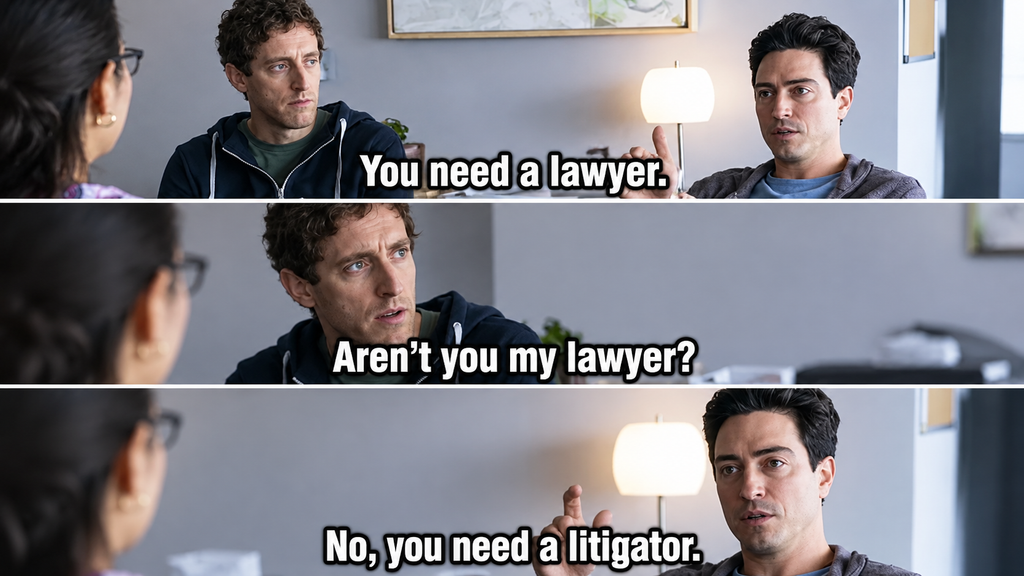
Silicon Valley (HBO)
We have gardeners who work in gardens, builders who build things and lawyers who work with the law.
English doesn’t always make life this straightforward, so perhaps we should appreciate the occasion.
Now consider solicitor.
What exactly does a solicitor solicit?
Clients?
Advice?
Documents?
The word doesn’t immediately reveal the profession it describes.
In fact, its history is rather interesting.
Solicitor comes through French from a Latin root associated with urging, prompting or setting something in motion.
In medieval English, it could describe someone who acted on another person’s behalf or conducted their affairs.
That makes considerably more sense once you know the history.
A solicitor was somebody who pursued matters for someone else.
The trouble is that this explanation requires knowing the history.
The word lawyer, meanwhile, simply gets on with the job.
2. Why Britain Has Solicitors and Barristers
England and Wales developed a legal profession with distinct roles.
Historically, solicitors dealt extensively with clients, legal paperwork, transactions and the preparation of cases.
Barristers specialised in advocacy, particularly in the higher courts, and in providing specialist legal opinions.
The distinction grew out of centuries of institutional development rather than somebody sitting down one afternoon and designing the most understandable legal system imaginable.
And the boundaries are not as rigid today as the traditional description might suggest.
Solicitors can appear in courts and tribunals, with suitably qualified solicitor-advocates able to exercise rights of audience in higher courts.
Barristers can, in appropriate circumstances, accept instructions directly from members of the public.
Nevertheless, the two professions remain separately regulated and retain distinct professional identities.
So the word solicitor does communicate something important.
It identifies a particular legal qualification.
It isn’t merely a more elaborate synonym for lawyer.
And that’s where the British terminology has a genuine advantage.
It tells us more precisely what sort of legal professional we’re dealing with.
Assuming, of course, we already know what a solicitor is.
3. America: Everybody’s Lawyer, Nobody’s Solicitor?
The United States largely uses a different vocabulary.
The words lawyer and attorney are commonly used for people licensed to practise law.
An American lawyer might advise clients, prepare documents, negotiate settlements and represent people in court, subject to the rules governing their practice and jurisdiction.
The familiar English division between solicitor and barrister isn’t generally how the American profession is organised.
That doesn’t mean American lawyers all perform identical work.
Far from it.
They specialise in criminal defence, family law, immigration, commercial litigation, intellectual property and countless other fields.
But their professional titles don’t usually reproduce the English solicitor-barrister distinction.
There is, however, a lovely linguistic complication.
America hasn’t entirely abandoned the word solicitor.
It survives in certain official titles, most famously the Solicitor General, who represents the federal government’s interests before the United States Supreme Court.
And in everyday American English, a solicitor might also be somebody knocking on your door trying to sell you something.
Which could produce a rather unfortunate misunderstanding if you announced that a solicitor had arrived at your house.
In England, you might be expecting legal advice.
In America, you might be expecting somebody to sell you double glazing.
4. Precision Versus Understanding
Here’s where the question becomes more serious.
In England and Wales, solicitor is a protected professional title.
Someone cannot simply declare themselves a solicitor without being entitled to use that description.
The term lawyer, however, does not have the same legally protected status.
According to the Solicitors Regulation Authority, the word has no defined meaning in UK law and does not, by itself, guarantee that the person using it holds a regulated professional qualification.
That is an important distinction.
Imagine two people advertising legal assistance.
One describes herself as a solicitor.
The other describes himself as a lawyer.
To somebody unfamiliar with the legal profession, both descriptions might sound equally reassuring.
But they don’t necessarily communicate the same regulatory status.
A solicitor’s professional standing can be checked against the relevant register.
The generic title lawyer alone does not establish equivalent credentials.
Suddenly, the word that seemed unnecessarily complicated has a very practical purpose.
Solicitor is less intuitive, but more precise. Lawyer is more intuitive, but potentially less informative.
Neither word is universally better.
They solve different communication problems.
5. When Professional Language Becomes a Barrier
This reminds me of something I’ve been encountering while trying to navigate the English justice system.
There is an enormous difference between a system being technically correct and a system being understandable to the people who need to use it.
A court employee might know exactly what a URN is.
A solicitor might immediately recognise the distinction between a case number and an enforcement account number.
A barrister might understand the procedural implications of a particular court order without giving it a second thought.
But an ordinary member of the public may not know any of those things.
And why should they?
Most people don’t spend their lives studying legal procedure.
They encounter it when something has gone wrong, when a dispute arises, or when they need professional assistance.
That is probably the worst possible moment to discover that the language itself requires an introduction.
The legal profession needs technical vocabulary.
Precision matters when people’s rights, liberty and property are at stake.
But precision should not become an excuse for making explanations unnecessarily difficult.
A good professional can use the technically correct term and then explain what it means.
A good public service should do the same.
6. A Software Engineer’s Perspective
In software engineering, we spend considerable time thinking about interfaces.
An interface is how one system communicates with another.
And a good interface should communicate enough information for its user to understand what is happening without requiring intimate knowledge of everything underneath.
Imagine a website with two buttons.
One says:
Submit.
The other says:
Execute asynchronous transaction persistence operation.
Both might ultimately do the same thing.
One tells the user what they need to know.
The other tells the user that the developer has recently discovered a thesaurus.
Legal terminology can present a similar problem.
A specialist term may be perfectly accurate within the profession but confusing to somebody outside it.
That doesn’t mean we should abolish technical language.
It means we should design explanations around the audience.
Perhaps lawyer is the useful public-facing category, while solicitor and barrister provide the necessary professional detail.
We already do something similar in other industries.
A person might describe themselves as an engineer before explaining that they specialise in software, civil engineering or electronics.
The broad term establishes the general field.
The specific term explains the expertise.
Why shouldn’t legal communication work in much the same way?
7. Should We Just Call Everybody a Lawyer?
Not quite.
There’s a risk in simplifying professional language too far.
If we treated lawyer, solicitor and barrister as interchangeable, we could obscure meaningful differences in qualifications, regulation and the services someone is authorised to provide.
And when someone is paying for legal advice, those differences matter.
But I do think there’s a case for leading with the language people naturally understand.
For example:
I’m a lawyer, qualified as a solicitor in England and Wales.
That tells somebody two useful things.
First, the person works in the legal profession.
Second, they hold a specific professional qualification.
It’s understandable without sacrificing precision.
And it doesn’t require the listener to have completed a preliminary course in English legal history.
So, What Should We Call Them?
Perhaps the answer depends on what we’re trying to communicate.
If I’m discussing the legal profession generally, lawyer seems perfectly sensible.
If I’m identifying a particular qualification in England and Wales, solicitor or barrister is more informative.
And if I’m speaking to somebody who has never encountered the British legal system, I might use both.
Because the purpose of language is not merely to demonstrate that the speaker understands something.
It’s to help the listener understand it too.
That’s a lesson that extends far beyond the legal profession.
Our institutions accumulate specialised vocabulary over centuries.
Sometimes that vocabulary preserves important distinctions.
Sometimes it preserves historical accidents.
And sometimes it simply makes ordinary people feel as though they’ve walked into a conversation that began several hundred years before they arrived.
The best legal language should be precise enough to protect people and simple enough to help them.
After all, a lawyer is someone who works with the law.
A solicitor is a particular kind of lawyer.
And explaining that distinction shouldn’t require another lawyer.
Leave a Reply