JonasBezzubovas.com

Independent legal research and commentary

Category: Criminal Law and Social Justice

  • From Human Roads to Automated Roads: A Possible Future for Self-Driving Vehicles in Britain

    From Human Roads to Automated Roads: A Possible Future for Self-Driving Vehicles in Britain

    Introduction: the transition may be political before it is technological

    The eventual transformation of road transport by autonomous vehicles may depend less upon the moment at which computers become capable of driving than upon the moment at which governments become willing to accept political responsibility for allowing them to do so.

    The first fatal collision caused unambiguously by an authorised autonomous vehicle would almost certainly receive extraordinary scrutiny. A fatal road collision involving an ordinary driver is tragic but familiar; a comparable collision involving a machine would raise questions about the manufacturer, software developer, regulator and government that authorised the system. Consequently, politicians may initially demand a substantially higher standard of evidence from autonomous vehicles than society historically demanded from human motorists.

    That does not, however, mean that Britain is presently refusing to contemplate autonomous vehicles. In fact, the legal transition has already begun. The Automated Vehicles Act 2024 established a framework under which self-driving vehicles can eventually be authorised for use on British roads. The government’s implementation programme currently aims to establish the full framework in 2027. The Act requires authorised systems to achieve safety equivalent to or better than that expected of a “careful and competent” human driver, while an authorised self-driving entity can be held responsible for the behaviour of the automated system.

    This considerably changes the starting point for any prediction. The likely political argument of the 2030s is therefore unlikely to be simply should self-driving vehicles be legal? It may instead become where, under what circumstances, and at what demonstrated level of risk should they be allowed to operate without human supervision?

    There is also a geographical distinction worth making. The core regulatory provisions of the Automated Vehicles Act apply to Great Britain—England, Wales and Scotland—rather than Northern Ireland, which has a separate road-traffic legal system. A paper referring to “the UK” throughout should therefore acknowledge this complication.

    Phase One: freight becomes the economic spearhead

    The first truly transformative application may not be the privately owned autonomous family car at all. It may be freight.

    Road haulage combines several characteristics particularly favourable to automation. HGVs travel enormous distances, frequently repeat predictable journeys, impose substantial labour costs on operators, and spend large portions of their journeys on comparatively structured roads such as motorways. In 2025, GB-registered HGVs travelled approximately 19 billion vehicle kilometres, moving 1.53 billion tonnes of goods. Driver recruitment also remains a constraint: 26% of HGV businesses reported driver vacancies in the fourth quarter of 2025.

    This supports the basic economic logic behind a “motorway first, city streets later” transition.

    However, describing the shortage of drivers as insurmountable would overstate the evidence. The present shortage is considerably smaller than at its post-pandemic peak: 43% of HGV businesses reported vacancies in the fourth quarter of 2021. Automation would therefore be better presented not as the only possible solution to an impossible labour shortage, but as an increasingly attractive solution to a persistent combination of wages, recruitment difficulties, retirement, working-time restrictions and the economic value of keeping expensive vehicles operating for longer periods.

    The result could be the emergence of hub-to-hub autonomous freight.

    An HGV might leave a distribution centre under human control, enter a designated autonomous motorway corridor, complete several hundred kilometres automatically, and transfer back to a human driver—or another vehicle—near its destination. Human labour would initially remain concentrated around depots, urban roads, loading operations and the difficult “last mile”, while automation would attack the long-distance portion where driving conditions are comparatively predictable.

    Interestingly, existing British legislation already anticipates the possibility of vehicles that drive themselves only for part of a journey. The Automated Vehicles Act describes a “user-in-charge” model in which the automated system can perform part of a journey before issuing a transition demand requiring a qualified human to resume control.

    Thus the hybrid system imagined here is not especially radical. What is speculative is its scale.

    Private motorways—or automated freight concessions?

    One part of the original prediction requires substantial modification.

    Large logistics companies could not straightforwardly approach financially pressured local authorities and purchase lanes on the M1, M6 or M25. England’s Strategic Road Network is owned by the Secretary of State and operated by National Highways; local authorities do not control those motorways. The network consists of more than 4,500 miles of motorways and major A-roads and already carries roughly two-thirds of England’s freight.

    The underlying idea nevertheless has a plausible precedent.

    Britain already has a privately funded motorway concession in the form of the M6 Toll. Midland Expressway Ltd was awarded the concession to build and operate it, and the road remains privately operated under that arrangement until 2054.

    Consequently, a more credible prediction would be the development of government-authorised automated freight corridors, possibly financed or operated through concessions, public-private partnerships or dedicated infrastructure agreements.

    Rather than Amazon, DHL or a major supermarket simply “buying Lane 1 of the M1”, a consortium of logistics businesses might finance infrastructure allowing authorised autonomous HGVs to use a specially managed corridor between major logistics hubs. Ports, motorway service areas, distribution parks and rail-freight terminals would become natural interchange points.

    The period 2035–2045 remains a defensible speculative window for this type of system, although it should explicitly be described as a scenario rather than a forecast supported by present government commitments.

    The safety tipping point
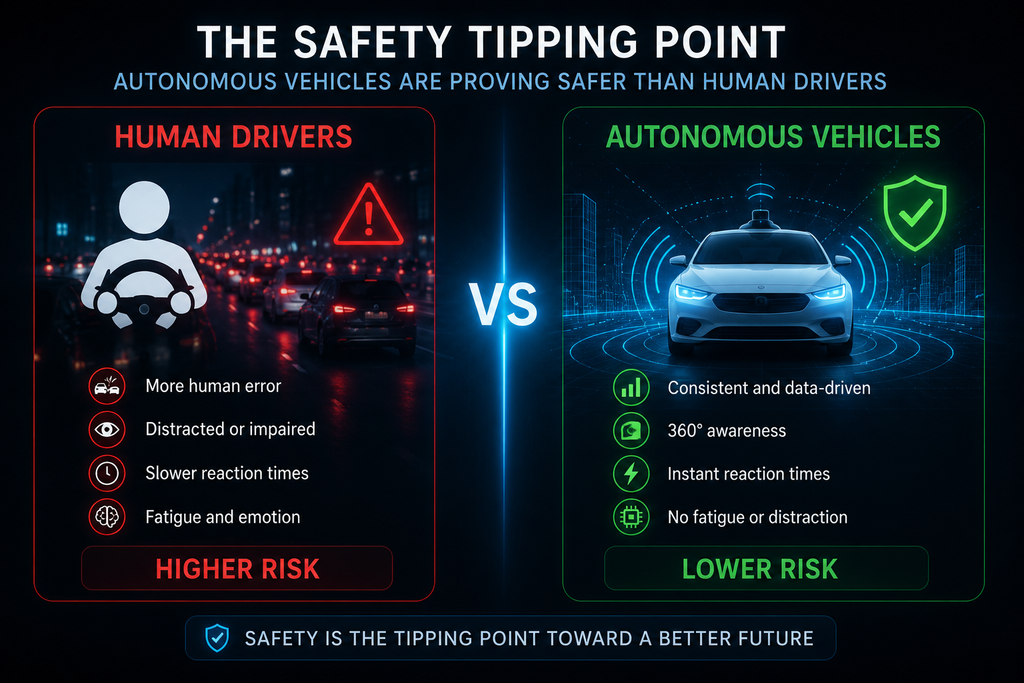
    The most interesting stage occurs if autonomous vehicles establish a substantial safety advantage over humans.

    Britain still pays an enormous human price for road mobility. In 2025 there were 1,538 reported road fatalities and 29,918 people killed or seriously injured in Great Britain. Behaviour or inexperience was the most common category of road-safety factor recorded by police, while ineffective observation was recorded in half of fatal or serious collisions to which a road-safety factor was assigned.

    This provides the ethical foundation for the strongest version of the autonomous-vehicle argument.

    If machines eventually demonstrate dramatically lower collision rates than people, continuing to permit unrestricted manual driving might cease to look like governmental neutrality. It could increasingly resemble a conscious decision to tolerate an avoidable source of death.

    There is already some evidence that highly developed autonomous systems can outperform human benchmarks within restricted operating environments. A peer-reviewed analysis of 7.14 million driverless Waymo miles in several American cities reported an injury-associated crash rate of approximately 0.6 incidents per million miles, compared with a human benchmark of 2.8.

    That result should not be exaggerated. It does not prove that autonomous vehicles are five times safer everywhere. Waymo’s vehicles operated in particular American cities, under particular operational design domains, using a particular system. British country lanes, motorway roadworks, snow, temporary traffic signals, cyclists, unusual junctions and HGV operation create different problems.

    Nevertheless, it demonstrates that “a machine could never be safer than a person” is no longer a defensible assumption.

    If, by the 2040s, Britain possessed billions of miles of operational evidence demonstrating a substantial autonomous safety advantage, the political incentives could reverse.

    Today a minister might fear being remembered as the politician who authorised a machine that killed somebody. A future minister might equally fear being asked why thousands of people continued to die in preventable human-driven crashes after a demonstrably safer technology existed.

    That creates the possibility of a profound inversion in political responsibility.

    At first:

    “Why did you allow the machine to drive?”

    Later:

    “Why did you still allow the human to drive?”

    That inversion may ultimately matter more than any individual technological breakthrough.

    A ban on human driving would probably arrive geographically
    Even if this change occurred, a nationwide prohibition on manual driving overnight is highly improbable.

    The more believable mechanism is progressive geographical restriction.

    Dense urban areas provide the most obvious starting point because congestion, pedestrian risk, pollution, scarce road space and public transport alternatives are concentrated there. Cities have already demonstrated that road access can be differentiated according to vehicle characteristics through mechanisms such as emissions zones and road-user charging.

    It is important not to overstate the existing precedent. London’s Congestion Charge does not prohibit internal-combustion vehicles, and an emissions zone such as ULEZ principally imposes standards and charges rather than representing a blanket ICE ban. Nevertheless, these schemes establish the broader political principle that access to particular public roads can depend upon characteristics of the vehicle.

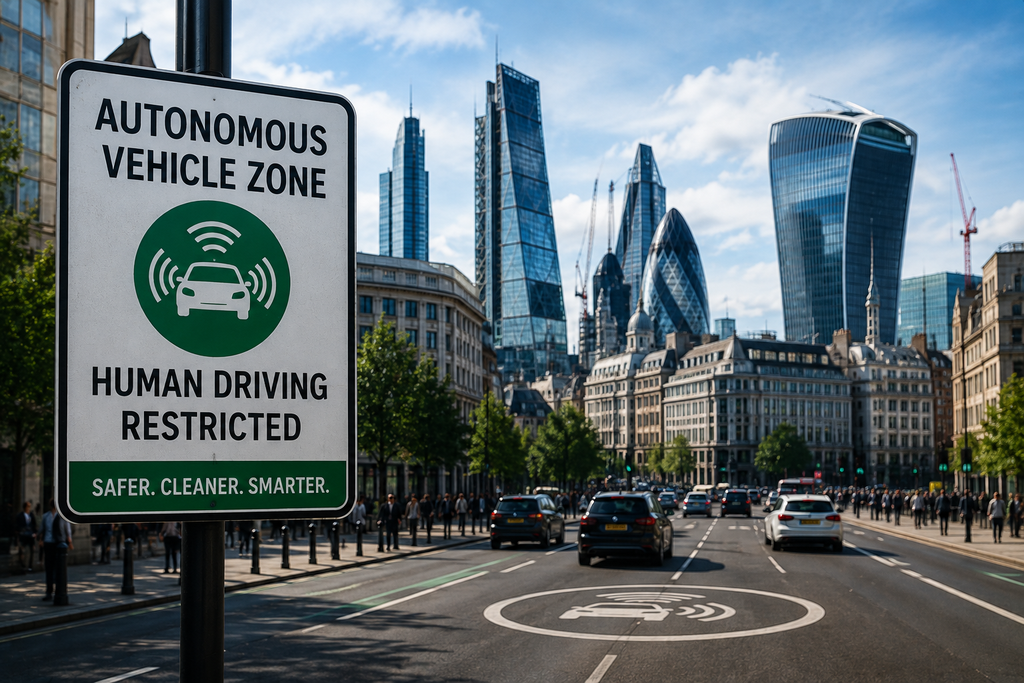
    A future city might therefore create an Automated Vehicle Zone.

    Initially, autonomous vehicles might receive preferential lanes, reduced charges or access to restricted districts. Later, manually driven vehicles might pay an additional risk charge. Eventually, ordinary manual driving could be prohibited within a particular high-density area except for emergency, historic, specialist or authorised vehicles.

    The policy could then expand outward.

    Central London might be followed by other major cities. Urban restrictions could be followed by motorway restrictions. Certain motorway lanes might become automation-only before entire motorway sections did. Only much later could the presumption change nationally from “humans may drive unless prohibited” to “machines drive unless manual operation is specifically permitted.”

    Under that scenario, manual driving does not disappear. It undergoes something similar to the transformation of horse riding: once fundamental transport, later increasingly recreational.

    Private circuits, specialist rural environments and designated roads might preserve manual driving long after it ceased to be the normal means of transport.

    Political conflict and the HGV workforce
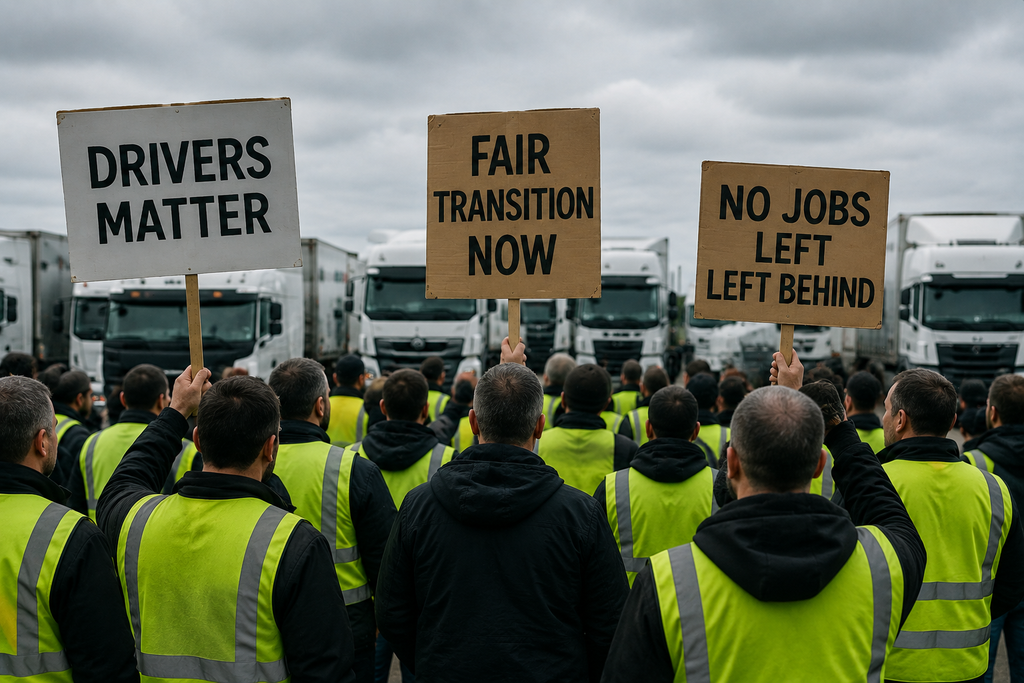
    This transition would create substantial economic winners and losers.

    Professional driving provides employment to people whose skills, identities and livelihoods are strongly connected to road transport. A rapid movement toward driverless freight could therefore provoke industrial opposition.

    Strikes, political campaigning, demands for transition protections and resistance from professional drivers are plausible. Government might respond with retraining schemes, redundancy protections, phased implementation, restrictions on fleet conversion or requirements to retain remote supervisors.

    However, predicting widespread sabotage of automated lanes should be treated much more carefully. It is conceivable as an extreme scenario, but there is presently no evidential basis for asserting that displaced HGV drivers would systematically sabotage autonomous infrastructure. In an academic paper it would be better presented as a security scenario arising from social conflict, rather than an expected behaviour of a particular occupational group.

    Automation could also transform rather than simply eliminate some jobs. Long-distance drivers might be replaced partly by local drivers, remote fleet supervisors, autonomous-vehicle technicians, depot staff, safety operators and logistics controllers.

    The labour question is consequently not merely “how many driving jobs disappear?” It is also “how much bargaining power transfers from geographically dispersed drivers to highly capitalised fleet operators?”

    That may become one of the central political questions surrounding autonomous freight.

    Cybersecurity: the danger is not necessarily one giant computer

    A completely automated transport system would introduce an entirely different category of infrastructure risk.

    However, it probably would not require every British vehicle to be controlled continuously from one national central server.

    A safer architecture would almost certainly keep fundamental vehicle functions—perception, braking, steering and basic route execution—inside the vehicle itself. External systems could supply mapping, traffic information, software updates, fleet instructions and communications without becoming necessary for every millisecond of vehicle operation.

    Indeed, existing UK cybersecurity guidance specifically recommends defence in depth, states that systems should not depend upon single points of failure, requires secure software management and says vehicles should remain resilient and fail-safe when systems or sensors are compromised.

    The more serious threat is correlated failure.

    If ten human drivers suffer ten unrelated medical emergencies, ten vehicles may crash independently.

    If ten million vehicles contain the same exploitable software component, one successful attack could theoretically affect an entire fleet.

    A malicious software update, compromised certificate authority, satellite-navigation spoofing attack, corrupted mapping database, fleet-management intrusion or vulnerability in a commonly used sensor could therefore create consequences radically different from traditional road accidents.

    Government regulation already recognises this problem. Current policy development explicitly includes cybersecurity throughout the vehicle’s service life and extends security requirements to operational control centres.

    This makes redundancy critical.

    An autonomous vehicle should ideally remain capable of executing a safe minimum-risk manoeuvre when communications disappear. Loss of mobile data should not mean loss of steering. Failure of cloud services should not disable braking. A compromised navigation system should be cross-checked against onboard perception.

    In other words, Britain’s future automated road network would ideally resemble the internet more than a railway signalling system: interconnected, but without requiring a single national computer to issue individual steering instructions.

    Would cars still have steering wheels?

    Some probably would. Others probably would not.

    During the transitional period, vehicles capable of automation only under certain conditions have an obvious reason to retain conventional controls. Current British legislation explicitly anticipates systems that hand control back to a user-in-charge.

    But if a vehicle eventually achieves full automation throughout its intended operating domain, retaining a steering wheel purely as an emergency device is not automatically safer.

    A human passenger who has spent an hour reading, sleeping or working is unlikely to be an ideal emergency controller when suddenly confronted with a situation that defeated an advanced automated system. Human-factors research and regulation therefore have to distinguish genuine human-supervised automation from systems capable of reaching a safe state independently.

    Consequently there may eventually be two categories: dual-mode vehicles retaining manual controls, and genuinely driverless vehicles without meaningful driving controls at all.

    The climate argument—and its biggest weakness

    Transport provides a powerful political argument for transformation. Domestic transport accounted for approximately 30% of UK greenhouse-gas emissions in 2024, and road vehicles constitute the overwhelming majority of domestic transport emissions.

    But autonomy itself is not decarbonisation.

    An autonomous diesel SUV stuck in traffic still burns diesel.

    Automation could improve efficiency through smoother acceleration, optimised routing, reduced stop-start behaviour and—in freight applications—closer coordination between vehicles. It may also permit lighter or differently designed vehicles eventually.

    Yet automation could simultaneously make road transport more attractive. A commuter who currently refuses a two-hour drive because it is exhausting may willingly accept it if those two hours can be spent working or watching television. Empty autonomous vehicles could reposition themselves between passengers. Parents might send an empty car to collect children. Businesses could operate additional delivery vehicles because the marginal cost of driver labour had disappeared.

    Academic reviews therefore find that the environmental consequences of autonomous vehicles depend heavily upon penetration, sharing, vehicle utilisation and interaction with other transport modes rather than automation alone.

    This makes electrification the indispensable partner to automation.

    The strongest future scenario is not:

    human petrol car → autonomous petrol car.

    It is:

    human-controlled ICE fleet → increasingly electric fleet → electric automated fleet coordinated to minimise congestion, energy consumption and unnecessary journeys.

    If autonomous vehicles increase total kilometres travelled substantially, some efficiency gains could disappear. Conversely, if electrification, shared mobility, intelligent routing and automation occur together, the environmental improvement could be dramatic.

    Thus it would be inaccurate to describe the human behind the steering wheel as the fundamental source of road-transport CO₂. The combustion engine is the larger culprit.

    Human driving does, however, introduce inefficiencies through unnecessary acceleration, braking, congestion formation, poor route choice and collisions. Automation could attack those secondary losses while electrification attacks the primary emissions source.

    A revised speculative timeline

    A useful forecast would therefore look less like a sudden autonomous revolution and more like overlapping transitions.

    PeriodPlausible development
    2027–2035Regulatory deployment begins; restricted autonomous passenger services and logistics applications expand; extensive accumulation of real-world safety data.
    2030–2040Increasing motorway automation, depot-to-depot freight systems and possibly dedicated or preferential automated freight infrastructure. Human drivers remain important for complex local operation.
    2035–2045If safety and economics prove favourable, widespread hub-to-hub autonomous HGV operations become plausible. Insurance and road-pricing policy may begin favouring autonomous operation.
    2040–2050Selected urban areas could introduce strong incentives or requirements for automated operation. Manual vehicles become increasingly restricted in particularly dense environments.
    2045–2060+If—and this is the crucial condition—autonomous systems have demonstrated overwhelming safety advantages across billions of miles, automation-only motorways or urban road networks become politically conceivable.
    Beyond thatManual driving could eventually become a licensed recreational or specialist activity rather than the default means of operating a vehicle.

    The dates should remain deliberately broad. Forecasting adoption is much harder than forecasting technical capability because roads, vehicles and legislation turn over slowly. Britain has more than a century’s worth of infrastructure designed around human-operated vehicles, and even extraordinarily capable technology cannot replace that ecosystem overnight.

    The central paradox

    The central prediction can therefore survive scrutiny, but in modified form.

    The transition toward autonomous vehicles may begin with politicians being frightened of trusting machines and end with politicians being frightened of continuing to trust humans.

    Between those points will lie several decades of hybrid infrastructure, incomplete automation, legal disputes, labour conflict, cybersecurity failures, successful deployments and public arguments over what constitutes an acceptable level of risk.

    At first, autonomous vehicles will be asked to prove that they are as safe as people. British law already effectively establishes that requirement: the safety framework is intended to ensure performance equal to or better than a careful and competent human driver.

    But if autonomous systems eventually become substantially safer than human drivers, the philosophical question becomes more uncomfortable.

    In 2025 Britain still recorded 1,538 road deaths.

    Suppose a future automated system could reduce that number not by five or ten percent, but by 80 or 90 percent.

    At what point does the freedom to drive manually outweigh the preventable deaths caused by maintaining that freedom?

    That—not whether a computer can successfully navigate the M25—may eventually become the defining political question of the autonomous age.

    The ban that may never need to happen: insurance and the voluntary death of manual driving

    There is, however, an alternative to the government eventually banning human drivers.

    It may never need to.

    If autonomous vehicles eventually demonstrate a substantial and statistically robust safety advantage over manually driven vehicles, the insurance industry would acquire an enormous financial incentive to distinguish between the two.

    Motor insurance is fundamentally concerned with risk. If decades of collision data eventually showed that a manually driven vehicle was several times more likely to be involved in an expensive collision than an autonomous equivalent, insurers could begin reflecting that difference in their premiums. Autonomous vehicles might become exceptionally cheap to insure, while manually driven vehicles became progressively more expensive.

    This could produce something more politically acceptable than prohibition: the gradual economic marginalisation of human driving.

    A motorist might remain perfectly entitled to drive manually, but doing so could eventually resemble choosing to insure a particularly dangerous or unusual vehicle today. The freedom technically remains; the individual simply bears more of the financial cost associated with the additional risk.

    The effects could reinforce themselves.

    As autonomous vehicles became safer, insurance premiums could fall. Lower premiums would encourage more consumers and commercial fleets to adopt them. Greater adoption would produce more operational data and potentially further safety improvements. Meanwhile, the remaining manually driven population could increasingly represent a disproportionately high-risk insurance pool, pushing manual premiums higher still.

    Commercial fleets could move even faster. A logistics company operating thousands of vehicles would have a powerful incentive to automate if doing so substantially reduced insurance costs, collisions, vehicle downtime and compensation claims. Employers might eventually prohibit manual driving within their fleets even where the law continued to permit it.

    The government could therefore find itself in the unusual position of never formally abolishing ordinary driving at all. Instead, insurance companies, employers, fleet operators and consumers could accomplish most of the transition voluntarily.

    Automation as an expansion of mobility

    This transition would also produce a counterintuitive social consequence: removing the human driver could actually increase personal mobility.

    At present, independent road transport is largely restricted to people who can legally and physically operate a motor vehicle. Age, disability, deteriorating eyesight and certain medical conditions can restrict or eliminate a person’s ability to drive safely.

    A genuinely autonomous vehicle changes the relevant question from:

    “Are you capable of driving this vehicle?”

    to:

    “Are you capable of telling this vehicle where you want to go?”

    That is a profound distinction.

    An elderly person who no longer satisfies the medical requirements for a driving licence might still be perfectly capable of travelling independently in an autonomous vehicle. Some visually impaired people who could never obtain an ordinary driving licence could potentially possess something functionally equivalent to a private car for the first time. People whose licences have been medically restricted could retain considerably greater independence rather than becoming dependent upon relatives, taxis or public transport.

    This is one reason it would be misleading to describe autonomous vehicles solely as a technology that removes human freedom.

    They remove one freedom—the necessity or opportunity to control the vehicle directly—but potentially extend another, more fundamental freedom: the ability to travel independently.

    There would, of course, have to be legal distinctions. A person disqualified from driving because of dangerous or criminal behaviour should not necessarily be treated identically to someone who cannot drive because of poor eyesight or physical disability. The law would have to determine whether travelling alone in a vehicle with no human driving controls legally constitutes “driving” at all.

    The conceptual difficulty nevertheless illustrates how dramatically autonomy could alter the meaning of the word driver. In a sufficiently automated vehicle, the occupant may legally and practically become a passenger even though they own the vehicle and determine its destination.

    From privilege to premium

    This leads to another possible stage in the decline of manual driving.

    Rather than government announcing that human driving is prohibited, manual control could gradually become a premium activity.

    Autonomous vehicles might receive cheaper insurance. Automated HGVs might receive preferential commercial rates. Cities could offer reduced road-user charges to autonomous vehicles with demonstrated safety records. Motorways might introduce automated-only lanes. Employers could prohibit manual operation of company vehicles. Leasing companies could offer substantially better terms for autonomous operation.

    At each stage, manual driving would remain legal.

    It would simply become more expensive, less convenient and increasingly unusual.

    Eventually, learning to drive manually might itself cease to be regarded as an essential rite of adulthood. A generation raised with autonomous taxis and family vehicles might reasonably ask why they should spend hundreds or thousands of pounds obtaining a qualification to perform manually a task that machines perform more safely.

    The decline of human driving could therefore resemble the decline of several older technologies: not destroyed by legislation, but displaced because the alternative became overwhelmingly easier.

    This possibility creates an important challenge to the prediction that Parliament will eventually enact a dramatic nationwide prohibition.

    There may never be a famous Prime Minister who “banned human driving”.

    By the time Parliament possessed sufficient evidence and public support to contemplate doing so, most people may already have stopped.

    The final restrictions could therefore be remarkably anticlimactic. Government might merely prohibit the remaining manually driven vehicles from particular motorways or urban centres after autonomous vehicles already accounted for the overwhelming majority of journeys.

    In this scenario, politicians would not create the autonomous road system.

    They would simply formalise a transition that economics, insurance, accessibility and consumer behaviour had already made effectively irreversible.

  • Nothing is more precious than freedom: how and why prisoners try to escape

    Nothing is more precious than freedom: how and why prisoners try to escape

    I don’t know if you’ve ever been locked in a concrete box, day after day, night after night. Every morning you wake up and think “F**k, I’m still here!”. No one appreciated freedom more than those who don’t have it. When I was locked up in Pentonville I remember looking out the high window (by perching my 6’3″ frame on a lateral gas pipe until my feet became too hot to bare) and seeing the simplicities of the outside world: a postie doing their rounds, a mother on the school run, even a homeless man wandering around brought great envy to my eyes.

    Bear in mind, I was serving a maximum of 2 years, with a real possibility of going home after just 4 months. Albeit, we were under COVID lockdown conditions so my time was a bit more boring and isolated than the typical custodial sentence, but it had me thinking, what if I was serving 10 years? 20 years? A whole life order?! Surely in that case there would be one thing on my mind: escape.

    At times I would observe the weak points in security around my cell and the wing as a whole, there were none. And any “hack” I could even attempt would leave me exposed to every officer in the prison ready to mob me as soon as I broke my leg from falling 5 storeys out of my cell window.

    But for some that is a risk they’re willing to take, there are people who know they may never see their loved ones again, everything they hold dear in the world will be gone or alienated by the time they walk out those gates (and that’s a big IF). So is it any wonder that prisoners try to escape? Not your typical PWIT 2-do-1s1 but more like the double murder charged, found guilty by jury and failed appeal-types.

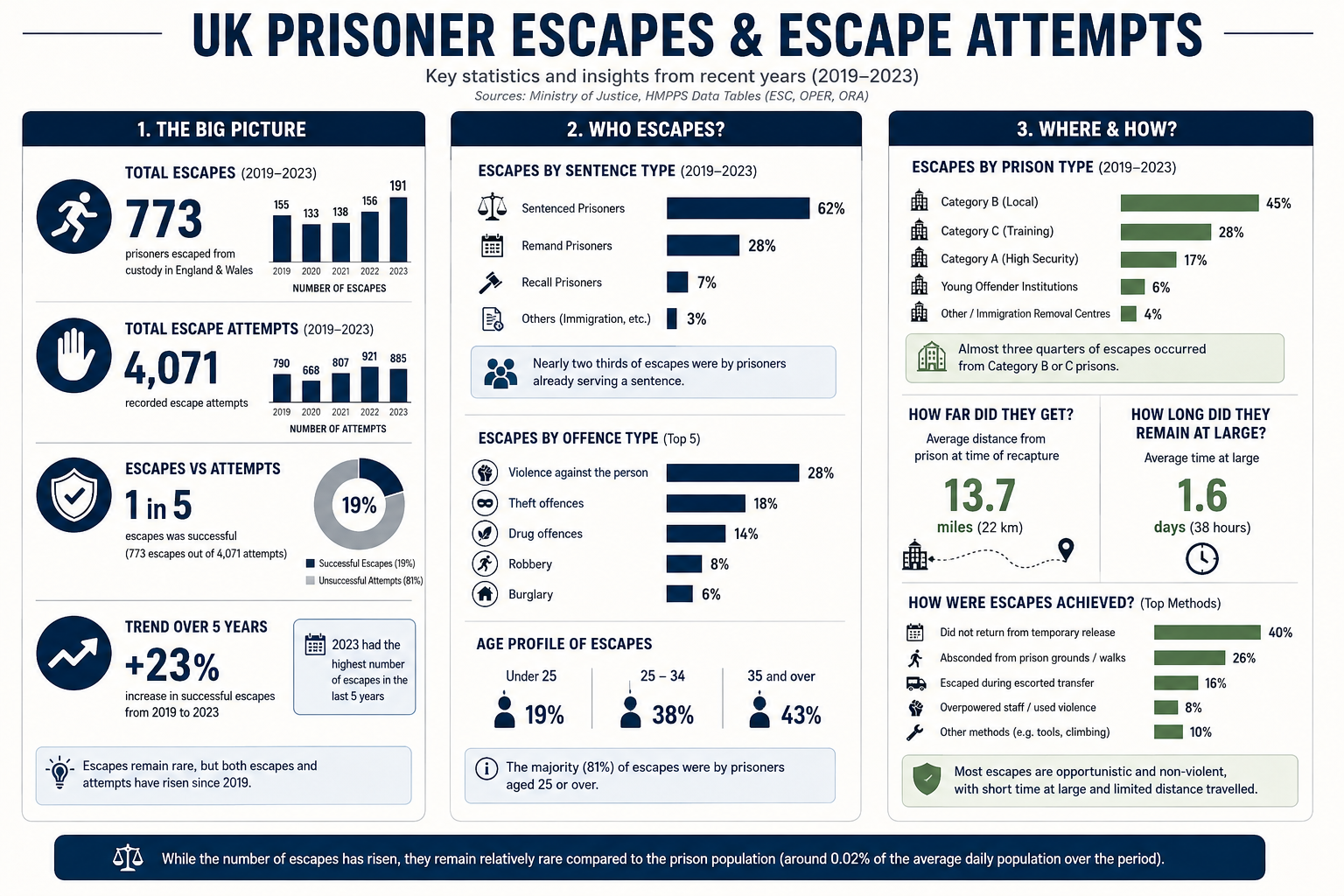
    In today’s article we’re going to look a how desperate (and cunning) some UK prisoners can be while we look at their escapes from the nick, how far they got and how they were ultimately sent back.

    10. Kyle Eglington — The Underpants Escape, 2022

    Prison/custody: Prison transport van, Dorset
    Time at large: About two days
    Escape rating: 6/10

    We’ll start with an escape that sounds less like The Shawshank Redemption and more like the beginning of a stag-do story.

    In March 2022, 32-year-old Kyle Eglington was being transported in a prison van in Poole when he allegedly assaulted a security officer and legged it.

    There was one minor problem with his newfound freedom:

    He was reportedly wearing nothing but his underpants and socks.

    A major search followed, involving armed police and a police helicopter. Officers even warned that he might have shaved his head and beard in an attempt to change his appearance.

    Considering he had started his life as a fugitive dressed for bed, that’s quite the transformation.

    His freedom didn’t last long. Police arrested him in the early hours of the following Monday.

    There is something beautifully British about the whole thing. You’ve escaped custody, helicopters are looking for you, armed police are on the streets…

    …and you’re running around Dorset in your pants.

    Brazen? Absolutely. Successful? Not particularly.


    9. Julien Chautard — Pentonville’s Human Undercarriage, 2009

    Prison: HMP Pentonville
    Time at large: Four days
    Ending: Gave himself up

    Fourteen years before Daniel Khalife became famous for disappearing beneath a vehicle, another prisoner reportedly pulled essentially the same trick at Pentonville.

    French arsonist Julien Chautard had just arrived at the jail from Snaresbrook Crown Court in 2009.

    Instead of settling into his new accommodation, Chautard escaped by clinging to the underside of the prison van that had delivered him.

    And somehow…

    the van drove back out with him underneath it.

    He remained free for four days.

    Then came perhaps the strangest part: rather than being hunted down and dragged back inside, Chautard returned voluntarily and surrendered himself to police.

    Imagine successfully getting out of Pentonville and then, four days later, thinking:

    “You know what? Fuck it. Take me back.”

    Having spent time in Pentonville myself, voluntarily returning wouldn’t have been high on my list.


    8. John Massey — The 64-Year-Old Lifer Who Climbed Out of Pentonville, 2012

    Prison: HMP Pentonville
    Sentence: Life imprisonment for murder
    Age: 64
    Time at large: Two days

    If I had struggled to identify an escape route while sitting in Pentonville in my twenties, imagine how humbling it is knowing that a 64-year-old lifer actually managed it.

    John Massey had been sentenced to life for a 1975 murder.

    And this wasn’t even his first taste of disappearing from custody. After previous parole problems and a spell at open prison, Massey eventually found himself back inside Pentonville.

    Then, on 27 June 2012, he escaped.

    At 64 years old.

    There is something almost offensive about that from a security perspective.

    This wasn’t some 21-year-old athlete seeing an opportunity and sprinting for his life. This was a man who had already spent decades dealing with the prison system managing to get himself out of a Victorian Category B jail in the middle of London.

    His second spell of freedom was brief. Police recaptured him in Kent two days later.

    Still, if I ever return to Pentonville and hear an officer telling prisoners that escape is impossible, I now know the appropriate response:

    “Tell that to the pensioner.”


    7. John Anslow — His Mates Brought Sledgehammers, 2012

    Custody: Prison van from HMP Hewell
    Status: Category A
    Time at large: Months
    Escape rating: 8/10

    Some prisoners carefully plan how they’re going to break out.

    John Anslow apparently had another solution:

    Get the boys to come and get you.

    In January 2012, Anslow was being transported from HMP Hewell to Stafford Crown Court while facing a murder charge.

    A car intercepted the prison van.

    Three masked men got out.

    Two were carrying sledgehammers.

    They smashed the windows of the vehicle, assaulted the driver and sprung Anslow from custody before making their getaway.

    This wasn’t some low-risk prisoner being taken to magistrates’ court, either.

    Anslow had been designated Category A — the category reserved for prisoners whose escape would pose a serious danger to the public, police or national security.

    His escape was significant enough that the Justice Secretary ordered an inquiry. Contemporary reporting described him as the first Category A prisoner to escape custody in more than 17 years.

    Whatever you think of the people involved, there’s no denying the audacity.

    Most escape plans involve finding a weakness in the prison.

    This one involved bringing your own demolition crew.


    6. Matthew Baker & James Whitlock — The Pentonville Dummy Trick, 2016

    Prison: HMP Pentonville
    Time at large: Roughly three and six days respectively
    Best detail: The fake bodies

    Now we’re back at my old residence.

    In November 2016, Matthew Baker and James Whitlock managed something every Pentonville prisoner has probably fantasised about at least once:

    They got over the wall.

    Baker had recently been convicted of attempted murder. Whitlock was on remand over allegations involving ATM burglaries.

    But it’s the theatrical element that earns them their place here.

    Before disappearing, the pair stuffed their beds to make it look as though they were still sleeping in them.

    Proper Escape from Alcatraz shit.

    They got through their cell security, made their way across the prison structure and escaped over the perimeter. Astonishingly, staff reportedly didn’t realise the men had vanished until around 15 hours after they were last seen in their cell.

    Baker lasted about three days before being arrested in east London, less than 10 miles from the prison.

    Whitlock lasted longer, but he too was eventually caught.

    This one particularly fascinates me because I’ve actually lived behind those walls.

    I’ve looked at them.

    I’ve looked at the windows.

    I’ve looked at the officers.

    I’ve looked at the drop.

    And my conclusion was always:

    “Nah.”

    These two apparently reached a different conclusion.


    5. Daniel Khalife — The Great Wandsworth Vanishing Act, 2023

    Prison: HMP Wandsworth
    Status: On remand
    Time at large: Around 75 hours
    Escape rating: 8/10

    Daniel Khalife’s escape caused national pandemonium precisely because prison escapes like this have become so rare.

    Khalife was a former British Army soldier being held at HMP Wandsworth while facing terrorism and espionage-related charges.

    On 6 September 2023, the 21-year-old disappeared from the prison.

    The escape involved the food-delivery operation where he worked in the kitchen. Khalife concealed himself beneath a catering vehicle as it left Wandsworth. He later pleaded guilty to escaping lawful custody.

    Then Britain collectively lost its mind.

    Ports and airports faced heightened checks. Police searched Richmond Park. Helicopters, dogs and officers were deployed across London.

    For roughly 75 hours, Khalife remained free.

    Eventually a plain-clothes counter-terrorism officer spotted him near a canal in west London and pulled him from a bicycle.

    Later investigations also established that Khalife had received assistance while on the run, including £400 arranged through an associate, helping him obtain a phone and other items.

    All that national attention…

    …because one prisoner managed to leave Wandsworth without using the front door in the conventional manner.


    4. The Parkhurst Three — The Escape From an Island Prison, 1995

    Prison: HMP Parkhurst, Isle of Wight
    Prisoners: Matthew Williams, Keith Rose and Andrew Rodger
    Time at large: Around four/five days
    Minor problem: They were still on an island

    Parkhurst was supposed to be serious business.

    Among the three men who escaped in January 1995 were two Category A prisoners.

    The men managed to get out of the prison and over its perimeter.

    Then they encountered the slight logistical flaw in their otherwise impressive plan:

    Parkhurst is on the Isle of Wight.

    Escaping the prison was only stage one.

    Escaping the fucking island was stage two.

    Official parliamentary accounts established that the men had exploited serious security failures before getting through the perimeter. Their disappearance prompted an enormous search and eventually a major review of prison security.

    For days, police searched the island.

    Rose and Rodger were eventually caught in open countryside roughly six miles from the prison. Williams briefly managed to evade capture again before being caught about 90 minutes later.

    All three ended up back inside.

    The escape was sufficiently embarrassing that it contributed to a much wider reassessment of security in British prisons.

    But it wasn’t even the most embarrassing high-security escape of the 1990s.

    That honour goes to…


    3. The Whitemoor Six — The “Escape-Proof” Prison That Wasn’t, 1994

    Prison: HMP Whitemoor
    Prisoners: Six
    Security: Special Secure Unit
    Result: All six recaptured

    Whitemoor wasn’t supposed to be Pentonville.

    This was a high-security prison containing some of the most dangerous prisoners in the country.

    And within it was a Special Secure Unit.

    In other words:

    “You’re already in a prison, but you’re so dangerous we’ve put another prison inside the prison.”

    On 9 September 1994, six prisoners escaped from that unit.

    And they weren’t harmless opportunists.

    They had firearms.

    During the breakout, a prison officer was shot and wounded. The men made it beyond the prison perimeter, triggering a huge response.

    Four were caught almost immediately.

    The remaining two managed about half a mile before police arrested them.

    So, as escapes go, their freedom was absolutely shite.

    But that’s not why this one ranks so highly.

    It’s because they had managed to get out of a Special Secure Unit in a high-security prison while armed.

    The subsequent Woodcock inquiry examined exactly how something so catastrophic had been possible, and security at Whitemoor and other high-security prisons was tightened afterwards.

    The prison system had just suffered a massive embarrassment.

    Four months later…

    Parkhurst happened.

    Not a great year for the Prison Service.


    2. Kendall & Draper — The Gartree Helicopter Escape, 1987

    Prison: HMP Gartree
    Prisoners: John Kendall and Sydney Draper
    Method: A FUCKING HELICOPTER
    Escape rating: 10/10

    Forget bedsheets.

    Forget vans.

    Forget tunnelling.

    In December 1987, two Category A prisoners escaped HMP Gartree in the manner normally reserved for a terrible 1980s action film.

    A helicopter landed inside the prison.

    The aircraft’s pilot had been hijacked by an armed passenger and forced to fly to Gartree.

    The helicopter descended into an open exercise area.

    High-risk prisoners John Kendall and Sydney Draper got aboard.

    And then it simply flew away.

    That isn’t an urban legend. The Home Secretary subsequently confirmed the basic facts to Parliament.

    Imagine being another prisoner watching this unfold.

    You’re spending months quietly considering whether you could somehow defeat a window grille with a sharpened toothbrush…

    …and two blokes have apparently ordered an Uber Helicopter.

    The aircraft landed a short distance away, where the escapees continued their getaway by road.

    Both men were eventually caught, as was Andrew Russell, who had helped facilitate the escape.

    But the incident exposed such an obvious vulnerability that it contributed to changes in how Britain’s most dangerous prisoners were managed. A later government inquiry specifically referenced the 1987 helicopter-assisted escape of two high-security prisoners from Gartree when discussing the evolution of enhanced security arrangements.

    There’s brazen.

    There’s audacious.

    And then there’s landing an aircraft in a Category A prison and flying two prisoners out.

    Yet somehow…

    That still isn’t number one.


    1. The Maze Prison Escape — 38 Prisoners Walk Out, 1983

    Prison: HM Prison Maze, Northern Ireland
    Prisoners who escaped: 38
    Initially still at large: 28 after the immediate recaptures
    Scale: Unmatched

    If we’re including the entire United Kingdom, nothing else on this list really comes close.

    On 25 September 1983, 38 republican prisoners escaped from the Maze.

    This wasn’t somebody spotting an unlocked door.

    It became a violent, coordinated takeover.

    Prisoners produced weapons inside H Block 7, overpowered officers and took control of the block. A prison officer was shot in the head but survived. The prisoners took officers’ uniforms and seized a prison meal-delivery van.

    Thirty-eight prisoners were driven toward the main gate.

    The vehicle passed through two manned gates without being searched.

    At the main gate, the escape descended into violence. Prison officers were seriously injured and officer James Ferris was killed.

    The prisoners then fled on foot.

    Ten were caught almost immediately.

    Nine more were recaptured over the following days.

    But 19 remained at large when the government reported back to Parliament the following month.

    The scale is difficult to comprehend in the context of the modern British prison system.

    Daniel Khalife escaping alone in 2023 triggered a national manhunt and days of wall-to-wall news coverage.

    The Maze lost 38 prisoners in one incident.

    The subsequent Hennessy inquiry examined the security failures surrounding the escape and produced recommendations for improving the prison’s security.

    Whatever political mythology subsequently grew around the event, it’s important not to romanticise what actually happened: this wasn’t a cheeky prisoner climbing through a toilet window. Prison officers were attacked, several people were seriously injured and one officer lost his life.

    But judged purely on scale and audacity?

    There has been nothing else like it in modern British prison history.


    Honourable Mention: The Brixton Two

    There is one escape I struggled to leave out.

    In July 1991, Pearse McAuley and Nessan Quinlivan, two Category A high-risk prisoners facing extremely serious charges, escaped from HMP Brixton.

    A firearm had made its way into the prison.

    After attending Catholic Mass, the pair overpowered their escorts, got over the perimeter and escaped into London. During the getaway, a motorist was shot in the leg and his vehicle was taken.

    Then — brilliantly illustrating how quickly an extraordinary escape can become mundane — they took a taxi to Baker Street station.

    From Category A prison…

    to armed breakout…

    to:

    “Baker Street please, mate.”

    They deserve an honourable mention because unlike most of our escapees, the story didn’t end with police catching both men a couple of days later. Their cases became tangled with Ireland, extradition and the politics of the Troubles.


    So, Is Escaping From a British Prison Actually Possible?

    Technically?

    Yes.

    Realistically?

    Good fucking luck.

    Looking through these cases, there’s an obvious pattern.

    The spectacular escapes generally weren’t the result of some genius prisoner spending twenty years secretly scraping through reinforced concrete with a spoon.

    They exploited moments when the normal security system broke down — transport, outside assistance, catastrophic procedural failures or vulnerabilities that subsequently got fixed.

    And that’s probably why sitting in my cell at Pentonville looking for an escape route seemed so hopeless.

    I was looking at the finished product.

    Modern prison security has been shaped partly by every lunatic on this list who came before me.

    Someone escapes from a supposedly secure unit? Procedures change.

    Someone goes over a wall? The perimeter changes.

    Someone gets sprung from a van? Transport procedures get reviewed.

    Someone escapes in a helicopter?

    Presumably somebody at the Ministry of Justice has to sit down and write a policy entitled:

    “Please Don’t Let Helicopters Land in the Fucking Prison.”

    The irony is that successful escapes help make the next escape more difficult.

    And even when prisoners do make it beyond the wall, that’s when an entirely different problem begins.

    Getting out is one thing.

    Staying out — without money, identification, somewhere safe to sleep, or half the country’s police looking for you — is something else entirely.

    That’s why so many prison escapes end the same way.

    A few hours of freedom.

    A few days if you’re lucky.

    Blue lights.

    Handcuffs.

    A prison van.

    And then that horrible familiar sound:

    the gate closing behind you again.

    1. PWIT: Possession with intent to supply, 2-do-1: prison slang for a sentence of 2 years that typically results in early release after 9-12 months. ↩︎

    [2] The Guardian, Dorset police arrest man reported to have escaped prison van in underpants, 29 March 2022. Source

    [3] Wikipedia, HM Prison Pentonville — section covering Julien Chautard’s 2009 escape. Source

    [4] ITV News, Convicted murderer escapes from Pentonville Prison, 27 June 2012. Source

    [5] Wikipedia, HM Prison Pentonville — history of escapes from the prison. Source

    [6] The Guardian, coverage of John Anslow’s escape from a prison van while being transported from HMP Hewell to Stafford Crown Court, January 2012. Source

    [7] The Guardian, One HMP Pentonville fugitive Matthew Baker convicted of attempted murder, 7 November 2016. Source

    [8] The Guardian, Pentonville inmate feared for his life before escape, court told, 15 June 2017. Source

    [9] The Guardian, Pentonville prison escape: Matthew Baker caught in east London, 10 November 2016. Source

    [10] ITV News, Daniel Khalife pleads guilty to escaping prison, 11 November 2024. Source

    [11] Evening Standard, reporting on Daniel Khalife’s recapture following approximately 75 hours at large, September 2023. Source

    [12] Metropolitan Police, Man convicted of assisting Daniel Khalife after he escaped from prison. Source

    [13] UK Parliament, House of Commons Hansard, Prison Service, 10 January 1995 — statement concerning the escape of three prisoners from HMP Parkhurst. Source

    [14] The Independent, Police and mud combine to capture Parkhurst escapers, January 1995. Source

    [15] UK Parliament, House of Commons Hansard, 19 December 1994 — discussion of the escape of six prisoners from the Special Secure Unit at HMP Whitemoor. Source

    [16] UK Government, Report of the enquiry into the escape of six prisoners from the Special Security Unit at Whitemoor Prison, Cambridgeshire (Woodcock Report). Source

    [17] UK Parliament, House of Commons Hansard, Gartree Prison (Escape), 21 January 1988 — official statement concerning the helicopter-assisted escape. Source

    [18] The Independent, Faces of the terrorists and the criminal who didn’t get away, September 1994 — retrospective reference to the Gartree helicopter escape. Source

    [19] UK Government, Review of the Security of High Risk Prisoners — historical discussion of the 1987 helicopter-assisted Gartree escape and subsequent high-security arrangements. Government report (PDF)

    [20] UK Parliament, House of Lords Hansard, Maze Prison: Escapes, 24 October 1983 — official account of the mass escape. Source

    [21] UK Parliament, House of Commons Hansard, Maze Prison, 24 October 1983 — government statement concerning the escape and subsequent recaptures. Source

    [22] CAIN Web Service, Ulster University, Report of an Inquiry into the Security Arrangements at HM Prison, Maze (Hennessy Report), 1984. Source

    [23] UK Parliament, House of Commons Hansard, Brixton Prison: Escapes, 8 July 1991 — official statement on the escape of Pearse McAuley and Nessan Quinlivan. Source

    [24] Wikipedia, Nessan Quinlivan — biographical background and subsequent extradition proceedings. Source

    [25] UK Government History Blog, What’s the Context? 22 October 1966: Spy George Blake escapes from Wormwood Scrubs, 21 October 2016. Source

  • Choosing David: Diminished Responsibility, Victim Vulnerability and the Problem of Selective Rationality in Homicide

    Choosing David: Diminished Responsibility, Victim Vulnerability and the Problem of Selective Rationality in Homicide

    Abstract

    The partial defence of diminished responsibility asks one of criminal law’s most difficult questions: when does mental disorder diminish responsibility for an intentional killing sufficiently to reduce murder to manslaughter?

    This article considers a comparatively neglected evidential problem. What significance should be attached to an offender who, while allegedly suffering a substantial impairment of rational judgment or self-control, nevertheless appears capable of distinguishing dangerous people from vulnerable ones?

    Cases in which a physically capable offender attacks a smaller, weaker, isolated or otherwise vulnerable victim can create an uncomfortable apparent contradiction. The offender may behave irrationally in deciding that somebody must be attacked, yet apparently rationally in selecting a person least capable of resisting. Conversely, some exceptional offenders experiencing severe mental disturbance behave with little apparent regard for their own safety, attacking stronger opponents, rescuers or strangers, exposing themselves to traffic or serious injury, or otherwise displaying a striking breakdown in ordinary threat avoidance.

    This article calls the problem selective rationality.

    It argues that choosing a vulnerable victim cannot, by itself, disprove diminished responsibility. Severe mental illness is compatible with retained practical abilities, and English law does not require an offender to be irrational in every sphere of thought. Nevertheless, evidence of threat discrimination, victim selection, planning, avoidance of stronger resistance and other self-protective conduct may legitimately bear upon the statutory questions of whether the defendant’s ability to form a rational judgment or exercise self-control was substantially impaired.

    The argument is tested against R v Byrne, R v Golds, the killings committed by Marcin Porczynski and Thomas McDowell, and the unusually disorganised behaviour of Sabina Eriksson before and after her killing of Glenn Hollinshead. The article also considers the killing of Iryna Zarutska, while emphasising that current competency proceedings in the United States cannot properly be equated with English diminished responsibility.

    Its ultimate argument is modest but important: vulnerability-sensitive behaviour should be treated as evidence about impairment, not as a substitute for psychiatric diagnosis and not as an automatic bar to diminished responsibility.


    1. The uncomfortable question

    Imagine two defendants.

    The first believes, as a consequence of psychosis, that certain strangers are evil and must be killed. He approaches one potential victim but retreats when confronted by a large and physically imposing man. Shortly afterwards he encounters a substantially smaller person, attacks and kills her, then flees when police arrive.

    The second defendant experiences an equally severe psychosis but behaves very differently. He attacks a person considerably larger than himself with his bare hands, continues despite being injured, attacks people attempting to help him, runs into moving traffic and makes no apparent effort to escape detection.

    Both defendants may be profoundly mentally ill.

    But are their respective behaviours equally informative about their capacities for rational judgment and self-control?

    The instinctive answer may be no.

    The first offender appears capable of evaluating physical danger, modifying behaviour accordingly and exploiting comparative vulnerability. The second appears to have suffered a much broader collapse of ordinary threat appraisal and self-preservation.

    Yet criminal law should be cautious about that intuition.

    It is tempting to reason backwards from apparently purposeful behaviour to mental normality. That inference can be profoundly misleading. A person suffering from schizophrenia may hold bizarre delusional beliefs while retaining the ability to cross a road safely, recognise a police officer, operate a telephone, unlock a door or run from somebody threatening him.

    Mental functioning is not necessarily all-or-nothing.

    The question therefore is not:

    “If the offender could recognise a weaker victim, how could he possibly have diminished responsibility?”

    It is instead:

    “What evidential significance, if any, should vulnerability-sensitive behaviour have when deciding whether the particular capacities identified by the law were substantially impaired?”

    That distinction is fundamental.


    2. What diminished responsibility actually requires

    Diminished responsibility in England and Wales is governed by section 2 of the Homicide Act 1957, substantially reformulated by section 52 of the Coroners and Justice Act 2009.

    A defendant must establish an abnormality of mental functioning arising from a recognised medical condition. That abnormality must substantially impair the defendant’s ability to do one or more of three things:

    • understand the nature of his conduct;
    • form a rational judgment; or
    • exercise self-control.

    The abnormality must additionally provide an explanation for the killing by causing, or significantly contributing to, the defendant’s conduct.

    The burden of establishing diminished responsibility rests upon the defendant on the balance of probabilities.

    The modern test therefore does not ask the scientifically imprecise question whether an offender was simply “mad”. Nor does diagnosis alone determine criminal responsibility.

    The law asks a more functional question: what did the recognised condition substantially impair?

    This distinction becomes particularly important when an offender’s behaviour displays a mixture of the rational and irrational.

    A delusion might provide an utterly irrational reason for attacking someone while leaving intact the practical capacity to determine how, where or against whom an attack can most safely be carried out.

    That possibility creates the problem of selective rationality.


    3. R v Byrne: rationality and control are separable

    The intellectual ancestry of the modern defence includes R v Byrne [1960] 2 QB 396.

    Patrick Byrne strangled a young woman and mutilated her body. Psychiatric evidence described abnormal sexual impulses which he had extreme difficulty controlling. The Court of Criminal Appeal held that the former statutory concept of “abnormality of mind” extended beyond intellectual understanding and encompassed the ability to exercise willpower over physical conduct.

    The importance of Byrne extends beyond its disturbing facts.

    It demonstrates that criminal responsibility cannot be assessed simply by asking whether an offender possessed some rational capacity.

    A person might know what he is doing, appreciate aspects of its wrongfulness and nevertheless possess a severely impaired capacity to control himself.

    The modern legislation effectively disaggregates these capacities. Understanding conduct, rational judgment and self-control are expressly identified rather than submerged within a general assessment of “mental responsibility”.

    That structure is an immediate difficulty for any simplistic vulnerability-selection theory.

    If an offender selects a physically weaker victim, that might demonstrate practical judgment. It does not necessarily demonstrate unimpaired self-control.

    Likewise, avoiding a physically dangerous opponent might demonstrate intact appreciation of immediate physical risk while telling us considerably less about the rationality of a psychotic belief which produced the desire to attack in the first place.

    The relevant capacities overlap, but they are not identical.


    4. R v Golds: “substantial” must mean something

    The modern Supreme Court authority of R v Golds [2016] UKSC 61 provides particularly important support for treating observable behaviour seriously.

    The Supreme Court emphasised that the statutory requirement of substantial impairment represents a genuine threshold. The existence of some impairment does not automatically establish diminished responsibility.

    More importantly for the present argument, the Court recognised that circumstances such as pre-planning and meticulous preparation may provide grounds for rejecting expert opinion that self-control was substantially impaired.

    That observation has significant implications.

    If planning may constitute behavioural evidence relevant to the degree of impairment, there is no obvious conceptual reason why other forms of purposeful behaviour must be excluded.

    Consider:

    avoiding a person capable of overpowering the offender;

    waiting until a victim is alone;

    selecting an isolated victim;

    abandoning an attempted attack when resistance appears;

    choosing a substantially less physically capable victim shortly afterwards;

    obtaining a weapon before returning;

    concealing evidence;

    or immediately changing behaviour when police arrive.

    None proves sanity.

    None necessarily disproves substantial impairment.

    But neither should such behaviour automatically be treated as irrelevant merely because psychiatric evidence establishes the presence of a recognised disorder.

    Indeed, the Sentencing Council’s guideline for manslaughter by reason of diminished responsibility separately recognises targeting a victim because of actual or perceived vulnerability as a factor capable of increasing culpability.

    The criminal law therefore already acknowledges that vulnerability-sensitive conduct can tell us something important about culpability.

    The unresolved question is how much it should tell us about impairment itself.


    5. The Porczynski problem

    The killing of Nicola Cross by Marcin Porczynski provides a particularly difficult example.

    Porczynski was suffering from paranoid schizophrenia. Evidence before the court indicated that he had been hearing voices and believed children needed to be “freed” from mistreatment. He wandered around his neighbourhood asking whether houses contained children.

    On 14 September 2015 he attempted to enter homes in Hemel Hempstead.

    After police had encountered and released him, Porczynski returned to the area carrying a small knife. He initially smashed the patio door of the wrong house. A male occupant confronted him and demanded to know what he was doing.

    Porczynski ran away.

    Shortly afterwards he smashed his way into the neighbouring Cross household.

    Inside was 37-year-old Nicola Cross with her two children. Porczynski obtained a larger knife from the kitchen, went upstairs and fatally stabbed Cross as she attempted to prevent him reaching her children.

    His plea to manslaughter by reason of diminished responsibility was accepted. He was suffering from paranoid schizophrenia and was subsequently detained indefinitely in a secure psychiatric hospital.

    The case creates precisely the evidential problem considered in this article.

    One possible interpretation is deeply troubling.

    Porczynski encountered resistance from an adult man and retreated. He subsequently entered another home occupied by a woman and young children and committed lethal violence.

    Viewed superficially, that sequence looks like elementary threat discrimination:

    dangerous resistance → retreat; weaker resistance → attack.

    But that interpretation should not be converted into a factual conclusion the evidence cannot establish.

    Porczynski may not have consciously compared the physical characteristics of potential victims at all. His behaviour may instead have reflected the changing content of his delusions, immediate circumstances, accessibility of children, fear, surprise or any number of factors inaccessible to an observer.

    More importantly, even successful threat discrimination would not prove that his schizophrenia was somehow inoperative.

    The case instead illustrates a narrower proposition.

    Severe psychosis and retained self-protective decision-making can coexist.

    That fact should prevent two opposite errors.

    The first is assuming that purposeful conduct disproves psychosis.

    The second is assuming that a diagnosis of psychosis renders purposeful conduct irrelevant to the statutory assessment of substantial impairment.

    Both propositions are too strong.


    6. McDowell: when diminished responsibility is rejected

    Thomas Hamilton McDowell provides a useful contrast.

    McDowell killed Andreas Hinz in 2002 after meeting him in a Camden bar. Hinz was strangled and his body subsequently dismembered.

    McDowell admitted the killing and advanced manslaughter on the basis of diminished responsibility. The prosecution rejected the plea.

    At trial the Crown characterised him as a controlled and predatory psychopath who knew what he was doing. A jury unanimously convicted him of murder.

    The case demonstrates an important limitation upon psychiatric evidence.

    The presence of serious personality pathology does not determine the legal conclusion.

    Behaviour before, during and after a homicide remains relevant because diminished responsibility is ultimately a legal judgment informed by — but not surrendered to — psychiatry.

    McDowell therefore provides a useful comparison with Porczynski.

    Both cases involve defendants for whom psychiatric abnormality was important. Their legal outcomes were nevertheless different because the existence of abnormality and the legal question of substantial impairment are not synonymous.


    7. Sabina Eriksson: the opposite pattern

    If Porczynski raises the question of preserved threat discrimination, Sabina Eriksson presents something approaching its behavioural opposite.

    In May 2008, Sabina Eriksson and her identical twin Ursula displayed extraordinarily dangerous behaviour on the M6 motorway.

    Their conduct included repeatedly entering fast-moving traffic. Both suffered serious collisions. Sabina resisted police and continued behaving irrationally.

    After later encountering 54-year-old Glenn Hollinshead in Stoke-on-Trent, she accepted his offer of accommodation.

    She subsequently stabbed him to death.

    Her behaviour afterwards was scarcely more self-protective. Witnesses saw her striking herself with a hammer before she jumped approximately 40 feet from a bridge onto the A50.

    Eriksson pleaded guilty to manslaughter by reason of diminished responsibility. The prosecution accepted the plea.

    This case is valuable because the surrounding behaviour looks strikingly different from calculated vulnerability selection.

    Running into motorway traffic is difficult to reconcile with ordinary self-preservation. So is serious self-injury. Jumping from a bridge while fleeing provides further evidence of profoundly abnormal danger appraisal.

    Hollinshead was an adult male and Eriksson a woman. But the case should not be exaggerated into a perfect “David kills Goliath” example.

    Eriksson used a knife.

    A weapon can radically alter a physical power imbalance. Consequently the homicide itself does not establish that a physically weaker, unarmed offender irrationally attacked a much stronger opponent.

    Nevertheless, her broader behaviour is highly significant.

    Where Porczynski’s conduct can be read as containing elements of danger avoidance, Eriksson’s behaviour provides dramatic evidence of danger indifference.

    That distinction may be more useful than the sex or physical size of either victim.


    8. The elusive true “David versus Goliath” homicide

    The original hypothesis underlying this article began with an observation:

    cases in which an offender attacks a smaller, weaker or more vulnerable victim appear intuitively common, whereas cases in which an unarmed, sober and substantially weaker offender spontaneously attacks and kills a much stronger person appear much harder to identify.

    If such a case occurred during severe psychosis, it might appear particularly compelling evidence of radically impaired threat assessment.

    But there is presently an important evidential difficulty.

    The literature does not appear to contain a sufficiently developed dataset comparing the relative height, weight, strength and weapon status of psychotic homicide offenders and their victims.

    Consequently, it would be irresponsible to claim that “David almost never attacks Goliath”.

    That proposition remains a hypothesis.

    More importantly, research into stranger homicide during psychosis complicates any assumption that psychotic offenders characteristically select physically vulnerable women.

    A major study of stranger homicide during psychosis reported that stranger victims were mostly adult males.

    A 2022 Finnish study examining 389 psychotic homicide offenders responsible for 414 homicides found 40 complete-stranger victims — approximately 9.7 per cent. Including victims known for less than 24 hours raised the proportion to 13.3 per cent.

    A systematic review and meta-analysis published in 2026 examined 1,438 psychotic homicide perpetrators and identified 177 stranger victims. Its pooled estimate was approximately 12.7 per cent.

    These findings matter.

    Sensational stranger killings involving mentally ill defendants can dominate public perception, but they are not representative of homicide committed during psychosis as a whole.

    Nor does the available evidence establish a general rule that psychotic offenders preferentially attack physically weaker strangers.

    The David-and-Goliath hypothesis therefore remains a question worthy of empirical investigation, rather than an established criminological fact.


    9. Self-preservation without the “lizard brain”

    There is an attractive evolutionary explanation for vulnerability-sensitive offending.

    Humans, like other animals, possess powerful systems for detecting threats and avoiding injury. An offender who retreats from a physically formidable opponent but attacks a weaker person may therefore appear to demonstrate that some primitive survival mechanism remains perfectly functional despite an asserted mental disorder.

    Popular discussion sometimes attributes this to the “reptilian” or “lizard” brain.

    That terminology should be avoided.

    The older triune-brain model, in which evolution supposedly placed a rational human brain on top of a mammalian emotional brain and an ancient reptilian survival brain, does not accurately describe contemporary neuroscience.

    Threat processing emerges from interacting neural systems. Mental illness likewise does not simply switch the rational brain off while leaving an autonomous reptilian survival computer underneath.

    A more defensible concept is preserved threat discrimination.

    An offender may possess:

    • distorted beliefs about why another person is dangerous;
    • impaired reasoning about moral or social reality;
    • hallucinations influencing conduct;

    while simultaneously retaining:

    • recognition that a larger opponent presents greater immediate physical danger;
    • the ability to flee;
    • the ability to conceal himself;
    • the capacity to use tools;
    • awareness that police represent a threat to his liberty;
    • and the ability to modify behaviour when circumstances change.

    Psychosis does not necessarily abolish every domain of rational cognition simultaneously.

    This is precisely why selective rationality deserves attention.


    10. Rationality about means versus rationality about ends

    The central distinction can be expressed philosophically as one between ends and means.

    Suppose a psychotic defendant believes:

    A supernatural force has ordered me to rescue children from demons disguised as their parents.

    The end is delusionally generated.

    The defendant then decides:

    I cannot enter that house because the large man inside will overpower me. I will go next door instead.

    The means may be instrumentally rational.

    The defendant can therefore reason rationally within an irrational premise.

    This phenomenon is hardly unique to psychosis. Human beings routinely reason competently from false premises.

    If:

    A is believed to be true,

    and

    if A were true, B would logically follow,

    a person may reason impeccably from A to B even though A is completely false.

    Consequently, successful victim selection does not necessarily establish unimpaired rational judgment in the legal sense.

    But it does establish something.

    It demonstrates that certain capacities for instrumental reasoning, risk assessment and behavioural adaptation survived.

    The legal question should be how that surviving capacity relates to the particular impairment alleged by the defence.


    11. A proposed concept: vulnerability-sensitive conduct

    Rather than treating relative physical strength as a new legal test, courts could conceptualise a broader category of vulnerability-sensitive conduct.

    Relevant behaviour might include evidence that the defendant:

    1. abandoned an attack when confronted with unexpectedly strong resistance;
    2. preferentially approached victims perceived as physically weaker;
    3. waited for potential protectors to leave;
    4. deliberately isolated the victim;
    5. armed himself after discovering that an intended victim could resist;
    6. changed targets following resistance;
    7. selected circumstances minimising personal danger;
    8. stopped or changed behaviour immediately upon the arrival of police;
    9. took sophisticated steps to avoid identification or apprehension.

    No single factor establishes normal mental functioning.

    Their cumulative significance could nevertheless be considerable.

    The important question would remain statutory:

    What does this behaviour tell the fact-finder about the defendant’s ability to form rational judgments or exercise self-control at the relevant time?

    This approach would be consistent with Golds.

    If meticulous preparation can provide a rational evidential basis for questioning substantial impairment, sophisticated vulnerability-sensitive conduct should at least be capable of doing the same.


    12. Vulnerability selection should not become a pseudo-diagnostic test

    There is an obvious danger in the argument.

    Jurors could begin reasoning:

    He chose a small woman rather than a large man; therefore he cannot have been seriously mentally ill.

    That conclusion would be scientifically unjustified and legally wrong.

    The proposed approach must therefore distinguish diagnosis from functional impairment.

    Target selection should never be used by lay fact-finders to diagnose or exclude schizophrenia, bipolar disorder, psychotic depression or another recognised medical condition.

    Instead, once expert evidence establishes the relevant condition, observable conduct can assist the jury in deciding the separate legal questions concerning its functional consequences.

    The distinction is subtle but essential:

    Bad inference:
    “He avoided danger, therefore he wasn’t psychotic.”

    Potentially legitimate inference:
    “He avoided danger through apparently sophisticated reasoning. How does that behaviour affect the claim that his capacity for rational judgment or self-control was substantially impaired?”

    The psychiatrist and jury answer different questions.

    Psychiatry identifies and explains pathology.

    Criminal law determines responsibility.


    13. Drugs, violence and apparent fearlessness

    Another complication concerns intoxication.

    Popular culture contains numerous stories of people intoxicated with phencyclidine (PCP), methamphetamine or other stimulants displaying extraordinary aggression, apparent insensitivity to pain or reckless confrontation with much larger opponents.

    Some of this mythology exceeds the evidence.

    Nevertheless, PCP intoxication can produce severe agitation, psychosis, analgesia and dangerously disorganised behaviour. Published clinical literature includes homicide and severe self-injury associated with PCP intoxication.

    Amphetamine use is likewise associated at population level with increased risks of psychosis and violence.

    Such cases complicate the David-and-Goliath hypothesis because apparently irrational disregard for physical danger need not result from an underlying psychiatric disorder capable of founding diminished responsibility. Acute intoxication may provide an alternative explanation.

    For that reason, the theoretically cleanest test case would be unusually specific:

    a sober, unarmed, substantially physically weaker offender who, while suffering a recognised mental disorder, initiates lethal violence against a substantially stronger victim despite an obvious physical disadvantage.

    A well-documented case meeting all those conditions would provide an unusually powerful test of the relationship between mental disorder and self-preservation.

    No sufficiently documented English authority meeting every one of those conditions has been identified for this article.

    That absence must not be mistaken for proof that such events do not occur.

    It identifies a gap in the evidence.


    14. The killing of Iryna Zarutska: an important warning about comparative law

    The 2025 killing of Iryna Zarutska aboard a Charlotte, North Carolina light-rail train has inevitably entered public discussion about severe mental illness and apparently unprovoked homicide.

    But it should not presently be described as a diminished-responsibility case.

    DeCarlos Brown Jr has been charged with Zarutska’s killing. In June 2026 a federal judge found him incompetent to stand trial at that time and ordered treatment. Public reporting records a history of schizophrenia and bizarre beliefs.

    Competency to stand trial, however, concerns the defendant’s present ability to understand proceedings and assist his lawyers.

    It does not determine his criminal responsibility at the time of the killing.

    Nor is North Carolina’s law equivalent to the partial defence of diminished responsibility operating in England and Wales.

    The case therefore illustrates an important methodological warning.

    Terms such as:

    mental illness,

    psychosis,

    incompetency,

    insanity,

    diminished capacity,

    and diminished responsibility

    are not interchangeable.

    A responsible comparative analysis must identify precisely which legal doctrine is operating in each jurisdiction.

    At the time of writing, Brown’s competency finding cannot establish what legal effect, if any, his mental condition will ultimately have upon criminal responsibility for Zarutska’s death.


    15. A spectrum of behavioural organisation

    The argument can now be reformulated without relying on physical size alone.

    At one end of a hypothetical spectrum lies highly organised, vulnerability-sensitive violence:

    threat encountered → danger assessed → stronger resistance avoided → weaker opportunity selected → attack executed → detection avoided.

    At the opposite end lies globally disorganised violence:

    danger ignored → stronger opponents attacked → serious injury disregarded → rescuers attacked → escape opportunities ignored → self-injury or extreme physical risk undertaken.

    Porczynski contains behavioural features potentially closer to the first pattern.

    Eriksson contains extraordinary features of the second.

    McDowell demonstrates that fact-finders can reject diminished responsibility where psychiatric abnormality coexists with evidence interpreted as controlled or predatory conduct.

    But this spectrum should not become an alternative statutory defence.

    It is an evidential framework.

    The ultimate question remains whether the recognised medical condition substantially impaired one or more of the capacities Parliament identified.


    16. Why victim vulnerability matters morally as well as medically

    There is also a social-justice dimension.

    The criminal law properly seeks to avoid punishing severely mentally disordered offenders as though their choices were entirely unimpaired.

    But justice operates in more than one direction.

    Victims who are selected because they are isolated, elderly, disabled, physically weaker or otherwise vulnerable possess an equal claim to legal recognition.

    There is something morally uncomfortable about a system that might treat sophisticated exploitation of vulnerability as irrelevant once psychiatric abnormality has been established.

    English sentencing law implicitly recognises the problem. The Sentencing Council’s diminished-responsibility manslaughter guideline provides that culpability may be increased where an offender targeted a victim because of actual or perceived vulnerability.

    That principle deserves greater theoretical attention.

    If exploitation of vulnerability matters when determining culpability after diminished responsibility has succeeded, it is reasonable at least to ask whether the behaviour producing that vulnerability-sensitive selection tells us anything about the degree of functional impairment before the defence succeeds.

    The answer will sometimes be no.

    Sometimes it may be highly significant.

    The law should permit the question to be asked.


    17. Self-critique: objections to the argument

    A theory concerned with mental illness and violence must be particularly willing to expose its own weaknesses.

    17.1 Physical size is a crude proxy for vulnerability

    A smaller person is not necessarily weaker.

    Age, fitness, disability, fighting experience, surprise, weapons, environment and numerical advantage may matter considerably more than height or body mass.

    The phrase “David and Goliath” is therefore useful rhetorically but inadequate scientifically.

    The better concept is perceived vulnerability or resistance, not physical size alone.

    17.2 The hypothesis risks hindsight bias

    After a homicide, observers know which encounter became fatal.

    It becomes tempting to construct a rational sequence retrospectively.

    An offender who runs from one house and attacks somebody in another may appear to have “selected” the second victim when no conscious comparison occurred.

    Courts would need affirmative evidence of discrimination rather than merely imposing a narrative upon chaotic behaviour.

    17.3 Psychosis is not global irrationality

    This is the strongest objection.

    A person can be profoundly psychotic while retaining numerous ordinary abilities.

    Recognising that a large angry man represents physical danger therefore does not establish that the psychotic process made an insignificant contribution to homicide.

    The argument of this article consequently cannot support an automatic exclusion rule.

    17.4 Instrumental rationality is not moral rationality

    A defendant can efficiently pursue an insane objective.

    Choosing the safest method of obeying a hallucinated divine command does not make the command rational.

    Evidence of rational means must therefore be related carefully to the precise statutory capacity said to be impaired.

    17.5 Self-preservation varies among healthy people

    People without mental illness sometimes fight stronger opponents.

    They may do so through anger, loyalty, desperation, miscalculation, courage or impulsivity.

    Conversely, choosing weaker opponents can reflect cowardice or opportunism without telling us anything clinically meaningful.

    Threat behaviour therefore has substantial individual variation.

    17.6 Weapons distort physical comparisons

    A knife, firearm or improvised weapon can instantly reverse a physical disadvantage.

    Any empirical study of “David versus Goliath” homicide would have to control rigorously for weapon possession.

    17.7 Substance use is a major confounder

    Alcohol, stimulants and dissociative drugs can alter inhibition, pain perception, paranoia and threat assessment.

    A serious empirical investigation would therefore require reliable toxicological evidence rather than assumptions based upon witness descriptions.

    17.8 Reported cases are not a representative sample

    Spectacular stranger murders attract disproportionate media coverage.

    Most homicide involving psychosis does not resemble the highly publicised cases discussed here.

    The empirical literature demonstrates that stranger homicide by people with psychosis remains uncommon.

    Any theory derived primarily from exceptional cases risks selection bias.

    17.9 The argument could inadvertently stigmatise mental illness

    The overwhelming majority of people experiencing psychosis do not commit homicide.

    People with serious mental illness are also themselves disproportionately vulnerable to violence.

    Discussing psychosis predominantly through notorious killings can reinforce an inaccurate association between schizophrenia and predatory violence.

    That risk requires explicit acknowledgement.

    The purpose of this analysis is therefore not to identify mentally ill people as dangerous. It is to examine the much narrower population in which homicide has already occurred and diminished responsibility has become a legal issue.

    17.10 Behaviour may be easier to interpret than it really is

    The greatest methodological danger is epistemic confidence.

    A person running away appears afraid.

    A person selecting an isolated victim appears calculating.

    A person jumping from a bridge appears indifferent to survival.

    Those interpretations may often be reasonable.

    But external behaviour does not provide transparent access to internal cognition.

    Psychiatric evidence remains indispensable.


    18. What evidence would actually test the hypothesis?

    The argument presented here ultimately requires empirical testing.

    A useful study would examine a substantial cohort of homicide offenders subjected to forensic psychiatric assessment and code:

    • offender sex, age, height and approximate weight;
    • victim sex, age, height and approximate weight;
    • disability or frailty;
    • weapons possessed by each party;
    • intoxication and toxicology;
    • relationship between offender and victim;
    • psychotic symptoms at the time;
    • recognised psychiatric diagnosis;
    • evidence of previous encounters immediately preceding the homicide;
    • abandonment of attacks following resistance;
    • attempts to isolate victims;
    • behaviour when confronted by police or bystanders;
    • escape and concealment behaviour;
    • self-injury and objectively dangerous conduct;
    • psychiatric opinion concerning rational judgment and self-control;
    • whether diminished responsibility was raised;
    • whether prosecutors accepted it;
    • and the eventual verdict.

    Researchers could then ask a question considerably more precise than “do mad killers choose weak victims?”

    They could ask:

    Among homicide offenders with comparable psychiatric diagnoses, is vulnerability-sensitive target selection associated with forensic assessments of greater preserved rational judgment or behavioural control?

    A second question could examine the opposite phenomenon:

    Are attacks undertaken despite extreme physical disadvantage associated with more severe contemporaneous psychotic disorganisation, after controlling for weapons and intoxicants?

    At present, those propositions should be treated as hypotheses.

    That is not a weakness in itself.

    It is how empirical research begins.


    19. Conclusion

    Diminished responsibility exists because criminal responsibility cannot always be reduced to the binary proposition that an offender either knew what he was doing or did not.

    Mental disorder can impair human agency without destroying it.

    That insight is humane and legally necessary.

    But partial impairment creates an equally difficult question: how much agency remained?

    Observable behaviour matters to that inquiry.

    An offender who plans, adapts, retreats from danger, exploits vulnerability and modifies conduct according to the likelihood of resistance may reveal surviving capacities for instrumental judgment and behavioural control.

    Those capacities do not disprove mental illness.

    They do not necessarily disprove diminished responsibility.

    But neither should they disappear from the analysis.

    The converse is equally important. Behaviour demonstrating extraordinary indifference to personal danger — attacking despite overwhelming disadvantage, repeatedly exposing oneself to lethal hazards or engaging in severe self-injury — may provide unusually persuasive behavioural corroboration of profound mental disorganisation.

    The metaphor of David and Goliath is therefore ultimately too simple.

    The relevant distinction is not strong victim versus weak victim.

    It is preserved versus impaired threat-sensitive decision-making.

    The law should resist two equally dangerous shortcuts.

    It should not conclude that because an offender behaved purposefully, he could not have been profoundly mentally ill.

    Nor should it conclude that because an offender was profoundly mentally ill, purposeful and vulnerability-sensitive behaviour tells us nothing about the degree to which his rational judgment or self-control survived.

    Diminished responsibility is a doctrine about degrees of impaired agency.

    Evidence of surviving agency belongs within that inquiry.

    The challenge is to determine its significance without mistaking behaviour for diagnosis, intuition for neuroscience, or a compelling hypothesis for an established empirical fact.


    References

    Cases

    R v Byrne [1960] 2 QB 396 (CCA).

    R v Golds [2016] UKSC 61.

    Legislation and official guidance

    Coroners and Justice Act 2009, s 52.

    Homicide Act 1957, s 2.

    Crown Prosecution Service, Homicide: Murder, Manslaughter, Infanticide and Causing or Allowing the Death or Serious Injury of a Child or Vulnerable Adult, section on diminished responsibility.

    Sentencing Council, Manslaughter by Reason of Diminished Responsibility: Definitive Guideline (effective 1 October 2019).

    Research literature

    Nielssen O, Bourget D, Laajasalo T, Liem M, Labelle A, Häkkänen-Nyholm H, Koenraadt F and Large M, ‘Homicide of Strangers by People with a Psychotic Illness’ (2011) 37 Schizophrenia Bulletin 572–579.

    Ojansuu I and others, ‘Psychosis and the Risk of Stranger Homicides’ (2022) 3 Schizophrenia Bulletin Open, sgac021.

    ‘Systematic Review of Stranger Homicides by Psychotic Individuals’ (2026) 52 Schizophrenia Bulletin. The meta-analysis included 13 studies comprising 1,438 psychotic homicide perpetrators and reported a pooled stranger-homicide proportion of 12.7 per cent.

    Mackay RD, ‘What’s Happening with the Reformed Diminished Responsibility Plea?’ (2021) 72 Northern Ireland Legal Quarterly 225.

    Case-study and contemporary reporting

    Independent Police Complaints Commission, investigation concerning Hertfordshire Constabulary’s contact with Marcin Porczynski before the death of Nicola Cross (2017).

    ITV News Anglia, reporting of Porczynski’s sentencing and psychiatric evidence, 19 December 2016.

    Press Association, ‘Psychopath Faces Life for Killing Trainee Rabbi’, The Guardian, 30 September 2004 (Thomas McDowell/Andreas Hinz).

    RTÉ News, ‘Woman Jailed for UK Stabbing’, 26 November 2009 (Sabina Eriksson/Glenn Hollinshead).

    WFAE, ‘DeCarlos Brown Jr. Found Incompetent to Stand Trial in Killing of Iryna Zarutska’, 9 June 2026.


    Author’s note on terminology and scope

    This article uses individual homicide cases to explore questions of criminal responsibility, not to suggest that people experiencing schizophrenia or other psychotic disorders are generally violent. Stranger homicide associated with psychosis is rare, and sensational cases should not be treated as representative of people living with serious mental illness.

    “David and Goliath” is used only as a shorthand for situations involving conspicuous disparities in perceived physical vulnerability. It is not proposed as a clinical concept or legal test.

    The concept of “selective rationality” used here is likewise analytical rather than diagnostic. Further empirical research would be required before any relationship between vulnerability-sensitive target selection and preserved rational judgment could properly be asserted.

  • The Top 10 Prison Systems in the Developed World

    What makes a prison system successful? Keeping dangerous offenders securely detained is only one part of the job. A genuinely effective system should also make it less likely that prisoners will commit another crime after release — and, ultimately, contribute to a society in which serious violence is rare.

    This ranking therefore concentrates on two outcomes: recidivism and the national murder rate, while also considering rehabilitation, education, reintegration and the use of alternatives to imprisonment. There is an important catch: countries do not calculate recidivism in the same way. Some count a new conviction, others a return to prison and others any proven reoffence. Follow-up periods also vary. International research has found two-year reconviction rates among released prisoners ranging from 17.6% to 54.9%, illustrating just how large the differences can be.

    With that caveat, here is the ranking.


    1. Norway — The rehabilitation benchmark.

    Norway takes first place because few developed countries have aligned their prison philosophy so consistently around the idea that the punishment is the loss of liberty, not the deliberate degradation of life inside prison. Norwegian government data found that only 20% of prisoners released in 2014 had recidivated within two years, the joint-lowest level in the Nordic comparison; another international review put Norway’s two-year reconviction figure as low as 17.6%. Norway’s intentional-homicide rate was approximately 0.7 per 100,000 people in 2023. What Norway gets right is unusually extensive. Prisons aim to resemble ordinary life wherever security permits; education, employment and treatment are regarded as part of the sentence rather than optional extras; community sentences are used heavily, with Norway reporting that since 2018 more sentences have been carried out in the community than in prison; and preparations for housing, employment and services after release form a central part of rehabilitation. Norwegian policy explicitly recognises that security, staff, physical surroundings, activities and contact with the outside world can all affect whether imprisonment rehabilitates someone or makes matters worse. The result is a system designed around a simple question: what sort of neighbour will this person be when they eventually come home?


    2. Japan — Extremely low violence and remarkably low reimprisonment.

    Japan combines one of the lowest murder rates in the developed world with comparatively low rates of former prisoners returning to custody. The World Bank/UNODC series puts Japan’s intentional-homicide rate at roughly 0.2 per 100,000 in 2023. Japanese Ministry of Justice data track former prisoners particularly closely: recent figures cited from the ministry put the two-year reimprisonment rate for people released in 2022 at about 13.2% for men and 10.8% for women. Japan’s strengths include a national recidivism-prevention strategy, strong parole supervision, work and vocational activity in prisons, targeted support for elderly offenders and an increasing emphasis on employment, housing, health and welfare after release. Its 2025 White Paper continues to track reimprisonment over two-, five- and ten-year periods rather than simply counting how many people leave prison. Japan is not as comfortable or individualistic a prison model as Norway — discipline is considerably stricter — but judged by the two headline outcomes of repeat imprisonment and lethal violence, its results are difficult to ignore.


    3. Switzerland — Low offending without mass imprisonment.

    Switzerland’s intentional-homicide rate was about 0.6 per 100,000 in 2023. Swiss statistics found that about 19% of adults receiving a reference criminal judgment in 2014 were reconvicted within three years, although this is a broader offender measure rather than a prison-release statistic and should not be compared directly with Norway’s figure. Its success comes from proportionate sentencing, extensive use of non-custodial sanctions and a relatively restrained approach to incarceration. Swiss prisons also place considerable emphasis on work, gradual release and reintegration. The bigger lesson is that Switzerland manages to maintain exceptionally low serious violence without treating imprisonment as the default response to every offence.


    4. Sweden — A strong rehabilitative system facing new pressures.

    Sweden recorded an intentional-homicide rate of around 0.6 per 100,000 in 2023. Official Swedish statistics show that around 41% of people with a qualifying criminal-justice event in 2018 committed a new adjudicated offence within three years; earlier research found roughly two in five prisoners committed an offence punishable by prison or probation within three years of release. That is considerably higher than Norway’s figure, but Sweden still scores well for a prison culture based on rehabilitation, professional staff-inmate relationships, education, drug treatment, probation and reintegration assistance. Its ranking is held back partly because recidivism remains substantial and because Sweden has faced a serious recent challenge from organised criminal networks and gun violence, even though its overall homicide rate remains very low by international standards.


    5. Finland — Quietly transformed by reducing its reliance on prison.

    Finland’s intentional-homicide rate was about 0.8 per 100,000 in 2023. Its headline recidivism statistic looks less impressive: among prisoners released in 2018, 60% received a new unconditional prison or community-service sentence within five years. The long follow-up period and definition make this much harsher than a two-year measure, so it cannot be directly compared with Norway’s 20%. Finland nevertheless deserves a high position because rehabilitation is built into everyday prison life. In 2023, education accounted for around 10% of prisoners’ recorded use of time, while prisoners also participated in work, substance-abuse rehabilitation, programmes intended to reduce reoffending and other social-rehabilitation activities. Finland has also historically moved away from heavy dependence on incarceration, demonstrating that a country can pursue public safety without continually increasing the severity of imprisonment.


    6. The Netherlands — Excellent public safety, mixed recidivism results.

    The Netherlands had an intentional-homicide rate of only about 0.5 per 100,000 in 2023, one of the lowest in Europe. Its recidivism picture is less flattering: Dutch government research found that 47% of adults released from prison in 2019 committed a new offence leading to a prosecutorial disposal or court conviction within two years. Around 27% returned to detention within two years. What keeps the Netherlands in the upper half is its commitment to alternatives to prison, forensic treatment, probation and reintegration. Dutch research also provides an important policy lesson: stable housing and employment, as well as avoiding serious debt, are strongly associated with reduced reoffending after release. In other words, rehabilitation does not finish at the prison gate.


    7. Canada — Strong reintegration results, especially in the federal system.

    Canada’s intentional-homicide rate is roughly 1–2 per 100,000, depending on the dataset and rounding used. Correctional Service Canada reports a striking long-term improvement: the proportion of federal offenders who did not return to federal custody within five years of sentence expiry increased from 83% in 2014–15 to 89.9% in 2023–24. That measure is narrower than reconviction and therefore should not be read as a directly comparable 10.1% recidivism rate. Still, Canada’s federal system performs well in correctional programming, conditional release and community supervision. Its position is weakened by major disparities in outcomes for Indigenous people: even after improvement, the five-year non-return figure for Indigenous federal offenders was 83.8%, substantially below the overall figure.


    8. England and Wales — Good programmes trapped inside an overstretched system.

    The UK’s intentional-homicide rate is approximately 0.7–1 per 100,000. In the latest England-and-Wales statistics, the overall proven reoffending rate for the July–September 2024 cohort was 29.9%, measured over a one-year follow-up period, although the population includes people receiving several different types of criminal-justice disposal rather than prisoners alone. For April–June 2024, adults released from custody or starting court orders had a 37.5% proven-reoffending rate; among prisoners serving less than 12 months it reached 67.1%. The system has sophisticated probation services, accredited offending-behaviour programmes, education and release-on-licence arrangements. But overcrowding, short sentences, recalls and pressure on prison capacity make consistent rehabilitation considerably harder.


    9. Australia — Strong institutions, but too many people come back.

    Australia has many well-developed prison education, treatment and community-corrections programmes, but recidivism pushes it near the bottom of this ranking. The Australian Productivity Commission reported that 44.5% of prisoners released in 2022–23 had returned to prison within two years by 2024–25 — a six-year high. A broader measure found 53.6% had returned to either prison or community corrections. Australia’s biggest weakness is the enormous disparity affecting Aboriginal and Torres Strait Islander people, whose rates of return to corrective services are higher across every state and territory for which comparable data are available. The country has the resources and programmes of a high-performing corrections system, but its repeat-incarceration figures show that those interventions are not yet delivering consistently enough.


    10.

    United States — Some world-class programmes inside a system producing poor overall outcomes.

    The United States finishes tenth. Its biggest problem is scale: the country combines a historically enormous correctional population with much higher lethal violence than the other countries in this ranking. UNODC-derived World Bank data put the US intentional-homicide rate at about 5.8 per 100,000 in 2023, several times the rate in most of Western Europe and East Asia. Recidivism is also high. The Bureau of Justice Statistics followed state prisoners released across 34 states in 2012 and found that 62% were arrested within three years and 71% within five years; 46% returned to prison within five years for a new sentence or a probation/parole violation. There are important successes — specialist drug courts, educational programmes, prison industries, therapeutic communities and innovative rehabilitation schemes in individual federal and state institutions — but they operate inside a fragmented system whose overall results remain far behind the leaders. The comparison with Norway is particularly striking: Norway starts from the assumption that almost every prisoner will return to society and structures imprisonment around that fact. The United States has often relied much more heavily on incapacitation and long sentences. Judged by what happens after prisoners leave, the Norwegian approach has the stronger claim to success.

    The broader lesson from the ranking is not that comfortable prisons automatically create safe societies. Japan achieves low reimprisonment with a much stricter institutional culture than Norway, while countries with broadly Nordic approaches can still report substantial recidivism. What the better-performing systems tend to share is more important: proportionate use of imprisonment, meaningful work and education, treatment for addiction and mental-health problems, gradual release, strong probation, and serious attention to housing and employment after release.

    Ultimately, the best prison system is not the one that inflicts the most punishment inside its walls. It is the one that can release people at the end of their sentence without creating the next victim.

  • “See You on the Other Side”: Attachment, Loss and Sudden Violence in Confinement

    CONTENT WARNING: This article begins with a graphic description of a stabbing in prison and subsequently discusses interpersonal violence, confinement and psychological distress. Names and identifying details have been changed.

    In December 2021, while incarcerated at HMP Pentonville in London, I witnessed an incident that has remained difficult for me to explain.

    Two prisoners whom I will call Tione and Kay appeared to be among the closest friends on the wing.

    Tione was approximately nineteen or twenty years old. He was a first-time prisoner serving a relatively short sentence. Kay was considerably older, in his mid-to-late thirties, had spent substantial periods of his adult life moving in and out of custody, and was facing the possibility of a sentence approaching ten years for a firearms-related offence.

    Their friendship was unusually visible.

    During free-flow periods they were almost invariably together. They trained at the gym together, worked together on the servery and spent their association time in each other’s company. Kay appeared, at least from the outside, to occupy something resembling a paternal or mentoring role. Tione was the younger newcomer; Kay was the experienced prisoner who understood the rhythms, rules and informal culture of confinement.

    To those of us living alongside them, theirs did not look like a fragile alliance.

    It looked like friendship.

    Then, one afternoon, the relationship appeared to collapse in seconds.

    Tione was unexpectedly called from the wing for a bail hearing. Because he was young, a first-time offender and serving a relatively short sentence, there was considerable optimism that he might not return.

    I watched from an upper landing as two officers escorted him towards the exit.

    When they reached Kay’s cell, Tione asked them to stop.

    Kay was standing in his doorway. Tione told him about the hearing and explained that, if everything went well, this might be the last time they saw each other inside. It was effectively a farewell: see you on the other side.

    Tione moved towards him for an embrace.

    Kay embraced him back.

    Then Kay produced an improvised weapon concealed in his clothing. Holding Tione close, he stabbed him repeatedly.

    For several seconds even the officers seemed to struggle to comprehend what was happening. They eventually separated the men and Kay was taken away to segregation.

    Those watching from the landings were stunned.

    The obvious question was also the most difficult one.

    Why?

    How could somebody apparently occupy the role of closest friend, mentor and almost father figure one moment, and violently attack that same person the next?

    The temptation is to search for a single hidden explanation: perhaps drugs, gang politics, an argument nobody knew about, psychopathy or a betrayal that had been concealed from everybody else.

    But another possibility is more psychologically interesting.

    Perhaps the violence did not demonstrate that the relationship had always been false.

    Perhaps it demonstrated how psychologically complicated a relationship can become inside a prison.

    Prison changes what relationships are required to do

    Classic prison sociology begins with what Gresham Sykes called the “pains of imprisonment”: losses of liberty, autonomy, security, goods and services, and ordinary intimate relationships. Imprisonment does not merely place a person behind a locked door. It removes or severely restricts many of the normal structures through which identity, belonging and emotional regulation are maintained.

    Later scholarship has continued to emphasise that prisoner society partly develops in response to these deprivations. Social relationships can become mechanisms through which people defend themselves against loneliness, insecurity, boredom and assaults upon their sense of self.

    The circumstances at Pentonville around this period make that context particularly important. The prison had experienced the extreme restrictions associated with the COVID-19 regime. HM Inspectorate of Prisons reported during the pandemic that time outside cells was very limited and that many prisoners felt unsafe. Subsequent inspection material recorded the continuing effects of pandemic restrictions and problems involving purposeful activity and time out of cell.

    Research into imprisonment during COVID similarly found that severe restrictions disrupted normal prisoner relationships and reduced meaningful contact, sometimes leaving the relatively few accessible relationships carrying an unusually large emotional burden.

    Under these circumstances, friendship is not merely friendship.

    A companion may simultaneously become one’s conversation, protection, entertainment, source of information, emotional confidant, training partner, colleague and connection to normal human affection.

    A relationship that would occupy one section of someone’s life outside prison can therefore occupy a disproportionately large section of life inside it.

    That may help explain why prison friendships can sometimes appear to develop remarkably quickly.

    Accelerated intimacy does not necessarily mean superficial intimacy

    The speed with which two prisoners become close should not automatically be interpreted as evidence that their relationship is fake.

    Human attachment is strongly influenced by proximity, repeated interaction and dependency. Prison intensifies all three.

    The same people are encountered repeatedly in a restricted physical environment. Work, recreation, meals and association occur within the same small social population. Outside friendships and family relationships are harder to access. Opportunities to choose companions are dramatically reduced.

    At the same time, prison friendships exist within an unusually difficult environment for trust.

    Research examining prisoner social networks notes a paradox. Alliances with other prisoners can offer protection and support, yet incarceration makes reliable judgements of another prisoner’s character difficult. Social life is highly public; prisoners are conscious of exploitation, victimisation and informing; and opportunities for private, authentic interaction are constrained.

    British prison research likewise describes friendship, loyalty and affiliation as central elements of prisoner society, while research from a high-security English prison has documented very low levels of interpersonal trust and the importance of violence and insecurity in shaping prisoner relationships.

    This produces an important distinction:

    emotional closeness and interpersonal security are not necessarily the same thing.

    Two prisoners may spend every available hour together and nevertheless understand the relationship differently.

    The father-and-son appearance may be particularly significant

    The age difference between Kay and Tione makes another interpretation possible.

    From the outside, Kay appeared paternal.

    For Tione, an older and experienced prisoner might have represented guidance and protection during an unfamiliar first incarceration.

    For Kay, however, the relationship could conceivably have served a different psychological function.

    Being the experienced mentor may have provided status, purpose and identity.

    Imprisonment strips people of ordinary adult roles. A man may cease, practically speaking, to function every day as an employee, neighbour, partner, father or autonomous adult. Prison dictates when he eats, sleeps, moves and communicates.

    Under those conditions, becoming somebody’s protector or mentor can restore something valuable: a socially meaningful role.

    That does not make the relationship manipulative. Kay could genuinely have cared for Tione while also depending psychologically upon being needed by him.

    Research on male imprisonment has increasingly challenged the simplistic idea that prison masculinity consists only of emotional suppression. Ben Crewe, for example, argues that male prison life contains important forms of homosocial intimacy—emotional attachment between men that may be concealed, displaced or expressed indirectly because conventional prison masculinity makes explicit vulnerability difficult.

    Other UK research shows that prisoners can construct positive masculine identities through helping, mentoring and supporting other prisoners.

    Consequently, Kay’s apparently paternal behaviour does not have to be interpreted as an act.

    It might have been profoundly real.

    And that is precisely why the impending separation may have mattered.

    Then came the bail hearing

    Until Tione was called from the wing, the two men’s futures were radically different but psychologically abstract.

    Kay potentially faced years of incarceration.

    Tione might soon leave.

    The bail hearing suddenly converted that difference into an immediate reality.

    One man was walking towards the gate.

    The other was walking back to his cell.

    This is where ordinary language such as jealousy may be insufficient.

    Several emotions could conceivably have arrived simultaneously: envy, abandonment, grief, humiliation, anger, fear of loneliness, resentment and perceived rejection.

    Importantly, this does not require Tione actually to have rejected Kay.

    Psychology distinguishes between an objective event and the meaning a person assigns to it.

    From Tione’s perspective, the embrace might have meant:

    I care about you. I hope to see you outside.

    From Kay’s perspective, the same moment might conceivably have signified:

    You are leaving me here.

    Those propositions are emotionally very different despite referring to exactly the same event.

    Experimental psychology consistently finds that perceived social rejection can increase aggressive responding. A 2022 meta-analysis involving 3,864 participants found a medium overall effect of rejection upon aggression and reduced prosocial behaviour.

    Other experimental research suggests that exclusion can also encourage hostile cognition—a greater tendency to interpret ambiguous information as hostile.

    None of this means that separation normally produces violence. It overwhelmingly does not.

    It means only that rejection or anticipated abandonment is one recognised psychological route through which aggression can become more likely in vulnerable individuals.

    Attachment provides another possible lens

    Attachment theory may also be relevant, although it must be applied cautiously.

    People differ in the way they respond to closeness and threatened separation. Securely attached individuals are generally better able to tolerate temporary distance without interpreting it as catastrophic abandonment. Insecure attachment can involve much greater sensitivity either to dependency or to rejection.

    Research involving prisoners has found links between attachment characteristics and particular forms of antisocial or aggressive behaviour. A Norwegian prison study, for example, found considerable avoidant attachment in its incarcerated sample and reported that anxious attachment accounted for substantial variation in aggression within intimate relationships.

    That study cannot tell us anything directly about Kay.

    But it provides a useful theoretical possibility.

    If somebody becomes unusually emotionally dependent upon a relationship while simultaneously lacking healthy ways of communicating vulnerability, impending separation may be experienced not merely as sadness but as threat.

    And anger is sometimes easier to express than grief.

    In a masculine environment where saying “I am terrified of losing you” may feel impossible, the emotional transformation from attachment to hostility can occur without the attachment ever having been unreal.

    “If I cannot keep this relationship, I will destroy it”

    There is an uncomfortable psychological principle here.

    Love and aggression are not always psychological opposites.

    The opposite of attachment may be indifference.

    Intense hostility can sometimes occur precisely because another person matters enormously.

    This does not romanticise violence. Stabbing another human being remains an act of serious violence for which the attacker is responsible.

    But explanation and excuse are different things.

    A relationship may become dangerous when another person has acquired so much psychological significance that their independence is experienced as an injury.

    In this interpretation, Kay need not suddenly have changed from loving Tione to hating him.

    The same attachment could potentially have generated both behaviours.

    Before the bail hearing:

    “You are my boy. I protect you.”

    At the cell door:

    “You are leaving me.”

    That transition could be especially destabilising if Kay’s identity within the relationship depended upon being older, needed and in control.

    Threatened identity may matter as much as threatened attachment

    A related body of psychological research concerns threatened egotism.

    Baumeister and colleagues challenged the popular idea that violence simply results from low self-esteem. Their work suggested instead that aggression can emerge when an individual’s favourable conception of himself is contradicted or threatened by another person or situation. Later experimental work found particularly strong aggression following insult among participants high in narcissistic traits.

    Again, this is emphatically not evidence that Kay was narcissistic.

    The wider concept is useful, however.

    Imagine that his internal identity had gradually become:

    I am the experienced one.

    I look after this young man.

    He needs me.

    We are doing this sentence together.

    Tione’s release could destroy that narrative instantly.

    The younger first-time prisoner has a future outside.

    The older mentor remains behind facing years.

    The goodbye therefore potentially contains an enormous status reversal.

    The person who appeared dependent is suddenly free.

    The protector is suddenly powerless.

    In an ordinary environment that might produce painful envy.

    In prison—where autonomy, dignity, status and control are already scarce—the psychological impact could be magnified.

    Prison violence is also communication

    Prison violence cannot be understood purely as uncontrolled anger.

    It can have an interpersonal and symbolic function.

    Prison sociology repeatedly emphasises the importance of reputation, recognition, security, masculinity and respect. Recent English research has specifically examined prison violence through prisoners’ struggles for recognition and respect.

    Violence can therefore communicate something when emotional vocabulary fails.

    It can say:

    You cannot humiliate me.

    You cannot abandon me.

    I am still powerful.

    I control how this relationship ends.

    This possibility becomes particularly interesting because the assault occurred during the embrace.

    The hug and stabbing happening almost simultaneously makes the event psychologically striking.

    It combines intimacy and violence rather than simply replacing one with the other.

    That does not prove a particular motive.

    But phenomenologically it looks less like two established enemies fighting and more like violence erupting at precisely the moment of separation.

    Was it spontaneous or planned?

    The concealed weapon introduces another complication.

    If Kay already possessed the improvised weapon before hearing about Tione’s bail hearing, that tells us relatively little because weapons may be carried in prison for reasons unrelated to a particular intended victim.

    If he specifically obtained, positioned or prepared it after learning Tione might leave, however, that would suggest at least some premeditation.

    Yet premeditation and emotional violence are not opposites.

    A person can form a violent intention minutes or hours beforehand while the underlying motivation remains jealousy, abandonment, humiliation or rage.

    Planning does not necessarily mean that Kay had secretly hated Tione for months.

    Conversely, apparent spontaneity would not prove that the attack was entirely irrational.

    The critical evidential questions would concern when Kay learned about the hearing, when the weapon was obtained, whether he had behaved differently beforehand, whether threats or unusual conversations occurred, and what he subsequently told investigators.

    Without those facts, distinguishing a months-long plan from an acute reaction would be speculation.

    The prison itself belongs in the explanation

    This is why prison violence is poorly explained by theories that locate the cause entirely inside the violent individual.

    Criminologists commonly distinguish between deprivation, importation and situational explanations.

    Importation theories examine what prisoners bring into custody: personality, previous experiences, criminal affiliations, learned behaviour and coping styles.

    Deprivation theories examine what imprisonment does to people: the loss of liberty, autonomy, relationships, security and meaningful activity.

    Situational theories examine the immediate environment in which violence occurs.

    Research testing these explanations finds evidence for all three, with situational factors sometimes providing particularly strong explanatory power.

    General Strain Theory offers one way of combining them. Prison produces significant strains; individuals differ in their vulnerability and coping resources; social support can protect against those strains; and certain environments increase the probability that strain will be expressed through misconduct or violence.

    A major Ministry of Justice review reached essentially the same broad conclusion after examining 97 studies of violence among adult male prisoners. Prison violence reflected the interaction between characteristics prisoners brought into custody, features of the institutional environment, daily regimes and interpersonal relationships rather than one simple cause.

    Kay therefore cannot meaningfully be separated from Pentonville.

    The individual matters.

    But so does the cage.

    The paradox of the relationship

    There is another possibility worth considering.

    The friendship may have been helping Kay cope with imprisonment.

    General Strain Theory specifically identifies social support and social capital as factors capable of buffering the strains of prison life.

    That creates a paradox.

    Tione may have been one of the things making Kay’s incarceration psychologically tolerable.

    If so, Tione’s release did not merely remove a friend.

    It removed a coping mechanism.

    The closer their friendship became, the greater the eventual loss potentially became.

    Relationships in confinement can consequently contain the seeds of an unusual instability:

    the person who protects someone from the pains of imprisonment may, by becoming indispensable, acquire the power to intensify those pains enormously simply by leaving.

    This helps explain how attachment in confinement might grow rapidly yet apparently deteriorate with extraordinary speed.

    The deterioration may sometimes be less complete than it appears.

    What changes instantly is not necessarily affection.

    It is the perceived meaning of the relationship.

    So why did Kay stab Tione?

    The academically responsible answer is that we cannot know.

    Perhaps information unknown to other prisoners existed.

    Perhaps the motive involved debt, contraband, intimidation or an earlier grievance.

    Perhaps Kay had contemplated the attack for days.

    Perhaps it was initiated within seconds of learning that Tione might leave.

    But if those conventional explanations are absent, psychological and sociological research permits another coherent possibility.

    Kay may have developed a genuinely meaningful attachment to Tione inside an environment characterised by deprivation, insecurity and limited emotional resources.

    Being the older mentor may have restored a sense of purpose and status.

    Tione may simultaneously have become companionship, emotional support and part of Kay’s strategy for enduring a potentially long sentence.

    Then an unexpected bail hearing abruptly exposed the asymmetry between them.

    Tione could leave.

    Kay could not.

    What Tione experienced as liberation could therefore have been experienced by Kay as abandonment, envy, loss of status, loss of control and the destruction of an emotionally important relationship.

    For most people those emotions produce sadness, resentment or withdrawal.

    For someone with particular vulnerabilities, learned attitudes towards violence, poor emotional regulation, intense rejection sensitivity or a prison-adapted understanding of status and control, the same emotional shock could potentially be translated into aggression.

    In that interpretation, Kay did not necessarily transform instantaneously from “best friend” into “mortal enemy.”

    Something more disturbing may have occurred.

    The violence may have emerged from the same relationship that had previously produced the closeness.

    The friendship was potentially both protective and dangerous because confinement had increased what the relationship meant.

    That may ultimately be one of the most important things prison teaches us about human attachment.

    Confinement does not abolish people’s need for intimacy.

    It can magnify it.

    It places human beings in conditions of dependency while simultaneously making trust difficult; it restricts the ordinary relationships through which emotion is regulated while demanding performances of toughness and independence; it creates intense proximity while continually threatening involuntary separation through transfers, release, court appearances, segregation and sentence differences.

    The resulting relationships can therefore be sincere without being stable, intimate without being secure, and protective without being harmless.

    From the landing that afternoon, what we saw looked like a friendship disappearing in seconds.

    Psychologically, something more complicated may have been happening.

    We may have been watching what occurs when, inside an environment built around involuntary separation, one prisoner’s freedom becomes another prisoner’s loss.

    References and suggested literature

    Baumeister, R. F., Smart, L., & Boden, J. M. (1996). Relation of threatened egotism to violence and aggression: The dark side of high self-esteem. Psychological Review, 103(1), 5–33.

    Bushman, B. J., & Baumeister, R. F. (1998). Threatened egotism, narcissism, self-esteem, and direct and displaced aggression. Journal of Personality and Social Psychology, 75(1), 219–229.

    Blevins, K. R., Listwan, S. J., Cullen, F. T., & Jonson, C. L. (2010). A General Strain Theory of prison violence and misconduct: An integrated model of inmate behavior. Journal of Contemporary Criminal Justice, 26(2).

    Crewe, B. (2009). The Prisoner Society: Power, Adaptation and Social Life in an English Prison. Oxford University Press. Particularly Chapter 7, “Friendship and Social Relations.”

    Crewe, B. (2014). Not Looking Hard Enough: Masculinity, Emotion, and Prison Research. Qualitative Inquiry, 20(4), 392–403.

    Hansen, A. L., Waage, L., Eid, J., Johnsen, B. H., & Hart, S. (2011). The relationship between attachment, personality and antisocial tendencies in a prison sample. Scandinavian Journal of Psychology, 52, 268–276.

    Jiang, S., & Fisher-Giorlando, M. (2002). Inmate Misconduct: A Test of the Deprivation, Importation, and Situational Models. The Prison Journal, 82(3), 335–358.

    Liebling, A., & Arnold, H. (2012). Social relationships between prisoners in a maximum security prison: Violence, faith, and the declining nature of trust. Journal of Criminal Justice, 40(5), 413–424.

    Ministry of Justice. (2018). Understanding prison violence: A rapid evidence assessment. Review of 97 studies concerning violence among adult male prisoners.

    Nixon, S. (2023). The dynamics of peer support work in a UK adult male prison: A way of performing positive masculinities?

    Sykes, G. M. (1958). The Society of Captives: A Study of a Maximum Security Prison. Princeton University Press. The “pains of imprisonment” framework is discussed and developed in later scholarship.

    Testing Effects of Social Rejection on Aggressive and Prosocial Behavior: A Meta-Analysis (2022). The meta-analysis included 3,864 participants and found that experimentally induced social rejection increased aggressive behaviour.

    HM Inspectorate of Prisons. HMP Pentonville scrutiny visit and subsequent inspection material, documenting the severe restrictions and institutional conditions surrounding the COVID-19 period.

  • No Release Date: The Unfinished Injustice of IPP Sentences

    No Release Date: The Unfinished Injustice of IPP Sentences

    Names and identifying details in the personal account below have been changed.

    I first understood the reality of Imprisonment for Public Protection not in a lecture theatre or a law report, but in HMP Doncaster.

    At the time, I knew almost nothing about IPP sentences. I met several prisoners serving them, including two men I will call Smithy and AJ. In the ordinary rhythm of prison conversation, one question seems obvious: When are you getting out?

    I remember asking Smithy whether he had a release date.

    He slowly shook his head.

    It was a small exchange, but his reaction told me immediately that I had stumbled onto something much more painful than I understood. I did not ask again. Yet the answer—or rather, the absence of an answer—stayed with me long after that conversation.

    My assumption at the time was that a prisoner with no ascertainable release date must have committed an offence of extraordinary gravity: multiple murder, terrorism, or something comparable. After leaving prison and researching IPP sentences, I discovered how badly mistaken that assumption was.

    Advertisement

    A sentence abolished, but not ended

    The IPP sentence was created by the Criminal Justice Act 2003 and came into use in 2005. It was an indeterminate sentence intended for offenders considered to present a significant risk of serious harm, but whose offences did not justify a conventional life sentence. Parliament eventually abolished IPPs in 2012 after profound criticism of how the regime operated. By then, 8,711 IPP and DPP sentences had been imposed by the courts.1

    Abolition, however, was not retrospective.

    That distinction is the heart of the problem. Parliament stopped courts imposing new IPP sentences, while leaving people already serving them subject to the old regime.2

    An IPP prisoner was given a minimum term—the tariff—representing the punitive part of the sentence. Completing that tariff did not mean release. Thereafter, release depended upon satisfying the statutory risk test through the parole system.3

    The consequences have sometimes been extraordinary. The Justice Committee reported in 2022 that 608 prisoners were at least ten years beyond their original tariff. Of those, 188 had originally received tariffs of less than two years. 4

    That statistic changes the way I remember my conversation with Smithy.

    “No release date” did not necessarily mean that the court had decided at sentence that a person deserved to spend the rest of his life in prison. It could mean that the punitive period imposed years earlier had expired, while an indeterminate preventive mechanism continued to determine whether he could leave.

    The institutional paradox

    There is an uncomfortable circularity at the centre of the IPP problem.

    The state requires a prisoner to demonstrate that risk has sufficiently diminished before release. Yet the Justice Committee identified deficiencies in precisely the rehabilitative and progression mechanisms upon which IPP prisoners depend. Its investigation received an exceptional volume of evidence and identified barriers both within prison and following release. 5

    The consequences extend beyond delayed release. The Committee reported that the uncertainty associated with IPPs produced “hopelessness and despair”, alongside elevated concerns about self-harm and suicide within the IPP population. 6

    This presents a fundamental criminal-justice question.

    If the state continues imprisoning somebody because he has not demonstrated sufficient rehabilitation, what responsibility does the state bear when its own institutions impede his ability to demonstrate it?7

    Public protection matters. Some IPP prisoners have committed extremely serious offences, and nobody proposing reform can responsibly pretend that risk disappears merely because a tariff expires. But public protection and proportionality are not mutually exclusive principles.

    Indeed, the Justice Committee expressly framed resentencing around a balance between protection of the public and justice for the individual offender, judicial independence, and protection against retrospectively imposing a harsher punishment. 8

    Progress, but not resolution

    There has been important reform since the Committee reported.

    The Victims and Prisoners Act 2024 substantially changed the licence regime for people who had been released on IPP sentences. Further reforms followed in the Sentencing Act 2026. From 1 June 2026, the qualifying period for consideration of termination of an IPP licence was reduced from three years to two years following first release. Where a licence is not terminated at that stage, an individual may apply for a further Parole Board review one year later, before the point at which automatic termination may occur.9

    HMPPS has also continued its IPP Action Plan, including measures intended to improve progression towards safe release and eventual licence termination. The 2026–27 plan includes additional psychological support, an IPP approved-premises pilot, a trial IPP advocate role and measures intended to improve progression opportunities for prisoners.10

    The numbers are moving in the right direction, but the scale of the problem remains substantial. As at 31 March 2026, 896 IPP prisoners had never been released and 1,433 were in prison following recall. At 31 December 2025, a further 891 people serving IPP sentences were in the community and 207 were detained in hospital for treatment under the Mental Health Act 1983.11

    Those figures represent progress: one year earlier there had been 1,012 unreleased and 1,532 recalled IPP prisoners. But they also demonstrate the extraordinary longevity of a sentencing regime abolished more than a decade ago.12

    So abolition in 2012 did not end the IPP story.

    It created the extraordinary situation in which a sentence Parliament concluded should no longer be imposed continues to determine the liberty of people sentenced under it years earlier.

    What should happen now?

    The most important—and most controversial—proposal remains resentencing.

    In 2022, the House of Commons Justice Committee concluded that the IPP sentence was “irredeemably flawed”. It recommended primary legislation establishing a comprehensive resentencing exercise for those who remained subject to IPP sentences, whether detained or released on licence, except for those whose licences had already been terminated.13

    Crucially, the Committee did not propose indiscriminate release. It recommended that a time-limited expert committee, working with the senior judiciary, devise the practical framework for resentencing. It identified three principles that should govern the process: protection of the public must be balanced against justice for the individual; judicial independence must be preserved so that judges can assess each case individually; and resentencing must not expose a person to a heavier penalty than could have been imposed when the offence was committed.14

    The Government continues to reject that approach. As recently as May 2026, the Ministry of Justice stated that it did not intend to undertake a resentencing exercise. Its position is that resentencing could result in the release of prisoners whom the independent Parole Board has determined have not satisfied the statutory release test, thereby creating an unacceptable risk of harm to victims and the public.15

    That objection deserves serious consideration. Public protection cannot become an afterthought simply because the original sentencing regime was defective. Victims are entitled to expect the state to take genuine continuing risks seriously.

    But resentencing and indiscriminate release are not the same thing.

    A resentencing exercise could return individual cases to an independent judiciary. Judges could consider the circumstances of the original offence, the sentence originally imposed, the period already served, subsequent progress and other matters Parliament considered relevant within a carefully constructed statutory framework. Resentencing could therefore provide judicial scrutiny of individual cases without requiring Parliament simply to order the release of every remaining IPP prisoner.16

    There is also an important limitation on what the courts can accomplish without Parliament. In R v Roberts, the Court of Appeal considered an IPP sentence that had been lawfully imposed under the statutory regime then in force. The subsequent change in penal policy did not, by itself, make the original sentence unlawful.17

    This helps explain why the unresolved IPP problem is ultimately one for Parliament: if a comprehensive resentencing exercise is to take place, Parliament must create the legal machinery through which it can occur.

    That is where I believe reform should now concentrate. The question should not simply be whether IPP prisoners are dangerous or deserving of sympathy. The more difficult legal question is whether a sentence abolished because of its fundamental defects should continue indefinitely without providing those still subject to it with an individual judicial reconsideration of the sentence itself.

    The Justice Committee’s recommendation really does distinguish resentencing from blanket release: it expressly proposed individual judicial discretion, public-protection safeguards and an expert implementation process.

    Why I intend to keep working on this

    For me, IPP sentences are therefore more than an interesting defect in sentencing policy.

    I encountered their human consequences before I understood their legal architecture.

    As I continue my study of criminal law and social justice, I want to examine how the law can correct an injustice created by law itself: how Parliament can legislate retrospectively without undermining public protection; how courts could conduct fair individual resentencing; how the parole system evaluates risk; and how prison and probation services can provide a genuine route towards rehabilitation rather than requiring prisoners to demonstrate progress through systems that may themselves obstruct it.

    I also want to resist an easy division between concern for prisoners and concern for victims. A functioning criminal justice system owes responsibilities to both. Public confidence depends upon punishment being serious where seriousness is warranted, but also proportionate, reviewable and governed by intelligible legal principles.

    IPP presents a particularly difficult test of those principles because its continuing consequences cannot simply be attributed to one judge, one prison governor, one Parole Board panel or one government.

    It is institutional.

    Parliament created the sentence. Courts imposed it under the statutory framework Parliament enacted. The prison, probation and parole systems subsequently inherited responsibility for managing those serving it. Parliament abolished the sentence for new cases in 2012, yet the consequences of IPP continue for those sentenced before abolition.

    The Justice Committee ultimately concluded that a comprehensive solution requires Parliament to act. Drawing upon R v Roberts, it observed that the courts had applied the statutory regime Parliament created and that it must therefore be for Parliament to provide a correction if it chooses to do so.¹⁸18

    I agree.

    But for me this is not solely an abstract question of sentencing legislation. Behind the statistics, reports and judgments are individual prisoners living with the consequences of that legislation.

    That brings me back to HMP Doncaster.

    Years later, I still remember a man slowly shaking his head when I asked a question that I had assumed would have a simple answer:

    Do you have a release date?

    For an IPP prisoner, sometimes the most disturbing answer is no answer at all.

    1. House of Commons Justice Committee, IPP Sentences (Third Report of Session 2022-23, HC 266) para 3. ↩︎
    2. Legal Aid, Sentencing and Punishment of Offenders Act 2012, s 123; see also Victims and Prisoners Act 2024, Explanatory Notes, para 179. ↩︎
    3. Crime (Sentences) Act 1997, s 28(6)(b); Victims and Prisoners Act 2024, Explanatory Notes, para 179.  ↩︎
    4. House of Commons Justice Committee, IPP Sentences (Third Report of Session 2022-23, HC 266) summary. ↩︎
    5. House of Commons Justice Committee, IPP Sentences (Third Report of Session 2022-23, HC 266) paras 31-39, 60-93. ↩︎
    6. Justice Committee (n 5) para 58. ↩︎
    7. Secretary of State for Justice v James [2009] UKHL 22, [2010] 1 AC 553. ↩︎
    8. Justice Committee (n 5), paras 139-141. ↩︎
    9. Sentencing Act 2026; see also Ministry of Justice, Sentencing Act 2026: Explanatory Notes, paras 1-2 under ‘Imprisonment or detention for public protection: termination of licences’. ↩︎
    10. HMPPS, Annual Report on the IPP Sentence 2025-26 (9 July 2026), IPP Action Plan 2026-27. ↩︎
    11. HMPPS, Annual Report on the IPP Sentence 2025-26 (9 July 2026). ↩︎
    12. ibid. ↩︎
    13. House of Commons Justice Committee, IPP Sentences (Third Report of Session 2022-23, HC 266) paras 137-138. ↩︎
    14. ibid, paras 139-141. ↩︎
    15. Ministry of Justice, ‘Imprisonment for Public Protection: Resentencing’ (written answer, 22 May 2026). ↩︎
    16. Justice Committee (n 13) paras 137-141. ↩︎
    17. R v Roberts [2016] EWCA Crim 71. ↩︎
    18. House of Commons Justice Committee, IPP Sentences (Third Report of Session 2022-23, HC 266) para 151, citing R v Roberts [2016] EWCA Crim 71. ↩︎