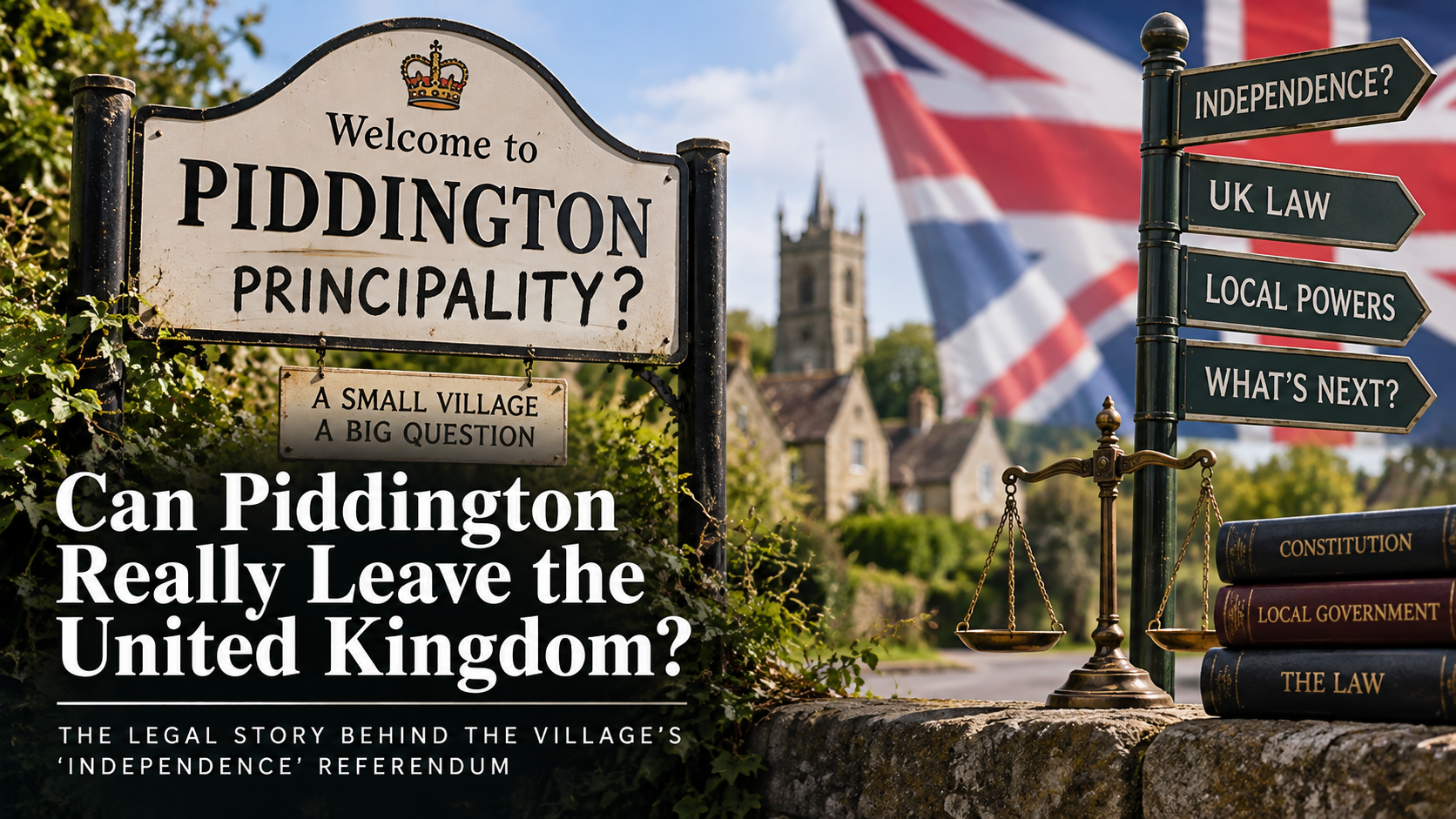
Can Piddington Really Leave the United Kingdom? The Law Behind the Village’s ‘Independence’ Referendum
Residents of Piddington in Oxfordshire have voted overwhelmingly to “leave” the United Kingdom, but the legal consequences of the vote are considerably less dramatic than the headline suggests.
In a referendum held on 15 September 2026, 312 votes were cast. Of those, 285 supported independence, 26 opposed it and one ballot was spoiled. Following the result, Piddington Parish Council chairman Tim McNally announced that the village would be known as the “Principality of Piddington”.
The referendum was held against the backdrop of government proposals to accommodate up to 1,256 male asylum seekers at a former Ministry of Defence site near Bicester. Residents and local representatives have raised objections concerning matters including consultation, infrastructure and pedestrian access to the site. The Government, meanwhile, has said the use of former military sites forms part of its policy of reducing reliance on asylum hotels.
But whatever its political significance, the referendum does not make Piddington an independent country.
A parish council cannot secede from the United Kingdom
The fundamental difficulty for the proposed “Principality” is straightforward: there is no mechanism in UK law allowing an English parish, village, town or city to unilaterally declare itself independent.
The BBC’s explanation of the Piddington referendum similarly notes that there is no legal mechanism by which a village, town or city can declare independence from the UK, meaning Piddington’s vote is symbolic.
Piddington Parish Council is not a sovereign legislature. It is part of the first tier of English local government.
Modern parish councils derive their status principally from legislation including the Local Government Act 1972. Their powers concern local-government matters rather than questions of national sovereignty. The House of Commons Library describes parish and town councils as the “first tier of local government”.
Piddington Parish Council itself lists powers covering such matters as community buildings, recreational facilities, allotments, rights of way, public conveniences, local transport initiatives and neighbourhood planning. None amounts to a power to alter the territory of the United Kingdom or remove the parish from UK jurisdiction.
Consequently, the referendum does not remove Piddington from England, Oxfordshire or the United Kingdom.
UK Acts of Parliament continue to apply there. Residents remain subject to the same national taxation and criminal and civil law as before. UK citizenship is unaffected, and the courts, police and public authorities retain their existing jurisdiction.
Calling the village the “Principality of Piddington” does not alter that position.
What about the referendum result?
Referendums can have very different legal effects depending upon the legislation under which they are conducted.
The UK permits local referendums on matters affecting local areas, but the existence of a referendum does not itself confer constitutional powers upon the authority organising it. Government material concerning the local-referendum regime has expressly distinguished such votes from binding decision-making, describing the policy objective as giving residents a means of influence rather than control.
That distinction is particularly important in Piddington.
A vote can demonstrate what participating residents want. It cannot give a parish council a power that Parliament has never conferred upon it.
The 285 votes for independence therefore constitute a substantial democratic expression among those who voted, but they do not themselves alter Piddington’s constitutional status.
In legal terms, Piddington was part of the United Kingdom before the referendum and remains part of the United Kingdom afterwards.
Could Piddington ever become independent?
This produces a more interesting constitutional question.
Although Piddington cannot unilaterally leave the United Kingdom, it does not necessarily follow that its independence would be legally impossible under every imaginable circumstance.
The reason is parliamentary sovereignty.
The orthodox constitutional position is that the UK Parliament is the supreme legislative authority. Parliament describes parliamentary sovereignty as meaning that it can create or end any law, while the House of Commons Library describes Parliament as possessing the authority to “make or unmake any law”.
Accordingly, Parliament could in principle enact primary legislation fundamentally changing Piddington’s constitutional status.
Such an extraordinary measure would have to deal with numerous practical questions: the precise territorial boundary, nationality and citizenship, taxation, property, policing, courts, public services, highways, utilities, existing contractual obligations and the relationship between the new territory and the remainder of the UK.
The important distinction is therefore between unilateral secession and independence authorised through UK constitutional law.
Piddington has no legal power to accomplish the former. Parliament’s legislative sovereignty means that the latter is theoretically conceivable, although there is presently no indication that Parliament intends to enact such legislation.
Could Piddington simply refuse to recognise UK law?
No.
A declaration of independence by the parish council would not deprive Parliament of legislative authority over the area. Nor would declaring Piddington a “principality” create a separate legal system.
Residents could not, for example, stop paying UK taxes on the basis that they now lived in another country. Businesses would remain subject to applicable UK law, and criminal offences committed in Piddington would continue to fall within the ordinary criminal justice system.
The same principle would apply to attempts to establish border controls, issue legally effective passports or disregard decisions of UK public authorities.
Those activities require legal authority. A local declaration cannot manufacture that authority.
Does international law change the position?
References to the international-law principle of self-determination would not automatically transform Piddington into a sovereign state.
Questions of self-determination and secession under international law are considerably more complicated than the proposition that any community which votes for independence thereby becomes independent.
Most importantly for Piddington’s immediate situation, a local referendum cannot by itself disapply UK domestic law. Unless and until the UK’s constitutional arrangements were legally changed, British authorities and courts would continue to treat Piddington as UK territory.
Recognition by other states would also be an entirely separate issue from the parish council declaring itself independent.
What has actually changed?
Legally, very little.
Politically, the referendum gives campaigners a striking piece of evidence about the views expressed by participating residents and has generated national media attention for their objections to the proposed asylum accommodation site. The public consultation concerning the development was reported as running until 17 September.
Constitutionally, however, the position remains much more mundane.
The “Principality of Piddington” is a symbolic title rather than a new sovereign state. There is no new international border in Oxfordshire, no separate Piddington citizenship and no legal basis for the parish council to substitute its authority for that of Parliament.
The referendum therefore matters primarily as an act of political expression rather than an exercise of constitutional power.
Piddington has voted to leave the United Kingdom.
Legally, it has not left at all.
This article provides general legal and constitutional information and does not constitute legal advice.
Leave a Reply