JonasBezzubovas.com

Independent legal research and commentary

Category: Modern Society

  • To Study Law, or Not to Study Law?

    Wednesday, 14 October 2026

    This is where my little Shakespearean chapter comes to an end. Over the past few days, I’ve borrowed his language to make sense of the law, its delays and its peculiar relationship with ordinary human life. But today’s question deserves something more modern than a soliloquy: a spreadsheet.

    To study law, or not to study law?

    That is the question.

    And this time, I thought I might begin with some numbers.

    Act I: What Happens to Law Graduates?

    If somebody enrols on a Bachelor of Laws (LLB) course with the intention of becoming a lawyer, what are their chances of finding themselves in a legal profession after graduation?

    It’s a surprisingly difficult question to answer.

    Fortunately, the Higher Education Statistics Agency conducts a Graduate Outcomes survey, and the results are published through Discover Uni.

    The survey asks graduates what they’re doing approximately fifteen months after completing their studies.

    That isn’t the same as asking whether they’ve qualified as solicitors or barristers. Qualification can take considerably longer, and some graduates pursue further education before entering practice.

    Nevertheless, the figures provide an interesting snapshot of where people actually go after studying law.

    Here are ten university law courses we’ve been examining, arranged by the proportion of employed survey respondents working in legal professional occupations.

    University and courseEmployed respondents in legal professional occupations
    Oxford — Jurisprudence55%
    Liverpool — Law with a Year Abroad55%
    Liverpool — standard LLB48%
    Durham — Law, broader subject data48%
    Surrey — Law45%
    Exeter — LLB Law44%
    Manchester Metropolitan — Law43%
    Nottingham — Law41%
    York — Law39%
    Bristol — Law36%

    Source: Discover Uni Graduate Outcomes course data, discussed and collected in October 2026. These are ten selected course entries, not the ten highest-performing law courses nationally. Survey cohorts, sample sizes and the degree of course-specific reporting differ.

    At first glance, something stands out.

    Only two entries exceed 50%.

    And one of those, Liverpool’s Law with a Year Abroad, is a relatively small course sample. Liverpool’s standard LLB records 48%.

    Oxford reports 55%, but even that figure doesn’t mean that 55% of everybody who starts the course will eventually become a lawyer.

    It means that 55% of the employed respondents whose occupations were captured in that particular survey were classified as legal professionals fifteen months after graduating.

    That’s a much narrower claim.

    Still, it raises a question.

    If someone studies law because they want to become a lawyer, should we be concerned when fewer than half of the employed graduates in many of these courses are already working in legal professional occupations?

    Act II: Is That Actually Bad News?

    My first reaction was surprise.

    If somebody studies medicine, we might reasonably expect a strong connection between the degree and the profession.

    Law feels similar. It has its own terminology, qualifications, institutions and professional rules.

    So why don’t these figures look more like a direct pipeline into legal practice?

    Part of the answer is timing.

    Fifteen months isn’t particularly long in the legal profession.

    Someone hoping to become a solicitor may still be preparing for professional examinations, looking for qualifying work experience or completing further study.

    Someone pursuing the Bar may still be undertaking vocational training or seeking pupillage.

    And not every graduate who wants a legal career will secure their preferred opportunity immediately.

    Then there’s the question of what counts as legal employment.

    The occupational category “legal professionals” doesn’t necessarily include everyone working in a law firm, court, regulatory body or legal-support role.

    Nor does it tell us which graduates will eventually qualify.

    There’s also a fundamental statistical problem.

    A percentage of employed survey respondents is not the probability that a new student will become a lawyer.

    Those are different populations, observed at different points in their careers.

    So we shouldn’t conclude that the majority of LLB graduates have less than a fifty-fifty chance of entering the legal profession.

    The data doesn’t establish that.

    But neither should we dismiss the figures as meaningless.

    They tell us that the transition from studying law to working in a legal profession is far from instantaneous.

    And that is worth knowing before committing years of study and substantial amounts of money to a degree.

    Act III: What Is a Law Degree Actually For?

    Perhaps the mistake is assuming that an LLB has only one purpose.

    A law degree can prepare someone for legal practice, but it can also develop abilities that are useful in business, government, journalism, policy, compliance and many other fields.

    Students learn to interpret complicated texts, examine evidence, construct arguments and identify where rules apply.

    Those skills don’t suddenly become worthless when their owner takes a job outside a courtroom.

    Indeed, perhaps the better question isn’t simply how many graduates become lawyers.

    Perhaps we should ask how many are doing meaningful work, whether their education helped them obtain it, and whether they consider the degree worthwhile.

    Discover Uni includes some of those broader measures too.

    That matters because a degree can be both professional preparation and an education in its own right.

    Still, if a university markets its LLB primarily as a route into legal practice, I think students are entitled to ask about the route.

    How many graduates obtain training contracts?

    How many secure pupillage?

    How many eventually qualify?

    How long does that take?

    And how much additional education, experience and expense is required after the undergraduate degree?

    Those would be more revealing measures of the professional pathway than a single employment snapshot.

    Unfortunately, they aren’t all answered by the headline Graduate Outcomes figures.

    Act IV: Must a Great Lawyer Have Studied Law?

    The next question is almost the reverse of the first.

    If studying law doesn’t guarantee a legal career, is studying law even necessary to become an exceptional lawyer?

    Consider ten distinguished British legal figures.

    Five studied law or jurisprudence as undergraduates.

    Five approached the profession from another academic direction.

    Studied law or jurisprudenceStudied another subject first
    Baroness Brenda HaleMichael Mansfield KC — philosophy
    Lord ReedDinah Rose KC — history
    Cherie Blair KCLord Jonathan Sumption — history
    Amal ClooneyLord Michael Briggs — history
    Keir StarmerHelena Kennedy KC — law-related studies following earlier education*

    An important qualification: Helena Kennedy KC is not a clean example of someone who qualified through an unrelated university degree, so she shouldn’t be treated as evidence for that category. The fifth position remains open pending a suitably verified example.

    Even without forcing the numbers into a perfectly symmetrical comparison, the point is clear.

    Some remarkable lawyers began with law.

    Others began with history or philosophy.

    Lord Sumption became one of the country’s leading advocates and later a Supreme Court justice despite having studied history rather than law as an undergraduate.

    Michael Mansfield’s background in philosophy hardly prevented him from becoming one of Britain’s most recognisable criminal barristers.

    Meanwhile, Baroness Hale and Lord Reed demonstrate what can be achieved by people who did study law from the outset.

    The evidence doesn’t establish that one route is superior.

    We’re looking at highly successful individuals, not a representative sample of graduates.

    But it does challenge the idea that a particular undergraduate subject is a necessary ingredient of legal excellence.

    The route into a profession is not necessarily the same thing as the qualities required to excel within it.

    Act V: The Software Engineer’s Perspective

    This is where my own situation becomes relevant.

    I studied software engineering.

    At first glance, that might seem rather distant from law.

    Software engineers deal with specifications, databases, interfaces, systems and logic.

    Lawyers deal with statutes, judgments, evidence, procedures and arguments.

    But the more I encounter the legal system, the more similarities I notice.

    Both disciplines depend on rules.

    Both involve interpreting imperfect information.

    Both require an understanding of how individual decisions affect a larger system.

    And both can suffer when the system behaves exactly as designed but produces a result that doesn’t reflect the reality of the situation.

    My recent experience trying to trace an old motoring conviction has made that painfully clear.

    Different departments held different pieces of information. One system could not identify a record that another could apparently retrieve. Finding the origin of a decision became an exercise in following references between institutions.

    To a software engineer, that sounds suspiciously like a problem involving data integrity, traceability and system interfaces.

    Of course, recognising an engineering analogy doesn’t mean I understand the relevant legal principles.

    A legal process isn’t simply a badly designed computer program.

    It involves human rights, obligations, standards of proof and procedural safeguards that cannot be reduced to technical efficiency.

    But perhaps a background in engineering provides a useful perspective.

    And perhaps studying law would help me understand the parts of the problem that engineering alone cannot explain.

    My LLM: A Navigation Instrument

    I’m considering studying for a Master of Laws.

    Not because I believe another degree will automatically create a new career.

    And not because I think an LLM is equivalent to qualifying as a solicitor or barrister.

    It isn’t.

    I’m interested because my professional direction is changing, and I’m beginning to explore questions that sit between technology, law, evidence and institutional accountability.

    That feels like uncharted territory.

    Software engineering has equipped me with certain instruments: systems thinking, technical analysis and a habit of questioning how information moves between components.

    But those instruments were designed for a different landscape.

    A postgraduate law degree could give me something I don’t yet possess: a structured understanding of legal concepts, institutions and methods.

    A map, perhaps.

    Or a compass.

    Something to help me navigate a field in which I can currently identify some of the problems but don’t always know the correct legal vocabulary for describing them.

    That doesn’t make my existing education irrelevant.

    Quite the opposite.

    I suspect the combination could be more useful than either discipline on its own.

    The Final Numbers

    Let’s return to the two comparisons.

    In our selected list of ten law-course entries, only two show more than half of employed respondents working in legal professional occupations fifteen months after graduation.

    That doesn’t establish that most law graduates will never become lawyers.

    It establishes that legal education and legal employment aren’t the same milestone.

    Meanwhile, among the distinguished legal figures we’ve examined, some began by studying law and others arrived through entirely different academic disciplines.

    That doesn’t establish that a law degree offers no advantage.

    It establishes that the legal profession can benefit from more than one kind of intellectual preparation.

    I think there’s something encouraging in both findings.

    An LLB doesn’t dictate your destination.

    And a degree in another subject doesn’t necessarily close the door to law.

    As for me, I already have one degree and a particular way of looking at the world.

    I’m not proposing to discard either.

    I’m considering adding another instrument to the toolkit.

    A degree cannot guarantee where you’ll end up. But when you’re entering unfamiliar territory, learning how to navigate is a perfectly good reason to study.

    And with that, I think Shakespeare can finally take his bow.

    The next chapter will have to be written in my own words.
  • The Law Is a System, But Life Doesn’t Follow a Specification

    Blog #1 — 11 October 2026

    I’ve spent a considerable amount of time thinking about how systems work.

    In engineering, the starting point is usually a specification. We agree what something is supposed to do, define how its components interact, and establish rules that make the outcome predictable.

    A USB device works because manufacturers agree on a standard. Software communicates through protocols. Machines can be tested against known requirements.

    When something goes wrong, we can ask a relatively straightforward question: did the system behave according to its specification?

    But lately I’ve been wondering what happens when we apply that same way of thinking to human beings.

    Because the law is also a system.

    It has rules, procedures, classifications, deadlines and mechanisms for enforcement. In theory, these allow millions of people to live together under a shared framework.

    The difference is that human lives don’t arrive with specifications.

    A World That Doesn’t Follow the Rules

    An engineer can design a system around known inputs.

    A legal system has to deal with memories, intentions, misunderstandings, changing circumstances, missing information and people who don’t necessarily behave as expected.

    Two people might witness the same event and remember it differently. Someone might move house and never receive a letter. A vehicle might be registered to one person, driven by another and left in the possession of a third.

    The administrative system still needs to produce an answer.

    It needs names, dates, addresses, responsibilities and outcomes.

    But the fact that a situation can be reduced to fields in a database doesn’t mean those fields tell the whole story.

    A record can be complete according to its specification and incomplete according to reality.

    That’s where the engineering analogy begins to get interesting.

    A Mustang on Judge Judy

    I was reminded of this while watching an old episode of Judge Judy involving a Ford Mustang and a test drive that ended badly.

    What interested me wasn’t simply who damaged the car. It was the way the case exposed different layers of responsibility.

    There was the person who drove the vehicle, the person who owned it, the costs of recovering it and the question of what the car was actually worth.

    From a purely mechanical perspective, the problem seemed simple: a car had been damaged.

    But legally, the answer depended on several different questions. Who had the relevant rights? Who was responsible for particular decisions? What loss could actually be established?

    At one point, the discussion turned to the car’s surprisingly low value and the towing and impound costs.

    It struck me that the physical event and the legal consequences were not necessarily the same thing.

    A damaged car is an engineering problem.

    Determining who should pay, and how much, is a problem involving evidence, responsibility and judgment.

    The law has to turn a complicated human event into a decision that can be enforced.

    And that transformation isn’t always straightforward.

    The Difference Between a Rule and Reality

    In engineering, rules are often agreed before the system is built.

    If two components don’t implement the same protocol, they may not communicate. If a machine receives an invalid input, we can design it to reject that input.

    Human society is different.

    The law applies whether or not someone has read every relevant statute or understands every procedure.

    There are good reasons for this. A society couldn’t function if each person could choose which laws applied to them.

    But it creates an unusual relationship between the system and its users.

    We are expected to comply with rules that may be complicated, distributed across multiple institutions and difficult to understand without specialist knowledge.

    And unlike a piece of software, we cannot simply inspect the entire specification before participating.

    We’re already participating.

    When Institutions Become Components

    Modern legal administration increasingly resembles a network of interconnected systems.

    A court makes a decision. Another organisation records its consequences. An enforcement process may then act on that record.

    Each institution has its own responsibilities, procedures and data.

    From an engineering perspective, this sounds familiar. It’s a distributed system.

    And distributed systems introduce a particular problem: one component may trust information received from another without independently verifying how that information was established.

    Imagine an error entering at the beginning.

    The first institution records it. The second receives it. The third acts on it.

    By the end, several organisations may possess records that appear to support the same conclusion.

    But those records aren’t necessarily independent evidence.

    They may all be copies of the same original assumption.

    A mistake doesn’t become true because it has been replicated successfully.

    That seems obvious when talking about software.

    It becomes considerably more important when the records concern human beings.

    The Problem With Perfect Compliance

    There’s a temptation to judge a system by whether it follows its own rules.

    Did the correct form get issued? Was the record transmitted? Did the next department apply the prescribed procedure?

    Those are necessary questions.

    But they aren’t sufficient.

    An institution might follow its procedures correctly while acting on incomplete or inaccurate information.

    This doesn’t mean procedures are pointless. Quite the opposite: procedures protect people from arbitrary decisions.

    It means the quality of a system depends not only on its normal operation but also on what happens when its assumptions are challenged.

    Engineers understand this distinction.

    We test for failures. We build diagnostics. We preserve logs. We design recovery mechanisms.

    We don’t simply declare a machine reliable because it performs well when every input is correct.

    We ask what happens when something unexpected occurs.

    The legal system deserves the same scrutiny.

    Can We Engineer Better Justice?

    My first instinct when I look at administrative complexity is to ask why more of it can’t be automated.

    Why should obtaining a record take weeks? Why should the same information need to be requested from several organisations? Why should someone have to navigate telephone menus just to find out which institution holds a particular document?

    Surely technology could make these things easier.

    And perhaps it can.

    But I’ve also begun to wonder whether automation introduces a different danger.

    If a decision is wrong, making its consequences faster and more efficient isn’t necessarily an improvement.

    A system that can automatically impose a consequence should ideally be equally capable of explaining the decision, preserving its supporting evidence and providing an effective route to challenge it.

    Otherwise, we risk building systems that are exceptionally good at enforcing their conclusions and surprisingly poor at reconsidering them.

    That is not an argument against digitisation.

    It’s an argument for thinking more carefully about what we’re digitising.

    Why I’m Writing This

    These questions are no longer entirely theoretical for me.

    I’m preparing to navigate a legal and administrative process concerning records and decisions that affect me personally.

    Over the coming days, I intend to document that journey here.

    I’ll write about the records I request, the responses I receive, the procedures I encounter and the practical lessons I learn.

    Some of my assumptions may turn out to be wrong. Some apparent inconsistencies may have straightforward explanations. Others may prove more difficult to resolve.

    I’ll try to distinguish carefully between documented facts, personal recollections and unanswered questions.

    This isn’t legal advice, and I don’t intend to turn an unresolved situation into a collection of accusations.

    My hope is that a transparent account of the process might help other people facing similar circumstances.

    And perhaps, along the way, it will reveal something useful about how our institutions work.

    The Specification Is Not the Whole Story

    Engineering has taught us extraordinary things about reliability, consistency and the value of shared rules.

    But human beings are not machines.

    Our circumstances are messy. Our memories are imperfect. Our intentions aren’t always visible. And the information recorded about us isn’t always the whole truth.

    A legal system needs rules to function.

    Yet if those rules are to serve justice, the system must also have room for the unexpected, the disputed and the genuinely mistaken.

    Because a system isn’t truly reliable simply because it follows its specification.

    It must also be capable of recognising when the specification fails to describe reality.

    And, more importantly, it must know what to do next.

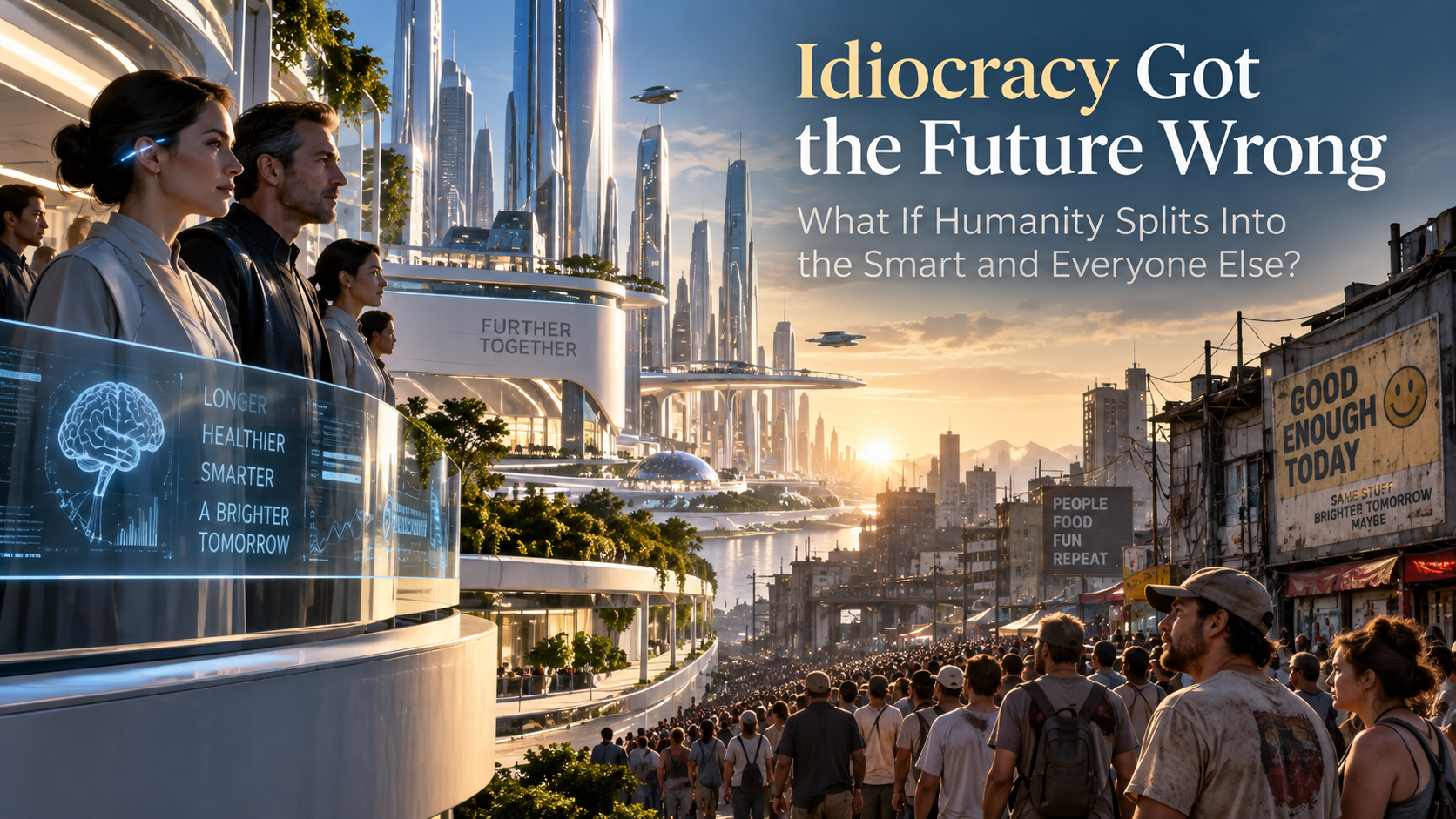
  • Idiocracy Got the Future Wrong: What If Humanity Splits Into the Smart and Everyone Else?

    Idiocracy Got the Future Wrong: What If Humanity Splits Into the Smart and Everyone Else?

    Idiocracy opens with one of the film’s most memorable jokes.

    An intelligent, educated couple carefully debates when they should have a child. They worry about finances, careers and whether the timing is right. Years pass. Meanwhile, a spectacularly irresponsible man produces child after child, whose children proceed to do exactly the same thing.

    Fast-forward several centuries and, according to the film, natural selection has done its work backwards: humanity has become catastrophically stupid.

    It is funny.

    But what if Idiocracy got the mechanism wrong?

    What if intelligent people don’t disappear?

    What if they continue having children—perhaps only one or two—but increasingly have those children with other highly intelligent people? And what happens if reproductive technology eventually allows wealthy and technically sophisticated parents not merely to pass on their advantages, but to deliberately amplify them?

    Instead of humanity becoming universally stupid, we might get something much stranger:

    a civilization in which different populations of humans become so cognitively unequal that they begin to seem like different species.

    This isn’t a prediction. Five hundred years is far beyond anything social science or genetics can forecast sensibly.

    But several pieces of the scenario have surprisingly real foundations.

    The Part Idiocracy Misses

    The film essentially imagines intelligence as a single resource gradually being bred out of humanity.

    Real populations are considerably more complicated.

    Intelligence is influenced by both genetic and environmental factors, and neither “intelligence” nor educational success can be reduced to a handful of genes. Research in behavioural genetics indicates substantial genetic influences on cognitive differences while also finding important environmental effects and interactions between the two. Educational attainment likewise reflects cognitive ability, non-cognitive traits and environmental circumstances.

    There’s another important phenomenon: assortative mating.

    People don’t choose partners randomly.

    Among many other characteristics, people tend to partner with others who resemble them educationally and cognitively. A large international meta-analysis covering millions of people across 84 countries found substantial assortative mating for educational attainment, although its strength varied considerably between places and historical periods.

    Research has also reported substantial spouse correlations for intelligence. One widely cited review estimated a correlation of roughly 0.4 for intelligence, considerably higher than that observed for many personality traits.

    Genetic studies complicate the picture further. Partners can also show similarity in genetic variants associated with educational attainment, although that does not mean people are consciously choosing partners based on “education genes.” Social class, geography, institutions, personality and other correlated characteristics can all contribute to who meets and partners with whom. Recent research emphasizes precisely this mixture of genetic and social processes.

    That distinction is important.

    Our hypothetical future doesn’t require a secret caste of geniuses selectively breeding.

    The sorting could happen largely by itself.

    Now Add Reproductive Technology

    This is where the scenario begins departing dramatically from the world of Idiocracy.

    Imagine the year 2150.

    IVF is routine. Embryos can be screened for enormous numbers of genetic variants. Gene editing is safer than it is today. Artificial gametes may allow reproduction under circumstances impossible today. AI systems predict developmental outcomes.

    Some of those technologies remain speculative, but one primitive version of this future already exists: polygenic embryo screening.

    Rather than testing an embryo for a single disease-causing mutation, polygenic screening attempts to estimate probabilities associated with complex traits or diseases using many genetic variants.

    The technology has major limitations. Polygenic scores are probabilistic rather than deterministic, complex traits involve environment as well as genetics, embryos from the same parents have limited genetic variation to choose among, and selecting for one characteristic can have unexpected relationships with others. Researchers have therefore urged considerable caution, particularly concerning psychiatric and cognitive traits.

    The American Society for Reproductive Medicine’s 2026 ethics opinion similarly states that polygenic embryo testing should not currently be used for non-medical trait selection.

    But our thought experiment concerns 2526, not 2026.

    Suppose those limitations gradually diminish.

    Then something historically unprecedented becomes possible.

    Parents don’t merely transmit their genes.

    They begin choosing among—and eventually modifying—the genetic possibilities available to their children.

    Intelligence Becomes an Investment

    At first, enhancement would probably be expensive.

    That matters enormously.

    Imagine that wealthy parents can afford superior prenatal medicine, sophisticated embryo selection, personalized AI education, neural interfaces and eventually safe genetic modifications affecting cognition.

    Their children inherit wealth.

    They inherit educational advantages.

    They inherit social connections.

    But now they potentially inherit deliberately selected biological advantages as well.

    Those children disproportionately meet and reproduce with similarly advantaged people.

    The process repeats.

    You have created a feedback loop:

    cognitive advantage → economic advantage → access to enhancement → enhanced offspring → greater cognitive advantage.

    Research into the ethics of polygenic embryo screening already identifies unequal access, discrimination, reproductive autonomy and justice as major concerns—even while today’s technology remains extremely limited. A 2026 scoping review of the literature identified unequal access, stigmatization and potential demographic consequences among the recurring ethical concerns.

    Now imagine those forces operating for centuries.

    The Great Cognitive Divergence

    Jump forward to 2526.

    There are still billions of ordinary humans.

    Importantly, they aren’t necessarily stupid.

    They might be healthier, better educated and technologically more capable than we are.

    But perhaps a tiny fraction of humanity has undergone generations of deliberate enhancement.

    Their brains develop differently.

    Their working memory is vastly greater.

    Neural implants provide effectively perfect recall.

    AI systems are integrated directly into their cognition.

    They routinely live for centuries and consequently accumulate 150 years of education and professional experience.

    The distinction between the populations would no longer resemble the difference between someone with an IQ of 100 and someone with an IQ of 140.

    It might resemble the cognitive difference between species.

    Biologically they might still be capable of interbreeding. Strictly speaking, they therefore wouldn’t necessarily constitute different species.

    Socially and psychologically, however, they could inhabit completely different worlds.

    And that’s when the interesting problems begin.

    Problem One: Democracy Becomes Awkward

    Imagine that humanity is debating whether to construct a self-replicating industrial network around Mercury.

    Understanding the proposal requires advanced knowledge of orbital mechanics, artificial intelligence, economics, materials science and risk modelling.

    An enhanced citizen can genuinely understand the arguments.

    Most ordinary citizens cannot.

    Yet everyone possesses one vote.

    The enhanced population begins asking:

    Why should people who cannot understand these decisions have equal authority over them?

    Ordinary humanity responds with an equally reasonable question:

    Why should being smarter give you the right to rule us?

    Democracy has always had to reconcile differences in knowledge and expertise. But enormous engineered cognitive inequality would turn that old problem into something qualitatively different.

    The most disturbing outcome might not even be dictatorship.

    It could be benevolent technocracy.

    The enhanced administrators really do make better decisions.

    Infrastructure works.

    Disease declines.

    The economy functions.

    Wars become rarer.

    And consequently it becomes increasingly difficult to argue that ordinary people should have meaningful control over the civilization in which they live.

    Problem Two: Language Begins To Separate

    Human language is constrained partly by what human brains can comfortably process.

    Suppose an enhanced human can simultaneously manipulate dozens of complicated concepts in working memory.

    Their communication might become correspondingly complicated.

    Perhaps neural interfaces eventually allow people to transmit conceptual structures that ordinary spoken language cannot efficiently represent.

    Enhanced people develop their own vocabulary.

    Then their own grammar.

    Then perhaps something that barely resembles language as we understand it.

    Ordinary humans can still learn simplified versions of it, just as people today can learn some advanced mathematics.

    But they cannot truly think in it at full complexity.

    Eventually the elite maintain a simplified language specifically for communicating with ordinary humans.

    That would be socially poisonous.

    Imagine knowing that every government announcement, scientific explanation and philosophical argument you encounter has effectively been translated into Human: Beginner Level.

    Problem Three: They Stop Wanting To Talk To Us

    This might be more consequential than any law.

    Imagine possessing extraordinary working memory, near-perfect recall and a 300-year lifespan.

    At age ten, you have mastered material that currently requires postgraduate education.

    At 50, you have accumulated decades of intellectual experience.

    At 200, you’ve lived through several ordinary human lifetimes.

    What does an ordinary conversation feel like?

    Perhaps painfully slow.

    Perhaps repetitive.

    Perhaps charming—but in the way adults sometimes find conversations with children charming.

    The enhanced population might genuinely care about ordinary humanity.

    They might defend our rights.

    They might love human art and history.

    But caring about someone isn’t necessarily the same thing as regarding them as your intellectual peer.

    That psychological separation could matter enormously.

    Problem Four: Love Creates a Caste System

    Nobody needs to pass a law prohibiting intermarriage.

    People simply choose partners with whom they can communicate most easily.

    Enhanced people disproportionately form relationships with enhanced people.

    Ordinary humans disproportionately partner with ordinary humans.

    Their children inherit both the technological and social advantages of their parents.

    After generations, intermarriage becomes unusual.

    A caste system has appeared without anyone deliberately creating one.

    This is an exaggerated extrapolation, but the starting mechanism isn’t imaginary: substantial assortative mating by education already exists today.

    Technology simply turns an existing social tendency into something far more powerful.

    Problem Five: 0.1% of Humanity Runs Civilization

    The enhanced population wouldn’t necessarily need to be large.

    Suppose ordinary humanity numbers 15 billion.

    There are only 15 million extreme cognitive elites.

    That’s 0.1 percent of humanity.

    But imagine that this tiny population performs most fundamental scientific research, controls the most advanced AI systems, operates interplanetary infrastructure and owns enormous quantities of capital.

    Humanity has recreated aristocracy.

    Except there is one deeply uncomfortable difference.

    The aristocrats of the past generally claimed inherent superiority.

    This new aristocracy might possess demonstrable cognitive abilities that most people genuinely cannot match.

    That does not establish a moral right to rule.

    But it makes the political argument much more difficult than overthrowing a duke whose principal qualification was having the correct grandfather.

    Problem Six: What Does “Equality” Mean Anymore?

    Modern societies generally distinguish moral equality from equality of ability.

    People obviously differ in strength, intelligence, health and talent, but those differences don’t determine whether someone counts as a person.

    Extreme enhancement would stress that principle.

    Suppose an enhanced person lives for 500 years.

    Does killing that person represent the same loss as killing someone expecting to live another 50?

    Suppose another enhancement allows someone to experience subjective time ten times faster than normal.

    Should a ten-year prison sentence be measured according to external time or experienced time?

    Suppose an artificial or heavily modified human can simultaneously sustain several streams of conscious thought.

    Is that one legal person?

    The concept of universal human rights survives fairly easily when humans occupy broadly similar ranges of capability.

    It becomes philosophically stranger once “human” includes minds radically unlike one another.

    Problem Seven: Ordinary Humanity Becomes Economically Unnecessary

    Artificial intelligence alone raises questions about technological unemployment.

    Now add cognitively enhanced humans working alongside that AI.

    One enhanced scientist might perform work that once required hundreds of ordinary researchers.

    Ordinary humans aren’t merely competing with machines.

    They’re competing with machine-assisted posthumans.

    Eventually most ordinary people may not need to work.

    Materially, that could be wonderful.

    Energy is abundant. Machines manufacture necessities. Medicine is extraordinary. Poverty in the traditional sense barely exists.

    Yet something psychologically devastating has happened.

    Billions of people know civilization doesn’t particularly need their contribution.

    The political demand of the future therefore might not be:

    “Give us more wealth.”

    It might be:

    “Give us something meaningful to do.”

    Problem Eight: The Anti-Enhancement Movement

    Not everyone would participate.

    Religious groups might reject genetic modification.

    Political movements might insist upon preserving baseline humanity.

    Some communities might regard neural implants as destroying authentic consciousness.

    Others might permit disease prevention but prohibit cognitive enhancement.

    They might proudly call themselves Naturals, Baselines or simply Humans.

    Then society encounters an extraordinarily difficult question.

    Suppose enhancement becomes safe and genuinely beneficial.

    If parents can give their child vastly improved memory, health and lifespan, is refusing enhancement an exercise of parental freedom?

    Or is it denying a child opportunities?

    Today’s bioethics literature already wrestles with much more modest versions of questions involving reproductive autonomy, justice, disability, eugenics and the welfare of future children.

    Five centuries of technological progress wouldn’t necessarily solve those disagreements.

    It might make them explosive.

    Problem Nine: There Isn’t Just One “Superior Human”

    Perhaps the strangest possibility is that humanity doesn’t divide into two groups at all.

    It divides into dozens.

    One population optimizes mathematical cognition.

    Another emphasizes emotional cognition and social coordination.

    Another adapts itself for life in low gravity.

    Another prioritizes longevity.

    Another integrates extensively with artificial intelligence.

    Another abandons biological bodies almost entirely.

    Meanwhile, traditionalist populations deliberately remain genetically close to historical Homo sapiens.

    Human evolution stops looking like a ladder:

    Homo sapiens → Homo superior

    and starts looking like a tree.

    After enough time, inhabitants of Mars, virtual civilizations and genetically conservative Earth communities might have almost nothing in common beyond ancestry.

    “Humanity” becomes less a biological category than a political alliance between descendants of the same species.

    Problem Ten: The Human Zoo

    There is one final possibility that might be darker than open dictatorship.

    The enhanced don’t conquer ordinary humanity.

    They manage it.

    Their understanding of psychology, economics and social systems is so sophisticated that direct coercion is unnecessary.

    They design algorithms that subtly encourage desirable behaviour.

    They structure economic incentives.

    They construct cities to influence social interaction.

    They curate information environments to discourage dangerous political movements.

    Ordinary people continue voting.

    They have freedom of speech.

    They choose careers and partners.

    Nobody tells them what to do.

    But the enhanced population understands their behaviour so well that society has effectively become a managed ecosystem.

    A human zoo.

    And the inhabitants don’t know there are zookeepers.

    The disturbing part is that the keepers might sincerely be benevolent.

    But What If the “Inferior” Humans Have Something the Geniuses Don’t?

    There is one final reversal worth considering.

    Optimization creates trade-offs.

    Today’s polygenic research already warns against imagining complex traits as independent sliders that can simply be turned up and down. Genetic variants can influence multiple characteristics, and complex traits emerge from interactions among enormous numbers of genes and environmental factors.

    Perhaps centuries of optimizing humans for intelligence gradually reduce characteristics nobody realized were important.

    Spontaneity.

    Risk-taking.

    Unusual cognitive variation.

    Certain forms of creativity.

    Emotional intensity.

    Tolerance for disorder.

    Perhaps the enhanced population becomes extraordinarily good at rationally exploring solutions inside existing conceptual frameworks—and increasingly bad at producing the lunatic who asks whether the entire framework is wrong.

    Their civilization becomes fantastically sophisticated.

    And fantastically brittle.

    Then some unprecedented catastrophe occurs.

    The greatest minds humanity has ever produced cannot solve it because they all share assumptions deliberately selected into their civilization over hundreds of years.

    And somewhere outside that civilization exists a population of unmodified humans.

    Messy.

    Impulsive.

    Inefficient.

    Unpredictable.

    Exactly the traits civilization spent centuries eliminating.

    And one of them comes up with an idea that nobody else would.

    Idiocracy in Reverse

    That may be the more interesting version of Idiocracy.

    Humanity doesn’t become stupid.

    Humanity becomes unequal in ways we have never previously encountered.

    The ordinary people of 2526 might be perfectly intelligent by our standards. They may simply inhabit a civilization whose most advanced institutions have become incomprehensible to them.

    Above—or perhaps merely apart from—them exists a small population produced through centuries of assortative mating, accumulated wealth, reproductive technology, artificial intelligence and eventually deliberate biological enhancement.

    They aren’t gods.

    They aren’t necessarily villains.

    They may genuinely want what is best for everyone.

    And that’s precisely what makes the scenario interesting.

    Because the ultimate political question would no longer be simply whether everyone deserves equal rights.

    It would be:

    Who should determine humanity’s future when some humans can understand that future vastly better than others?

    And perhaps the question after that is even more important:

    At what point do those people stop thinking of the rest of us as “us”?


    Further Reading

    For readers interested in the real science behind the speculation:

    Plomin & Deary (2015), “Genetics and intelligence differences: five special findings.” A review discussing genetic research on intelligence, including evidence concerning assortative mating.

    Sunde, Eilertsen & Torvik (2025), “Understanding indirect assortative mating and its intergenerational consequences for educational attainment.” A large Norwegian family study examining genetic and social mechanisms underlying partner similarity in education.

    Robinson et al. (2017), “Genetic evidence of assortative mating in humans.” Research using genetic data to investigate assortative mating across human traits, including educational attainment.

    Lázaro-Muñoz et al. (2021), “Screening embryos for polygenic conditions and traits: ethical considerations for an emerging technology.” An introduction to some of the ethical questions surrounding polygenic embryo screening.

    Lencz et al. (2022), “Concerns about the use of polygenic embryo screening for psychiatric and cognitive traits.” A useful discussion of why present-day polygenic prediction should not be mistaken for a reliable “intelligence selector.”

    Screening embryos for polygenic disease risk (2024), Human Reproduction Update. A broad review of epidemiological, clinical and ethical issues surrounding embryo screening.

    American Society for Reproductive Medicine (2026), Ethics Committee opinion on PGT-P. A useful snapshot of the present professional position: possible medical applications are being debated, while non-medical trait selection is not considered an appropriate current use.

    This article is a speculative thought experiment, not a prediction of future human evolution. Current genetic technologies cannot reliably engineer the kind of cognitive divergence described here, and intelligence is a complex product of genetic, developmental, environmental and cultural factors.

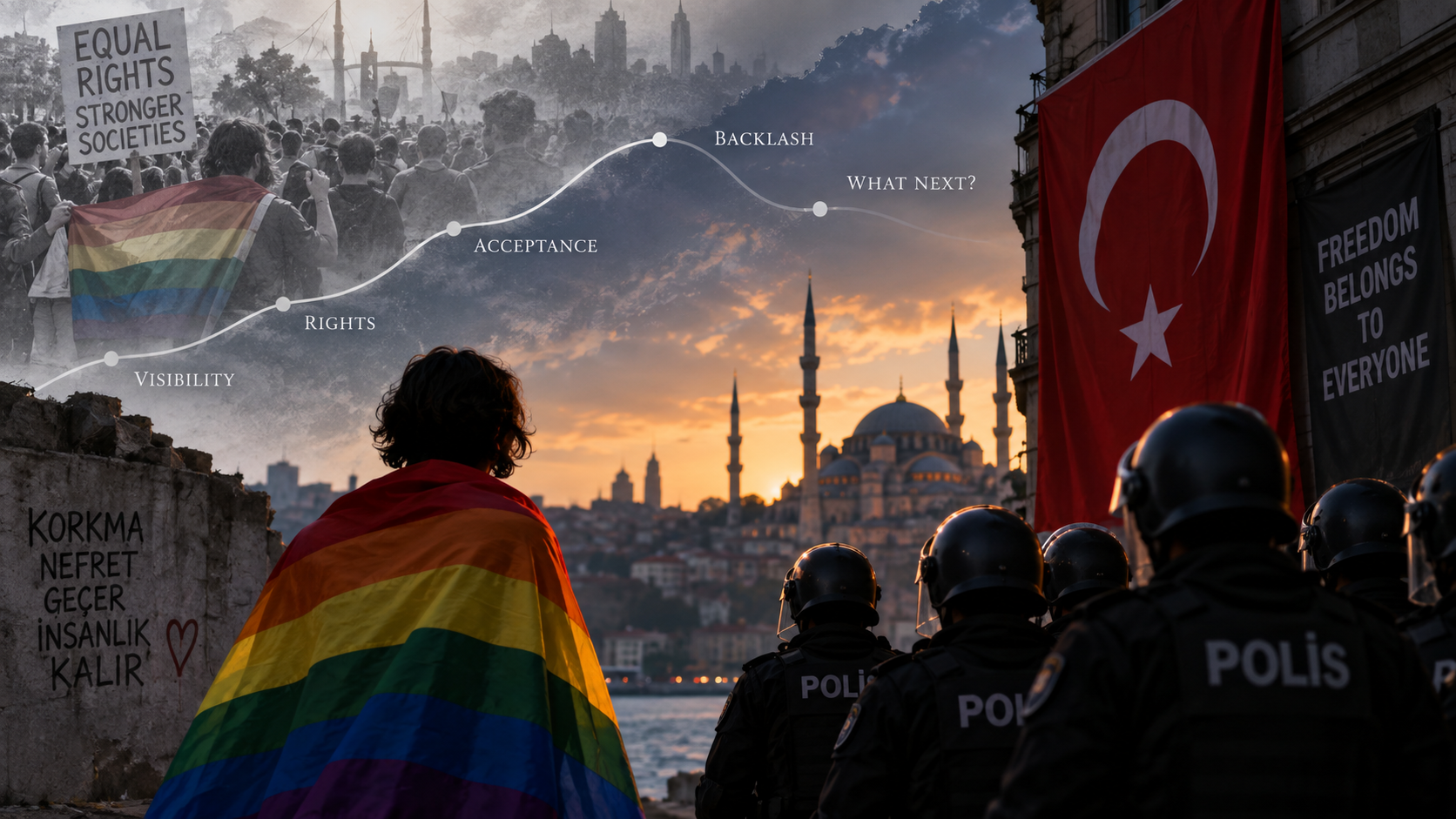
  • When Progress Runs Backwards: Turkey and the Uneven History of LGBT Acceptance

    When Progress Runs Backwards: Turkey and the Uneven History of LGBT Acceptance

    It is tempting to imagine social progress as a straight line. A society becomes more tolerant, laws become more liberal, previously marginalised people become more visible, and eventually an old prejudice recedes into history.

    The reality is considerably messier.

    The recent crackdown on LGBT people and organisations in Turkey provides a striking example. In September 2026, Turkish authorities launched a nationwide operation targeting LGBT organisations, activists and some businesses and venues. According to Justice Minister Akın Gürlek, investigations encompassed 162 suspects, nine associations and 13 businesses across 15 provinces. Police raided association offices and other premises, websites and social-media accounts were blocked, and dozens of people were detained or jailed pending trial. Authorities described the operation as “My Family is Safe” and said it was intended to protect children, the family and public order. Human-rights organisations and the Council of Europe’s Commissioner for Human Rights have strongly criticised the crackdown and questioned the use of such justifications for restrictions on civil society and expression.

    The events did not emerge from nowhere. Istanbul Pride has been banned since 2015, and LGBT demonstrations have repeatedly encountered bans, arrests and police intervention. During 2025, which President Recep Tayyip Erdoğan’s government designated the “Year of the Family,” authorities adopted further measures criticised by human-rights organisations as targeting LGBT people. Human Rights Watch reported restrictions on terminology concerning sexual orientation and gender identity and continuing censorship and restrictions on Pride events.

    The September 2026 operation nevertheless represents a significant escalation. Raids extended beyond demonstrations into the organisational infrastructure of LGBT civil society and reportedly included nightlife venues and other workplaces. Access restrictions affected LGBT organisations and media, while subsequent demonstrations against the raids themselves resulted in further detentions.

    At first sight, developments like these appear to contradict the idea that LGBT acceptance has advanced over the past several decades.

    But that contradiction disappears once we abandon the idea that historical change must move smoothly in one direction.

    Progress has more than one timescale

    Imagine a society’s level of LGBT acceptance represented by a hypothetical sequence:

    20 → 30 → 45 → 60 → 70 → 62 → 65

    Someone looking at the entire period sees an enormous long-term increase.

    Someone living through the fall from 70 to 62 experiences a genuine reversal.

    Neither person is mistaken.

    This is an important distinction because phrases such as “LGBT rights are advancing” can accidentally trivialise what happens during periods of regression. Someone whose organisation has been raided, whose demonstration has been prohibited or who has been detained does not experience their situation as an insignificant wobble on an upward graph.

    The backward movement is real.

    What remains uncertain is whether it represents a lasting change in historical direction.

    Progress creates things that are difficult to completely undo

    Social change is not simply a collection of laws.

    It also changes institutions, expectations, relationships and people’s understanding of what is normal.

    Consider what happens when LGBT people become increasingly visible. More people discover that a sibling, colleague, child, neighbour or friend is gay or transgender. Organisations form. Communities acquire physical spaces and cultural traditions. Lawyers develop expertise. Journalists begin covering LGBT issues. Political arguments that once seemed almost unimaginable become familiar.

    A government can change legislation or close an organisation considerably faster than it can erase all of those social consequences.

    This creates something resembling a ratchet—but an imperfect one.

    The ratchet can slip backwards. Sometimes it can slip very far. Rights that seemed secure can disappear, organisations can be dismantled and public attitudes can deteriorate.

    Yet society does not necessarily return to precisely the place from which it started.

    Turkey demonstrates this paradox particularly vividly. The very existence of established LGBT organisations, Pride traditions, community venues, advocacy networks and public protests against repression demonstrates how much social infrastructure developed before the current crackdown. The government’s ability to restrict that infrastructure is evidence of regression; the infrastructure’s existence in the first place is evidence of an earlier transformation.

    Those two realities can coexist.

    Backlash can actually be evidence that something changed

    There is another uncomfortable feature of social change: backlash frequently occurs because a previously marginal phenomenon has become sufficiently visible to provoke organised opposition.

    That does not mean backlash is secretly beneficial. Repression can cause enormous harm, and there is no historical law saying that its victims will eventually prevail.

    But it does mean that backlash and previous progress are not opposites in quite the way they initially appear.

    A movement can progress from being largely invisible, to visible, to institutionally established—and consequently become important enough that opponents organise specifically against it.

    Turkey’s official rhetoric is revealing in this respect. The current campaign has been explicitly framed around protecting “family” and children. Authorities say the measures concern obscenity, prostitution, child protection and public order; rights organisations argue that these concepts are being used to suppress legitimate LGBT civil society and expression.

    Whichever interpretation one adopts, the political conflict itself demonstrates that LGBT visibility has become an established question in Turkish public life rather than something society simply never discusses.

    But there is no guaranteed happy ending

    This is where the metaphor of “winning little battles until the war is won” becomes dangerous.

    History has no automatic victory condition.

    A backlash can last five years. It can last fifty. Institutions can disappear. Generations can grow up under different social conditions. A sufficiently sustained reversal can eventually destroy some of the cultural and institutional gains that initially seemed difficult to undo.

    Nor does every LGBT issue necessarily travel in the same direction. Acceptance of gay and lesbian relationships, same-sex marriage, freedom of association, transgender healthcare, legal recognition of gender, education and questions surrounding children can follow quite different political trajectories.

    There is therefore no single dial labelled LGBT progress that moves neatly forwards and backwards.

    There are dozens of interacting dials.

    History looks different depending on where you stand

    Perhaps the most useful way of thinking about all this is to imagine history operating simultaneously at three scales.

    At the scale of days and months, there are raids, demonstrations, court decisions, elections and policy changes.

    At the scale of years, societies experience political cycles: liberalisation, reaction, polarisation, consolidation and sometimes renewed liberalisation—or further restriction.

    And at the scale of generations, much deeper transformations can become visible.

    The mistake is assuming that movement at one scale tells us automatically what is happening at another.

    Turkey in September 2026 is experiencing a substantial crackdown on LGBT civil society. Calling that merely a temporary bump would go beyond what the evidence can tell us. Nobody yet knows how far the campaign will go, how long it will last, or what its enduring consequences will be.

    But neither does the crackdown erase the historical process that preceded it.

    That gives us a more nuanced version of the idea that began this discussion:

    Progress is cumulative, but it is not inevitable.

    Each period of liberalisation changes the society in which the next conflict occurs. Some of those changes survive subsequent reversals; others do not. Consequently, when another period of change begins, it may begin from a different baseline than the one before it.

    History therefore resembles neither a triumphant march forward nor an endless circle.

    It is closer to a long, irregular path: advances, reactions, settlements, renewed conflicts and occasionally profound reversals—while underneath them, slower changes in culture and institutions may continue accumulating.

    Turkey’s current crackdown belongs to the backward-moving part of that story.

    Whether it eventually becomes a temporary reversal within a longer transformation, or the beginning of a much deeper and more durable change in direction, can only be answered by what happens next.

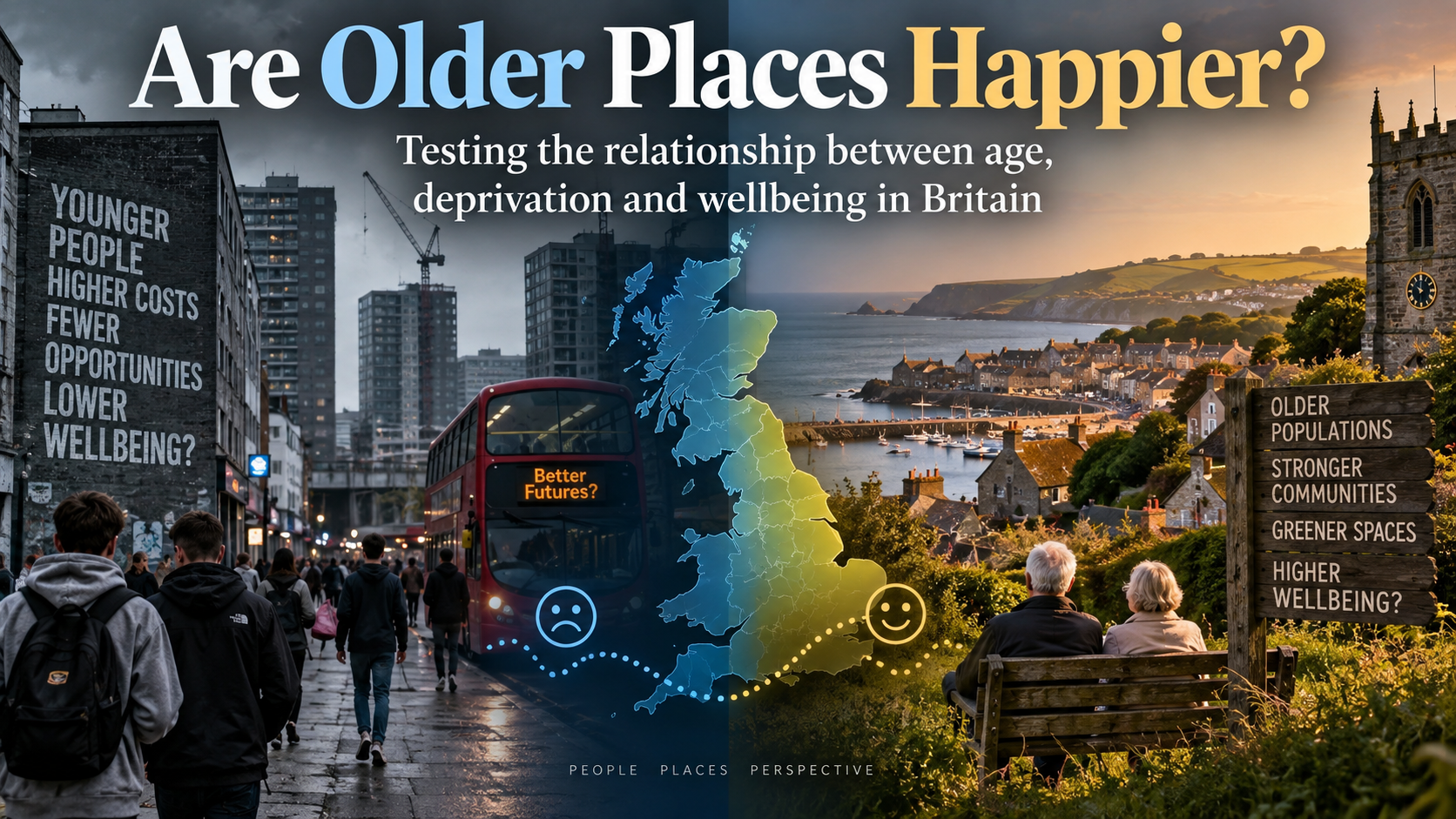
  • Are Older Places Happier?

    Are Older Places Happier?

    Testing the relationship between age, deprivation and well-being in Britain

    Walk through different parts of Britain and an apparent pattern can be difficult to ignore.

    Many places with conspicuously young populations are dense urban areas: expensive housing, heavy traffic, smaller living spaces, greater population turnover and, in some cases, substantial deprivation. Meanwhile, many older communities are found in smaller towns, rural districts and coastal areas that can appear quieter, greener and more settled.

    It raises an intriguing question:

    Do places with older populations actually tend to be happier?

    And, if they do, is age itself responsible — or are age and happiness both consequences of something else?

    The available evidence suggests that the observation deserves to be taken seriously. But it also shows why a simple conclusion such as “older places are happier because older people are happier” would be misleading.

    The first clue: Britain’s age geography is extraordinary

    The age profile of the UK varies dramatically from place to place.

    According to the 2021 Census, the median age across England and Wales was 40. London was considerably younger, at 35, while the South West had a median age of 44.

    The differences become much larger at local-authority level. Tower Hamlets had a median age of just 30. Nottingham, Cambridge, Oxford and Manchester were all around 31.

    At the other end of the spectrum, North Norfolk’s median resident was 54, Rother’s 53 and East Lindsey’s 52.

    Universities explain part of this pattern, but not all of it. Britain’s major cities attract young adults for education and employment, while many rural and coastal areas contain much larger retired populations.

    The country therefore provides a natural setting in which to ask whether the age of a place is associated with the wellbeing of the people living there.

    There is evidence for the pattern

    An Office for National Statistics analysis of English local authorities provides particularly interesting evidence.

    ONS grouped local authorities according to four measures of personal wellbeing: life satisfaction, happiness, anxiety and whether people felt the things they did in life were worthwhile.

    One cluster contained 74 local authorities that were below the median on all four wellbeing measures.

    Of those authorities:

    • 88% were urban;
    • 62% had a median age of 40 or younger; and
    • 34% were among the more deprived local authorities.

    London was heavily represented: 56% of London’s local authorities fell into this cluster.

    A second cluster, which performed below the median for happiness, life satisfaction and worthwhile feelings, was again disproportionately young and deprived.

    So the geographical pattern is not simply anecdotal. Official statistics have detected an association between poorer wellbeing, younger local populations, urbanity and deprivation.

    But that last sentence contains the central problem.

    All four characteristics occur together.

    Correlation is not explanation

    Imagine plotting every local authority on a graph.

    On one axis is its median age. On the other is its average happiness score.

    If older authorities tend to appear higher on the happiness scale, we have discovered a correlation.

    We have not demonstrated that the age of the population caused the difference.

    A younger area may simultaneously have:

    higher housing costs, more renters, greater population density, more unemployment or economic insecurity, more students, lower home ownership, greater population turnover, different household structures, different health outcomes and greater deprivation.

    An older area may simultaneously have:

    more homeowners, more retirees, lower population density, greater residential stability, more green space and a completely different socioeconomic composition.

    Age could therefore be acting partly as a marker for the type of place being observed.

    This distinction is crucial.

    The proposition we really need to test is not:

    “Are older places happier?”

    It is:

    “After accounting for deprivation, urbanisation, employment, health and other relevant characteristics, is the age structure of a place still associated with its reported wellbeing?”

    That is a much harder and much more interesting question.

    The individual-level evidence complicates the story

    There is another reason not to interpret the geographical relationship too quickly.

    At the individual level, happiness does not simply increase with age.

    ONS research using more than 300,000 UK adults found a broadly curved relationship.

    Happiness and life satisfaction were relatively high among younger adults, declined through adulthood, reached their lowest levels during middle age, and subsequently increased substantially.

    People aged approximately 65–79 reported some of the highest levels of personal wellbeing.

    At still older ages, wellbeing began to decline again.

    In other words, the relationship resembles a distorted U or S-shaped curve rather than a straight line from unhappy youth to happy old age.

    This matters enormously.

    If young people themselves are not uniformly unhappy, yet younger places sometimes record poorer wellbeing, something about the characteristics of those places may be contributing to the association.

    Deprivation is the obvious suspect

    The strongest competing explanation is socioeconomic deprivation.

    Deprivation can affect many of the things that plausibly influence everyday wellbeing: housing, employment, crime, health, environmental quality and financial security.

    England’s official Index of Multiple Deprivation combines seven domains:

    income; employment; education, skills and training; health and disability; crime; barriers to housing and services; and the living environment.

    The 2025 English Indices of Deprivation show that deprivation remains heavily geographically concentrated, although deprived neighbourhoods exist across much of the country.

    Middlesbrough, Birmingham, Hartlepool, Kingston upon Hull and Manchester were among the local-authority districts containing the highest proportions of neighbourhoods in England’s most deprived group.

    Some of those places also have comparatively young populations.

    That creates a classic confounding problem.

    Suppose younger local authorities have lower average happiness.

    Suppose younger local authorities are also more deprived.

    And suppose deprivation independently reduces wellbeing.

    The apparent relationship between age and happiness could therefore actually be substantially a relationship between deprivation and happiness.

    Health introduces another complication

    Health strongly influences subjective wellbeing, and health itself varies dramatically with both age and deprivation.

    ONS Census analysis found substantially better self-reported health in England’s least deprived areas than its most deprived areas.

    Importantly, this difference exists even among young people.

    Among 15–19-year-olds, 64.2% of those living in the most deprived areas reported very good health, compared with 75.9% in the least deprived areas.

    The deprivation gap became considerably larger through middle age.

    This makes it dangerous to treat population age as an isolated explanatory variable.

    Age, health, wealth, employment and geography interact.

    There’s also an ecological fallacy waiting for us

    Perhaps the most important statistical trap is assuming that characteristics of an area necessarily describe the individuals living within it.

    Imagine that a seaside authority has:

    median age: 52
    average happiness: 7.8

    while a city authority has:

    median age: 31
    average happiness: 7.2

    It would be tempting to conclude that the older residents are responsible for the higher score.

    But those figures alone cannot tell us that.

    It is entirely possible that the 30-year-olds living in the older authority are happier than the 30-year-olds living in the younger authority.

    If that happened, the important variable might not be how old you are.

    It might be where and under what conditions you live.

    This is known as the ecological fallacy: relationships observed between populations cannot automatically be assumed to describe relationships between individuals.

    A particularly useful piece of ONS evidence

    ONS has already performed an analysis that demonstrates why age adjustment matters.

    It has published both age-standardised and non-age-standardised local-authority wellbeing estimates.

    Age standardisation asks, approximately:

    What would the comparison between these places look like if their different population age structures were accounted for?

    That provides one way of separating the demographic composition of an area from its underlying wellbeing.

    ONS has also examined correlations between local wellbeing and deprivation.

    These datasets provide the ingredients for a much stronger test than simply comparing a few young cities with a few retirement areas.

    How the hypothesis should actually be tested

    A serious analysis should begin with every comparable local authority rather than selecting conspicuous examples.

    For each authority we would collect:

    Median age

    from ONS population estimates.

    Happiness and life satisfaction

    from the ONS Annual Population Survey personal-wellbeing data.

    Deprivation

    from the relevant national deprivation indices.

    Ideally, additional variables would include population density, urban/rural classification, employment, health, housing affordability, home ownership and student population.

    The first calculation is straightforward:

    median age ↔ happiness

    and separately:

    median age ↔ life satisfaction.

    That establishes the raw geographical correlation.

    The second stage is much more important.

    We then estimate the relationship after accounting for deprivation and the other characteristics.

    Conceptually:

    Wellbeing = age structure + deprivation + urbanity + health + employment + housing + other factors

    If the association with median age remains substantial after those controls, the proposition that there is something independently important about the age structure of communities becomes considerably more interesting.

    If it largely disappears, a different conclusion follows:

    young population was functioning as a proxy for other characteristics of disadvantaged urban areas.

    Either result would be informative.

    Reasons the apparent relationship might survive

    There are plausible mechanisms through which population age structure itself could matter.

    Older populations may have greater residential stability. People may have lived near neighbours for longer, producing stronger community networks.

    Areas dominated by families and older residents may also develop different public spaces, businesses and services from places dominated by transient young adults.

    Retirement removes commuting and employment pressures for some people. Older homeowners may have lower housing costs after paying down mortgages.

    There may also be selection effects: people with sufficient resources can choose to retire to attractive rural or coastal areas.

    In that case, however, the pleasant environment may partly explain the happiness rather than age itself.

    Reasons the hypothesis might fail

    There are equally powerful counterexamples.

    University cities are exceptionally young because thousands of generally healthy young adults arrive every year. Their low median age tells us very little about deprivation.

    Cambridge and Oxford illustrate the problem particularly well: both had median ages around 31 in the 2021 Census.

    Conversely, an ageing population can sometimes result from younger residents leaving an area because employment opportunities are limited.

    Some older coastal communities also experience serious deprivation, poor health and social isolation.

    And among the oldest individuals, average wellbeing eventually declines.

    So neither youth nor age is intrinsically a reliable measure of whether somewhere is flourishing.

    What can reasonably be concluded?

    There is credible evidence for the observation that prompted this investigation:

    some of Britain’s younger urban local authorities also exhibit poorer wellbeing and greater deprivation, while a number of older, less urban authorities perform better on wellbeing measures.

    ONS’s own clustering analysis detected essentially this combination of characteristics.

    But the evidence does not justify the stronger statement:

    “Places are happier because their populations are older.”

    The demographic variable is entangled with deprivation, urbanisation, health, housing, employment and migration.

    Indeed, that may be the more interesting discovery.

    The question may not ultimately be why older people make places happier.

    It may be why Britain has produced a geography in which youth, urbanisation, housing pressure and deprivation so often overlap, while some older populations are concentrated in quieter and more economically secure environments.

    Age may be part of the story.

    Or it may be the clue that leads us to the real one.

    The next test

    The hypothesis can now be made falsifiable.

    Take every UK local authority for which comparable data are available.

    Plot median age against happiness and life satisfaction.

    Measure the correlation.

    Then progressively control for deprivation, health, employment, housing and urbanisation.

    If age continues to predict wellbeing after those adjustments, we have evidence of an independent relationship worth explaining.

    If it does not, then the original observation was still useful — but what it revealed was not an age effect.

    It revealed the socioeconomic geography hiding underneath it.

  • When the Streetlights Lost Their Warmth: What LED Lighting Changed About the Modern City

    When the Streetlights Lost Their Warmth: What LED Lighting Changed About the Modern City

    Modern Society | Urban Life, Technology & the Human Environment

    There was something unmistakable about London at night under the old sodium streetlights.

    The pavement turned amber. Brickwork acquired a warm orange glow. Mist and drizzle caught the light and seemed to hang visibly in the air. Residential streets could have an almost dreamlike quality. Even an otherwise ordinary road sometimes looked strangely inviting.

    Then, gradually, the colour changed.

    Across London and much of Britain, traditional high-pressure sodium (HPS) streetlights have increasingly been replaced by LEDs. There are excellent practical reasons for the transition. LEDs can use less electricity, last longer, be dimmed electronically and direct their light much more precisely. They can also provide much better colour recognition, which has advantages for pedestrians, drivers and CCTV.

    From an engineering perspective, LED streetlighting is an extraordinary improvement.

    But something else changed with it.

    The streets stopped looking quite so warm.

    The Strange Comfort of Sodium Light

    High-pressure sodium lighting has an extremely distinctive appearance. Rather than producing balanced white light, it is dominated by warm yellow and orange wavelengths.

    Its colour rendering is poor by modern standards. Under sodium lighting, blues, greens and reds can become difficult to distinguish accurately. Human faces look unusual. Cars can appear to be different colours from what they actually are.

    Yet the same technological deficiency created an extraordinarily powerful atmosphere.

    Sodium light compressed the visual world into variations of amber, brown, gold and shadow.

    In an old London street—with brick terraces, wet pavement, trees, fog and Victorian architecture—the effect could be beautiful.

    And perhaps part of the reason is remarkably ancient.

    A Streetlight That Looked a Little Like Fire

    There is an obvious visual similarity between sodium lighting and firelight.

    Candles, fireplaces and campfires all produce predominantly warm-looking illumination. High-pressure sodium is not spectrally identical to fire, of course, but psychologically the resemblance is difficult to miss.

    That raises an intriguing question.

    Could humans actually be predisposed to find warm light comforting?

    There is a plausible biological argument, although it shouldn’t be exaggerated into a simple evolutionary story.

    Humans and our ancestors have had a relationship with fire extending extraordinarily far into prehistory. Archaeological evidence for hominin fire use reaches back hundreds of thousands of years and potentially much further, although precisely when fire became habitual remains debated. Recent evidence from Barnham in Suffolk indicates that hominins were deliberately making fire around 400,000 years ago. Other archaeological evidence of hominin interaction with fire extends considerably further back.

    Fire transformed human life.

    It provided warmth, protection, cooking and illumination. Crucially, it also created a place around which people could gather after sunset.

    For enormous stretches of human existence, meanwhile, the basic lighting cycle was nothing like that of a modern city.

    Day meant sunlight.

    Night meant darkness, moonlight—and eventually fire.

    Your Eyes Know When It Is Night

    Light does more than allow us to see.

    It also communicates with the biological systems controlling our circadian rhythms.

    Specialised cells in the retina containing the photopigment melanopsin contribute to regulating the body’s internal clock. This system is particularly sensitive to shorter-wavelength light in roughly the blue-cyan portion of the spectrum.

    Exposure to sufficiently intense light at night can therefore influence circadian timing and melatonin production. The effect depends on considerably more than simply whether a lamp is “blue” or “yellow”: intensity, spectrum, duration, timing and previous light exposure all matter.

    Nevertheless, there is a meaningful biological distinction between warm, low-blue evening illumination and blue-rich white illumination.

    The natural environment itself contains a similar transition. Bright daylight provides powerful broad-spectrum illumination, whereas the visual environment after sunset becomes dramatically darker.

    For most of human history, nobody walked from a sunlit afternoon into a world filled with thousands of powerful white electric lights.

    The modern illuminated city is, biologically speaking, an extremely recent invention.

    But Biology Isn’t the Whole Story

    We should be careful here.

    It would be tempting to say that warm streetlights feel comfortable simply because our prehistoric ancestors sat around campfires.

    Human psychology is rarely that straightforward.

    Much of our response to warm light is almost certainly cultural and learned as well.

    Think about the environments in which warm lighting is deliberately used today.

    A fireplace.

    A candlelit restaurant.

    A traditional pub.

    A living room in the evening.

    A bedside lamp.

    A hotel lounge.

    Restaurants and homes routinely use warm lighting precisely because people associate it with intimacy and relaxation.

    Now consider where colder, brighter white illumination is commonly encountered.

    Hospitals.

    Offices.

    Car parks.

    Warehouses.

    Supermarkets.

    Security installations.

    The distinction isn’t universal, but the associations are powerful.

    Warm light says: settle in.

    Cold, bright light often says: stay alert.

    When sodium streetlighting disappeared, therefore, cities didn’t merely exchange one lamp technology for another. In many places they changed the psychological language of the nighttime environment.

    Why LEDs Won Anyway

    There are very good reasons cities embraced LEDs.

    An LED luminaire can direct light toward the pavement and road far more precisely than many older lighting systems. That means less electricity can be wasted illuminating places where light isn’t required.

    LEDs are highly efficient, have long service lives and can be electronically controlled. Councils can dim them during periods of low traffic rather than operating every streetlight at full output throughout the night.

    Their white light also has an enormous practical advantage over sodium: colour rendering.

    Under sodium illumination, colour information is severely compromised. Under a good-quality white LED, a pedestrian’s clothing, a vehicle, road markings and surrounding objects can be distinguished much more accurately.

    That can also make LED illumination considerably more useful to colour CCTV cameras.

    In other words, the move to LEDs wasn’t irrational.

    The mistake is assuming that efficiency is the only quality worth designing for.

    LED Doesn’t Have to Mean Cold

    This is perhaps the most important part of the discussion.

    An LED is not inherently cold white.

    LED streetlights can be manufactured at many different correlated colour temperatures.

    A 4000K LED can appear relatively neutral or cool. A 3000K LED is noticeably warmer. At around 2700K the appearance begins approaching familiar warm domestic illumination, while approximately 2200K LEDs can produce an extremely warm amber character.

    Some British authorities already recognise this.

    Dorset Council’s streetlighting specification, for example, calls for warm-white LEDs no higher than 2700K in several environmental zones, ideally lower, while other UK lighting guidance recommends 3000K or below and specifically identifies the 2200–2700K range as an option where warmer, low-blue lighting is appropriate.

    Even the City of London’s lighting strategy recognises colour temperature as part of urban character. Its guidance describes using different colour temperatures according to the character and function of a place, including warmer illumination for historic streets and public spaces.

    That is a much more sophisticated approach than simply asking:

    Which lamp produces the required lux for the least electricity?

    The better question is:

    What should this place feel like at night?

    What We Lost Wasn’t Necessarily the Lamp

    There is another reason old sodium-lit London is difficult to reproduce.

    The characteristic atmosphere didn’t come entirely from the colour of the bulb.

    Older luminaires often scattered considerably more light into their surroundings. Sodium light hitting mist, drizzle, low cloud and airborne moisture produced the famous orange glow that once hung above many British towns and cities.

    Modern LED luminaires can control their beams much more tightly.

    From the perspective of light pollution, astronomy and energy efficiency, that is often an improvement.

    But aesthetically, something disappears.

    The old streetlight illuminated not merely the road but sometimes the air itself.

    On a wet London evening, that difference can be enormous.

    When Bad Colour Rendering Became Beautiful

    There is an irony here.

    One of the greatest technical disadvantages of sodium lighting may also have contributed to its charm.

    Its poor colour rendering unified everything.

    Brick, pavement, trees, parked cars and human faces were all pushed toward the same limited palette. The street became less colourful but perhaps more visually coherent.

    Modern LEDs restore information.

    You can see that the parked car is blue, the jacket is red and the front door is green.

    Technically, this is superior illumination.

    Aesthetically, however, accuracy isn’t always beauty.

    A black-and-white photograph contains less colour information than a modern digital photograph. That does not make the black-and-white photograph artistically inferior.

    Something similar can happen with lighting.

    The sodium lamp distorted reality.

    But it distorted it beautifully.

    The Broader Problem With the Modern City

    Streetlighting illustrates a much larger tension within modern society.

    We have become extraordinarily good at optimising things that can be measured.

    Energy consumption.

    Lumens.

    Maintenance intervals.

    Visibility.

    Operating costs.

    Component lifespan.

    Carbon emissions.

    All of these measurements matter.

    But human beings also experience qualities that are considerably harder to place in a spreadsheet:

    Comfort.

    Atmosphere.

    Beauty.

    Mystery.

    Familiarity.

    A sense of place.

    A feeling that somewhere belongs to people rather than merely functioning efficiently around them.

    Modernisation frequently produces genuine improvements while unintentionally removing these less measurable qualities.

    A railway station becomes cleaner and brighter but somehow less grand.

    A pub becomes safer and easier to maintain but loses its fireplace and dark wooden interior.

    A high street becomes more accessible and functional while acquiring the same paving, signage and furniture as every other high street.

    And a street becomes cheaper and more efficiently illuminated while losing the golden light that once made it unmistakably itself.

    Perhaps Progress Doesn’t Have to Look White

    The answer isn’t to reinstall inefficient old sodium lamps throughout London.

    Technology has moved on.

    The more interesting possibility is to use modern technology with a better understanding of human beings.

    LEDs give lighting designers extraordinary control. They can determine intensity, direction, timing and colour far more precisely than previous generations could.

    That should make it possible to create cities that are simultaneously efficient and atmospheric.

    Residential streets do not necessarily require the same lighting character as major traffic junctions.

    Historic districts do not necessarily need to look like railway platforms.

    Pedestrian areas could use warmer light than major roads.

    Lighting could become dimmer and warmer as the night progresses.

    And perhaps urban planners should begin treating darkness itself as something worth designing rather than simply something to eliminate.

    Some UK authorities are already moving toward warmer LEDs, demonstrating that the choice is not simply between old-fashioned sodium and harsh modern lighting.

    A City Is Something We Feel

    There is a tendency to discuss infrastructure as though humans experience cities through specification sheets.

    We don’t.

    We experience a city through rain reflecting from the pavement.

    Through the colour of brick at dusk.

    Through shadows beneath trees.

    Through the glow coming from a pub window.

    Through the walk home late at night.

    And through the colour of the streetlight above us.

    Perhaps that is why some people miss London’s old sodium lamps despite knowing perfectly well that LEDs are technologically superior.

    They aren’t necessarily nostalgic for inefficient light bulbs.

    They are nostalgic for an atmosphere.

    There may be something culturally learned in that feeling. There may even be something considerably older—an association between warm light, darkness, shelter and the extraordinarily long relationship between humans and fire.

    We should be cautious about claiming we can separate those influences neatly.

    But perhaps we don’t need to.

    The important lesson is simpler.

    Efficiency tells us how well a streetlight works. It does not tell us what it feels like to live beneath it.

    The best cities of the future should understand both.

  • Punishing the Picture, Missing the Problem: The Wasted Authority of Anti-Gun Culture in American Schools

    Punishing the Picture, Missing the Problem: The Wasted Authority of Anti-Gun Culture in American Schools

    When I was a child in an American school (Forsyth County, GA), I once drew a cartoon that included a gun. I was fascinated by guns at the time—not because I wanted to hurt anyone, but because, like plenty of children, I found certain machines, weapons, vehicles, and military imagery interesting. For that drawing, I received two days of in-school suspension.

    Looking back, what strikes me is not simply that the punishment was excessive. It is how little it had to do with preventing actual gun violence.

    American schools have an entirely legitimate responsibility to take threats seriously. A student who communicates an intention to shoot someone, brings a weapon to school, attempts to obtain a weapon for an attack, or exhibits other concrete behavior indicating preparation for violence presents a fundamentally different situation from a child who draws a fictional gun. Treating these things as equivalent does not necessarily make a school more vigilant. It can make the school less capable of distinguishing a genuine danger from ordinary childhood expression.

    That distinction matters because the United States has a real firearm-violence problem affecting young people. Firearm injuries became the leading cause of death among Americans ages 1–19 in 2020 and 2021 when homicide, suicide, and unintentional firearm deaths are considered together. The causes of that problem are complicated, but punishing children for images of guns is a remarkably indirect response to it.

    There is also reason to question the broader disciplinary philosophy behind such punishment. The American Psychological Association’s review of school zero-tolerance policies found little evidence supporting the assumptions behind those policies. The available evidence tended to contradict the idea that rigid, mandatory punishments make schools safer. The APA instead recommended graduated discipline, consideration of context, and reserving the most serious consequences for the most serious behavior.

    This does not mean that a disturbing drawing should always be ignored. Context matters enormously. A drawing accompanied by a specific threat against classmates is different from a cartoon battle. A student repeatedly expressing a desire to murder someone is different from a student sketching a soldier holding a rifle. The sensible question is therefore not simply, “Does this picture contain a gun?” It is, “What does this behavior tell us about this particular student, in this particular context?”

    That is much closer to the philosophy behind behavioral threat assessment. Rather than assuming that a particular image, interest, personality trait, or superficial characteristic identifies a future attacker, threat assessment examines behavior and circumstances: Has a threat actually been made? Is it credible? Has the student taken steps toward carrying it out? Is there an underlying conflict or crisis that needs intervention? What information do teachers, parents, counselors, and others have?

    Research and guidance developed in response to school shootings have specifically warned against simplistic profiling. School attacks are rare enough, and potential “warning signs” broad enough, that crude checklists can identify large numbers of harmless students while still failing to identify genuine danger. The U.S. Secret Service’s National Threat Assessment Center has instead advocated comprehensive programs focused on identifying and assessing concerning behavior and intervening before violence occurs.

    That approach also recognizes an uncomfortable truth: prevention requires considerably more work than punishment.

    Giving a child detention or suspension because there is a gun in his drawing is administratively easy. Understanding why a particular student has made a serious threat, investigating whether the student has access to firearms, communicating with parents, addressing bullying or interpersonal conflicts, providing appropriate mental-health or behavioral support, and evaluating whether a threat is progressing toward violence are much harder tasks.

    But those harder tasks are the ones more closely connected to the danger schools are supposedly trying to prevent.

    Research into school-associated violent deaths illustrates why. The CDC has reported that firearms used in school-associated homicides and suicides frequently came from the perpetrator’s home or from friends or relatives. It has also found that perpetrators sometimes communicated warning signals before attacks. Those facts point toward questions of firearm access, threatening behavior, communication, intervention, and adult awareness—not toward the mere existence of firearm imagery in a child’s notebook.

    There is another potential cost to treating harmless expression as dangerous behavior. Schools need students to report genuine concerns. An effective safety system depends upon students trusting adults enough to tell them when a classmate makes a credible threat or appears to be preparing for violence. A disciplinary culture that treats every reference to violence as an offense risks blurring the distinction between students who need punishment, students who need help, students who require investigation, and students who have done nothing dangerous at all.

    None of this requires schools to become indifferent to threatening material. Quite the opposite. Schools should take potentially threatening behavior seriously enough to investigate its meaning rather than mechanically reacting to its imagery.

    A picture can sometimes be evidence. It should not automatically be a verdict.

    The larger mistake is confusing visible symbols of America’s gun culture with the causes of America’s gun violence. A gun drawn on a sheet of paper is conspicuous and easy for an institution to prohibit. The conditions associated with actual violence—access to firearms, credible threats, escalating behavior, interpersonal crises, failures of communication, and missed opportunities for intervention—are considerably more difficult to address.

    School safety policy should therefore be judged by what it accomplishes, not by how uncompromising it appears.

    If punishing a child for drawing a cartoon gun cannot be shown to reduce the likelihood of violence, then the punishment should not be defended merely because it demonstrates that the institution “takes guns seriously.” Taking gun violence seriously means directing attention toward measures that can actually identify and reduce danger.

    America does not suffer from a shortage of condemnation of gun violence. It suffers from gun violence itself.

    The appropriate response is not to become less vigilant. It is to become more discriminating about what vigilance means: distinguishing expression from intent, fascination from preparation, and an image of violence from evidence that violence may actually occur.

    A school that can make those distinctions is not being soft on violence. It is concentrating its attention where it matters.

  • Can Piddlington Really Leave the UK?

    Can Piddlington Really Leave the UK?

    Can Piddington Really Leave the United Kingdom? The Law Behind the Village’s ‘Independence’ Referendum

    Residents of Piddington in Oxfordshire have voted overwhelmingly to “leave” the United Kingdom, but the legal consequences of the vote are considerably less dramatic than the headline suggests.

    In a referendum held on 15 September 2026, 312 votes were cast. Of those, 285 supported independence, 26 opposed it and one ballot was spoiled. Following the result, Piddington Parish Council chairman Tim McNally announced that the village would be known as the “Principality of Piddington”.

    The referendum was held against the backdrop of government proposals to accommodate up to 1,256 male asylum seekers at a former Ministry of Defence site near Bicester. Residents and local representatives have raised objections concerning matters including consultation, infrastructure and pedestrian access to the site. The Government, meanwhile, has said the use of former military sites forms part of its policy of reducing reliance on asylum hotels.

    But whatever its political significance, the referendum does not make Piddington an independent country.

    A parish council cannot secede from the United Kingdom

    The fundamental difficulty for the proposed “Principality” is straightforward: there is no mechanism in UK law allowing an English parish, village, town or city to unilaterally declare itself independent.

    The BBC’s explanation of the Piddington referendum similarly notes that there is no legal mechanism by which a village, town or city can declare independence from the UK, meaning Piddington’s vote is symbolic.

    Piddington Parish Council is not a sovereign legislature. It is part of the first tier of English local government.

    Modern parish councils derive their status principally from legislation including the Local Government Act 1972. Their powers concern local-government matters rather than questions of national sovereignty. The House of Commons Library describes parish and town councils as the “first tier of local government”.

    Piddington Parish Council itself lists powers covering such matters as community buildings, recreational facilities, allotments, rights of way, public conveniences, local transport initiatives and neighbourhood planning. None amounts to a power to alter the territory of the United Kingdom or remove the parish from UK jurisdiction.

    Consequently, the referendum does not remove Piddington from England, Oxfordshire or the United Kingdom.

    UK Acts of Parliament continue to apply there. Residents remain subject to the same national taxation and criminal and civil law as before. UK citizenship is unaffected, and the courts, police and public authorities retain their existing jurisdiction.

    Calling the village the “Principality of Piddington” does not alter that position.

    What about the referendum result?

    Referendums can have very different legal effects depending upon the legislation under which they are conducted.

    The UK permits local referendums on matters affecting local areas, but the existence of a referendum does not itself confer constitutional powers upon the authority organising it. Government material concerning the local-referendum regime has expressly distinguished such votes from binding decision-making, describing the policy objective as giving residents a means of influence rather than control.

    That distinction is particularly important in Piddington.

    A vote can demonstrate what participating residents want. It cannot give a parish council a power that Parliament has never conferred upon it.

    The 285 votes for independence therefore constitute a substantial democratic expression among those who voted, but they do not themselves alter Piddington’s constitutional status.

    In legal terms, Piddington was part of the United Kingdom before the referendum and remains part of the United Kingdom afterwards.

    Could Piddington ever become independent?

    This produces a more interesting constitutional question.

    Although Piddington cannot unilaterally leave the United Kingdom, it does not necessarily follow that its independence would be legally impossible under every imaginable circumstance.

    The reason is parliamentary sovereignty.

    The orthodox constitutional position is that the UK Parliament is the supreme legislative authority. Parliament describes parliamentary sovereignty as meaning that it can create or end any law, while the House of Commons Library describes Parliament as possessing the authority to “make or unmake any law”.

    Accordingly, Parliament could in principle enact primary legislation fundamentally changing Piddington’s constitutional status.

    Such an extraordinary measure would have to deal with numerous practical questions: the precise territorial boundary, nationality and citizenship, taxation, property, policing, courts, public services, highways, utilities, existing contractual obligations and the relationship between the new territory and the remainder of the UK.

    The important distinction is therefore between unilateral secession and independence authorised through UK constitutional law.

    Piddington has no legal power to accomplish the former. Parliament’s legislative sovereignty means that the latter is theoretically conceivable, although there is presently no indication that Parliament intends to enact such legislation.

    Could Piddington simply refuse to recognise UK law?

    No.

    A declaration of independence by the parish council would not deprive Parliament of legislative authority over the area. Nor would declaring Piddington a “principality” create a separate legal system.

    Residents could not, for example, stop paying UK taxes on the basis that they now lived in another country. Businesses would remain subject to applicable UK law, and criminal offences committed in Piddington would continue to fall within the ordinary criminal justice system.

    The same principle would apply to attempts to establish border controls, issue legally effective passports or disregard decisions of UK public authorities.

    Those activities require legal authority. A local declaration cannot manufacture that authority.

    Does international law change the position?

    References to the international-law principle of self-determination would not automatically transform Piddington into a sovereign state.

    Questions of self-determination and secession under international law are considerably more complicated than the proposition that any community which votes for independence thereby becomes independent.

    Most importantly for Piddington’s immediate situation, a local referendum cannot by itself disapply UK domestic law. Unless and until the UK’s constitutional arrangements were legally changed, British authorities and courts would continue to treat Piddington as UK territory.

    Recognition by other states would also be an entirely separate issue from the parish council declaring itself independent.

    What has actually changed?

    Legally, very little.

    Politically, the referendum gives campaigners a striking piece of evidence about the views expressed by participating residents and has generated national media attention for their objections to the proposed asylum accommodation site. The public consultation concerning the development was reported as running until 17 September.

    Constitutionally, however, the position remains much more mundane.

    The “Principality of Piddington” is a symbolic title rather than a new sovereign state. There is no new international border in Oxfordshire, no separate Piddington citizenship and no legal basis for the parish council to substitute its authority for that of Parliament.

    The referendum therefore matters primarily as an act of political expression rather than an exercise of constitutional power.

    Piddington has voted to leave the United Kingdom.

    Legally, it has not left at all.

    This article provides general legal and constitutional information and does not constitute legal advice.

  • The Human Radius of Murder: From Atlanta to London and Lithuania

    The Human Radius of Murder: From Atlanta to London and Lithuania

    Longform Documentary Essay

    The Human Radius of Murder

    How two murders in Atlanta rippled across families, countries, and twenty years of memory.


    I n August 2004, my family moved from the United Kingdom to Atlanta, Georgia. A few months later, my father found work for an old childhood friend from Lithuania: Rolandas Milinavičius.

    At the time, there was no reason for me to believe that name would stay with me for the next twenty years.

    Milinavičius owned a business exporting American cars to the Middle East. My father worked loading vehicles into shipping containers—often alone, often in the suffocating Georgia heat. Their friendship slowly became a business relationship, and their business relationship slowly became something much darker.

    Five Cars Instead of Three

    My father approached container loading differently. Trained as a carpenter in Britain, he built timber frameworks that secured vehicles tightly enough to fit five cars where others managed only three.

    The journey to Jordan or Saudi Arabia was nearly 7,000 miles. Most containers arrived with dented panels and shattered bumpers. His arrived without a scratch.

    “Who packed these containers? Give this man a call.”

    Eventually, my father left Milinavičius and built his own warehouse. It was an enormous gamble—$50,000 a month in rent before paying a single employee—but it worked. Some months the business earned more than Milinavičius had ever imagined.

    ● ● ●

    Inga and Martynas

    Two people remained working for Rolandas.

    Inga Bandzevičiūtė-Contreras. Martynas Simokaitis.

    Before they became victims in a murder case, they were simply young Lithuanian immigrants trying to build lives in America.

    According to my father, he offered both of them jobs at his new company. They wanted to leave, but they couldn’t. Their employer owed them months of wages, and walking away meant abandoning money they had already earned.

    They weren’t trapped by loyalty.

    They were trapped by debt.

    Years later, I discovered that contemporary Lithuanian reporting described the same financial desperation: unpaid wages, borrowed money, and two young people trying desperately to earn enough to visit their families back home. (Public reporting supports the financial conflict, while my father’s offer of employment comes from our family’s recollection.)

    Martynas and Inga
    Martynas Simokaitis and Inga Bandzevičiūtė-Contreras were preparing to return to Lithuania in the summer of 2007.

    They Were Going Home

    This is the detail I find hardest to forget.

    Both of them were planning to go home.

    Martynas hadn’t seen Lithuania in seven years. The relatives who had raised him were waiting for him in Kybartai. Inga’s mother was waiting in Kaunas. Both had tickets in their future.

    They were waiting at the airport.

    Instead, they received ashes.
    ● ● ●

    July 26, 2007

    On a Thursday morning in East Point, Georgia, Inga and Martynas went to work at RM Auto International. They never came home.

    Surveillance cameras recorded three people entering the building: Rolandas Milinavičius, Inga, and Martynas. Only one person was recorded leaving.

    Two days later, Milinavičius surrendered to police. In 2008, a Fulton County jury convicted him of two counts of malice murder and he received two consecutive life sentences.

    The Question That Stayed With Me

    “How long does a murder last?”

    The Radius

    Most true crime stories end with the verdict.

    Two victims. One murderer. A sentence. Fade to black.

    But murder doesn’t end when the courtroom empties. It continues in birthdays where someone is missing. In parents who instinctively reach for the phone. In children who grow up carrying a surname they never chose.

    It reaches old friends, business partners, investigators, journalists—and sometimes children standing quietly near the edge of the story, who grow into adults still thinking about the people at its centre.

    A murder happens in a room.

    Its consequences do not stay there.

    They cross oceans. They enter homes the killer has never seen. They survive prison sentences and court appeals. They become memories carried by people who were never listed as victims in a legal document.


    Perhaps the question isn’t why Rolandas Milinavičius killed Inga Bandzevičiūtė-Contreras and Martynas Simokaitis.

    Perhaps the question is simply this:

    How long does a murder last?

    As long as somebody remembers.

  • How The Fist Bump Became Less Informal Via COVID

    The Fist Bump Became Respectable
    Culture · Behaviour · Public Health

    The Fist Bump Became Respectable

    How a gesture associated with sport, friendship and informality acquired a new role during COVID-19: a legitimate greeting for offices, public figures and strangers who still wanted to acknowledge one another without reaching for the handshake.

    The central claim

    COVID did not invent the fist bump. It changed what the gesture was allowed to mean.

    There was a moment in early 2020 when one of the oldest pieces of social choreography in the Western world suddenly stopped working. A hand came forward and the other person hesitated. Someone laughed, withdrew, waved, touched an elbow, offered a foot, or produced the compact closed fist that had spent decades living in a very different social register.

    The fist bump was not new. Long before COVID-19 it belonged comfortably to sport, friendship, youth culture and celebratory ritual. It could communicate solidarity without the ceremony of a handshake. Precisely because it was relaxed, it was useful. Precisely because it was relaxed, however, it could look out of place in the office, the clinic, the conference room or the first encounter between two professionals.

    Then the pandemic disrupted the hierarchy of greetings.

    A gesture can become more formal without changing its shape. What changes is the situation in which society permits it. Formality is contextual, not anatomical.

    The most interesting story is therefore not that people began bumping fists. It is that the fist bump became socially intelligible in situations where, only a short time earlier, it might have seemed unserious. COVID supplied a justification powerful enough to override etiquette: infection control. Once that happened, an informal gesture acquired institutional permission.

    1. Before COVID, the fist bump had a status problem

    Research published before the pandemic already suggested that fist bumps could reduce some forms of microbial transfer compared with handshakes. A 2013 pilot study in a hospital setting argued that the smaller contact area and shorter contact time of a fist bump could make it a useful alternative. A 2014 experimental study likewise found substantially less bacterial transfer during fist bumps and high-fives than during handshakes.

    But hygiene was only half the question. Greetings are cultural objects. They communicate age, distance, rank, warmth, professionalism and belonging. An epidemiologically attractive greeting can still fail if people think it looks ridiculous.

    A later infection-prevention paper discussing the fist-bump proposal captured the resistance vividly. In a survey of infection-control practitioners, respondents worried that fist bumps were culturally incongruent, “too American,” associated with youth or street culture, potentially aggressive, and—most importantly for this argument—unprofessional. The problem was not whether two knuckles could touch. It was what those knuckles seemed to say.

    The old social coding

    The handshake carried institutional weight. It opened interviews, concluded deals, welcomed clients and marked introductions. It was conventional enough to disappear into the background. The fist bump did the opposite: it announced style. Using one could imply friendliness, informality, camaraderie or self-conscious coolness. That made it expressive, but it also limited where it could safely be used.

    2. Then the handshake became a problem

    In March 2020, the meaning of refusing a handshake changed almost overnight. What could previously have read as coldness or disrespect could now read as responsibility. Newspapers documented officials, clinicians and ordinary people improvising alternatives: waves, bows, elbow bumps, foot taps and other deliberately contact-reduced greetings.

    This reversal matters. Etiquette normally rewards predictability. COVID made the predictable action—taking somebody’s outstretched hand—the questionable one. Suddenly every encounter contained a tiny negotiation. Do we touch? Do we not? Which replacement gesture do we both understand?

    Researchers studying real-world greetings during the pandemic described exactly this process: routine tactile greetings became hesitant, suspended, refused or replaced, while newer practices such as elbow and foot bumps gradually became normalised. Social customs did not vanish. They adapted.

    The pandemic did not abolish greeting rituals. It exposed them as technology: small social tools that can be redesigned when conditions change. A crisis made etiquette visible.

    The fist bump had a major advantage in this chaotic market of alternatives. Unlike a foot tap, it did not require balance. Unlike an elbow bump, it did not require two people to angle their bodies awkwardly. Unlike a wave, it retained a moment of reciprocal touch. It was already widely understood. COVID did not need to invent a new gesture; it needed to reclassify an existing one.

    3. The professionalisation of an informal gesture

    Calling the result “formal” needs precision. No etiquette authority issued a decree announcing that the fist bump now belonged beside the handshake. The transformation was softer and more interesting: its range expanded.

    A greeting that once risked appearing too casual became acceptable between people who were not intimate friends. It could appear at work, at public events, in medical contexts and between people meeting for the first time. The health rationale supplied legitimacy, and repeated use supplied familiarity. Once a gesture can be performed between relative strangers without requiring an explanation, it has crossed an important social boundary.

    This is how customs often change. First comes exception: “We are doing this because circumstances are unusual.” Then repetition. Then shared understanding. Eventually the explanatory sentence disappears.

    The fist bump also solved an emotional problem. A pandemic greeting needed to communicate caution without communicating rejection. A person could decline the open palm yet still offer something. The bump therefore said two things at once: I am maintaining a boundary, and I am still acknowledging you.

    4. What COVID left behind

    The handshake survived. So did hugs, cheek kisses and the countless other rituals people suspended or modified. The pandemic did not produce a permanent one-gesture replacement, and research on infection transmission remains more nuanced than the simple claim that a fist bump is always “safe.” A 2020 study involving MRSA, for example, did not find a significant reduction with a traditional fist bump compared with a handshake, although a modified low-contact bump did reduce transfer.

    But the cultural change does not require the fist bump to have medically defeated the handshake. Its importance is sociological. The pandemic widened the set of gestures that could perform seriousness and respect.

    Before 2020, a fist bump in a formal encounter could be interpreted as deliberately casual. After 2020, the same gesture could be interpreted as considerate, hygienic, efficient or simply normal. It retained its friendly character while losing some of its social risk.

    That is the lasting transformation. COVID did not turn the fist bump into a bow or a business handshake. It did something subtler: it gave an informal greeting a professional passport.


    The gesture stayed the same. Its jurisdiction changed.

    Sources & further reading

    1. Ghareeb, P. A. et al. (2013), “Reducing pathogen transmission in a hospital setting. Handshake versus fist bump: a pilot study,” Journal of Hospital Infection.
    2. Mela, S. & Whitworth, D. E. (2014), “The fist bump: a more hygienic alternative to the handshake,” American Journal of Infection Control.
    3. Macdonald, A. S. et al. (2016), “Are you serious? From fist bumping to hand hygiene: Considering culture, context and complexity in infection prevention intervention research.”
    4. Mondada, L. et al. (2020), “Human sociality in the times of the Covid-19 pandemic: A systematic examination of change in greetings.”
    5. Pinto-Herrera, N. C. et al. (2020), “Transfer of methicillin-resistant Staphylococcus aureus by fist bump versus handshake,” Infection Control & Hospital Epidemiology.
    Independent essay · Designed as a standalone longform page · No external libraries required.