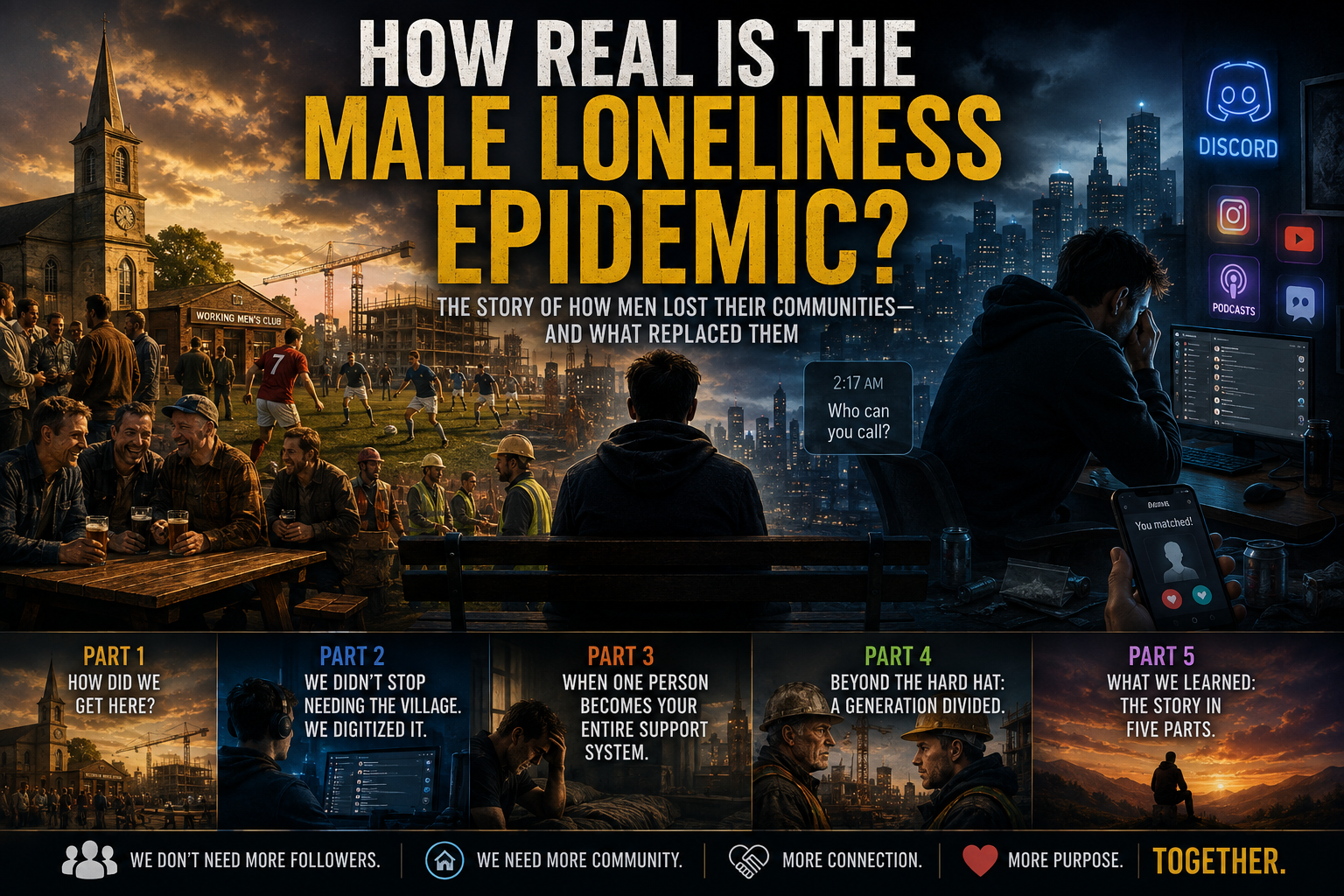
Part 1: From the church hall to the Discord server
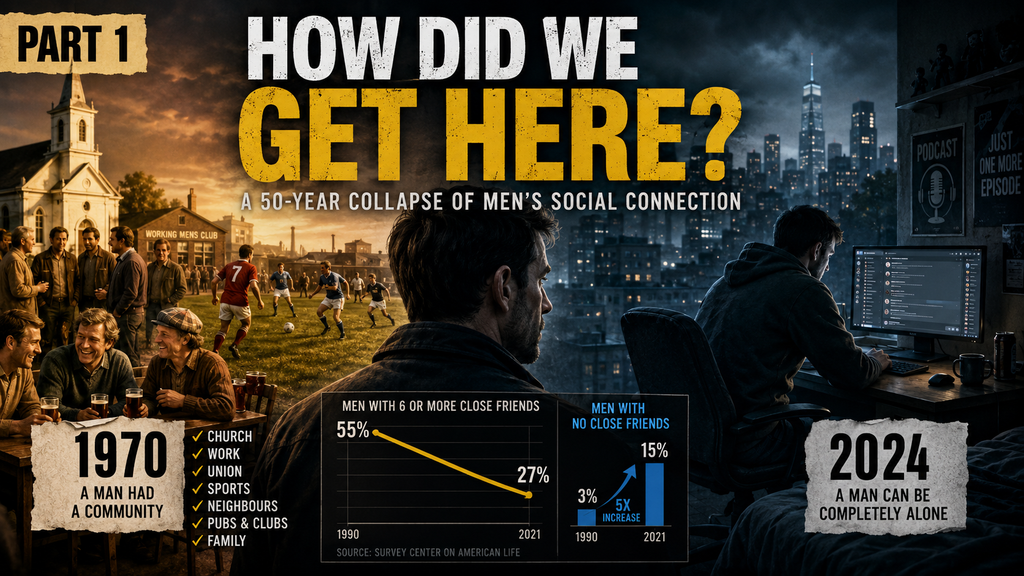
For much of the twentieth century, social connection was frequently institutionalized.
You didn’t necessarily wake up thinking, “I need to make some friends today.”
You went somewhere.
Church on Sunday. The union hall. The pub. The bowling league. The football club. The veterans’ organization. The neighbourhood association. The workplace canteen.
Researchers sometimes describe these environments as “third places”—places outside home and work where people repeatedly encounter one another. Academic research explicitly includes religious organizations, civic associations, libraries, bars, cafés, gyms and community centres in this category.
That repetition matters.
You might see Dave every Sunday for three years before Dave becomes your friend.
The institution does the awkward introductory work for you.
And churches provided something especially powerful: scheduled belonging.
You didn’t have to organize it. Sunday came around automatically. There were services, men’s groups, volunteering, dinners, charity work, youth activities, committees, weddings, funerals and community events.
Someone might notice when you hadn’t shown up for three weeks.
That’s very different from simply having someone’s phone number.
Then the internet begins rebuilding some of this
Interestingly, people recognized this possibility surprisingly early.
In 2001, Pew was already describing online communities as potential “virtual third places.” Its research found online groups generating new relationships and connecting people across age, economic and ethnic boundaries. Pew also noted something important: some online communities became particularly vibrant when their members eventually met face-to-face.
Fast-forward twenty-five years and you can see the idea everywhere.
A Discord server can resemble a bizarre digital combination of:
pub + clubhouse + church hall + hobby club + group chat.
People aren’t necessarily there because they’re lonely.
They’re there because they all like Liverpool.
Or Warhammer.
Or cars.
Or a particular YouTuber.
Or coding.
Or bodybuilding.
Or obscure military history.
But underneath the stated interest, something else can develop:
community.
A guy joins because he wants to discuss football.
Six months later he’s talking about losing his job.
Someone else is getting divorced.
Someone’s father dies.
Someone gets married.
Eventually five of them are sitting in voice chat at midnight talking about their lives.
The football server has accidentally become a support network.
That is remarkably similar to the way traditional institutions created friendships as a by-product of doing something else.
Discord can reproduce something podcasts can’t
This distinction is important.
Discord is potentially reciprocal.
You speak. Someone answers.
People recognize your username. They remember yesterday’s conversation. You acquire a reputation. You become part of the group.
In sociological terms, that makes online communities potentially capable of producing at least some of the associational activity traditionally associated with physical third places. Researchers have been debating for decades whether virtual spaces can supplement brick-and-mortar third places, although the evidence doesn’t justify treating the two as completely interchangeable.
And Discord has another enormous advantage over traditional organizations:
geography disappears.
Imagine you’re a 19-year-old guy in a small town who’s obsessed with restoring 1980s Japanese cars.
In 1970, there might have been nobody within twenty miles who shared that obsession.
Today there could be 40,000 of them in one server.
For people with niche interests—or people who feel uncomfortable in conventional social environments—that can be genuinely valuable.
Podcasts fill a different part of the void
Podcasts are arguably even more psychologically interesting.
Put headphones on and listen to the same two or three people talk for three hours every week.
After 200 episodes, you’ve potentially heard them discuss:
their relationships,
their childhoods,
their failures,
their politics,
their fears,
their embarrassing stories,
their friends,
their families.
Your brain possesses an enormous amount of social information about these people.
They possess none about you.
That’s a parasocial relationship: a one-sided sense of familiarity or intimacy with a media personality.
Research on podcasts specifically finds that the conversational format, repeated exposure, voice continuity and host self-disclosure can foster feelings of psychological closeness. A 2026 review of 13 empirical studies found recurring links between podcast parasocial relationships and trust, engagement and emotional involvement, while cautioning that much of the evidence is correlational rather than causal.
The American Psychological Association describes the basic mechanism similarly: repeated exposure and personal disclosure can create a feeling that you know the media personality almost as you would know someone personally, despite the relationship being one-sided.
And that helps explain something culturally significant.
The podcast host can become a sort of digital companion.
You’re commuting alone.
They’re talking.
You’re cooking alone.
They’re talking.
You’re at the gym alone.
They’re talking.
You’re working from home.
They’re talking.
You’re driving six hours across the country.
They’re still talking.
Silence—which once might have signalled solitude—is replaced with human conversation.
Except you’re not actually participating in it.
That’s where the comparison with church gets fascinating
I’m not suggesting podcasts are literally replacing religion. The theological, moral and ritual functions of religion are obviously much broader.
But socially, there are some interesting parallels.
A traditional congregation offers:
Regularity — Sunday at 10.
Familiar voices — priest, pastor, congregation.
Shared worldview — broadly common beliefs.
Ritual — familiar recurring activities.
Community identity — we belong here.
Interpretation — someone helps make sense of events.
Social network — relationships with other members.
A podcast can reproduce some of those functions:
Regularity — new episode every Tuesday.
Familiar voices — the same hosts.
Shared worldview — politics, comedy, sport, masculinity, technology, etc.
Ritual — listening during the commute/gym/work.
Community identity — I’m one of these people.
Interpretation — the host explains what happened this week.
But there is one enormous difference.
The congregation can know you exist.
The podcast host usually cannot.
That distinction could become a central theme of the report.
Discord + podcast is more powerful than either alone
This is where modern online communities become particularly interesting.
Suppose someone listens to a podcast.
Then joins its Discord.
Now the ecosystem provides both halves:
Podcast → parasocial relationship with the host
Discord → reciprocal relationships with the audience
Suddenly you have something resembling an institution.
There are regular gatherings.
Inside jokes.
Status hierarchies.
Moderators.
Norms.
Shared language.
Arguments.
Friendships.
People leaving.
New people arriving.
Meetups.
Sometimes charitable fundraising.
And frequently a charismatic personality around whom the whole community originally formed.
That’s no longer simply content consumption.
It’s associational life.
But there’s a crucial difference: friction
The old institutions demanded something of you.
To attend church:
Get dressed → leave house → travel → enter room → talk to people → remain there.
Discord:
click.
Podcast:
play.
That reduction in friction is simultaneously their greatest strength and potentially their greatest weakness.
Someone experiencing social anxiety can enter a Discord server without enduring the enormous psychological hurdle of walking alone into a pub or community group.
That’s valuable.
But they can also leave instantly.
They can lurk without speaking.
Mute everyone.
Change username.
Join another server.
Listen to a podcast without interacting with another human being for the entire day.
Physical institutions often force weak social interaction upon us.
The old man says hello.
Someone asks where you’ve been.
The bartender recognizes you.
The church volunteer asks you to move some chairs.
Someone introduces you to their brother.
These interactions seem trivial.
Collectively, they’re social infrastructure.
And this changes our loneliness hypothesis
The report could distinguish between three layers of connection:
1. Parasocial connection
Podcast / YouTube / livestream
“I know these people.”
But they don’t know you.
2. Digital reciprocal connection
Discord / gaming / group chats / forums
“These people know me.”
That’s potentially genuine friendship.
3. Embodied community
Church / pub / club / workplace / sports team / neighbourhood
“These people know me—and physically expect me to be somewhere.”
That final distinction may be particularly important.
A Discord friend can absolutely be a real friend. We shouldn’t fall into the lazy assumption that online relationships are fake.
But physical communities often generate something digital communities struggle to reproduce:
obligation.
Someone needs a lift.
Someone needs help moving.
Your teammate needs you Saturday morning.
The church needs volunteers.
Your friend is sick, so you bring food.
You aren’t merely exchanging messages.
Other human beings require your presence.
And being needed may be an underappreciated component of belonging.
That gives the report a much more nuanced conclusion
Instead of:
“The internet destroyed male friendship.”
Our argument becomes:
As the institutions that once automatically placed men into recurring communities weakened, digital culture moved into the empty space.
And it succeeded—partially.
Discord can provide community.
Gaming can produce genuine friendships.
Podcasts can provide companionship and psychological familiarity.
Online groups can connect an isolated man with people he never could have met in his physical environment.
But they don’t necessarily reproduce all the functions of the church, union, pub, sports club or neighbourhood.
And sometimes they may provide just enough sensation of social contact to make isolation tolerable without actually ending it.
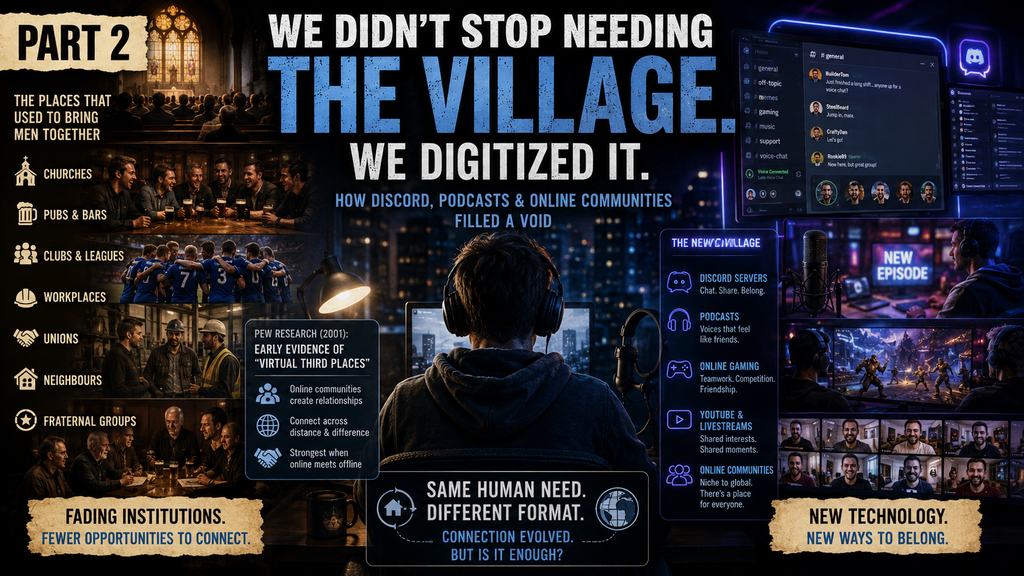
PART 2 — WE DIDN’T STOP NEEDING THE VILLAGE. WE DIGITIZED IT.
In Part One, we looked at something that has been happening for decades.
The places where men traditionally formed relationships began to weaken.
Churches.
Unions.
Social clubs.
Sports leagues.
Local pubs.
Community organizations.
Even the workplace itself.
For generations, these institutions did something we rarely talk about.
They made friendship almost automatic.
You didn’t necessarily go to church because you needed friends.
You went to church.
And eventually, you made friends.
You didn’t join a bowling league because you were suffering from social isolation.
You wanted to bowl.
But every Wednesday night, you saw the same twelve guys.
Eventually, you knew their wives.
Their kids.
Their problems.
Their jokes.
And if you suddenly disappeared?
Somebody noticed.
THEN SOMETHING INTERESTING HAPPENED.
Those institutions weakened.
But our need for them didn’t.
So we started building replacements.
Except this time…
they weren’t buildings.
They were servers.
Forums.
YouTube channels.
Podcasts.
Livestreams.
Online games.
And eventually…
Discord.
Think about what a Discord server actually is.
Thousands of people voluntarily gather in the same digital location because they share an interest.
Football.
Gaming.
Cars.
Politics.
History.
Fitness.
A YouTuber.
It doesn’t really matter.
Because after you’ve been there long enough, the original subject sometimes becomes almost secondary.
You joined because you wanted to talk about Liverpool.
Six months later, you’re talking about losing your job.
Someone else is getting divorced.
Another guy’s becoming a father.
Someone’s dad just died.
And suddenly…
the football server isn’t really about football anymore.
It’s a community.
THE DIGITAL PUB
This is where dismissing online friendship as “not real” becomes a mistake.
Two people who meet through gaming can become genuine friends.
Someone living in a tiny town can find people who share an obscure interest that nobody around him understands.
Someone who’s socially anxious can enter a Discord voice chat far more easily than he can walk alone into a crowded pub.
Geography almost disappears.
In 1970, if you were obsessed with some incredibly niche hobby and nobody in your town cared about it…
too bad.
Today?
There’s probably a Discord server with 30,000 people arguing about it.
And that’s extraordinary.
The internet solved a problem that physical communities never could.
It allowed us to find our people, regardless of where they lived.
But it created another problem.
Because there’s a major difference between someone existing on your screen…
and someone expecting you to show up.
THE PODCAST FRIEND
Then there’s something even stranger.
The podcast.
Think about your favourite podcast host.
Maybe you’ve listened to them for hundreds of hours.
You’ve heard about their childhood.
Their relationships.
Their failures.
Their embarrassing stories.
Their political opinions.
Their family.
Their fears.
You’ve heard them laugh.
You’ve heard them angry.
Maybe you’ve even heard them cry.
After 500 hours…
you feel like you know this person.
There’s only one problem.
They have absolutely no idea who you are.
Psychologists call this a parasocial relationship.
And podcasts may be particularly good at creating them.
Because unlike a two-minute television appearance, you’re spending hours listening to the same people have what sounds like an ordinary conversation.
Put your headphones on…
and suddenly you’re sitting at the table with them.
You’re driving alone?
They’re there.
Working alone?
They’re there.
Cooking dinner?
They’re there.
At the gym?
They’re there.
Three-hour motorway journey?
They’re there.
The podcast has accomplished something remarkable.
It can make solitude feel less solitary.
But there’s a catch.
You’re hearing a conversation.
You’re not participating in one.
FROM THE SERMON TO THE PODCAST
And this is where the comparison becomes uncomfortable.
Not because podcasts have replaced religion.
They haven’t.
But look purely at the social structure.
A church gives you a familiar voice every Sunday.
A podcast gives you a familiar voice every Tuesday.
A church has recurring rituals.
So does your favourite show.
A church creates a shared identity.
Podcast audiences do too.
A church offers interpretations of what’s happening in the world.
So do podcast hosts.
A church has familiar stories, language and inside references.
So does an online community.
But there’s one enormous difference.
The congregation can know you exist.
The podcast host usually can’t.
And that difference matters.
DISCORD COMPLETES THE CIRCUIT
But now something fascinating happens.
The podcast creates a Discord.
You listen to the hosts.
Then you join their community.
Suddenly you’ve got both halves.
The podcast provides the familiar personalities.
The Discord provides the congregation.
People recognize your username.
There are regulars.
Newcomers.
Moderators.
Arguments.
Inside jokes.
Status.
Rules.
Shared language.
People disappear.
People return.
Friendships form.
Some eventually meet in real life.
Look at that closely enough…
and we’ve basically reinvented the social institution.
Just without the building.
BUT THERE’S SOMETHING THE INTERNET REMOVED.
Friction.
Going to church requires effort.
Getting dressed.
Leaving the house.
Driving somewhere.
Walking through the door.
Talking to somebody.
Joining a football team means committing to Saturday morning.
Going to the pub means physically sitting beside strangers.
Discord?
Click.
Podcast?
Play.
And removing that friction has enormous benefits.
A lonely 19-year-old can enter a community tonight without leaving his bedroom.
But there’s another side to it.
He can also leave without anybody noticing.
Mute the server.
Close the tab.
Change his username.
Join another community.
Or never speak at all.
He can spend six hours listening to human voices…
without another human being hearing his.
THE POWER OF BEING EXPECTED
The old institutions contained something we’ve possibly underestimated.
Obligation.
Your football team needs eleven players.
The church needs somebody to stack the chairs.
Your friend needs help moving house.
The pub quiz needs its fourth player.
Your neighbour needs somebody to look after his dog.
Those obligations can occasionally be annoying.
But they communicate something psychologically powerful.
Somebody needs you to show up.
And when you don’t…
someone notices.
That might be one of the fundamental differences between having an audience, having an online community…
and actually being embedded in somebody else’s life.
THREE LEVELS OF CONNECTION
Maybe modern connection exists on three levels.
Level One: Parasocial connection.
“I know them.”
YouTube.
Podcasts.
Livestreams.
They make you feel less alone.
But they don’t know you.
Level Two: Digital friendship.
“They know me.”
Discord.
Gaming.
Group chats.
Forums.
These relationships can be completely genuine.
But there’s another level.
Level Three: Embodied community.
“They know me…
and they expect me to be somewhere.”
Church.
Football.
The pub.
Work.
The neighbourhood.
The club.
Now your absence has consequences.
And maybe that’s the part of the loneliness conversation we’ve been missing.
We keep asking whether technology connects us…
or isolates us.
Maybe the answer is:
both.
The internet didn’t destroy our desire for community.
If anything, Discord servers, podcasts, livestreams and online communities prove how desperately we still want it.
We didn’t stop needing the village.
We digitized it.
And in some ways…
the digital village is incredible.
It’s bigger.
More accessible.
More diverse.
And capable of connecting people who would never have found each other before.
But perhaps the real question isn’t whether the digital village is real.
It is.
The question is…
did we successfully digitize everything that made the old village work?
Because you can have thousands of followers.
Hundreds of Discord friends.
Ten podcasts you listen to every week.
And still find yourself wondering…
who would actually notice if I didn’t show up tomorrow?
And that takes us to Part Three.
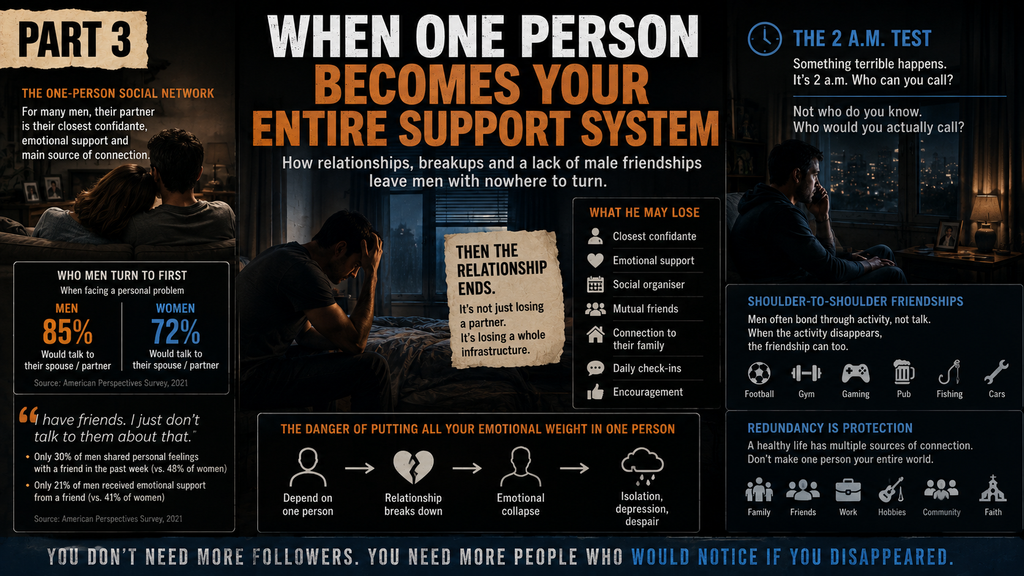
PART 3 — WHEN ONE PERSON BECOMES YOUR ENTIRE SUPPORT SYSTEM
So far, we’ve talked about the disappearance of places.
Churches.
Clubs.
Unions.
Neighbourhood groups.
And we’ve talked about the digital communities that have partially replaced them.
But there’s another piece of the male loneliness story.
And this one is much more personal.
Because for many men, the most important relationship in their life isn’t a friend.
It isn’t a brother.
It isn’t somebody from work.
It’s their partner.
Their wife.
Their girlfriend.
And there’s nothing inherently wrong with that.
Your partner probably should be one of the closest people in your life.
The problem begins when she becomes…
the only one.
THE ONE-PERSON SOCIAL NETWORK
Imagine a guy in his thirties.
He’s got people around him.
Colleagues.
Old school friends.
A couple of guys he games with.
Maybe a football group chat.
So technically…
he has friends.
But something goes wrong.
He loses his job.
His father gets sick.
He’s struggling financially.
He’s terrified about the future.
Who does he actually tell?
For many men, the answer is:
his partner.
And we can see this in the data.
A 2021 American Perspectives Survey found that among married Americans, 85% of men said their spouse would be the first person they talked to when facing a personal problem.
For married women, it was 72%.
That difference matters.
Because it suggests that men’s emotional lives may be more heavily concentrated in their romantic relationships.
And that creates vulnerability.
“I HAVE FRIENDS. I JUST DON’T TALK TO THEM ABOUT THAT.”
This may be one of the strangest contradictions in male friendship.
A man can have friends he’s known for twenty years…
and still know almost nothing about what’s happening inside their heads.
They know each other’s football teams.
They know each other’s jobs.
They know who bought a ridiculous car.
They know who still owes somebody twenty quid from 2017.
But ask:
“When was the last time you told him you were scared?”
And suddenly things get uncomfortable.
In the same 2021 friendship research, only 30% of men said they’d shared personal feelings with a friend during the previous week.
For women?
48%.
And only 21% of men said they’d received emotional support from a friend during that week.
For women?
41%.
That’s nearly double.
So perhaps some men aren’t completely friendless.
They have something different.
Friendships with limited emotional bandwidth.
THE SHOULDER-TO-SHOULDER FRIENDSHIP
And this is where male friendship gets misunderstood.
Men often bond incredibly well.
But frequently through activity.
Watching football.
Gaming.
Fishing.
Working on a car.
Going to the gym.
Playing golf.
Building something.
Going to the pub.
The activity creates the reason to be together.
You’re not sitting opposite each other saying:
“Right, Dave. Let’s discuss our emotional wellbeing.”
You’re doing something.
And somewhere between complaining about the referee and ordering another drink…
something personal might slip out.
This is sometimes described as men socializing shoulder-to-shoulder rather than face-to-face.
And there’s nothing necessarily inferior about that.
In fact, it can be incredibly effective.
But remember what we discussed in Part One.
What happens when the places where those activities occurred begin disappearing?
No bowling league.
No church group.
No union hall.
Less time at the pub.
More remote work.
More entertainment at home.
Suddenly the activity disappears.
And because the activity was holding the friendship together…
sometimes the friendship disappears with it.
THEN HE MEETS SOMEONE
And something interesting happens.
He gets a girlfriend.
For perhaps the first time in years, somebody asks:
“How was your day?”
And actually wants the long answer.
She knows when he’s stressed.
She knows what’s happening with his family.
She knows what he’s afraid of.
She remembers his doctor’s appointment.
She knows when something is wrong before he says anything.
And suddenly…
he has emotional infrastructure again.
Except now almost all of it may be concentrated in one person.
His partner becomes:
best friend,
confidante,
emotional support,
social organizer,
and sometimes even the connection between him and the wider world.
Who remembers birthdays?
Who organizes dinner with friends?
Who keeps in touch with other couples?
Who notices that nobody has seen Steve for six months?
In some heterosexual relationships, researchers have long observed women doing disproportionate amounts of what’s sometimes called kin-keeping—maintaining family and social relationships.
So the man’s social network may appear perfectly healthy.
But part of it may actually be running through his partner.
THEN THE RELATIONSHIP ENDS.
Now remove her.
Not only has he lost the person he loved.
He may have lost:
his closest confidante,
his primary emotional support,
some mutual friends,
his social calendar,
perhaps connections with her family,
and the person who encouraged him to maintain other relationships.
That’s not one loss.
That’s an infrastructure collapse.
And suddenly the difference between:
“I have mates”
and
“I have people I can call”
becomes painfully obvious.
THE 2 A.M. TEST
Here’s a simple question.
Forget followers.
Forget contacts.
Forget how many people are in your group chat.
Forget how many people liked your last post.
Your relationship just ended.
It’s two o’clock in the morning.
You’re sitting alone.
You’re devastated.
Who can you call?
Not:
“Who do you know?”
Who can you call?
And more importantly…
would you actually call them?
Those are two very different questions.
A man might have fifteen people who would happily answer.
But if he’s spent twenty years believing that admitting distress makes him a burden…
he may never dial the number.
THIS IS WHERE MASCULINITY ENTERS THE STORY
This conversation often becomes simplistic very quickly.
“Men need to open up.”
Okay.
But open up where?
To whom?
And under what circumstances?
If we’ve simultaneously weakened the institutions that repeatedly put men together…
then telling men to “talk more” only addresses half the problem.
You need somebody to talk to.
You need relationships strong enough to survive uncomfortable conversations.
And those relationships usually require time.
Repeated contact.
Shared experiences.
Trust.
History.
In other words…
infrastructure.
THE BREAKUP DOESN’T CREATE EVERY PROBLEM.
Sometimes it reveals one.
This distinction is important.
A man goes through a divorce and suddenly appears completely isolated.
We might assume:
“The divorce made him lonely.”
Sometimes it did.
But sometimes the relationship had been concealing how socially isolated he already was.
His wife wasn’t one person in a large support network.
She was the support network.
And when she disappeared…
there was nothing underneath.
NOW RETURN TO THE DIGITAL WORLD
And this connects directly to Part Two.
Where does he go?
Maybe Discord.
Maybe gaming.
Maybe Reddit.
Maybe YouTube.
Maybe a podcast.
And suddenly a guy he’s never met in another country is listening to him at midnight…
while the friend who lives fifteen minutes away has absolutely no idea anything is wrong.
That’s simultaneously beautiful…
and incredibly strange.
The internet can provide the emergency bridge.
Sometimes online friendships become lifelong friendships.
But again we return to the same question:
Who is physically in your life?
Who knocks on your door?
Who drags you outside?
Who notices you haven’t eaten?
Who makes you come to football even when you don’t feel like going?
Who looks at you and immediately says:
“Mate…you don’t look right.”
A screen can do many things.
But sometimes you need somebody in the room.
SO MAYBE THE REAL PROBLEM ISN’T THAT MEN DON’T HAVE FRIENDS.
Maybe it’s that some men have built a social structure with no redundancy.
One romantic relationship.
A handful of activity-based friendships.
Some colleagues.
A Discord server.
A podcast.
Everything works…
until one major pillar disappears.
Lose the relationship.
Lose the job.
Move cities.
Stop playing the sport.
And suddenly the whole structure collapses.
Compare that with the world we discussed earlier.
Family.
Church.
Work.
Neighbourhood.
Union.
Club.
Pub.
Team.
None of those institutions guaranteed happiness.
None guaranteed good friendships.
And we shouldn’t romanticize the past.
But having several independent communities meant something important.
Redundancy.
If one part of your life collapsed…
another part might still be standing.
THE SOLUTION ISN’T “GET A GIRLFRIEND.”
And it isn’t simply:
“Men need to talk about their feelings.”
The deeper question is:
How do you build a life in which no single person has to carry the entire weight of your emotional existence?
Maybe that means calling an old friend.
Joining a football club.
Going back to church.
Volunteering.
Finding a men’s group.
Joining a hobby club.
Turning Discord friends into real-world friendships where possible.
Actually telling your mate when things aren’t going well.
Not because every friendship needs to become a therapy session.
But because friendship has to be capable of surviving the sentence:
“Mate, I’m actually struggling.”
Because perhaps the healthiest social network isn’t the one with the most people.
It’s the one where losing one person doesn’t mean…
losing everyone.
And that brings us to an even darker question.
What happens to the men who don’t have the girlfriend…
don’t have the close friends…
don’t have the church…
don’t have the club…
and increasingly feel as though nobody needs them at all?
Because loneliness isn’t always just about being alone.
Sometimes it’s about something much more dangerous:
the feeling that your absence wouldn’t matter.
And that’s where Part Four begins.
PART 4 — THE MEN WHO BUILD BRITAIN
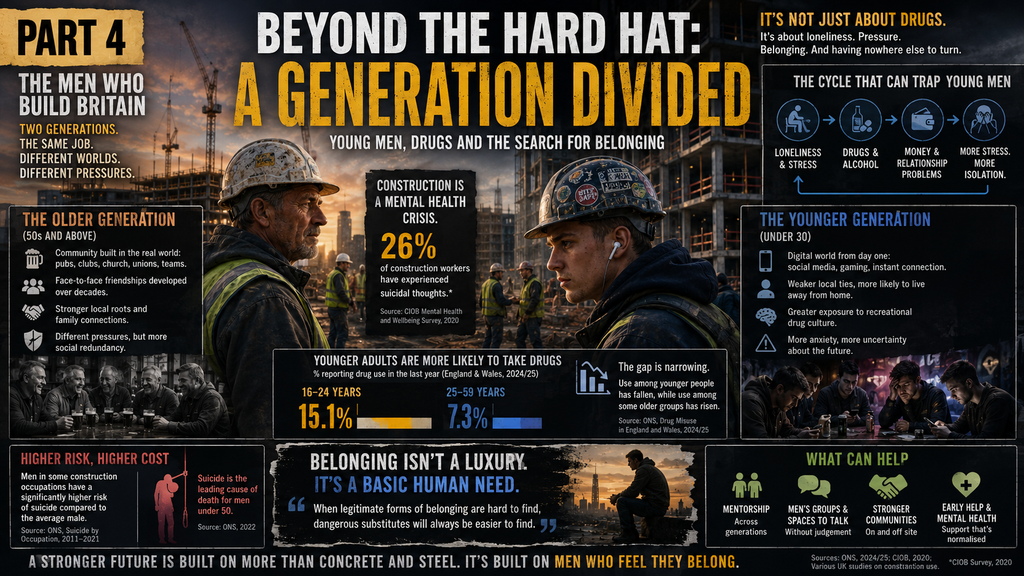
There’s one workplace where almost everything we’ve been talking about collides.
Masculinity.
Loneliness.
Mental health.
Alcohol.
Drugs.
Economic pressure.
And the enormous difference between one generation of men…
and the next.
The British construction site.
Walk onto a building site in Britain and you can sometimes see two generations working beside each other.
The older tradesman.
Maybe he’s in his fifties.
He’s been doing this for thirty years.
He learned from another bloke who’d been doing it for thirty years before him.
Then beside him is the apprentice.
Nineteen.
Twenty-one.
Twenty-four.
They might be doing exactly the same job.
But socially?
They may come from completely different worlds.
THE OLD SOCIAL WORLD
Think about the older construction worker.
He grew up before Discord.
Before smartphones.
Before social media.
Before dating apps.
Possibly before the internet entered his home.
If he wanted company…
he had to physically go somewhere.
The pub.
The football club.
The working men’s club.
Church.
The social club.
The union.
A mate’s house.
And construction itself could provide another community.
You worked beside other men.
You learned from older tradesmen.
You ate together.
You took the piss out of each other.
You went to the pub after work.
Sometimes the culture was brutal.
Sometimes the banter crossed the line.
And we absolutely should not romanticize it.
But there was one thing it provided almost automatically:
other men.
NOW LOOK AT THE 20-YEAR-OLD APPRENTICE.
He may work beside those same men during the day.
But when the shift finishes…
his social universe can be completely different.
Phone out.
Headphones in.
TikTok.
Instagram.
YouTube.
Discord.
Gaming.
Dating apps.
WhatsApp.
Podcasts.
Maybe he goes home to a house share.
Maybe his parents.
Maybe a rented room near a job hundreds of miles from home.
And here we arrive at another issue.
Recreational drugs.
THE AGE DIVIDE IS REAL — BUT IT’S COMPLICATED
Across England and Wales generally, younger adults remain considerably more likely to report taking illegal drugs than older adults.
Recent Crime Survey data found roughly 15% of 16-to-24-year-olds reported taking a drug during the previous year.
Among adults aged 25 to 59?
About 7%.
Roughly half the rate.
But here’s something important.
That difference has actually been narrowing over time.
Drug use among some younger groups has fallen from previous peaks, while use among some older groups has increased.
So this isn’t as simple as:
“Young people take drugs. Older people don’t.”
They do.
But younger adults are still disproportionately exposed to a recreational-drug culture that looks very different from the one many older construction workers entered decades ago.
And construction gives us an especially interesting environment in which to examine it.
FRIDAY NIGHT USED TO MEAN THE PUB.
And for plenty of construction workers…
it still does.
Alcohol has historically been deeply embedded in parts of British working-class social culture.
Finish the job.
Get paid.
Go to the pub.
Have six pints.
Do something stupid.
Come back Monday.
That culture caused enormous problems of its own.
Alcoholism didn’t suddenly become harmless because it belonged to an older generation.
But today’s recreational landscape contains more options.
Cocaine.
Cannabis.
Ketamine.
MDMA.
Pills.
And increasingly combinations of substances.
Alcohol hasn’t necessarily disappeared.
Sometimes the drugs have simply been added on top of it.
And that distinction matters.
BECAUSE THE DRUG ISN’T ALWAYS THE ORIGINAL PROBLEM.
Imagine the young worker living away from home.
He’s doing ten-hour shifts.
He’s exhausted.
His relationship is falling apart.
He’s worried about money.
He doesn’t know many people locally.
The lads are going out Friday.
So he goes.
Drinking turns into cocaine.
Cocaine keeps the night going.
Then Saturday disappears.
Sunday becomes recovery.
Monday he’s back on site.
And nobody asks:
“Why are you doing this?”
Because everybody thinks they’re just having a laugh.
Until they’re not.
CONSTRUCTION HAS A MENTAL-HEALTH PROBLEM WE CAN’T IGNORE.
This is where the story becomes much more serious.
Construction has repeatedly appeared in British occupational suicide research as an area of concern.
Men working in some construction occupations have experienced substantially elevated suicide risk compared with the male population generally.
And research into the industry repeatedly points toward combinations of:
financial pressure,
job insecurity,
working away from home,
relationship problems,
long hours,
workplace stress,
alcohol,
drugs,
and difficulty asking for help.
Look at those factors again.
Because they aren’t independent.
They can feed each other.
Loneliness leads to drinking.
Drinking leads to financial problems.
Financial problems create stress.
Stress damages the relationship.
The relationship collapses.
The loneliness gets worse.
Then something that began as:
“Few lines with the lads on Friday”
can become something very different.
AND THIS IS WHERE THE GENERATIONAL DIVIDE GETS INTERESTING.
The older tradesman might look at the apprentice and say:
“Your generation can’t cope with anything.”
The apprentice looks back and thinks:
“You lot drank yourselves stupid every weekend.”
And perhaps…
they’re both seeing part of the truth.
Older generations had substance problems.
Alcohol absolutely destroyed lives.
So did drugs.
So did gambling.
So did violence.
The past wasn’t some golden age of emotionally healthy builders discussing their feelings over tea.
But younger workers are entering adulthood in a different environment.
Housing is different.
Relationships are different.
Dating is different.
Community is different.
Technology is different.
And recreational drug availability and culture are different.
So the substances may change…
while the underlying human need remains remarkably familiar.
Escape.
THE QUESTION ISN’T JUST “WHY ARE THEY TAKING DRUGS?”
Ask another question.
What happens before the drug?
Boredom?
Loneliness?
Stress?
A breakup?
Wanting to fit in?
Working away from home?
Wanting to keep the night going?
Wanting to feel confident?
Wanting to stop thinking?
Because recreational drug use can sometimes look like the problem from the outside…
while functioning as the attempted solution from the inside.
A terrible solution.
But a solution to something.
And unless we understand what that something is…
telling someone simply to stop may not fix what drove them there.
THE APPRENTICE HAS ANOTHER PROBLEM.
He’s entering one of Britain’s most traditionally masculine industries…
at exactly the age when many men are trying desperately to prove they belong.
Imagine being nineteen.
You’re surrounded by men who’ve been doing the job longer than you’ve been alive.
You don’t want to look weak.
You don’t want to complain.
You don’t want to be the boring one.
You don’t want to be the bloke who can’t handle the banter.
And you definitely don’t want everyone thinking:
“The kid can’t hack it.”
So what happens when you’re struggling?
Maybe you don’t tell anybody.
You perform competence instead.
“I’m fine.”
“I’m fine.”
“I’m fine.”
Friday arrives.
Everyone goes out.
And suddenly the one socially acceptable way to stop being fine…
is getting absolutely smashed.
THAT’S WHY THIS ISN’T REALLY A STORY ABOUT DRUGS.
It’s a story about belonging.
Remember what we said in Part Three?
Men need redundancy.
Multiple relationships.
Multiple communities.
Multiple places where somebody knows them.
Now imagine a young construction worker who has none of that.
No church.
No club.
No local football team.
No wife.
No kids.
Family two hundred miles away.
His closest friends exist mainly on WhatsApp.
And the strongest physical community available to him is…
the lads on site.
If that group’s social ritual is drinking…
he drinks.
If it’s cocaine…
maybe cocaine becomes part of belonging.
Because saying no doesn’t merely mean refusing a substance.
Sometimes it feels like refusing the group.
NOW LOOK AT THE OLDER BLOKE AGAIN.
Maybe he’s fifty-eight.
He’s got a wife.
Adult children.
Grandchildren.
A mortgage that’s nearly paid.
He’s known the same mates for thirty years.
Maybe he still sees somebody from school.
Maybe he goes to church.
Maybe he’s in a golf club.
Maybe everybody knows him at the local.
Maybe none of those things apply.
But if they do…
notice what he possesses.
Roots.
The apprentice may have connectivity.
The older tradesman may have continuity.
Those aren’t the same thing.
One has 600 people on Instagram.
The other has six people who’ve known him since 1994.
Which network is stronger when something goes seriously wrong?
That’s the question.
Not the assumption.
BECAUSE AGE ALONE DOESN’T PROTECT YOU.
This needs saying.
Older construction workers struggle too.
Older men drink.
Older men take drugs.
Older men divorce.
Older men become isolated.
Older men experience financial disaster.
And Britain’s construction mental-health crisis isn’t confined to apprentices.
So we shouldn’t turn this into:
OLD MEN GOOD. YOUNG MEN BROKEN.
That would completely miss the point.
The more interesting possibility is that different generations developed different coping mechanisms inside different social environments.
One generation might have had:
pub,
church,
union,
wife,
football club,
workmates.
Another might have:
WhatsApp,
Discord,
gym,
cocaine,
podcast,
workmates.
Some of those are healthy.
Some aren’t.
Some are genuine communities.
Some merely imitate one.
AND CONSTRUCTION MAKES THE EXPERIMENT VISIBLE.
Because the two generations are standing beside each other.
Same building.
Same weather.
Same industry.
Same physical work.
Different social worlds.
The fifty-five-year-old bricklayer and the twenty-year-old apprentice might spend eight hours working three metres apart…
then go home to completely different versions of Britain.
And maybe that’s where we should stop asking:
“What’s wrong with young men?”
And start asking:
“What changed around young men?”
Because perhaps the apprentice isn’t fundamentally different from the man who started on that site in 1985.
Maybe he still wants exactly what that man wanted.
Money.
Respect.
A partner.
A few good mates.
A place to belong.
Somebody who needs him.
A reason to get up tomorrow.
The difference is that the institutions surrounding him have changed.
And when legitimate forms of belonging become harder to find…
human beings don’t stop searching for belonging.
They find substitutes.
Sometimes it’s Discord.
Sometimes it’s the gym.
Sometimes it’s football.
Sometimes it’s a podcast.
Sometimes it’s church.
Sometimes it’s the lads at work.
And sometimes…
it’s the Friday-night bag.
Which brings us back to the question underneath this entire series:
What happens to men when the structures that once gave them belonging disappear faster than we can build healthy replacements?
Because perhaps the real male loneliness epidemic isn’t simply a shortage of friends.
It’s a shortage of places where men can say:
“These are my people.
And they would notice if I disappeared.”
PART 5 — SO, ARE MEN REALLY LONELIER?
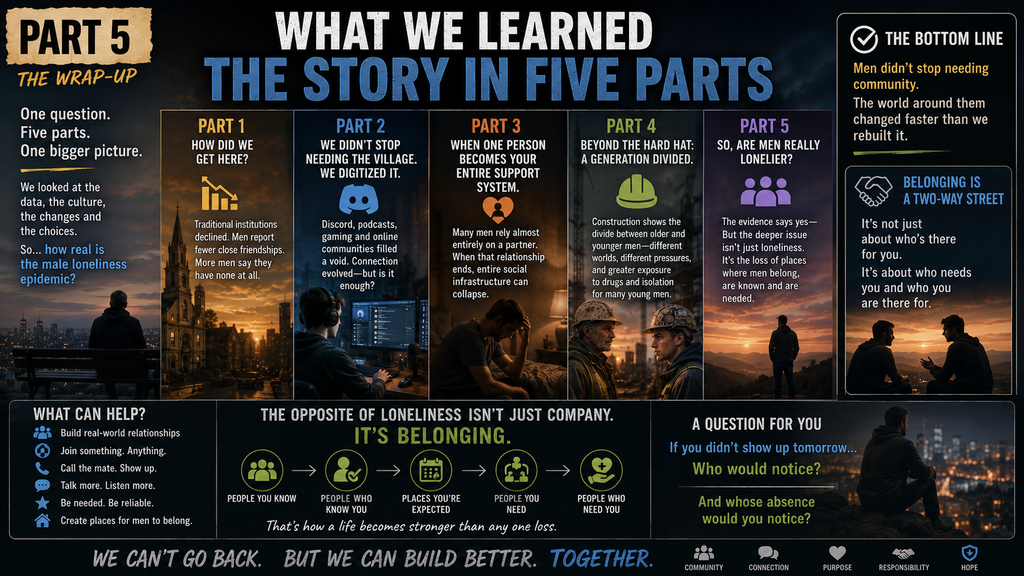
We’ve covered a lot.
Friendship.
Marriage.
Church.
Work.
The pub.
Discord.
Podcasts.
Relationships.
Construction sites.
Alcohol.
Drugs.
And underneath all of it has been one question:
Are men actually becoming lonelier?
The statistics suggest that something significant has changed.
But perhaps we’ve been asking the wrong question.
Because maybe the story isn’t simply that men became worse at making friends.
Maybe…
the world around them changed.
GO BACK TO 1970.
Imagine the social world surrounding a man fifty years ago.
Work.
Family.
Church.
Neighbourhood.
Union.
Pub.
Sports club.
Social club.
Friends.
Again, we shouldn’t romanticize this world.
Plenty of men were desperately lonely.
Alcoholism existed.
Domestic violence existed.
Depression existed.
Suicide existed.
Men frequently suffered in complete silence.
And many of those supposedly wonderful communities could be intolerant, exclusionary or downright miserable.
The past wasn’t paradise.
But it did contain something worth paying attention to.
Infrastructure.
There were places where people were repeatedly expected to appear.
And repeated contact is one of the basic ingredients from which relationships grow.
THEN WE STARTED REMOVING THE PLACES.
Church attendance declined.
Union membership declined.
Some clubs disappeared.
Neighbourhood life changed.
Marriage happened later.
Entertainment moved inside the home.
Then onto the computer.
Then onto the phone.
Work changed.
Remote work arrived.
And increasingly…
we stopped having to leave the house to participate in society.
Want food?
Delivery.
Want entertainment?
Netflix.
Want to shop?
Amazon.
Want to speak to your mates?
WhatsApp.
Want to meet someone?
Dating app.
Want community?
Discord.
Want conversation?
Podcast.
Want sex?
Pornography.
Want competition?
Gaming.
Want an argument?
Twitter.
Want absolutely anything?
Pick up the phone.
Technology removed an extraordinary amount of friction from human life.
But perhaps some of that friction was doing something we didn’t understand.
It was forcing us…
into each other’s lives.
WE DIDN’T STOP NEEDING THE VILLAGE.
We digitized it.
And as we saw in Part Two…
that isn’t entirely a bad thing.
The internet has created communities that could never have existed before.
A lonely teenager in a tiny town can find thousands of people who understand his obscure hobby.
A man struggling at midnight can speak to someone on the other side of the planet.
Gaming friendships can become real friendships.
Discord communities can become genuine support networks.
And podcasts can make an otherwise silent room feel inhabited.
The digital village is real.
But we asked an uncomfortable question:
Did we successfully digitize everything that made the old village work?
BECAUSE THERE’S A DIFFERENCE BETWEEN BEING CONNECTED…
AND BEING NEEDED.
A podcast host can keep you company.
But they don’t know you’re listening.
A Discord server can know your username.
But nobody necessarily knows whether you’ve eaten today.
Instagram can tell 800 people it’s your birthday.
But that doesn’t necessarily mean there’s somebody you can call at two in the morning.
And that’s where we reached Part Three.
THE ONE-PERSON SUPPORT SYSTEM.
For many men, their deepest emotional relationship isn’t with another man.
It’s their partner.
Their wife.
Their girlfriend.
And again…
that’s not a problem.
Until she’s the only person who knows what’s really going on.
The relationship ends.
And suddenly he hasn’t simply lost a girlfriend.
He’s lost:
his best friend,
his confidante,
his social organizer,
his emotional support,
and perhaps his connection to an entire wider network.
The breakup didn’t necessarily create his isolation.
Sometimes…
it revealed it.
And that’s why we introduced one of the simplest tests in this entire series.
The 2 A.M. test.
Something terrible happens tonight.
Who can you call?
Not:
“How many friends do you have?”
Not:
“How many followers?”
Not:
“How many contacts?”
Who can you actually call…
and say:
“Mate, I’m not okay.”
THEN WE WENT TO THE CONSTRUCTION SITE.
Because there you can sometimes see two versions of Britain standing beside each other.
The older tradesman.
And the apprentice.
Same job.
Same site.
Completely different social worlds.
One grew up before the internet.
The other has never known life without it.
One generation might have built relationships through the pub, church, union, football club and workplace.
The other might build them through WhatsApp, gaming, Discord, the gym and work.
And recreational drugs introduce another layer.
Not because every young construction worker takes drugs.
They obviously don’t.
And not because older generations didn’t have serious problems with alcohol and drugs.
They absolutely did.
But because substances can become another way of answering an ancient human question:
“How do I belong?”
If everyone goes out Friday…
you go.
If everyone drinks…
you drink.
And if drugs become part of that ritual…
saying no can sometimes feel like you’re not merely rejecting the drug.
You’re rejecting the group.
And suddenly a conversation about substance use becomes a conversation about loneliness again.
MAYBE THAT’S THE THREAD CONNECTING EVERYTHING.
Human beings want to belong.
That didn’t disappear in 1970.
It didn’t disappear when church attendance declined.
It didn’t disappear when the social club closed.
It didn’t disappear when the internet arrived.
And it hasn’t disappeared because we’ve got smartphones.
We still want the village.
We just keep trying to build new versions of it.
Sometimes successfully.
Sometimes disastrously.
SO WHAT DO WE ACTUALLY DO?
Maybe the answer isn’t particularly revolutionary.
Maybe we need to rebuild social redundancy.
Don’t make one person your entire world.
Have different people.
Different places.
Different communities.
Call the mate you haven’t spoken to.
Join something.
Football.
Boxing.
Running.
Gaming.
Volunteering.
Church.
A men’s group.
A hobby club.
A community organization.
It almost doesn’t matter what the activity is.
Because remember what we learned earlier:
sometimes friendship works best when you’re not deliberately trying to make friends.
You’re doing something together.
Week after week.
Month after month.
And eventually…
the strangers stop being strangers.
AND MAYBE WE NEED TO RECONSIDER SOMETHING ELSE.
We’ve spent decades optimizing life for convenience.
Faster.
Cheaper.
On demand.
Delivered.
Remote.
Personalized.
Automated.
And much of that has made life genuinely better.
But perhaps human relationships are one of the things that shouldn’t be completely frictionless.
Maybe having to leave the house is good for us.
Maybe having somewhere to be is good for us.
Maybe having somebody waiting for us is good for us.
Maybe even being slightly inconvenienced by other people…
is part of what being connected to other people actually means.
BECAUSE COMMUNITY ISN’T JUST SOMETHING YOU RECEIVE.
This might be the most important point.
We talk about loneliness as though the lonely person is waiting for society to provide something.
Friends.
Support.
Attention.
Community.
But belonging works in both directions.
It’s not only:
“Who is there for me?”
It’s also:
“Who am I there for?”
Who are you helping?
Who depends on you?
Who expects you?
Who would call you?
Who would notice if you weren’t there?
Maybe one of the strongest protections against feeling unnecessary…
is becoming necessary to somebody else.
Not famous.
Not important to thousands of people.
Important to three or four actual human beings.
AND THAT BRINGS US BACK TO THE BEGINNING.
We started with statistics.
Men reporting fewer close friends.
More men reporting none at all.
Young men reporting loneliness.
Marriage changing.
Churches declining.
Communities changing.
But statistics can only take us so far.
Because loneliness ultimately happens…
one person at a time.
One man sitting in his flat.
One apprentice driving home from work.
One divorced father on a Sunday afternoon.
One teenager staring at Discord at three in the morning.
One older man whose wife just died.
One bloke sitting in a pub surrounded by people…
who still feels completely alone.
They don’t necessarily need the same solution.
But perhaps they need the same fundamental thing.
To belong somewhere.
MAYBE THERE ISN’T A MALE LONELINESS EPIDEMIC.
Or at least…
maybe that’s not the whole story.
Maybe we’re experiencing something bigger.
A belonging crisis.
And men are one population in which we’re seeing the consequences particularly clearly.
Because you can give someone broadband.
A smartphone.
Spotify.
Netflix.
Discord.
Instagram.
Dating apps.
Video games.
Podcasts.
And access to virtually every human being on Earth…
and still fail to give him the one thing human beings have needed for thousands of years:
a few people who would notice if he disappeared.
So perhaps the solution isn’t going backwards.
We don’t need to recreate 1970.
We shouldn’t want to.
The question is what we build next.
Can we take the accessibility of the digital world…
and combine it with the responsibility of the physical one?
Can Discord lead to friendships?
Can gaming lead to meetups?
Can churches and clubs reinvent themselves?
Can workplaces create communities rather than simply extracting productivity?
Can older men mentor younger men?
Can younger men learn that asking for help isn’t the same thing as weakness?
Can we create places where men don’t need a crisis before they’re allowed to talk?
Because maybe the answer to loneliness isn’t:
more followers.
Maybe it’s not even:
more friends.
Maybe it’s something simpler.
People you know.
People who know you.
People you need.
People who need you.
And somewhere you’re expected to be.
Because perhaps the opposite of loneliness isn’t simply company.
It’s belonging.
And if there’s one question worth asking yourself after this entire series, maybe it’s this:
If you didn’t show up tomorrow…
who would notice?
And just as importantly…
whose absence would you notice?