Idiocracy opens with one of the film’s most memorable jokes.
An intelligent, educated couple carefully debates when they should have a child. They worry about finances, careers and whether the timing is right. Years pass. Meanwhile, a spectacularly irresponsible man produces child after child, whose children proceed to do exactly the same thing.
Fast-forward several centuries and, according to the film, natural selection has done its work backwards: humanity has become catastrophically stupid.
It is funny.
But what if Idiocracy got the mechanism wrong?
What if intelligent people don’t disappear?
What if they continue having children—perhaps only one or two—but increasingly have those children with other highly intelligent people? And what happens if reproductive technology eventually allows wealthy and technically sophisticated parents not merely to pass on their advantages, but to deliberately amplify them?
Instead of humanity becoming universally stupid, we might get something much stranger:
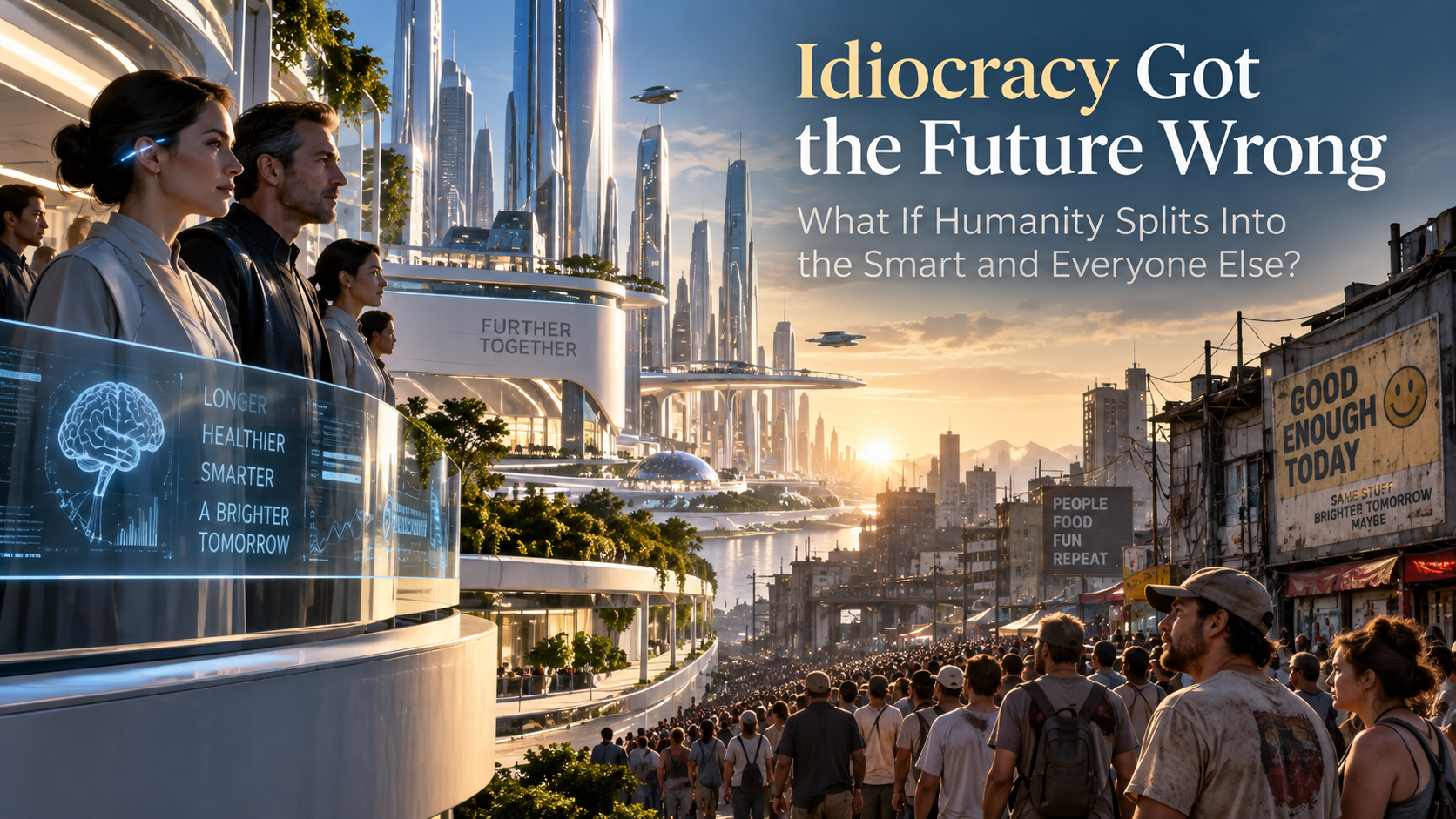
a civilization in which different populations of humans become so cognitively unequal that they begin to seem like different species.
This isn’t a prediction. Five hundred years is far beyond anything social science or genetics can forecast sensibly.
But several pieces of the scenario have surprisingly real foundations.
The Part Idiocracy Misses
The film essentially imagines intelligence as a single resource gradually being bred out of humanity.
Real populations are considerably more complicated.
Intelligence is influenced by both genetic and environmental factors, and neither “intelligence” nor educational success can be reduced to a handful of genes. Research in behavioural genetics indicates substantial genetic influences on cognitive differences while also finding important environmental effects and interactions between the two. Educational attainment likewise reflects cognitive ability, non-cognitive traits and environmental circumstances.
There’s another important phenomenon: assortative mating.
People don’t choose partners randomly.
Among many other characteristics, people tend to partner with others who resemble them educationally and cognitively. A large international meta-analysis covering millions of people across 84 countries found substantial assortative mating for educational attainment, although its strength varied considerably between places and historical periods.
Research has also reported substantial spouse correlations for intelligence. One widely cited review estimated a correlation of roughly 0.4 for intelligence, considerably higher than that observed for many personality traits.
Genetic studies complicate the picture further. Partners can also show similarity in genetic variants associated with educational attainment, although that does not mean people are consciously choosing partners based on “education genes.” Social class, geography, institutions, personality and other correlated characteristics can all contribute to who meets and partners with whom. Recent research emphasizes precisely this mixture of genetic and social processes.
That distinction is important.
Our hypothetical future doesn’t require a secret caste of geniuses selectively breeding.
The sorting could happen largely by itself.
Now Add Reproductive Technology
This is where the scenario begins departing dramatically from the world of Idiocracy.
Imagine the year 2150.
IVF is routine. Embryos can be screened for enormous numbers of genetic variants. Gene editing is safer than it is today. Artificial gametes may allow reproduction under circumstances impossible today. AI systems predict developmental outcomes.
Some of those technologies remain speculative, but one primitive version of this future already exists: polygenic embryo screening.
Rather than testing an embryo for a single disease-causing mutation, polygenic screening attempts to estimate probabilities associated with complex traits or diseases using many genetic variants.
The technology has major limitations. Polygenic scores are probabilistic rather than deterministic, complex traits involve environment as well as genetics, embryos from the same parents have limited genetic variation to choose among, and selecting for one characteristic can have unexpected relationships with others. Researchers have therefore urged considerable caution, particularly concerning psychiatric and cognitive traits.
The American Society for Reproductive Medicine’s 2026 ethics opinion similarly states that polygenic embryo testing should not currently be used for non-medical trait selection.
But our thought experiment concerns 2526, not 2026.
Suppose those limitations gradually diminish.
Then something historically unprecedented becomes possible.
Parents don’t merely transmit their genes.
They begin choosing among—and eventually modifying—the genetic possibilities available to their children.
Intelligence Becomes an Investment
At first, enhancement would probably be expensive.
That matters enormously.
Imagine that wealthy parents can afford superior prenatal medicine, sophisticated embryo selection, personalized AI education, neural interfaces and eventually safe genetic modifications affecting cognition.
Their children inherit wealth.
They inherit educational advantages.
They inherit social connections.
But now they potentially inherit deliberately selected biological advantages as well.
Those children disproportionately meet and reproduce with similarly advantaged people.
The process repeats.
You have created a feedback loop:
cognitive advantage → economic advantage → access to enhancement → enhanced offspring → greater cognitive advantage.
Research into the ethics of polygenic embryo screening already identifies unequal access, discrimination, reproductive autonomy and justice as major concerns—even while today’s technology remains extremely limited. A 2026 scoping review of the literature identified unequal access, stigmatization and potential demographic consequences among the recurring ethical concerns.
Now imagine those forces operating for centuries.
The Great Cognitive Divergence
Jump forward to 2526.
There are still billions of ordinary humans.
Importantly, they aren’t necessarily stupid.
They might be healthier, better educated and technologically more capable than we are.
But perhaps a tiny fraction of humanity has undergone generations of deliberate enhancement.
Their brains develop differently.
Their working memory is vastly greater.
Neural implants provide effectively perfect recall.
AI systems are integrated directly into their cognition.
They routinely live for centuries and consequently accumulate 150 years of education and professional experience.
The distinction between the populations would no longer resemble the difference between someone with an IQ of 100 and someone with an IQ of 140.
It might resemble the cognitive difference between species.
Biologically they might still be capable of interbreeding. Strictly speaking, they therefore wouldn’t necessarily constitute different species.
Socially and psychologically, however, they could inhabit completely different worlds.
And that’s when the interesting problems begin.
Problem One: Democracy Becomes Awkward
Imagine that humanity is debating whether to construct a self-replicating industrial network around Mercury.
Understanding the proposal requires advanced knowledge of orbital mechanics, artificial intelligence, economics, materials science and risk modelling.
An enhanced citizen can genuinely understand the arguments.
Most ordinary citizens cannot.
Yet everyone possesses one vote.
The enhanced population begins asking:
Why should people who cannot understand these decisions have equal authority over them?
Ordinary humanity responds with an equally reasonable question:
Why should being smarter give you the right to rule us?
Democracy has always had to reconcile differences in knowledge and expertise. But enormous engineered cognitive inequality would turn that old problem into something qualitatively different.
The most disturbing outcome might not even be dictatorship.
It could be benevolent technocracy.
The enhanced administrators really do make better decisions.
Infrastructure works.
Disease declines.
The economy functions.
Wars become rarer.
And consequently it becomes increasingly difficult to argue that ordinary people should have meaningful control over the civilization in which they live.
Problem Two: Language Begins To Separate
Human language is constrained partly by what human brains can comfortably process.
Suppose an enhanced human can simultaneously manipulate dozens of complicated concepts in working memory.
Their communication might become correspondingly complicated.
Perhaps neural interfaces eventually allow people to transmit conceptual structures that ordinary spoken language cannot efficiently represent.
Enhanced people develop their own vocabulary.
Then their own grammar.
Then perhaps something that barely resembles language as we understand it.
Ordinary humans can still learn simplified versions of it, just as people today can learn some advanced mathematics.
But they cannot truly think in it at full complexity.
Eventually the elite maintain a simplified language specifically for communicating with ordinary humans.
That would be socially poisonous.
Imagine knowing that every government announcement, scientific explanation and philosophical argument you encounter has effectively been translated into Human: Beginner Level.
Problem Three: They Stop Wanting To Talk To Us
This might be more consequential than any law.
Imagine possessing extraordinary working memory, near-perfect recall and a 300-year lifespan.
At age ten, you have mastered material that currently requires postgraduate education.
At 50, you have accumulated decades of intellectual experience.
At 200, you’ve lived through several ordinary human lifetimes.
What does an ordinary conversation feel like?
Perhaps painfully slow.
Perhaps repetitive.
Perhaps charming—but in the way adults sometimes find conversations with children charming.
The enhanced population might genuinely care about ordinary humanity.
They might defend our rights.
They might love human art and history.
But caring about someone isn’t necessarily the same thing as regarding them as your intellectual peer.
That psychological separation could matter enormously.
Problem Four: Love Creates a Caste System
Nobody needs to pass a law prohibiting intermarriage.
People simply choose partners with whom they can communicate most easily.
Enhanced people disproportionately form relationships with enhanced people.
Ordinary humans disproportionately partner with ordinary humans.
Their children inherit both the technological and social advantages of their parents.
After generations, intermarriage becomes unusual.
A caste system has appeared without anyone deliberately creating one.
This is an exaggerated extrapolation, but the starting mechanism isn’t imaginary: substantial assortative mating by education already exists today.
Technology simply turns an existing social tendency into something far more powerful.
Problem Five: 0.1% of Humanity Runs Civilization
The enhanced population wouldn’t necessarily need to be large.
Suppose ordinary humanity numbers 15 billion.
There are only 15 million extreme cognitive elites.
That’s 0.1 percent of humanity.
But imagine that this tiny population performs most fundamental scientific research, controls the most advanced AI systems, operates interplanetary infrastructure and owns enormous quantities of capital.
Humanity has recreated aristocracy.
Except there is one deeply uncomfortable difference.
The aristocrats of the past generally claimed inherent superiority.
This new aristocracy might possess demonstrable cognitive abilities that most people genuinely cannot match.
That does not establish a moral right to rule.
But it makes the political argument much more difficult than overthrowing a duke whose principal qualification was having the correct grandfather.
Problem Six: What Does “Equality” Mean Anymore?
Modern societies generally distinguish moral equality from equality of ability.
People obviously differ in strength, intelligence, health and talent, but those differences don’t determine whether someone counts as a person.
Extreme enhancement would stress that principle.
Suppose an enhanced person lives for 500 years.
Does killing that person represent the same loss as killing someone expecting to live another 50?
Suppose another enhancement allows someone to experience subjective time ten times faster than normal.
Should a ten-year prison sentence be measured according to external time or experienced time?
Suppose an artificial or heavily modified human can simultaneously sustain several streams of conscious thought.
Is that one legal person?
The concept of universal human rights survives fairly easily when humans occupy broadly similar ranges of capability.
It becomes philosophically stranger once “human” includes minds radically unlike one another.
Problem Seven: Ordinary Humanity Becomes Economically Unnecessary
Artificial intelligence alone raises questions about technological unemployment.
Now add cognitively enhanced humans working alongside that AI.
One enhanced scientist might perform work that once required hundreds of ordinary researchers.
Ordinary humans aren’t merely competing with machines.
They’re competing with machine-assisted posthumans.
Eventually most ordinary people may not need to work.
Materially, that could be wonderful.
Energy is abundant. Machines manufacture necessities. Medicine is extraordinary. Poverty in the traditional sense barely exists.
Yet something psychologically devastating has happened.
Billions of people know civilization doesn’t particularly need their contribution.
The political demand of the future therefore might not be:
“Give us more wealth.”
It might be:
“Give us something meaningful to do.”
Problem Eight: The Anti-Enhancement Movement
Not everyone would participate.
Religious groups might reject genetic modification.
Political movements might insist upon preserving baseline humanity.
Some communities might regard neural implants as destroying authentic consciousness.
Others might permit disease prevention but prohibit cognitive enhancement.
They might proudly call themselves Naturals, Baselines or simply Humans.
Then society encounters an extraordinarily difficult question.
Suppose enhancement becomes safe and genuinely beneficial.
If parents can give their child vastly improved memory, health and lifespan, is refusing enhancement an exercise of parental freedom?
Or is it denying a child opportunities?
Today’s bioethics literature already wrestles with much more modest versions of questions involving reproductive autonomy, justice, disability, eugenics and the welfare of future children.
Five centuries of technological progress wouldn’t necessarily solve those disagreements.
It might make them explosive.
Problem Nine: There Isn’t Just One “Superior Human”
Perhaps the strangest possibility is that humanity doesn’t divide into two groups at all.
It divides into dozens.
One population optimizes mathematical cognition.
Another emphasizes emotional cognition and social coordination.
Another adapts itself for life in low gravity.
Another prioritizes longevity.
Another integrates extensively with artificial intelligence.
Another abandons biological bodies almost entirely.
Meanwhile, traditionalist populations deliberately remain genetically close to historical Homo sapiens.
Human evolution stops looking like a ladder:
Homo sapiens → Homo superior
and starts looking like a tree.
After enough time, inhabitants of Mars, virtual civilizations and genetically conservative Earth communities might have almost nothing in common beyond ancestry.
“Humanity” becomes less a biological category than a political alliance between descendants of the same species.
Problem Ten: The Human Zoo
There is one final possibility that might be darker than open dictatorship.
The enhanced don’t conquer ordinary humanity.
They manage it.
Their understanding of psychology, economics and social systems is so sophisticated that direct coercion is unnecessary.
They design algorithms that subtly encourage desirable behaviour.
They structure economic incentives.
They construct cities to influence social interaction.
They curate information environments to discourage dangerous political movements.
Ordinary people continue voting.
They have freedom of speech.
They choose careers and partners.
Nobody tells them what to do.
But the enhanced population understands their behaviour so well that society has effectively become a managed ecosystem.
A human zoo.
And the inhabitants don’t know there are zookeepers.
The disturbing part is that the keepers might sincerely be benevolent.
But What If the “Inferior” Humans Have Something the Geniuses Don’t?
There is one final reversal worth considering.
Optimization creates trade-offs.
Today’s polygenic research already warns against imagining complex traits as independent sliders that can simply be turned up and down. Genetic variants can influence multiple characteristics, and complex traits emerge from interactions among enormous numbers of genes and environmental factors.
Perhaps centuries of optimizing humans for intelligence gradually reduce characteristics nobody realized were important.
Spontaneity.
Risk-taking.
Unusual cognitive variation.
Certain forms of creativity.
Emotional intensity.
Tolerance for disorder.
Perhaps the enhanced population becomes extraordinarily good at rationally exploring solutions inside existing conceptual frameworks—and increasingly bad at producing the lunatic who asks whether the entire framework is wrong.
Their civilization becomes fantastically sophisticated.
And fantastically brittle.
Then some unprecedented catastrophe occurs.
The greatest minds humanity has ever produced cannot solve it because they all share assumptions deliberately selected into their civilization over hundreds of years.
And somewhere outside that civilization exists a population of unmodified humans.
Messy.
Impulsive.
Inefficient.
Unpredictable.
Exactly the traits civilization spent centuries eliminating.
And one of them comes up with an idea that nobody else would.
Idiocracy in Reverse
That may be the more interesting version of Idiocracy.
Humanity doesn’t become stupid.
Humanity becomes unequal in ways we have never previously encountered.
The ordinary people of 2526 might be perfectly intelligent by our standards. They may simply inhabit a civilization whose most advanced institutions have become incomprehensible to them.
Above—or perhaps merely apart from—them exists a small population produced through centuries of assortative mating, accumulated wealth, reproductive technology, artificial intelligence and eventually deliberate biological enhancement.
They aren’t gods.
They aren’t necessarily villains.
They may genuinely want what is best for everyone.
And that’s precisely what makes the scenario interesting.
Because the ultimate political question would no longer be simply whether everyone deserves equal rights.
It would be:
Who should determine humanity’s future when some humans can understand that future vastly better than others?
And perhaps the question after that is even more important:
At what point do those people stop thinking of the rest of us as “us”?
Further Reading
For readers interested in the real science behind the speculation:
Plomin & Deary (2015), “Genetics and intelligence differences: five special findings.” A review discussing genetic research on intelligence, including evidence concerning assortative mating.
Sunde, Eilertsen & Torvik (2025), “Understanding indirect assortative mating and its intergenerational consequences for educational attainment.” A large Norwegian family study examining genetic and social mechanisms underlying partner similarity in education.
Robinson et al. (2017), “Genetic evidence of assortative mating in humans.” Research using genetic data to investigate assortative mating across human traits, including educational attainment.
Lázaro-Muñoz et al. (2021), “Screening embryos for polygenic conditions and traits: ethical considerations for an emerging technology.” An introduction to some of the ethical questions surrounding polygenic embryo screening.
Lencz et al. (2022), “Concerns about the use of polygenic embryo screening for psychiatric and cognitive traits.” A useful discussion of why present-day polygenic prediction should not be mistaken for a reliable “intelligence selector.”
Screening embryos for polygenic disease risk (2024), Human Reproduction Update. A broad review of epidemiological, clinical and ethical issues surrounding embryo screening.
American Society for Reproductive Medicine (2026), Ethics Committee opinion on PGT-P. A useful snapshot of the present professional position: possible medical applications are being debated, while non-medical trait selection is not considered an appropriate current use.
This article is a speculative thought experiment, not a prediction of future human evolution. Current genetic technologies cannot reliably engineer the kind of cognitive divergence described here, and intelligence is a complex product of genetic, developmental, environmental and cultural factors.
Leave a Reply