Names and identifying details in the personal account below have been changed.
I first understood the reality of Imprisonment for Public Protection not in a lecture theatre or a law report, but in HMP Doncaster.
At the time, I knew almost nothing about IPP sentences. I met several prisoners serving them, including two men I will call Smithy and AJ. In the ordinary rhythm of prison conversation, one question seems obvious: When are you getting out?
I remember asking Smithy whether he had a release date.
He slowly shook his head.
It was a small exchange, but his reaction told me immediately that I had stumbled onto something much more painful than I understood. I did not ask again. Yet the answer—or rather, the absence of an answer—stayed with me long after that conversation.
My assumption at the time was that a prisoner with no ascertainable release date must have committed an offence of extraordinary gravity: multiple murder, terrorism, or something comparable. After leaving prison and researching IPP sentences, I discovered how badly mistaken that assumption was.
Advertisement
A sentence abolished, but not ended
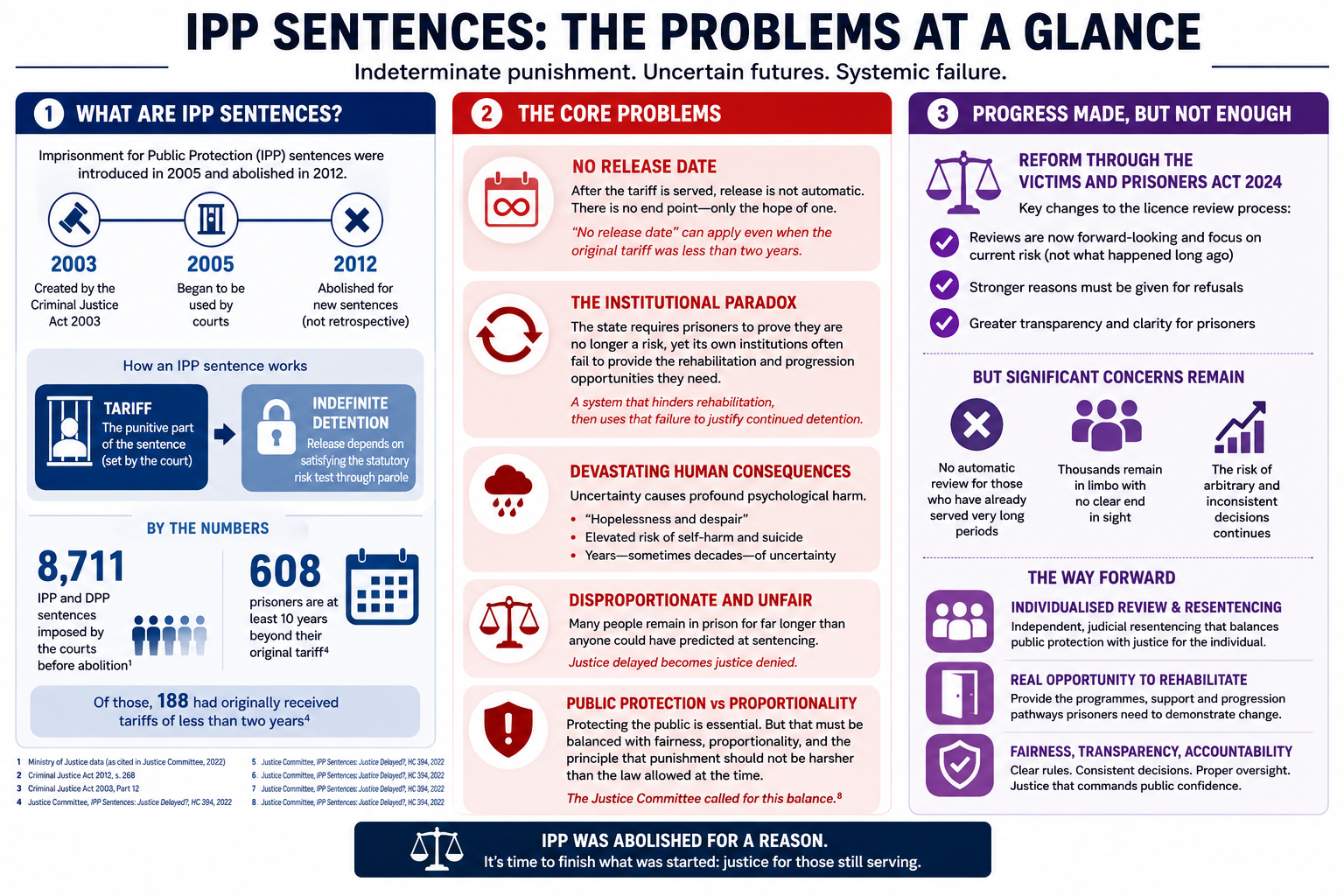
The IPP sentence was created by the Criminal Justice Act 2003 and came into use in 2005. It was an indeterminate sentence intended for offenders considered to present a significant risk of serious harm, but whose offences did not justify a conventional life sentence. Parliament eventually abolished IPPs in 2012 after profound criticism of how the regime operated. By then, 8,711 IPP and DPP sentences had been imposed by the courts.1
Abolition, however, was not retrospective.
That distinction is the heart of the problem. Parliament stopped courts imposing new IPP sentences, while leaving people already serving them subject to the old regime.2
An IPP prisoner was given a minimum term—the tariff—representing the punitive part of the sentence. Completing that tariff did not mean release. Thereafter, release depended upon satisfying the statutory risk test through the parole system.3
The consequences have sometimes been extraordinary. The Justice Committee reported in 2022 that 608 prisoners were at least ten years beyond their original tariff. Of those, 188 had originally received tariffs of less than two years. 4
That statistic changes the way I remember my conversation with Smithy.
“No release date” did not necessarily mean that the court had decided at sentence that a person deserved to spend the rest of his life in prison. It could mean that the punitive period imposed years earlier had expired, while an indeterminate preventive mechanism continued to determine whether he could leave.
The institutional paradox
There is an uncomfortable circularity at the centre of the IPP problem.
The state requires a prisoner to demonstrate that risk has sufficiently diminished before release. Yet the Justice Committee identified deficiencies in precisely the rehabilitative and progression mechanisms upon which IPP prisoners depend. Its investigation received an exceptional volume of evidence and identified barriers both within prison and following release. 5
The consequences extend beyond delayed release. The Committee reported that the uncertainty associated with IPPs produced “hopelessness and despair”, alongside elevated concerns about self-harm and suicide within the IPP population. 6
This presents a fundamental criminal-justice question.
If the state continues imprisoning somebody because he has not demonstrated sufficient rehabilitation, what responsibility does the state bear when its own institutions impede his ability to demonstrate it?7
Public protection matters. Some IPP prisoners have committed extremely serious offences, and nobody proposing reform can responsibly pretend that risk disappears merely because a tariff expires. But public protection and proportionality are not mutually exclusive principles.
Indeed, the Justice Committee expressly framed resentencing around a balance between protection of the public and justice for the individual offender, judicial independence, and protection against retrospectively imposing a harsher punishment. 8
Progress, but not resolution
There has been important reform since the Committee reported.
The Victims and Prisoners Act 2024 substantially changed the licence regime for people who had been released on IPP sentences. Further reforms followed in the Sentencing Act 2026. From 1 June 2026, the qualifying period for consideration of termination of an IPP licence was reduced from three years to two years following first release. Where a licence is not terminated at that stage, an individual may apply for a further Parole Board review one year later, before the point at which automatic termination may occur.9
HMPPS has also continued its IPP Action Plan, including measures intended to improve progression towards safe release and eventual licence termination. The 2026–27 plan includes additional psychological support, an IPP approved-premises pilot, a trial IPP advocate role and measures intended to improve progression opportunities for prisoners.10
The numbers are moving in the right direction, but the scale of the problem remains substantial. As at 31 March 2026, 896 IPP prisoners had never been released and 1,433 were in prison following recall. At 31 December 2025, a further 891 people serving IPP sentences were in the community and 207 were detained in hospital for treatment under the Mental Health Act 1983.11
Those figures represent progress: one year earlier there had been 1,012 unreleased and 1,532 recalled IPP prisoners. But they also demonstrate the extraordinary longevity of a sentencing regime abolished more than a decade ago.12
So abolition in 2012 did not end the IPP story.
It created the extraordinary situation in which a sentence Parliament concluded should no longer be imposed continues to determine the liberty of people sentenced under it years earlier.
What should happen now?
The most important—and most controversial—proposal remains resentencing.
In 2022, the House of Commons Justice Committee concluded that the IPP sentence was “irredeemably flawed”. It recommended primary legislation establishing a comprehensive resentencing exercise for those who remained subject to IPP sentences, whether detained or released on licence, except for those whose licences had already been terminated.13
Crucially, the Committee did not propose indiscriminate release. It recommended that a time-limited expert committee, working with the senior judiciary, devise the practical framework for resentencing. It identified three principles that should govern the process: protection of the public must be balanced against justice for the individual; judicial independence must be preserved so that judges can assess each case individually; and resentencing must not expose a person to a heavier penalty than could have been imposed when the offence was committed.14
The Government continues to reject that approach. As recently as May 2026, the Ministry of Justice stated that it did not intend to undertake a resentencing exercise. Its position is that resentencing could result in the release of prisoners whom the independent Parole Board has determined have not satisfied the statutory release test, thereby creating an unacceptable risk of harm to victims and the public.15
That objection deserves serious consideration. Public protection cannot become an afterthought simply because the original sentencing regime was defective. Victims are entitled to expect the state to take genuine continuing risks seriously.
But resentencing and indiscriminate release are not the same thing.
A resentencing exercise could return individual cases to an independent judiciary. Judges could consider the circumstances of the original offence, the sentence originally imposed, the period already served, subsequent progress and other matters Parliament considered relevant within a carefully constructed statutory framework. Resentencing could therefore provide judicial scrutiny of individual cases without requiring Parliament simply to order the release of every remaining IPP prisoner.16
There is also an important limitation on what the courts can accomplish without Parliament. In R v Roberts, the Court of Appeal considered an IPP sentence that had been lawfully imposed under the statutory regime then in force. The subsequent change in penal policy did not, by itself, make the original sentence unlawful.17
This helps explain why the unresolved IPP problem is ultimately one for Parliament: if a comprehensive resentencing exercise is to take place, Parliament must create the legal machinery through which it can occur.
That is where I believe reform should now concentrate. The question should not simply be whether IPP prisoners are dangerous or deserving of sympathy. The more difficult legal question is whether a sentence abolished because of its fundamental defects should continue indefinitely without providing those still subject to it with an individual judicial reconsideration of the sentence itself.
The Justice Committee’s recommendation really does distinguish resentencing from blanket release: it expressly proposed individual judicial discretion, public-protection safeguards and an expert implementation process.
Why I intend to keep working on this
For me, IPP sentences are therefore more than an interesting defect in sentencing policy.
I encountered their human consequences before I understood their legal architecture.
As I continue my study of criminal law and social justice, I want to examine how the law can correct an injustice created by law itself: how Parliament can legislate retrospectively without undermining public protection; how courts could conduct fair individual resentencing; how the parole system evaluates risk; and how prison and probation services can provide a genuine route towards rehabilitation rather than requiring prisoners to demonstrate progress through systems that may themselves obstruct it.
I also want to resist an easy division between concern for prisoners and concern for victims. A functioning criminal justice system owes responsibilities to both. Public confidence depends upon punishment being serious where seriousness is warranted, but also proportionate, reviewable and governed by intelligible legal principles.
IPP presents a particularly difficult test of those principles because its continuing consequences cannot simply be attributed to one judge, one prison governor, one Parole Board panel or one government.
It is institutional.
Parliament created the sentence. Courts imposed it under the statutory framework Parliament enacted. The prison, probation and parole systems subsequently inherited responsibility for managing those serving it. Parliament abolished the sentence for new cases in 2012, yet the consequences of IPP continue for those sentenced before abolition.
The Justice Committee ultimately concluded that a comprehensive solution requires Parliament to act. Drawing upon R v Roberts, it observed that the courts had applied the statutory regime Parliament created and that it must therefore be for Parliament to provide a correction if it chooses to do so.¹⁸18
I agree.
But for me this is not solely an abstract question of sentencing legislation. Behind the statistics, reports and judgments are individual prisoners living with the consequences of that legislation.
That brings me back to HMP Doncaster.
Years later, I still remember a man slowly shaking his head when I asked a question that I had assumed would have a simple answer:
Do you have a release date?
For an IPP prisoner, sometimes the most disturbing answer is no answer at all.
- House of Commons Justice Committee, IPP Sentences (Third Report of Session 2022-23, HC 266) para 3. ↩︎
- Legal Aid, Sentencing and Punishment of Offenders Act 2012, s 123; see also Victims and Prisoners Act 2024, Explanatory Notes, para 179. ↩︎
- Crime (Sentences) Act 1997, s 28(6)(b); Victims and Prisoners Act 2024, Explanatory Notes, para 179. ↩︎
- House of Commons Justice Committee, IPP Sentences (Third Report of Session 2022-23, HC 266) summary. ↩︎
- House of Commons Justice Committee, IPP Sentences (Third Report of Session 2022-23, HC 266) paras 31-39, 60-93. ↩︎
- Justice Committee (n 5) para 58. ↩︎
- Secretary of State for Justice v James [2009] UKHL 22, [2010] 1 AC 553. ↩︎
- Justice Committee (n 5), paras 139-141. ↩︎
- Sentencing Act 2026; see also Ministry of Justice, Sentencing Act 2026: Explanatory Notes, paras 1-2 under ‘Imprisonment or detention for public protection: termination of licences’. ↩︎
- HMPPS, Annual Report on the IPP Sentence 2025-26 (9 July 2026), IPP Action Plan 2026-27. ↩︎
- HMPPS, Annual Report on the IPP Sentence 2025-26 (9 July 2026). ↩︎
- ibid. ↩︎
- House of Commons Justice Committee, IPP Sentences (Third Report of Session 2022-23, HC 266) paras 137-138. ↩︎
- ibid, paras 139-141. ↩︎
- Ministry of Justice, ‘Imprisonment for Public Protection: Resentencing’ (written answer, 22 May 2026). ↩︎
- Justice Committee (n 13) paras 137-141. ↩︎
- R v Roberts [2016] EWCA Crim 71. ↩︎
- House of Commons Justice Committee, IPP Sentences (Third Report of Session 2022-23, HC 266) para 151, citing R v Roberts [2016] EWCA Crim 71. ↩︎
Leave a Reply