Modern Society | Urban Life, Technology & the Human Environment
There was something unmistakable about London at night under the old sodium streetlights.
The pavement turned amber. Brickwork acquired a warm orange glow. Mist and drizzle caught the light and seemed to hang visibly in the air. Residential streets could have an almost dreamlike quality. Even an otherwise ordinary road sometimes looked strangely inviting.
Then, gradually, the colour changed.
Across London and much of Britain, traditional high-pressure sodium (HPS) streetlights have increasingly been replaced by LEDs. There are excellent practical reasons for the transition. LEDs can use less electricity, last longer, be dimmed electronically and direct their light much more precisely. They can also provide much better colour recognition, which has advantages for pedestrians, drivers and CCTV.
From an engineering perspective, LED streetlighting is an extraordinary improvement.
But something else changed with it.
The streets stopped looking quite so warm.
The Strange Comfort of Sodium Light
High-pressure sodium lighting has an extremely distinctive appearance. Rather than producing balanced white light, it is dominated by warm yellow and orange wavelengths.
Its colour rendering is poor by modern standards. Under sodium lighting, blues, greens and reds can become difficult to distinguish accurately. Human faces look unusual. Cars can appear to be different colours from what they actually are.
Yet the same technological deficiency created an extraordinarily powerful atmosphere.
Sodium light compressed the visual world into variations of amber, brown, gold and shadow.
In an old London street—with brick terraces, wet pavement, trees, fog and Victorian architecture—the effect could be beautiful.
And perhaps part of the reason is remarkably ancient.
A Streetlight That Looked a Little Like Fire
There is an obvious visual similarity between sodium lighting and firelight.
Candles, fireplaces and campfires all produce predominantly warm-looking illumination. High-pressure sodium is not spectrally identical to fire, of course, but psychologically the resemblance is difficult to miss.
That raises an intriguing question.
Could humans actually be predisposed to find warm light comforting?
There is a plausible biological argument, although it shouldn’t be exaggerated into a simple evolutionary story.
Humans and our ancestors have had a relationship with fire extending extraordinarily far into prehistory. Archaeological evidence for hominin fire use reaches back hundreds of thousands of years and potentially much further, although precisely when fire became habitual remains debated. Recent evidence from Barnham in Suffolk indicates that hominins were deliberately making fire around 400,000 years ago. Other archaeological evidence of hominin interaction with fire extends considerably further back.
Fire transformed human life.
It provided warmth, protection, cooking and illumination. Crucially, it also created a place around which people could gather after sunset.
For enormous stretches of human existence, meanwhile, the basic lighting cycle was nothing like that of a modern city.
Day meant sunlight.
Night meant darkness, moonlight—and eventually fire.
Your Eyes Know When It Is Night
Light does more than allow us to see.
It also communicates with the biological systems controlling our circadian rhythms.
Specialised cells in the retina containing the photopigment melanopsin contribute to regulating the body’s internal clock. This system is particularly sensitive to shorter-wavelength light in roughly the blue-cyan portion of the spectrum.
Exposure to sufficiently intense light at night can therefore influence circadian timing and melatonin production. The effect depends on considerably more than simply whether a lamp is “blue” or “yellow”: intensity, spectrum, duration, timing and previous light exposure all matter.
Nevertheless, there is a meaningful biological distinction between warm, low-blue evening illumination and blue-rich white illumination.
The natural environment itself contains a similar transition. Bright daylight provides powerful broad-spectrum illumination, whereas the visual environment after sunset becomes dramatically darker.
For most of human history, nobody walked from a sunlit afternoon into a world filled with thousands of powerful white electric lights.
The modern illuminated city is, biologically speaking, an extremely recent invention.
But Biology Isn’t the Whole Story
We should be careful here.
It would be tempting to say that warm streetlights feel comfortable simply because our prehistoric ancestors sat around campfires.
Human psychology is rarely that straightforward.
Much of our response to warm light is almost certainly cultural and learned as well.
Think about the environments in which warm lighting is deliberately used today.
A fireplace.
A candlelit restaurant.
A traditional pub.
A living room in the evening.
A bedside lamp.
A hotel lounge.
Restaurants and homes routinely use warm lighting precisely because people associate it with intimacy and relaxation.
Now consider where colder, brighter white illumination is commonly encountered.
Hospitals.
Offices.
Car parks.
Warehouses.
Supermarkets.
Security installations.
The distinction isn’t universal, but the associations are powerful.
Warm light says: settle in.
Cold, bright light often says: stay alert.
When sodium streetlighting disappeared, therefore, cities didn’t merely exchange one lamp technology for another. In many places they changed the psychological language of the nighttime environment.
Why LEDs Won Anyway
There are very good reasons cities embraced LEDs.
An LED luminaire can direct light toward the pavement and road far more precisely than many older lighting systems. That means less electricity can be wasted illuminating places where light isn’t required.
LEDs are highly efficient, have long service lives and can be electronically controlled. Councils can dim them during periods of low traffic rather than operating every streetlight at full output throughout the night.
Their white light also has an enormous practical advantage over sodium: colour rendering.
Under sodium illumination, colour information is severely compromised. Under a good-quality white LED, a pedestrian’s clothing, a vehicle, road markings and surrounding objects can be distinguished much more accurately.
That can also make LED illumination considerably more useful to colour CCTV cameras.
In other words, the move to LEDs wasn’t irrational.
The mistake is assuming that efficiency is the only quality worth designing for.
LED Doesn’t Have to Mean Cold
This is perhaps the most important part of the discussion.
An LED is not inherently cold white.
LED streetlights can be manufactured at many different correlated colour temperatures.
A 4000K LED can appear relatively neutral or cool. A 3000K LED is noticeably warmer. At around 2700K the appearance begins approaching familiar warm domestic illumination, while approximately 2200K LEDs can produce an extremely warm amber character.
Some British authorities already recognise this.
Dorset Council’s streetlighting specification, for example, calls for warm-white LEDs no higher than 2700K in several environmental zones, ideally lower, while other UK lighting guidance recommends 3000K or below and specifically identifies the 2200–2700K range as an option where warmer, low-blue lighting is appropriate.
Even the City of London’s lighting strategy recognises colour temperature as part of urban character. Its guidance describes using different colour temperatures according to the character and function of a place, including warmer illumination for historic streets and public spaces.
That is a much more sophisticated approach than simply asking:
Which lamp produces the required lux for the least electricity?
The better question is:
What should this place feel like at night?
What We Lost Wasn’t Necessarily the Lamp
There is another reason old sodium-lit London is difficult to reproduce.
The characteristic atmosphere didn’t come entirely from the colour of the bulb.
Older luminaires often scattered considerably more light into their surroundings. Sodium light hitting mist, drizzle, low cloud and airborne moisture produced the famous orange glow that once hung above many British towns and cities.
Modern LED luminaires can control their beams much more tightly.
From the perspective of light pollution, astronomy and energy efficiency, that is often an improvement.
But aesthetically, something disappears.
The old streetlight illuminated not merely the road but sometimes the air itself.
On a wet London evening, that difference can be enormous.
When Bad Colour Rendering Became Beautiful
There is an irony here.
One of the greatest technical disadvantages of sodium lighting may also have contributed to its charm.
Its poor colour rendering unified everything.
Brick, pavement, trees, parked cars and human faces were all pushed toward the same limited palette. The street became less colourful but perhaps more visually coherent.
Modern LEDs restore information.
You can see that the parked car is blue, the jacket is red and the front door is green.
Technically, this is superior illumination.
Aesthetically, however, accuracy isn’t always beauty.
A black-and-white photograph contains less colour information than a modern digital photograph. That does not make the black-and-white photograph artistically inferior.
Something similar can happen with lighting.
The sodium lamp distorted reality.
But it distorted it beautifully.
The Broader Problem With the Modern City
Streetlighting illustrates a much larger tension within modern society.
We have become extraordinarily good at optimising things that can be measured.
Energy consumption.
Lumens.
Maintenance intervals.
Visibility.
Operating costs.
Component lifespan.
Carbon emissions.
All of these measurements matter.
But human beings also experience qualities that are considerably harder to place in a spreadsheet:
Comfort.
Atmosphere.
Beauty.
Mystery.
Familiarity.
A sense of place.
A feeling that somewhere belongs to people rather than merely functioning efficiently around them.
Modernisation frequently produces genuine improvements while unintentionally removing these less measurable qualities.
A railway station becomes cleaner and brighter but somehow less grand.
A pub becomes safer and easier to maintain but loses its fireplace and dark wooden interior.
A high street becomes more accessible and functional while acquiring the same paving, signage and furniture as every other high street.
And a street becomes cheaper and more efficiently illuminated while losing the golden light that once made it unmistakably itself.
Perhaps Progress Doesn’t Have to Look White
The answer isn’t to reinstall inefficient old sodium lamps throughout London.
Technology has moved on.
The more interesting possibility is to use modern technology with a better understanding of human beings.
LEDs give lighting designers extraordinary control. They can determine intensity, direction, timing and colour far more precisely than previous generations could.
That should make it possible to create cities that are simultaneously efficient and atmospheric.
Residential streets do not necessarily require the same lighting character as major traffic junctions.
Historic districts do not necessarily need to look like railway platforms.
Pedestrian areas could use warmer light than major roads.
Lighting could become dimmer and warmer as the night progresses.
And perhaps urban planners should begin treating darkness itself as something worth designing rather than simply something to eliminate.
Some UK authorities are already moving toward warmer LEDs, demonstrating that the choice is not simply between old-fashioned sodium and harsh modern lighting.
A City Is Something We Feel
There is a tendency to discuss infrastructure as though humans experience cities through specification sheets.
We don’t.
We experience a city through rain reflecting from the pavement.
Through the colour of brick at dusk.
Through shadows beneath trees.
Through the glow coming from a pub window.
Through the walk home late at night.
And through the colour of the streetlight above us.
Perhaps that is why some people miss London’s old sodium lamps despite knowing perfectly well that LEDs are technologically superior.
They aren’t necessarily nostalgic for inefficient light bulbs.
They are nostalgic for an atmosphere.
There may be something culturally learned in that feeling. There may even be something considerably older—an association between warm light, darkness, shelter and the extraordinarily long relationship between humans and fire.
We should be cautious about claiming we can separate those influences neatly.
But perhaps we don’t need to.
The important lesson is simpler.
Efficiency tells us how well a streetlight works. It does not tell us what it feels like to live beneath it.
The best cities of the future should understand both.
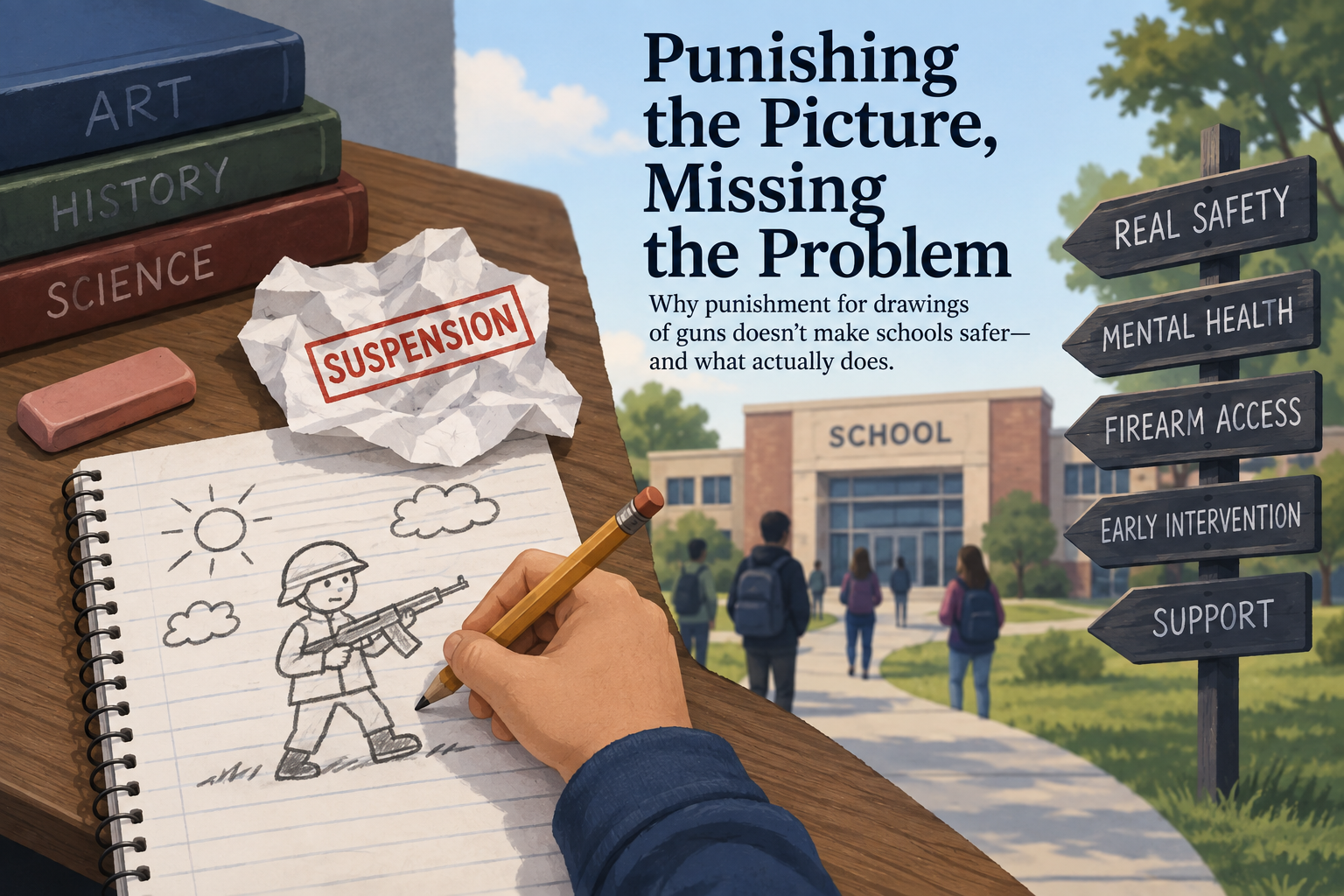
When I was a child in an American school (Forsyth County, GA), I once drew a cartoon that included a gun. I was fascinated by guns at the time—not because I wanted to hurt anyone, but because, like plenty of children, I found certain machines, weapons, vehicles, and military imagery interesting. For that drawing, I received two days of in-school suspension.
Looking back, what strikes me is not simply that the punishment was excessive. It is how little it had to do with preventing actual gun violence.
American schools have an entirely legitimate responsibility to take threats seriously. A student who communicates an intention to shoot someone, brings a weapon to school, attempts to obtain a weapon for an attack, or exhibits other concrete behavior indicating preparation for violence presents a fundamentally different situation from a child who draws a fictional gun. Treating these things as equivalent does not necessarily make a school more vigilant. It can make the school less capable of distinguishing a genuine danger from ordinary childhood expression.
That distinction matters because the United States has a real firearm-violence problem affecting young people. Firearm injuries became the leading cause of death among Americans ages 1–19 in 2020 and 2021 when homicide, suicide, and unintentional firearm deaths are considered together. The causes of that problem are complicated, but punishing children for images of guns is a remarkably indirect response to it.
There is also reason to question the broader disciplinary philosophy behind such punishment. The American Psychological Association’s review of school zero-tolerance policies found little evidence supporting the assumptions behind those policies. The available evidence tended to contradict the idea that rigid, mandatory punishments make schools safer. The APA instead recommended graduated discipline, consideration of context, and reserving the most serious consequences for the most serious behavior.
This does not mean that a disturbing drawing should always be ignored. Context matters enormously. A drawing accompanied by a specific threat against classmates is different from a cartoon battle. A student repeatedly expressing a desire to murder someone is different from a student sketching a soldier holding a rifle. The sensible question is therefore not simply, “Does this picture contain a gun?” It is, “What does this behavior tell us about this particular student, in this particular context?”
That is much closer to the philosophy behind behavioral threat assessment. Rather than assuming that a particular image, interest, personality trait, or superficial characteristic identifies a future attacker, threat assessment examines behavior and circumstances: Has a threat actually been made? Is it credible? Has the student taken steps toward carrying it out? Is there an underlying conflict or crisis that needs intervention? What information do teachers, parents, counselors, and others have?
Research and guidance developed in response to school shootings have specifically warned against simplistic profiling. School attacks are rare enough, and potential “warning signs” broad enough, that crude checklists can identify large numbers of harmless students while still failing to identify genuine danger. The U.S. Secret Service’s National Threat Assessment Center has instead advocated comprehensive programs focused on identifying and assessing concerning behavior and intervening before violence occurs.
That approach also recognizes an uncomfortable truth: prevention requires considerably more work than punishment.
Giving a child detention or suspension because there is a gun in his drawing is administratively easy. Understanding why a particular student has made a serious threat, investigating whether the student has access to firearms, communicating with parents, addressing bullying or interpersonal conflicts, providing appropriate mental-health or behavioral support, and evaluating whether a threat is progressing toward violence are much harder tasks.
But those harder tasks are the ones more closely connected to the danger schools are supposedly trying to prevent.
Research into school-associated violent deaths illustrates why. The CDC has reported that firearms used in school-associated homicides and suicides frequently came from the perpetrator’s home or from friends or relatives. It has also found that perpetrators sometimes communicated warning signals before attacks. Those facts point toward questions of firearm access, threatening behavior, communication, intervention, and adult awareness—not toward the mere existence of firearm imagery in a child’s notebook.
There is another potential cost to treating harmless expression as dangerous behavior. Schools need students to report genuine concerns. An effective safety system depends upon students trusting adults enough to tell them when a classmate makes a credible threat or appears to be preparing for violence. A disciplinary culture that treats every reference to violence as an offense risks blurring the distinction between students who need punishment, students who need help, students who require investigation, and students who have done nothing dangerous at all.
None of this requires schools to become indifferent to threatening material. Quite the opposite. Schools should take potentially threatening behavior seriously enough to investigate its meaning rather than mechanically reacting to its imagery.
A picture can sometimes be evidence. It should not automatically be a verdict.
The larger mistake is confusing visible symbols of America’s gun culture with the causes of America’s gun violence. A gun drawn on a sheet of paper is conspicuous and easy for an institution to prohibit. The conditions associated with actual violence—access to firearms, credible threats, escalating behavior, interpersonal crises, failures of communication, and missed opportunities for intervention—are considerably more difficult to address.
School safety policy should therefore be judged by what it accomplishes, not by how uncompromising it appears.
If punishing a child for drawing a cartoon gun cannot be shown to reduce the likelihood of violence, then the punishment should not be defended merely because it demonstrates that the institution “takes guns seriously.” Taking gun violence seriously means directing attention toward measures that can actually identify and reduce danger.
America does not suffer from a shortage of condemnation of gun violence. It suffers from gun violence itself.
The appropriate response is not to become less vigilant. It is to become more discriminating about what vigilance means: distinguishing expression from intent, fascination from preparation, and an image of violence from evidence that violence may actually occur.
A school that can make those distinctions is not being soft on violence. It is concentrating its attention where it matters.
Can Piddington Really Leave the United Kingdom? The Law Behind the Village’s ‘Independence’ Referendum
Residents of Piddington in Oxfordshire have voted overwhelmingly to “leave” the United Kingdom, but the legal consequences of the vote are considerably less dramatic than the headline suggests.
In a referendum held on 15 September 2026, 312 votes were cast. Of those, 285 supported independence, 26 opposed it and one ballot was spoiled. Following the result, Piddington Parish Council chairman Tim McNally announced that the village would be known as the “Principality of Piddington”.
The referendum was held against the backdrop of government proposals to accommodate up to 1,256 male asylum seekers at a former Ministry of Defence site near Bicester. Residents and local representatives have raised objections concerning matters including consultation, infrastructure and pedestrian access to the site. The Government, meanwhile, has said the use of former military sites forms part of its policy of reducing reliance on asylum hotels.
But whatever its political significance, the referendum does not make Piddington an independent country.
A parish council cannot secede from the United Kingdom
The fundamental difficulty for the proposed “Principality” is straightforward: there is no mechanism in UK law allowing an English parish, village, town or city to unilaterally declare itself independent.
The BBC’s explanation of the Piddington referendum similarly notes that there is no legal mechanism by which a village, town or city can declare independence from the UK, meaning Piddington’s vote is symbolic.
Piddington Parish Council is not a sovereign legislature. It is part of the first tier of English local government.
Modern parish councils derive their status principally from legislation including the Local Government Act 1972. Their powers concern local-government matters rather than questions of national sovereignty. The House of Commons Library describes parish and town councils as the “first tier of local government”.
Piddington Parish Council itself lists powers covering such matters as community buildings, recreational facilities, allotments, rights of way, public conveniences, local transport initiatives and neighbourhood planning. None amounts to a power to alter the territory of the United Kingdom or remove the parish from UK jurisdiction.
Consequently, the referendum does not remove Piddington from England, Oxfordshire or the United Kingdom.
UK Acts of Parliament continue to apply there. Residents remain subject to the same national taxation and criminal and civil law as before. UK citizenship is unaffected, and the courts, police and public authorities retain their existing jurisdiction.
Calling the village the “Principality of Piddington” does not alter that position.
What about the referendum result?
Referendums can have very different legal effects depending upon the legislation under which they are conducted.
The UK permits local referendums on matters affecting local areas, but the existence of a referendum does not itself confer constitutional powers upon the authority organising it. Government material concerning the local-referendum regime has expressly distinguished such votes from binding decision-making, describing the policy objective as giving residents a means of influence rather than control.
That distinction is particularly important in Piddington.
A vote can demonstrate what participating residents want. It cannot give a parish council a power that Parliament has never conferred upon it.
The 285 votes for independence therefore constitute a substantial democratic expression among those who voted, but they do not themselves alter Piddington’s constitutional status.
In legal terms, Piddington was part of the United Kingdom before the referendum and remains part of the United Kingdom afterwards.
Could Piddington ever become independent?
This produces a more interesting constitutional question.
Although Piddington cannot unilaterally leave the United Kingdom, it does not necessarily follow that its independence would be legally impossible under every imaginable circumstance.
The reason is parliamentary sovereignty.
The orthodox constitutional position is that the UK Parliament is the supreme legislative authority. Parliament describes parliamentary sovereignty as meaning that it can create or end any law, while the House of Commons Library describes Parliament as possessing the authority to “make or unmake any law”.
Accordingly, Parliament could in principle enact primary legislation fundamentally changing Piddington’s constitutional status.
Such an extraordinary measure would have to deal with numerous practical questions: the precise territorial boundary, nationality and citizenship, taxation, property, policing, courts, public services, highways, utilities, existing contractual obligations and the relationship between the new territory and the remainder of the UK.
The important distinction is therefore between unilateral secession and independence authorised through UK constitutional law.
Piddington has no legal power to accomplish the former. Parliament’s legislative sovereignty means that the latter is theoretically conceivable, although there is presently no indication that Parliament intends to enact such legislation.
Could Piddington simply refuse to recognise UK law?
No.
A declaration of independence by the parish council would not deprive Parliament of legislative authority over the area. Nor would declaring Piddington a “principality” create a separate legal system.
Residents could not, for example, stop paying UK taxes on the basis that they now lived in another country. Businesses would remain subject to applicable UK law, and criminal offences committed in Piddington would continue to fall within the ordinary criminal justice system.
The same principle would apply to attempts to establish border controls, issue legally effective passports or disregard decisions of UK public authorities.
Those activities require legal authority. A local declaration cannot manufacture that authority.
Does international law change the position?
References to the international-law principle of self-determination would not automatically transform Piddington into a sovereign state.
Questions of self-determination and secession under international law are considerably more complicated than the proposition that any community which votes for independence thereby becomes independent.
Most importantly for Piddington’s immediate situation, a local referendum cannot by itself disapply UK domestic law. Unless and until the UK’s constitutional arrangements were legally changed, British authorities and courts would continue to treat Piddington as UK territory.
Recognition by other states would also be an entirely separate issue from the parish council declaring itself independent.
What has actually changed?
Legally, very little.
Politically, the referendum gives campaigners a striking piece of evidence about the views expressed by participating residents and has generated national media attention for their objections to the proposed asylum accommodation site. The public consultation concerning the development was reported as running until 17 September.
Constitutionally, however, the position remains much more mundane.
The “Principality of Piddington” is a symbolic title rather than a new sovereign state. There is no new international border in Oxfordshire, no separate Piddington citizenship and no legal basis for the parish council to substitute its authority for that of Parliament.
The referendum therefore matters primarily as an act of political expression rather than an exercise of constitutional power.
Piddington has voted to leave the United Kingdom.
Legally, it has not left at all.
This article provides general legal and constitutional information and does not constitute legal advice.
The Evidential Weaknesses Surrounding the Conviction of Omar Benguit
A review of the witness evidence, forensic gaps, retrials and continuing concerns surrounding the 2005 conviction.
Important: Omar Benguit’s conviction remains legally valid. This article examines concerns about the strength and reliability of the evidence; it does not state that he has been judicially established to be innocent.
Introduction
Omar Benguit was convicted at Winchester Crown Court in January 2005 of murdering 26-year-old South Korean language student Jong-Ok Shin, known as Oki, in Bournemouth on 12 July 2002.
Benguit has consistently denied responsibility. His case has attracted sustained concern because the conviction was obtained without forensic evidence linking him to the murder and depended heavily upon testimony from witnesses whose reliability has been challenged.
Central question
Was the testimonial and circumstantial evidence sufficiently reliable to establish guilt beyond reasonable doubt in the absence of an independent forensic link?
Absence of forensic evidence
Perhaps the most striking feature of the prosecution case was the absence of forensic evidence connecting Benguit to Shin or the murder scene.
The murder weapon was never recovered, no eyewitness saw the attack itself, and the prosecution case was not supported by DNA, fingerprints or other scientific evidence directly placing Benguit with the victim.
The absence of forensic evidence did not make a conviction impossible, but it made the credibility of the witnesses exceptionally important.
Heavy dependence on a problematic principal witness
The prosecution relied heavily on a principal witness who gave accounts placing Benguit in circumstances allegedly connected to the killing.
However, her evidence contained serious credibility problems. She gave inconsistent statements, initially identified someone else, and admitted that parts of earlier accounts were untrue.
“`
Inconsistent accounts
The witness gave differing versions of events and altered important details over time.
False information
Parts of her early statements were acknowledged to be false or misleading.
Central importance
Her evidence was not peripheral: it formed a major part of the prosecution case.
“`
Post-trial contradictions
Concerns about the witness intensified after the trial when she later gave a public account that appeared materially different from her courtroom evidence.
The Criminal Cases Review Commission later investigated new material relating to her credibility and referred Benguit’s conviction back to the Court of Appeal.
2005Benguit convicted after a third murder trial.
2012The CCRC referred the conviction back to the Court of Appeal.
2014The Court of Appeal upheld the conviction.
2026Further scrutiny of the case continues.
Problems with supporting witnesses
Other witnesses provided circumstantial evidence suggesting that Benguit appeared agitated, had blood on him or his clothing, wanted to change clothes, or had spoken about stabbing someone.
These claims supported the prosecution case, but they remained witness testimony rather than physical proof of the murder.
Why this matters:
When a case depends heavily on multiple witnesses from a chaotic or unstable environment, the reliability, independence and consistency of those accounts become especially significant.
Two juries previously failed to convict
Benguit’s conviction came only after three murder trials. The first two juries were unable to reach a verdict on the murder charge.
Two hung juries do not prove innocence. However, they demonstrate that earlier juries who heard versions of the prosecution evidence were unable to reach the level of certainty required for conviction.
The knife evidence
Witnesses gave evidence suggesting Benguit sometimes carried knives or had been seen sharpening one.
Yet the murder weapon itself was never found, and no specific knife was scientifically connected to Shin’s death.
Evidential distinction
Evidence that a person possessed a knife is not the same as evidence that a particular knife was used by that person to commit a particular murder.
The victim’s account
Before her death, Shin was able to provide limited information about the attack. She reportedly described being attacked from behind by a masked man.
That evidence was consistent with a sudden attack but did not identify Benguit.
A possible alternative suspect
The case has also attracted attention because convicted murderer Danilo Restivo was living in Bournemouth at the relevant time.
The CCRC obtained evidence that it believed could have allowed the defence to raise an alternative-suspect argument. The Court of Appeal later considered and rejected that argument as insufficient to make the conviction unsafe.
Important distinction: It would be inaccurate to state as fact that Restivo killed Shin. His involvement has been raised as an alternative-suspect theory, not established by a court.
Why the conviction has survived
A balanced assessment must also acknowledge that the courts have repeatedly rejected the argument that the conviction is unsafe.
The prosecution case was cumulative. It relied on the principal witness alongside supporting testimony concerning Benguit’s movements, alleged bloodstaining, his behaviour, alleged admissions and evidence about knives.
The Court of Appeal concluded that the jury had been entitled to assess the weaknesses in the witness evidence and nevertheless convict.
Conclusion
The controversy surrounding Omar Benguit’s conviction arises not from a single decisive piece of exculpatory evidence but from the cumulative fragility of the case.
There was no forensic evidence linking him to the murder, no recovered murder weapon, no eyewitness to the stabbing, significant problems with the principal witness, and two previous juries failed to reach a guilty verdict.
None of those points proves that Benguit did not murder Jong-Ok Shin. But together they explain why the conviction has continued to attract scrutiny.
The key issue remains simple:
Was a heavily witness-dependent and circumstantial case, without an independent forensic link to the victim or crime scene, sufficiently reliable to prove guilt beyond reasonable doubt?
Schizophrenia in Prison: How Prevalence Compares with the General Population — and Why Women Are Especially Affected
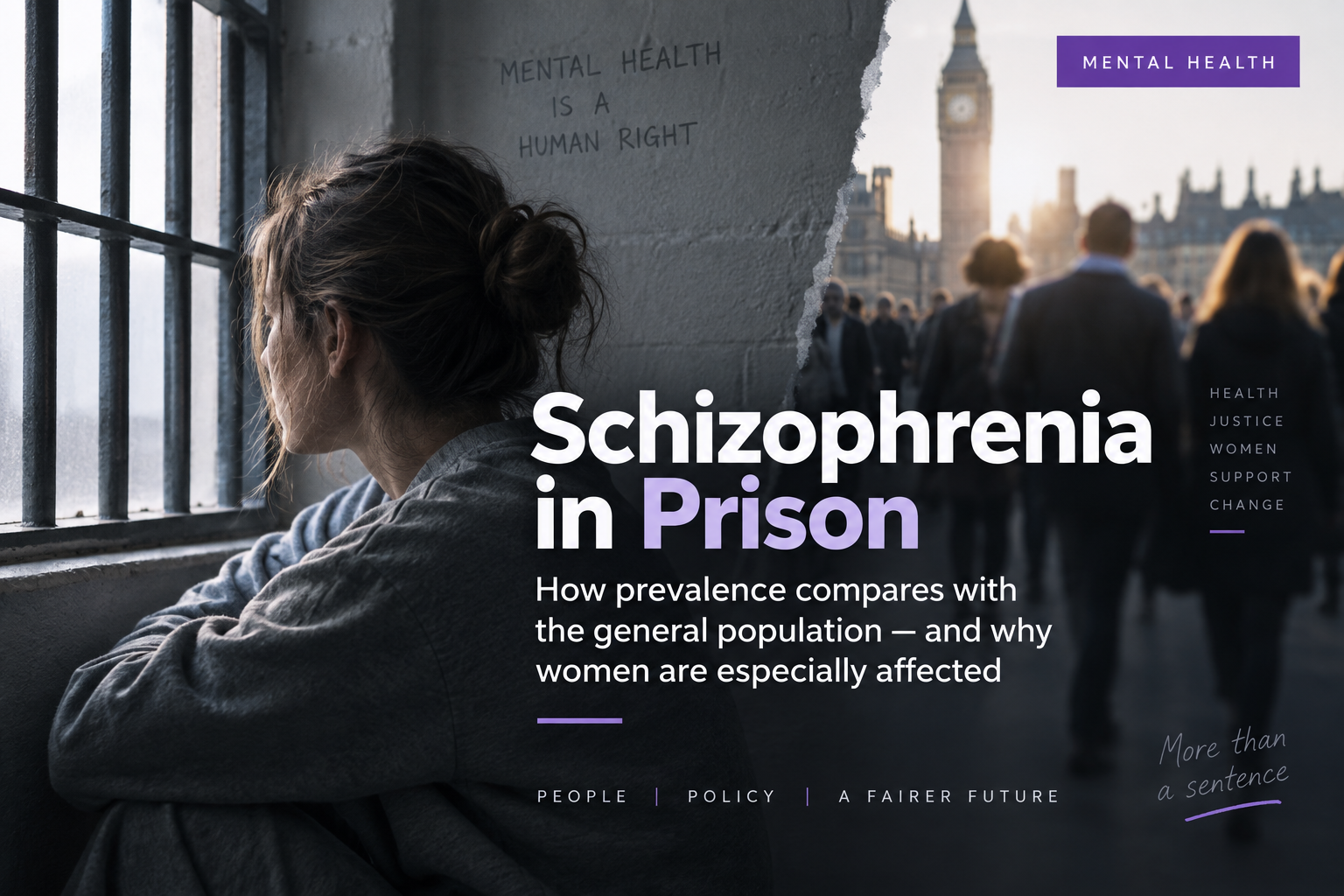
Severe mental illness is substantially over-represented in prisons. The disparity is particularly pronounced among women, who make up only a small proportion of the prison population but experience exceptionally high levels of mental ill-health, trauma and self-harm.
Important note on terminology:
schizophrenia and psychosis are not interchangeable terms. Schizophrenia is one cause of psychosis, while psychotic symptoms can also occur in bipolar disorder, severe depression, substance-related conditions and other illnesses. Modern prison research frequently reports psychotic disorder rather than schizophrenia alone. This report therefore distinguishes between the two wherever the evidence allows.
The headline finding
The gap between prisons and the wider population is substantial. In the major Office for National Statistics study of psychiatric morbidity among prisoners in England and Wales, approximately 14% of women in prison had experienced a functional psychosis during the previous year. Within the clinically interviewed group, approximately 13% were identified as having schizophrenia or a delusional disorder.
By comparison, psychotic disorders affect well below 1% of adults living in ordinary households. The latest Adult Psychiatric Morbidity Survey for England estimates past-year psychotic disorder at approximately 0.5% of adults overall, including approximately 0.6% of women.
14%
Women in prison
Functional psychosis in the previous year in the landmark England & Wales prison survey
“`
0.6%
Women in the community
Estimated past-year psychotic disorder in recent English household surveys
13%
Schizophrenia / delusional disorder
Women prisoners identified in the clinical component of the ONS study
“`
Caution: the 14% prison figure and contemporary 0.6% community figure come from different surveys conducted in different periods. They illustrate the scale of the disparity but should not be treated as a precise like-for-like calculation of risk.
How do prisoners compare with people outside prison?
Population / measure
Reported prevalence
What the figure means
Women in prison
14%
Functional psychosis during the previous year in the landmark ONS England & Wales prison survey.
Men on remand
10%
Functional psychosis during the previous year.
Sentenced men
7%
Functional psychosis during the previous year.
Women in the general population
0.6%
Recent pooled estimate of past-year psychotic disorder among women living in private households in England.
Adults overall in the general population
0.5%
Recent pooled estimate of past-year psychotic disorder among adults in England.
Although differences in study design prevent a simple mathematical comparison, the conclusion is difficult to miss: psychotic illness is many times more common among people in prison than among people living in the community, and historically the highest prison rates have been found among women.
Women in prison: a particularly vulnerable population
Women make up only a small minority of people held in prisons in England and Wales, but their mental-health needs are disproportionately high. Contemporary prison data continue to show this pattern. Recent Prison Reform Trust figures report that almost three-quarters of surveyed women in prison say that they have mental-health problems.
Research comparing male and female prisoners has also repeatedly found higher levels of mental-health need and greater psychiatric comorbidity among women. A 2019 UK prison study, for example, found that women reported significantly higher levels of mental-health need than men and were more likely to screen positively for multiple disorders.
Why the female prison population requires particular attention
The issue is not simply the number of women diagnosed with a particular psychiatric condition. Women entering custody frequently have overlapping needs involving severe mental illness, depression and anxiety, substance dependence, histories of trauma and abuse, self-harm, unstable housing and disrupted family relationships. These conditions can interact, making both diagnosis and treatment more complex.
Schizophrenia specifically
Schizophrenia is a severe, long-term mental-health condition that can affect a person’s thoughts, perceptions, emotions and behaviour. Symptoms may include hallucinations, delusions, disorganised thinking, reduced motivation and difficulties with everyday functioning.
The most frequently cited schizophrenia-specific evidence for female prisoners in England and Wales comes from the ONS psychiatric morbidity research. In its clinical assessment of women prisoners, approximately 13% were identified as having a schizophrenic or delusional disorder. Approximately 3% were classified specifically with schizophrenia, while the wider 13% category included other delusional disorders.
This distinction matters. Statements such as “14% of women prisoners have schizophrenia” are not supported by this dataset. The 14% figure relates to functional psychosis as a whole, not schizophrenia alone.
Is this still a problem today?
The most detailed national diagnostic study of schizophrenia among women prisoners is now old, which is itself an important limitation in the evidence base. However, newer information does not suggest that serious mental illness has ceased to be a major prison-health issue.
A recent analysis of mental-health caseloads covering around three-quarters of English prisons found that psychosis accounted for approximately 22% of the primary problems among patients on prison mental-health caseloads. This figure must not be interpreted as saying that 22% of all prisoners have psychosis: it describes people already receiving or identified for mental-health services. Nevertheless, it demonstrates the continuing demand that psychotic illness places on prison mental-health teams.
Recent surveys have also found that approximately 74% of women in prison report having mental-health problems, compared with 56% of men surveyed. Women consequently remain a group with particularly complex health and social-care needs.
Why is severe mental illness over-represented in prisons?
There is no single explanation. Prison populations are not randomly selected sections of society. Many of the social and health factors associated with contact with the criminal-justice system also overlap with factors associated with poor mental health.
Social disadvantage: poverty, insecure housing and homelessness are disproportionately represented among people entering custody.
Trauma and abuse: histories of violence, neglect, domestic abuse and sexual abuse are common among women who enter the criminal-justice system.
Substance use: drug and alcohol dependence can coexist with schizophrenia and other psychotic disorders, complicating both symptoms and treatment.
Breakdown of community support: people with severe mental illness may reach the criminal-justice system after difficulties obtaining stable housing, treatment or social support.
Remand and crisis: prisons can receive people who are acutely mentally unwell while they are awaiting trial or assessment.
The prison environment itself: isolation, uncertainty, disrupted relationships, sleep difficulties and the stresses of incarceration may aggravate existing psychiatric symptoms.
Trauma, self-harm and women
Looking only at schizophrenia risks overlooking the broader context in which severe mental illness occurs. Women in prison are also disproportionately affected by trauma and self-harm.
Recent prison statistics show that women account for a strikingly disproportionate share of self-harm incidents despite representing only around 4% of the prison population in England and Wales. This does not mean schizophrenia causes self-harm, but it illustrates the exceptionally high level of distress and complex need within the female estate.
For women with psychosis or schizophrenia, these overlapping vulnerabilities can make continuity of care particularly important. A prison sentence or period on remand can interrupt housing, family support, benefits, community psychiatric care and established therapeutic relationships.
Prison or healthcare?
The high prevalence of severe mental illness in custody raises a fundamental question: are some people with serious psychiatric disorders being dealt with primarily through the criminal-justice system when healthcare and community-based intervention would sometimes be more appropriate?
This is particularly relevant to women because many are imprisoned for relatively low-level or non-violent offending and because a significant proportion of the female prison population is held on remand. Prison Reform Trust research has highlighted cases in which severely mentally unwell women have entered custody while in crisis, including concerns about the historical use of prison as a place of safety.
Effective responses therefore extend beyond providing medication after somebody arrives in prison. They include early identification, court diversion and liaison services, timely psychiatric assessment, access to psychological treatment, transfer to appropriate hospital care where necessary, safe accommodation and continuity of treatment after release.
What should we conclude?
The central finding is clear: severe mental illness and psychotic disorders are substantially over-represented in prisons compared with the community, and women in prison show an especially high burden of mental-health need.
The classic national research found functional psychosis in around 14% of women prisoners and schizophrenia or delusional disorder in around 13% of the clinically assessed female sample. Contemporary population research, by contrast, places past-year psychotic disorder below 1% among women living in private households.
The precise figures should be interpreted cautiously because diagnostic definitions and research methods have changed over time. What has not disappeared is the underlying disparity. More recent studies and prison-health data continue to find exceptionally high levels of mental illness among people in custody and greater levels of need among women.
For policy, this suggests that schizophrenia and psychosis in prisons cannot be treated solely as issues of prison management. They are also questions of public health, social inequality, trauma, access to psychiatric services, diversion from custody and continuity of care.
A note on UK figures
Criminal justice and health systems differ across England and Wales, Scotland and Northern Ireland. The most robust national prison figures cited in this article relate primarily to England and Wales, while some later research is described as UK prison research. It is therefore more accurate to describe these figures by jurisdiction rather than assuming a single prevalence rate applies uniformly to every prison in the United Kingdom.
Sources and further reading
Office for National Statistics / O’Brien et al. — Psychiatric Morbidity among Women Prisoners in England and Wales. Landmark national research measuring psychosis, schizophrenia, personality disorder and other psychiatric morbidity among women prisoners.
NHS England Digital. — Adult Psychiatric Morbidity Survey: Survey of Mental Health and Wellbeing, England, 2023/24 — Chapter 12: Psychotic Disorder.
Tyler, N., Miles, H. L., Karadag, B. & Rogers, G. (2019). — An updated picture of the mental health needs of male and female prisoners in the UK: prevalence, comorbidity, and gender differences. Social Psychiatry and Psychiatric Epidemiology, 54, 1143–1152. DOI: 10.1007/s00127-019-01690-1.
Prison Reform Trust. — Health in Prison. Current overview of mental-health needs within prisons in England and Wales.
Durcan, G. / Centre for Mental Health (2023). — Prison mental health services in England, 2023: Prison and young offender institution mental health needs analysis.
Prison Reform Trust (2025–2026). — Publications concerning women in prison, remand, mental health, self-harm and approaches to reducing women’s imprisonment.
Editorial note: This article discusses population-level research and should not be used to infer that criminal behaviour is characteristic of people with schizophrenia. The great majority of people experiencing mental illness are not prisoners, and diagnosis alone does not determine an individual’s risk or behaviour.
How two murders in Atlanta rippled across families, countries, and twenty years of memory.
I
n August 2004, my family moved from the United Kingdom to Atlanta, Georgia.
A few months later, my father found work for an old childhood friend from Lithuania:
Rolandas Milinavičius.
At the time, there was no reason for me to believe that name would stay with me for the next twenty years.
Milinavičius owned a business exporting American cars to the Middle East.
My father worked loading vehicles into shipping containers—often alone, often in the suffocating Georgia heat.
Their friendship slowly became a business relationship, and their business relationship slowly became something much darker.
Five Cars Instead of Three
My father approached container loading differently. Trained as a carpenter in Britain,
he built timber frameworks that secured vehicles tightly enough to fit five cars where
others managed only three.
The journey to Jordan or Saudi Arabia was nearly 7,000 miles. Most containers arrived
with dented panels and shattered bumpers. His arrived without a scratch.
“Who packed these containers? Give this man a call.”
Eventually, my father left Milinavičius and built his own warehouse. It was an enormous
gamble—$50,000 a month in rent before paying a single employee—but it worked.
Some months the business earned more than Milinavičius had ever imagined.
● ● ●
Inga and Martynas
Two people remained working for Rolandas.
Inga Bandzevičiūtė-Contreras. Martynas Simokaitis.
Before they became victims in a murder case, they were simply young Lithuanian immigrants
trying to build lives in America.
According to my father, he offered both of them jobs at his new company. They wanted to leave,
but they couldn’t. Their employer owed them months of wages, and walking away meant abandoning
money they had already earned.
They weren’t trapped by loyalty.
They were trapped by debt.
Years later, I discovered that contemporary Lithuanian reporting described the same financial
desperation: unpaid wages, borrowed money, and two young people trying desperately to earn enough
to visit their families back home. (Public reporting supports the financial conflict, while my father’s offer of employment comes from our family’s recollection.)
Martynas Simokaitis and Inga Bandzevičiūtė-Contreras were preparing to return to Lithuania in the summer of 2007.
They Were Going Home
This is the detail I find hardest to forget.
Both of them were planning to go home.
Martynas hadn’t seen Lithuania in seven years. The relatives who had raised him were waiting
for him in Kybartai. Inga’s mother was waiting in Kaunas. Both had tickets in their future.
They were waiting at the airport.
Instead, they received ashes.
● ● ●
July 26, 2007
On a Thursday morning in East Point, Georgia, Inga and Martynas went to work at RM Auto International.
They never came home.
Surveillance cameras recorded three people entering the building: Rolandas Milinavičius, Inga,
and Martynas. Only one person was recorded leaving.
Two days later, Milinavičius surrendered to police. In 2008, a Fulton County jury convicted him
of two counts of malice murder and he received two consecutive life sentences.
The Question That Stayed With Me
“How long does a murder last?”
The Radius
Most true crime stories end with the verdict.
Two victims. One murderer. A sentence. Fade to black.
But murder doesn’t end when the courtroom empties. It continues in birthdays where someone is missing.
In parents who instinctively reach for the phone. In children who grow up carrying a surname they never chose.
It reaches old friends, business partners, investigators, journalists—and sometimes children standing quietly
near the edge of the story, who grow into adults still thinking about the people at its centre.
A murder happens in a room.
Its consequences do not stay there.
They cross oceans. They enter homes the killer has never seen. They survive prison sentences and court appeals.
They become memories carried by people who were never listed as victims in a legal document.
Perhaps the question isn’t why Rolandas Milinavičius killed Inga Bandzevičiūtė-Contreras and Martynas Simokaitis.
How a gesture associated with sport, friendship and informality acquired a new role during COVID-19: a legitimate greeting for offices, public figures and strangers who still wanted to acknowledge one another without reaching for the handshake.
The central claim
COVID did not invent the fist bump. It changed what the gesture was allowed to mean.
There was a moment in early 2020 when one of the oldest pieces of social choreography in the Western world suddenly stopped working. A hand came forward and the other person hesitated. Someone laughed, withdrew, waved, touched an elbow, offered a foot, or produced the compact closed fist that had spent decades living in a very different social register.
The fist bump was not new. Long before COVID-19 it belonged comfortably to sport, friendship, youth culture and celebratory ritual. It could communicate solidarity without the ceremony of a handshake. Precisely because it was relaxed, it was useful. Precisely because it was relaxed, however, it could look out of place in the office, the clinic, the conference room or the first encounter between two professionals.
Then the pandemic disrupted the hierarchy of greetings.
A gesture can become more formal without changing its shape. What changes is the situation in which society permits it.
Formality is contextual, not anatomical.
The most interesting story is therefore not that people began bumping fists. It is that the fist bump became socially intelligible in situations where, only a short time earlier, it might have seemed unserious. COVID supplied a justification powerful enough to override etiquette: infection control. Once that happened, an informal gesture acquired institutional permission.
1. Before COVID, the fist bump had a status problem
Research published before the pandemic already suggested that fist bumps could reduce some forms of microbial transfer compared with handshakes. A 2013 pilot study in a hospital setting argued that the smaller contact area and shorter contact time of a fist bump could make it a useful alternative. A 2014 experimental study likewise found substantially less bacterial transfer during fist bumps and high-fives than during handshakes.
But hygiene was only half the question. Greetings are cultural objects. They communicate age, distance, rank, warmth, professionalism and belonging. An epidemiologically attractive greeting can still fail if people think it looks ridiculous.
A later infection-prevention paper discussing the fist-bump proposal captured the resistance vividly. In a survey of infection-control practitioners, respondents worried that fist bumps were culturally incongruent, “too American,” associated with youth or street culture, potentially aggressive, and—most importantly for this argument—unprofessional. The problem was not whether two knuckles could touch. It was what those knuckles seemed to say.
The old social coding
The handshake carried institutional weight. It opened interviews, concluded deals, welcomed clients and marked introductions. It was conventional enough to disappear into the background. The fist bump did the opposite: it announced style. Using one could imply friendliness, informality, camaraderie or self-conscious coolness. That made it expressive, but it also limited where it could safely be used.
2. Then the handshake became a problem
In March 2020, the meaning of refusing a handshake changed almost overnight. What could previously have read as coldness or disrespect could now read as responsibility. Newspapers documented officials, clinicians and ordinary people improvising alternatives: waves, bows, elbow bumps, foot taps and other deliberately contact-reduced greetings.
This reversal matters. Etiquette normally rewards predictability. COVID made the predictable action—taking somebody’s outstretched hand—the questionable one. Suddenly every encounter contained a tiny negotiation. Do we touch? Do we not? Which replacement gesture do we both understand?
Researchers studying real-world greetings during the pandemic described exactly this process: routine tactile greetings became hesitant, suspended, refused or replaced, while newer practices such as elbow and foot bumps gradually became normalised. Social customs did not vanish. They adapted.
The pandemic did not abolish greeting rituals. It exposed them as technology: small social tools that can be redesigned when conditions change.
A crisis made etiquette visible.
The fist bump had a major advantage in this chaotic market of alternatives. Unlike a foot tap, it did not require balance. Unlike an elbow bump, it did not require two people to angle their bodies awkwardly. Unlike a wave, it retained a moment of reciprocal touch. It was already widely understood. COVID did not need to invent a new gesture; it needed to reclassify an existing one.
3. The professionalisation of an informal gesture
Calling the result “formal” needs precision. No etiquette authority issued a decree announcing that the fist bump now belonged beside the handshake. The transformation was softer and more interesting: its range expanded.
A greeting that once risked appearing too casual became acceptable between people who were not intimate friends. It could appear at work, at public events, in medical contexts and between people meeting for the first time. The health rationale supplied legitimacy, and repeated use supplied familiarity. Once a gesture can be performed between relative strangers without requiring an explanation, it has crossed an important social boundary.
This is how customs often change. First comes exception: “We are doing this because circumstances are unusual.” Then repetition. Then shared understanding. Eventually the explanatory sentence disappears.
The fist bump also solved an emotional problem. A pandemic greeting needed to communicate caution without communicating rejection. A person could decline the open palm yet still offer something. The bump therefore said two things at once: I am maintaining a boundary, and I am still acknowledging you.
4. What COVID left behind
The handshake survived. So did hugs, cheek kisses and the countless other rituals people suspended or modified. The pandemic did not produce a permanent one-gesture replacement, and research on infection transmission remains more nuanced than the simple claim that a fist bump is always “safe.” A 2020 study involving MRSA, for example, did not find a significant reduction with a traditional fist bump compared with a handshake, although a modified low-contact bump did reduce transfer.
But the cultural change does not require the fist bump to have medically defeated the handshake. Its importance is sociological. The pandemic widened the set of gestures that could perform seriousness and respect.
Before 2020, a fist bump in a formal encounter could be interpreted as deliberately casual. After 2020, the same gesture could be interpreted as considerate, hygienic, efficient or simply normal. It retained its friendly character while losing some of its social risk.
That is the lasting transformation. COVID did not turn the fist bump into a bow or a business handshake. It did something subtler: it gave an informal greeting a professional passport.
The gesture stayed the same. Its jurisdiction changed.
Sources & further reading
Ghareeb, P. A. et al. (2013), “Reducing pathogen transmission in a hospital setting. Handshake versus fist bump: a pilot study,” Journal of Hospital Infection.
Mela, S. & Whitworth, D. E. (2014), “The fist bump: a more hygienic alternative to the handshake,” American Journal of Infection Control.
Macdonald, A. S. et al. (2016), “Are you serious? From fist bumping to hand hygiene: Considering culture, context and complexity in infection prevention intervention research.”
Mondada, L. et al. (2020), “Human sociality in the times of the Covid-19 pandemic: A systematic examination of change in greetings.”
Pinto-Herrera, N. C. et al. (2020), “Transfer of methicillin-resistant Staphylococcus aureus by fist bump versus handshake,” Infection Control & Hospital Epidemiology.
Beyond Emergency Release: What England and Wales Can Learn from
Norway, Japan and Oklahoma
A comparative report on prison capacity, sentencing and public safety
Prepared for publication · Evidence checked September 2026
Executive summary
England and Wales have repeatedly come within a few thousand places
of a full prison system. Ministers have responded with accelerated
release, police-cell contingencies and an urgent building programme.
These measures may prevent an immediate breakdown, but they do not solve
the structural problem: the number and length of custodial sentences
have grown faster than the system’s safe, staffed capacity.
Norway and Japan show that a rich democracy does not have to operate
its prisons at the edge of collapse. They do not, however, offer a
single model. Norway confines far fewer people and deliberately moves
suitable sentences into the community, including extensive use of
electronic monitoring. Its correctional philosophy treats release and
reintegration as the normal destination of a sentence. Japan’s prison
population has fallen sharply for different reasons, including a long
decline in recorded crime and prison admissions, demographic change and
the retention of an estate built for a much larger population. Japan’s
prisons are orderly but often highly restrictive; low occupancy should
not be mistaken for proof that every feature of the Japanese regime is
humane or transferable.
Oklahoma provides a different lesson. The state became an
international symbol of very high incarceration, driven in part by
punitive sentencing and drug policy, before voters and legislators
pursued reforms. Its experience illustrates the danger of allowing
imprisonment to become the default response and then relying on
clemency, emergency powers or hurried releases once capacity and cost
become politically intolerable. It is a warning about governing by
pressure gauge.
As of 27 July 2026, England and Wales held 86,267 people in prison,
or about 136 per 100,000 residents. Norway held 3,019, or 54 per
100,000, at the end of July 2026. Japan held 41,232, or 33 per 100,000,
in mid-2025. These figures are not simple league tables: laws, recording
practices, crime patterns and demographic structures differ. But the
scale of the gap is too large to dismiss. England and Wales use
imprisonment much more heavily than either comparator. (World
Prison Brief: England and Wales, Norway,
Japan)
Reform should not mean indiscriminate release. Serious and dangerous
offenders must be confined where custody is necessary for public
protection and punishment. Reform means reserving expensive prison
places for those cases, reducing the use of short and ineffective
custody, strengthening community sentences, making progression and
release predictable, and investing in probation, treatment, housing and
employment. It also means publishing a binding annual prison-demand plan
so that sentencing legislation cannot quietly create more prisoners than
the state can safely hold.
This report recommends that the Government:
establish a statutory prison-demand and capacity duty, with
independent forecasts and a requirement that new sentencing laws
identify their prison and probation consequences;
create a presumption against short custodial sentences, with tightly
defined judicial exceptions;
expand credible, properly funded community sentences, treatment and
electronic monitoring;
introduce earned progression for eligible determinate sentences,
with exclusions and risk controls for serious violence, sexual offending
and terrorism;
repair probation before transferring large volumes of work from
prison;
reduce unnecessary remand and recall, while improving court speed
and licence decision-making;
make rehabilitation operational—through purposeful activity, family
contact, health care, housing and employment—not merely rhetorical;
retain sufficient headroom so emergency release is exceptional
rather than a recurring management tool; and
evaluate reforms by reconviction, harm, compliance, victim
confidence and total cost, not by prison numbers alone.
1. The question Britain
should be asking
Public debate often begins too late. When prisons are nearly full,
the apparent choice is between building cells and releasing prisoners
early. Both options become politically charged: construction is
presented as proof of toughness; release as proof of recklessness. Yet
by the time this argument begins, the most consequential decisions have
already been made—in criminal law, charging, remand, sentence lengths,
release rules, recall practice and the funding of probation.
England and Wales do not have one homogeneous “UK prison system”.
Criminal justice is devolved. Scotland and Northern Ireland operate
separate systems, so the immediate capacity crisis and the statistics in
this report concern England and Wales unless stated otherwise.
The prison population here stood at 86,267 on 27 July 2026. On a
comparable whole-population measure that was roughly 136 people per
100,000, compared with 54 in Norway and 33 in Japan. The remand
population in England and Wales was 15,386—17.9% of all prisoners. (World
Prison Brief)
The Ministry of Justice’s last five-year projection placed the March
2029 population between 95,700 and 105,200, with a central estimate of
100,800. Projections are conditional, not destiny, but they reveal the
direction produced by current policy assumptions. (Ministry
of Justice prison population projections)
The House of Commons Library also records a change in the composition
of the prison population: by June 2025, 48% of determinate-sentence
prisoners were serving terms longer than four years, up from 36% in
2010. In September 2025, 56% of prisons were classified as crowded. (House
of Commons Library) The pressure is therefore not explained simply
by a sudden wave of short sentences. Longer terms, remand, recall and
system delay all matter.
This is why “crime went up” is an inadequate diagnosis. Prison
population is a stock. It rises when inflows grow, outflows slow, or
both. Even if the number sentenced to custody were stable, longer
average time served would increase the population. Conversely, crime can
fall without promptly emptying prisons when long sentences already
imposed continue to run.
2. Four systems, four
different stories
Jurisdiction
Latest reported prison population
Rate per 100,000
What the comparison mainly shows
England and Wales
86,267 (27 July 2026)
136
High use of custody relative to northern European and East Asian
comparators; acute shortage of usable headroom
Norway
3,019 (31 July 2026)
54
Lower imprisonment plus structured use of community execution and
reintegration
Japan
41,232 (mid-2025)
33
Long-term population decline and spare estate capacity; not a direct
endorsement of prison conditions
Oklahoma
Not directly comparable with national
totals
Historically among the
highest-incarcerating US states
Consequences of sentence and drug-policy expansion, and the value of
front-end reform
Sources and caveat: National figures are from the World
Prison Brief, which compiles mainly official data. Oklahoma includes
state prisons and a complex local-jail/federal landscape, so it should
not be ranked mechanically against national prison systems. Dates and
definitions vary. The comparison is diagnostic, not a claim that one
number captures public safety or justice.
England and
Wales: a demand-management failure
The Independent Prison Capacity Review, led by Dame Anne Owers,
concluded that the crisis arose from failures to align demand and supply
and called for systems that trigger preventive action, including
sufficient probation and community-service capacity. (Independent
Prison Capacity Review) That finding matters because it reframes
overcrowding. It was not an unforeseeable natural disaster. Successive
policy choices accumulated without a reliable mechanism to reconcile
their consequences.
Emergency release can be necessary when the alternative is refusing
lawful admissions or holding people in police cells. But repeated
emergency release has serious costs. Victims receive short notice.
Probation teams inherit cases before plans are ready. Local authorities
and charities scramble for accommodation. Prisoners may leave without
treatment, documents, work or stable support. The result can be both
less humane and less safe than a planned shorter sentence with properly
funded supervision.
Conditions inside crowded establishments also weaken the very
functions invoked to justify imprisonment. The 2025–26 annual report of
HM Chief Inspector of Prisons drew on 84 inspections and related visits.
Its continuing scrutiny of safety, respect, purposeful activity and
rehabilitation demonstrates that nominal capacity is not enough: a place
requires staff, health care, education, workshops and functioning
infrastructure. (HM
Chief Inspector of Prisons annual report 2025–26) A cell added to a
spreadsheet is not necessarily a usable, decent or rehabilitative
place.
Norway: less
custody and a different use of custody
Norway is often reduced to photographs of attractive cells. That
misses the structural lesson. The system uses fewer prison places
because it limits their use and executes many eligible sentences under
supervision outside an institution.
Statistics Norway recorded 3,359 people in the prison population on 1
January 2024. During that year, there were 2,977 new institutional
prison sentences and 2,967 new prison sentences served through
electronic monitoring—almost equal numbers. Electronic monitoring may be
used for eligible unconditional sentences of up to six months or for the
final six months before expected release, with offence-based exclusions.
(Statistics
Norway)
That is not “letting everyone off”. It is punishment with
restrictions, surveillance and enforceable conditions, delivered without
the automatic disruption of housing, employment and family ties that
short imprisonment causes. Norway still uses closed prisons and
preventive detention for people assessed as dangerous. Its useful
principle is proportionality: the restriction should not exceed what
punishment and safety require.
Norway’s low reconviction figures are frequently advertised as a
single “20% recidivism rate”. Comparisons of recidivism are treacherous
because countries use different follow-up periods, populations and
outcomes—rearrest, reconviction or return to prison. A systematic
international review found a two-year reconviction rate of 17.6% for
released prisoners in Norway, but the number should not be compared
casually with a differently defined English statistic. (Yukhnenko
et al., 2023) The defensible lesson is not that Norwegian prisons
magically produce an exact percentage. It is that normalisation,
continuity of services and planned resettlement are plausible parts of a
lower-custody, lower-reconviction system.
Japan: low
occupancy, but not “Norway in Asia”
Japan held 41,232 prisoners in mid-2025, a rate of 33 per 100,000.
Its prison population peaked at more than 81,000 in the mid-2000s and
has since nearly halved. The present estate therefore contains
substantial capacity designed for a larger population. (World
Prison Brief: Japan)
This decline reflects a wider long-term reduction in recorded
offending and in people entering prison, combined with demographic
change. It cannot be attributed simply to comfortable prisons or
expansive community supervision. Japanese prisons have traditionally
imposed strict discipline, repetitive work and detailed behavioural
rules. A reform argument should not romanticise those conditions.
Japan also faces a distinctive challenge: an ageing prison
population. Older people form a growing share of admissions even as
admissions among younger groups have fallen. Poverty, isolation and
repeated petty theft feature in research on older prisoners. This
exposes an important limit to prison policy: unused cells do not resolve
the welfare failures that bring vulnerable people into custody. The
lesson for Britain is to divert health and social-care needs before they
become expensive penal cases, not to copy institutional rigidity.
Oklahoma: the
cost of reacting after expansion
Oklahoma is relevant precisely because it is not Norway or Japan. It
sits within a US system that divides people among state prisons, county
jails and federal custody, uses different sentence structures, and has
historically incarcerated at exceptionally high rates. Direct numerical
comparison with England and Wales would create false precision.
Its policy history nevertheless makes three points. First, prison
growth is strongly shaped by law: felony classifications, mandatory
terms, drug sentencing, parole eligibility and revocation rules. Second,
high incarceration carries fiscal and human costs without guaranteeing
proportionate gains in safety. Third, once prisons and jails fill,
government tends to reach for back-end relief—credits, commutations,
emergency release or contracts for beds—that is less coherent than
changing unnecessary admissions at the front end.
Oklahoma voters’ approval of State Question 780 in 2016, which
reclassified specified low-level drug-possession and property offences,
showed how a jurisdiction can reduce pressure by changing who receives a
felony and prison exposure. The broader warning is applicable to England
and Wales: sentencing expansion is easy to announce one offence at a
time, while its cumulative prison impact remains hidden until the system
reaches crisis.
3. What comparison can—and
cannot—prove
Comparative penal policy is full of tempting but weak claims. A lower
imprisonment rate does not by itself prove that a country is safer,
fairer or better at rehabilitation. Recorded crime depends on reporting
and classification. Conviction depends on policing and prosecution.
Prison population depends on legal thresholds and sentence length.
Occupancy depends on how capacity is defined. Reoffending figures depend
on the measure and follow-up window.
Norway is smaller, wealthier per head and supported by a broad
welfare state. Japan has lower levels of several forms of recorded
violent crime, a shrinking population and distinctive social
institutions. Oklahoma is a subnational US jurisdiction. England and
Wales cannot import any system wholesale.
But comparison remains valuable when it reveals mechanisms rather
than rankings. Norway demonstrates that electronic monitoring and
community execution can carry a substantial share of short custodial
punishment. Japan demonstrates that prison populations can fall
dramatically and leave spare capacity. Oklahoma demonstrates that high
incarceration is a political product that can be altered by law.
Together they refute the idea that chronic near-full occupancy is an
unavoidable feature of a modern democracy.
4. Why
emergency release is the wrong permanent policy
The objection to emergency release is not that every recipient
remains dangerous. Many prisoners would be released soon in any event.
The objection is that the date is moved because the estate is full
rather than because a transparent sentencing framework, risk assessment
and resettlement plan say it should be.
This undermines legitimacy in four directions:
victims can reasonably feel that the sentence announced in court did
not mean what it appeared to mean;
prison staff lose time needed for orderly progression and release
planning;
probation services receive sudden and unstable workloads; and
the public is invited to confuse a logistical emergency with a
considered reform.
Planned reform is safer than improvised release. Parliament should
determine in advance what proportion of eligible sentences is custodial,
what proportion can be earned through good progress, what exclusions
apply, and what supervision follows. The prison service should then
operate with headroom, not wait until only a few hundred places
remain.
5. A reform
programme for England and Wales
5.1 Put prison
demand under statutory control
An independent body should publish an annual ten-year forecast
covering prisons, probation, courts and community treatment. Every Bill
and major sentencing guideline should include independently validated
estimates of its effect on:
prison receptions and average time served;
remand and recall populations;
probation caseload and required staffing;
capital and operating costs; and
distributional effects, including women, young adults and minority
groups.
If policy creates demand above safe capacity, ministers should be
required to identify funding or an offsetting reduction. This would make
the hidden cumulative effect of “tougher” individual measures visible
before enactment.
5.2 Presume against short
custody
Short prison sentences often remove a person from work, housing,
treatment and family while providing too little time for meaningful
intervention. Courts should retain custody where immediate confinement
is necessary, but legislation should create a presumption that sentences
below a defined threshold are suspended or served in the community.
Exceptions should be explicit and reviewable—for persistent breach,
significant risk, domestic abuse cases requiring protection, or other
circumstances in which a community order cannot safely manage the case.
A presumption is preferable to an absolute ban because it preserves
judicial judgment while changing the default.
5.3 Make community
punishment credible
A community sentence that begins months late or offers no treatment
will not command judicial confidence. Reform therefore requires capacity
before diversion. Courts need rapid access to pre-sentence information
and a real menu of sanctions: unpaid work, curfews, exclusion zones,
alcohol monitoring, drug and mental-health treatment, restorative
processes where appropriate, and intensive supervision.
Norway’s scale of electronic monitoring is instructive, but
technology is not rehabilitation. A tag can enforce time and place; it
cannot secure a tenancy, treat addiction or create employment.
Monitoring should be proportionate, time-limited and combined with human
supervision and services.
5.4 Introduce
transparent earned progression
For eligible determinate sentences, movement through custody and into
supervised release should depend partly on engagement, conduct and risk
reduction. Rules must be clear at sentence, not invented during a
capacity crisis. Serious violent, sexual and terrorist offences require
distinct safeguards and, in appropriate cases, Parole Board
scrutiny.
Earned progression is defensible because it creates incentives and
makes release preparation continuous. It is not defensible if “good
behaviour” merely means passive compliance in a prison that offers no
courses or work. The state must provide meaningful opportunities before
it conditions progression on taking them.
5.5 Repair probation and
reduce churn
Prison reform can fail by moving an unmanageable caseload through the
gate. Probation needs stable staffing, manageable caseloads, specialist
domestic-abuse and sexual-offending capacity, treatment access and
timely enforcement.
Recall should protect the public when risk materially increases, but
avoidable technical breach and administrative delay should not create a
revolving door. Government should publish recall reasons, time spent
recalled and outcomes in sufficient detail to distinguish necessary
protection from system churn.
5.6 Reduce unnecessary remand
Almost 18% of prisoners in England and Wales were on remand in July
2026. Some present risks that only custody can manage. Others remain
because cases are delayed or because safe accommodation and supervised
bail are unavailable. Investment in court capacity, bail information,
supported housing and electronic monitoring can reduce unnecessary
detention without weakening public protection.
Remand reform also matters for legitimacy: people awaiting trial have
not been convicted, while those awaiting sentence may ultimately receive
a non-custodial disposal or a term shorter than time already served.
5.7 Turn prisons into
release institutions
Most prisoners will return to the community. Public safety therefore
depends on what happens before and after the gate. Each prisoner should
have a coordinated plan covering identification, benefits, housing,
physical and mental health, substance treatment, family contact,
education and work. Progress should be measured, and agencies should
share accountability for failures.
The Norwegian principle of “normality”—life inside should resemble
lawful life outside as far as security permits—is valuable because
release requires ordinary capabilities. Responsibility, appointments,
work and constructive relationships are not indulgences. They are
practice for citizenship.
5.8 Preserve genuine headroom
Official capacity is not safe operating capacity. Cells become
unavailable through maintenance, violence, segregation needs and
population mix. A national reserve should therefore be defined as a
percentage of usable, staffed places and protected by escalation rules.
Crossing thresholds should trigger published ministerial actions well
before emergency conditions.
Construction remains necessary to replace dilapidated accommodation
and meet irreducible demand. But new places should not become a licence
for further sentence inflation. Capital plans must include staffing,
health care and purposeful activity; otherwise Britain builds warehouses
rather than functioning prisons.
6. Public
safety, victims and the strongest objections
“Reform means
dangerous people will be released”
It should not. A serious reform plan differentiates by offence, risk
and sentence type. It reserves prison for people who require confinement
and applies enhanced scrutiny to high-risk release. Reducing short
custody for low-risk cases can protect capacity for the people who
genuinely need to be held.
“Longer sentences deter
crime”
The certainty of detection and proportionate punishment may deter. It
does not follow that every increase in sentence length produces a
matching safety gain. Marginal years are expensive, may have diminishing
deterrent value and can make eventual reintegration harder. Government
should be required to demonstrate the expected benefit of sentence
increases, not merely their symbolic force.
“Community orders are soft”
Poorly enforced orders are weak; well-designed ones are demanding.
Restrictions, frequent reporting, treatment, work and monitoring can
impose real punishment while preserving the stabilising factors that
reduce offending. Breach must have swift, proportionate
consequences.
“Britain is not Norway or
Japan”
Correct—and it does not need to be. The proposal is not cultural
imitation. It is to adopt tested mechanisms, adapt them to domestic law,
pilot them, publish outcomes and stop policies that fail. The relevant
question is not whether Britain can become Norway; it is why Britain
should keep running prisons at emergency pressure when other democracies
show that different equilibria are possible.
Victims must not be an
afterthought
Predictable release rules, timely notification and clear licence
conditions are essential. Victims should be told what the sentence means
at the outset and informed of material changes. Restorative justice
should be available only when genuinely voluntary and safe. Savings from
reduced custody should partly fund victim services, because penal reform
loses legitimacy if it appears to transfer every benefit to the offender
while externalising harm.
7. Measuring whether reform
works
Prison population reduction is a means, not the ultimate outcome. A
public dashboard should track:
proven reoffending at consistent one- and two-year intervals;
frequency and seriousness of reoffending, not just whether any
offence occurred;
compliance and completion for each community intervention;
victim satisfaction, notification and protection outcomes;
deaths, self-harm, violence and use of force in custody;
hours out of cell, education, treatment and employment;
housing and employment after release;
racial, sex and age disparities;
prison and probation staffing; and
full fiscal cost across justice, health, housing and benefits.
Reforms should be phased and evaluated with credible comparison
groups where possible. Results should be published even when
disappointing. Norway’s or Japan’s headline rate cannot substitute for
domestic evidence.
Conclusion: govern
the pipeline, not the panic
England and Wales are not short of emergency ingenuity. They are
short of a durable rule connecting sentencing policy to safe capacity.
When that connection breaks, government alternates between expensive
construction and hurried release, while staff, victims, prisoners and
communities absorb the consequences.
Norway shows the value of limiting institutional custody and making
supervised alternatives ordinary. Japan shows that low occupancy can
follow a sustained fall in admissions and that demographic and social
policy matter to penal outcomes. Oklahoma shows how punitive laws can
build a high-incarceration system—and how reform must address the front
door rather than depend on relief at the back.
The responsible reform position is neither “release everyone” nor
“build forever”. It is to imprison fewer people unnecessarily, confine
dangerous people safely, make every sentence intelligible, invest in
supervision and reintegration, and operate with enough headroom that
release dates are governed by law and risk rather than the number of
empty cells on a Tuesday night.
That is not softness. It is the harder discipline of making
punishment effective, proportionate and governable.
Part 1: From the church hall to the Discord server
For much of the twentieth century, social connection was frequently institutionalized.
You didn’t necessarily wake up thinking, “I need to make some friends today.”
You went somewhere.
Church on Sunday. The union hall. The pub. The bowling league. The football club. The veterans’ organization. The neighbourhood association. The workplace canteen.
Researchers sometimes describe these environments as “third places”—places outside home and work where people repeatedly encounter one another. Academic research explicitly includes religious organizations, civic associations, libraries, bars, cafés, gyms and community centres in this category.
That repetition matters.
You might see Dave every Sunday for three years before Dave becomes your friend.
The institution does the awkward introductory work for you.
And churches provided something especially powerful: scheduled belonging.
You didn’t have to organize it. Sunday came around automatically. There were services, men’s groups, volunteering, dinners, charity work, youth activities, committees, weddings, funerals and community events.
Someone might notice when you hadn’t shown up for three weeks.
That’s very different from simply having someone’s phone number.
Then the internet begins rebuilding some of this
Interestingly, people recognized this possibility surprisingly early.
In 2001, Pew was already describing online communities as potential “virtual third places.” Its research found online groups generating new relationships and connecting people across age, economic and ethnic boundaries. Pew also noted something important: some online communities became particularly vibrant when their members eventually met face-to-face.
Fast-forward twenty-five years and you can see the idea everywhere.
A Discord server can resemble a bizarre digital combination of:
pub + clubhouse + church hall + hobby club + group chat.
People aren’t necessarily there because they’re lonely.
They’re there because they all like Liverpool.
Or Warhammer.
Or cars.
Or a particular YouTuber.
Or coding.
Or bodybuilding.
Or obscure military history.
But underneath the stated interest, something else can develop:
community.
A guy joins because he wants to discuss football.
Six months later he’s talking about losing his job.
Someone else is getting divorced.
Someone’s father dies.
Someone gets married.
Eventually five of them are sitting in voice chat at midnight talking about their lives.
The football server has accidentally become a support network.
That is remarkably similar to the way traditional institutions created friendships as a by-product of doing something else.
Discord can reproduce something podcasts can’t
This distinction is important.
Discord is potentially reciprocal.
You speak. Someone answers.
People recognize your username. They remember yesterday’s conversation. You acquire a reputation. You become part of the group.
In sociological terms, that makes online communities potentially capable of producing at least some of the associational activity traditionally associated with physical third places. Researchers have been debating for decades whether virtual spaces can supplement brick-and-mortar third places, although the evidence doesn’t justify treating the two as completely interchangeable.
And Discord has another enormous advantage over traditional organizations:
geography disappears.
Imagine you’re a 19-year-old guy in a small town who’s obsessed with restoring 1980s Japanese cars.
In 1970, there might have been nobody within twenty miles who shared that obsession.
Today there could be 40,000 of them in one server.
For people with niche interests—or people who feel uncomfortable in conventional social environments—that can be genuinely valuable.
Podcasts fill a different part of the void
Podcasts are arguably even more psychologically interesting.
Put headphones on and listen to the same two or three people talk for three hours every week.
After 200 episodes, you’ve potentially heard them discuss:
their relationships, their childhoods, their failures, their politics, their fears, their embarrassing stories, their friends, their families.
Your brain possesses an enormous amount of social information about these people.
They possess none about you.
That’s a parasocial relationship: a one-sided sense of familiarity or intimacy with a media personality.
Research on podcasts specifically finds that the conversational format, repeated exposure, voice continuity and host self-disclosure can foster feelings of psychological closeness. A 2026 review of 13 empirical studies found recurring links between podcast parasocial relationships and trust, engagement and emotional involvement, while cautioning that much of the evidence is correlational rather than causal.
The American Psychological Association describes the basic mechanism similarly: repeated exposure and personal disclosure can create a feeling that you know the media personality almost as you would know someone personally, despite the relationship being one-sided.
And that helps explain something culturally significant.
The podcast host can become a sort of digital companion.
You’re commuting alone.
They’re talking.
You’re cooking alone.
They’re talking.
You’re at the gym alone.
They’re talking.
You’re working from home.
They’re talking.
You’re driving six hours across the country.
They’re still talking.
Silence—which once might have signalled solitude—is replaced with human conversation.
Except you’re not actually participating in it.
That’s where the comparison with church gets fascinating
I’m not suggesting podcasts are literally replacing religion. The theological, moral and ritual functions of religion are obviously much broader.
But socially, there are some interesting parallels.
A traditional congregation offers:
Regularity — Sunday at 10.
Familiar voices — priest, pastor, congregation.
Shared worldview — broadly common beliefs.
Ritual — familiar recurring activities.
Community identity — we belong here.
Interpretation — someone helps make sense of events.
Social network — relationships with other members.
A podcast can reproduce some of those functions:
Regularity — new episode every Tuesday.
Familiar voices — the same hosts.
Shared worldview — politics, comedy, sport, masculinity, technology, etc.
Ritual — listening during the commute/gym/work.
Community identity — I’m one of these people.
Interpretation — the host explains what happened this week.
But there is one enormous difference.
The congregation can know you exist.
The podcast host usually cannot.
That distinction could become a central theme of the report.
Discord + podcast is more powerful than either alone
This is where modern online communities become particularly interesting.
Suppose someone listens to a podcast.
Then joins its Discord.
Now the ecosystem provides both halves:
Podcast → parasocial relationship with the host
Discord → reciprocal relationships with the audience
Suddenly you have something resembling an institution.
There are regular gatherings.
Inside jokes.
Status hierarchies.
Moderators.
Norms.
Shared language.
Arguments.
Friendships.
People leaving.
New people arriving.
Meetups.
Sometimes charitable fundraising.
And frequently a charismatic personality around whom the whole community originally formed.
That’s no longer simply content consumption.
It’s associational life.
But there’s a crucial difference: friction
The old institutions demanded something of you.
To attend church:
Get dressed → leave house → travel → enter room → talk to people → remain there.
Discord:
click.
Podcast:
play.
That reduction in friction is simultaneously their greatest strength and potentially their greatest weakness.
Someone experiencing social anxiety can enter a Discord server without enduring the enormous psychological hurdle of walking alone into a pub or community group.
That’s valuable.
But they can also leave instantly.
They can lurk without speaking.
Mute everyone.
Change username.
Join another server.
Listen to a podcast without interacting with another human being for the entire day.
Physical institutions often force weak social interaction upon us.
The old man says hello.
Someone asks where you’ve been.
The bartender recognizes you.
The church volunteer asks you to move some chairs.
Someone introduces you to their brother.
These interactions seem trivial.
Collectively, they’re social infrastructure.
And this changes our loneliness hypothesis
The report could distinguish between three layers of connection:
1. Parasocial connection
Podcast / YouTube / livestream
“I know these people.”
But they don’t know you.
2. Digital reciprocal connection
Discord / gaming / group chats / forums
“These people know me.”
That’s potentially genuine friendship.
3. Embodied community
Church / pub / club / workplace / sports team / neighbourhood
“These people know me—and physically expect me to be somewhere.”
That final distinction may be particularly important.
A Discord friend can absolutely be a real friend. We shouldn’t fall into the lazy assumption that online relationships are fake.
But physical communities often generate something digital communities struggle to reproduce:
obligation.
Someone needs a lift.
Someone needs help moving.
Your teammate needs you Saturday morning.
The church needs volunteers.
Your friend is sick, so you bring food.
You aren’t merely exchanging messages.
Other human beings require your presence.
And being needed may be an underappreciated component of belonging.
That gives the report a much more nuanced conclusion
Instead of:
“The internet destroyed male friendship.”
Our argument becomes:
As the institutions that once automatically placed men into recurring communities weakened, digital culture moved into the empty space.
And it succeeded—partially.
Discord can provide community.
Gaming can produce genuine friendships.
Podcasts can provide companionship and psychological familiarity.
Online groups can connect an isolated man with people he never could have met in his physical environment.
But they don’t necessarily reproduce all the functions of the church, union, pub, sports club or neighbourhood.
And sometimes they may provide just enough sensation of social contact to make isolation tolerable without actually ending it.
PART 2 — WE DIDN’T STOP NEEDING THE VILLAGE. WE DIGITIZED IT.
In Part One, we looked at something that has been happening for decades.
The places where men traditionally formed relationships began to weaken.
Churches.
Unions.
Social clubs.
Sports leagues.
Local pubs.
Community organizations.
Even the workplace itself.
For generations, these institutions did something we rarely talk about.
They made friendship almost automatic.
You didn’t necessarily go to church because you needed friends.
You went to church.
And eventually, you made friends.
You didn’t join a bowling league because you were suffering from social isolation.
You wanted to bowl.
But every Wednesday night, you saw the same twelve guys.
Eventually, you knew their wives.
Their kids.
Their problems.
Their jokes.
And if you suddenly disappeared?
Somebody noticed.
THEN SOMETHING INTERESTING HAPPENED.
Those institutions weakened.
But our need for them didn’t.
So we started building replacements.
Except this time…
they weren’t buildings.
They were servers.
Forums.
YouTube channels.
Podcasts.
Livestreams.
Online games.
And eventually…
Discord.
Think about what a Discord server actually is.
Thousands of people voluntarily gather in the same digital location because they share an interest.
Football.
Gaming.
Cars.
Politics.
History.
Fitness.
A YouTuber.
It doesn’t really matter.
Because after you’ve been there long enough, the original subject sometimes becomes almost secondary.
You joined because you wanted to talk about Liverpool.
Six months later, you’re talking about losing your job.
Someone else is getting divorced.
Another guy’s becoming a father.
Someone’s dad just died.
And suddenly…
the football server isn’t really about football anymore.
It’s a community.
THE DIGITAL PUB
This is where dismissing online friendship as “not real” becomes a mistake.
Two people who meet through gaming can become genuine friends.
Someone living in a tiny town can find people who share an obscure interest that nobody around him understands.
Someone who’s socially anxious can enter a Discord voice chat far more easily than he can walk alone into a crowded pub.
Geography almost disappears.
In 1970, if you were obsessed with some incredibly niche hobby and nobody in your town cared about it…
too bad.
Today?
There’s probably a Discord server with 30,000 people arguing about it.
And that’s extraordinary.
The internet solved a problem that physical communities never could.
It allowed us to find our people, regardless of where they lived.
But it created another problem.
Because there’s a major difference between someone existing on your screen…
and someone expecting you to show up.
THE PODCAST FRIEND
Then there’s something even stranger.
The podcast.
Think about your favourite podcast host.
Maybe you’ve listened to them for hundreds of hours.
You’ve heard about their childhood.
Their relationships.
Their failures.
Their embarrassing stories.
Their political opinions.
Their family.
Their fears.
You’ve heard them laugh.
You’ve heard them angry.
Maybe you’ve even heard them cry.
After 500 hours…
you feel like you know this person.
There’s only one problem.
They have absolutely no idea who you are.
Psychologists call this a parasocial relationship.
And podcasts may be particularly good at creating them.
Because unlike a two-minute television appearance, you’re spending hours listening to the same people have what sounds like an ordinary conversation.
Put your headphones on…
and suddenly you’re sitting at the table with them.
You’re driving alone?
They’re there.
Working alone?
They’re there.
Cooking dinner?
They’re there.
At the gym?
They’re there.
Three-hour motorway journey?
They’re there.
The podcast has accomplished something remarkable.
It can make solitude feel less solitary.
But there’s a catch.
You’re hearing a conversation.
You’re not participating in one.
FROM THE SERMON TO THE PODCAST
And this is where the comparison becomes uncomfortable.
Not because podcasts have replaced religion.
They haven’t.
But look purely at the social structure.
A church gives you a familiar voice every Sunday.
A podcast gives you a familiar voice every Tuesday.
A church has recurring rituals.
So does your favourite show.
A church creates a shared identity.
Podcast audiences do too.
A church offers interpretations of what’s happening in the world.
So do podcast hosts.
A church has familiar stories, language and inside references.
So does an online community.
But there’s one enormous difference.
The congregation can know you exist.
The podcast host usually can’t.
And that difference matters.
DISCORD COMPLETES THE CIRCUIT
But now something fascinating happens.
The podcast creates a Discord.
You listen to the hosts.
Then you join their community.
Suddenly you’ve got both halves.
The podcast provides the familiar personalities.
The Discord provides the congregation.
People recognize your username.
There are regulars.
Newcomers.
Moderators.
Arguments.
Inside jokes.
Status.
Rules.
Shared language.
People disappear.
People return.
Friendships form.
Some eventually meet in real life.
Look at that closely enough…
and we’ve basically reinvented the social institution.
Just without the building.
BUT THERE’S SOMETHING THE INTERNET REMOVED.
Friction.
Going to church requires effort.
Getting dressed.
Leaving the house.
Driving somewhere.
Walking through the door.
Talking to somebody.
Joining a football team means committing to Saturday morning.
Going to the pub means physically sitting beside strangers.
Discord?
Click.
Podcast?
Play.
And removing that friction has enormous benefits.
A lonely 19-year-old can enter a community tonight without leaving his bedroom.
But there’s another side to it.
He can also leave without anybody noticing.
Mute the server.
Close the tab.
Change his username.
Join another community.
Or never speak at all.
He can spend six hours listening to human voices…
without another human being hearing his.
THE POWER OF BEING EXPECTED
The old institutions contained something we’ve possibly underestimated.
Obligation.
Your football team needs eleven players.
The church needs somebody to stack the chairs.
Your friend needs help moving house.
The pub quiz needs its fourth player.
Your neighbour needs somebody to look after his dog.
Those obligations can occasionally be annoying.
But they communicate something psychologically powerful.
Somebody needs you to show up.
And when you don’t…
someone notices.
That might be one of the fundamental differences between having an audience, having an online community…
and actually being embedded in somebody else’s life.
THREE LEVELS OF CONNECTION
Maybe modern connection exists on three levels.
Level One: Parasocial connection.
“I know them.”
YouTube.
Podcasts.
Livestreams.
They make you feel less alone.
But they don’t know you.
Level Two: Digital friendship.
“They know me.”
Discord.
Gaming.
Group chats.
Forums.
These relationships can be completely genuine.
But there’s another level.
Level Three: Embodied community.
“They know me…
and they expect me to be somewhere.”
Church.
Football.
The pub.
Work.
The neighbourhood.
The club.
Now your absence has consequences.
And maybe that’s the part of the loneliness conversation we’ve been missing.
We keep asking whether technology connects us…
or isolates us.
Maybe the answer is:
both.
The internet didn’t destroy our desire for community.
If anything, Discord servers, podcasts, livestreams and online communities prove how desperately we still want it.
We didn’t stop needing the village.
We digitized it.
And in some ways…
the digital village is incredible.
It’s bigger.
More accessible.
More diverse.
And capable of connecting people who would never have found each other before.
But perhaps the real question isn’t whether the digital village is real.
It is.
The question is…
did we successfully digitize everything that made the old village work?
Because you can have thousands of followers.
Hundreds of Discord friends.
Ten podcasts you listen to every week.
And still find yourself wondering…
who would actually notice if I didn’t show up tomorrow?
And that takes us to Part Three.
PART 3 — WHEN ONE PERSON BECOMES YOUR ENTIRE SUPPORT SYSTEM
So far, we’ve talked about the disappearance of places.
Churches.
Clubs.
Unions.
Neighbourhood groups.
And we’ve talked about the digital communities that have partially replaced them.
But there’s another piece of the male loneliness story.
And this one is much more personal.
Because for many men, the most important relationship in their life isn’t a friend.
It isn’t a brother.
It isn’t somebody from work.
It’s their partner.
Their wife.
Their girlfriend.
And there’s nothing inherently wrong with that.
Your partner probably should be one of the closest people in your life.
The problem begins when she becomes…
the only one.
THE ONE-PERSON SOCIAL NETWORK
Imagine a guy in his thirties.
He’s got people around him.
Colleagues.
Old school friends.
A couple of guys he games with.
Maybe a football group chat.
So technically…
he has friends.
But something goes wrong.
He loses his job.
His father gets sick.
He’s struggling financially.
He’s terrified about the future.
Who does he actually tell?
For many men, the answer is:
his partner.
And we can see this in the data.
A 2021 American Perspectives Survey found that among married Americans, 85% of men said their spouse would be the first person they talked to when facing a personal problem.
For married women, it was 72%.
That difference matters.
Because it suggests that men’s emotional lives may be more heavily concentrated in their romantic relationships.
And that creates vulnerability.
“I HAVE FRIENDS. I JUST DON’T TALK TO THEM ABOUT THAT.”
This may be one of the strangest contradictions in male friendship.
A man can have friends he’s known for twenty years…
and still know almost nothing about what’s happening inside their heads.
They know each other’s football teams.
They know each other’s jobs.
They know who bought a ridiculous car.
They know who still owes somebody twenty quid from 2017.
But ask:
“When was the last time you told him you were scared?”
And suddenly things get uncomfortable.
In the same 2021 friendship research, only 30% of men said they’d shared personal feelings with a friend during the previous week.
For women?
48%.
And only 21% of men said they’d received emotional support from a friend during that week.
For women?
41%.
That’s nearly double.
So perhaps some men aren’t completely friendless.
They have something different.
Friendships with limited emotional bandwidth.
THE SHOULDER-TO-SHOULDER FRIENDSHIP
And this is where male friendship gets misunderstood.
And somewhere between complaining about the referee and ordering another drink…
something personal might slip out.
This is sometimes described as men socializing shoulder-to-shoulder rather than face-to-face.
And there’s nothing necessarily inferior about that.
In fact, it can be incredibly effective.
But remember what we discussed in Part One.
What happens when the places where those activities occurred begin disappearing?
No bowling league.
No church group.
No union hall.
Less time at the pub.
More remote work.
More entertainment at home.
Suddenly the activity disappears.
And because the activity was holding the friendship together…
sometimes the friendship disappears with it.
THEN HE MEETS SOMEONE
And something interesting happens.
He gets a girlfriend.
For perhaps the first time in years, somebody asks:
“How was your day?”
And actually wants the long answer.
She knows when he’s stressed.
She knows what’s happening with his family.
She knows what he’s afraid of.
She remembers his doctor’s appointment.
She knows when something is wrong before he says anything.
And suddenly…
he has emotional infrastructure again.
Except now almost all of it may be concentrated in one person.
His partner becomes:
best friend,
confidante,
emotional support,
social organizer,
and sometimes even the connection between him and the wider world.
Who remembers birthdays?
Who organizes dinner with friends?
Who keeps in touch with other couples?
Who notices that nobody has seen Steve for six months?
In some heterosexual relationships, researchers have long observed women doing disproportionate amounts of what’s sometimes called kin-keeping—maintaining family and social relationships.
So the man’s social network may appear perfectly healthy.
But part of it may actually be running through his partner.
THEN THE RELATIONSHIP ENDS.
Now remove her.
Not only has he lost the person he loved.
He may have lost:
his closest confidante,
his primary emotional support,
some mutual friends,
his social calendar,
perhaps connections with her family,
and the person who encouraged him to maintain other relationships.
That’s not one loss.
That’s an infrastructure collapse.
And suddenly the difference between:
“I have mates”
and
“I have people I can call”
becomes painfully obvious.
THE 2 A.M. TEST
Here’s a simple question.
Forget followers.
Forget contacts.
Forget how many people are in your group chat.
Forget how many people liked your last post.
Your relationship just ended.
It’s two o’clock in the morning.
You’re sitting alone.
You’re devastated.
Who can you call?
Not:
“Who do you know?”
Who can you call?
And more importantly…
would you actually call them?
Those are two very different questions.
A man might have fifteen people who would happily answer.
But if he’s spent twenty years believing that admitting distress makes him a burden…
he may never dial the number.
THIS IS WHERE MASCULINITY ENTERS THE STORY
This conversation often becomes simplistic very quickly.
“Men need to open up.”
Okay.
But open up where?
To whom?
And under what circumstances?
If we’ve simultaneously weakened the institutions that repeatedly put men together…
then telling men to “talk more” only addresses half the problem.
You need somebody to talk to.
You need relationships strong enough to survive uncomfortable conversations.
And those relationships usually require time.
Repeated contact.
Shared experiences.
Trust.
History.
In other words…
infrastructure.
THE BREAKUP DOESN’T CREATE EVERY PROBLEM.
Sometimes it reveals one.
This distinction is important.
A man goes through a divorce and suddenly appears completely isolated.
We might assume:
“The divorce made him lonely.”
Sometimes it did.
But sometimes the relationship had been concealing how socially isolated he already was.
His wife wasn’t one person in a large support network.
She was the support network.
And when she disappeared…
there was nothing underneath.
NOW RETURN TO THE DIGITAL WORLD
And this connects directly to Part Two.
Where does he go?
Maybe Discord.
Maybe gaming.
Maybe Reddit.
Maybe YouTube.
Maybe a podcast.
And suddenly a guy he’s never met in another country is listening to him at midnight…
while the friend who lives fifteen minutes away has absolutely no idea anything is wrong.
That’s simultaneously beautiful…
and incredibly strange.
The internet can provide the emergency bridge.
Sometimes online friendships become lifelong friendships.
But again we return to the same question:
Who is physically in your life?
Who knocks on your door?
Who drags you outside?
Who notices you haven’t eaten?
Who makes you come to football even when you don’t feel like going?
Who looks at you and immediately says:
“Mate…you don’t look right.”
A screen can do many things.
But sometimes you need somebody in the room.
SO MAYBE THE REAL PROBLEM ISN’T THAT MEN DON’T HAVE FRIENDS.
Maybe it’s that some men have built a social structure with no redundancy.
One romantic relationship.
A handful of activity-based friendships.
Some colleagues.
A Discord server.
A podcast.
Everything works…
until one major pillar disappears.
Lose the relationship.
Lose the job.
Move cities.
Stop playing the sport.
And suddenly the whole structure collapses.
Compare that with the world we discussed earlier.
Family.
Church.
Work.
Neighbourhood.
Union.
Club.
Pub.
Team.
None of those institutions guaranteed happiness.
None guaranteed good friendships.
And we shouldn’t romanticize the past.
But having several independent communities meant something important.
Redundancy.
If one part of your life collapsed…
another part might still be standing.
THE SOLUTION ISN’T “GET A GIRLFRIEND.”
And it isn’t simply:
“Men need to talk about their feelings.”
The deeper question is:
How do you build a life in which no single person has to carry the entire weight of your emotional existence?
Maybe that means calling an old friend.
Joining a football club.
Going back to church.
Volunteering.
Finding a men’s group.
Joining a hobby club.
Turning Discord friends into real-world friendships where possible.
Actually telling your mate when things aren’t going well.
Not because every friendship needs to become a therapy session.
But because friendship has to be capable of surviving the sentence:
“Mate, I’m actually struggling.”
Because perhaps the healthiest social network isn’t the one with the most people.
It’s the one where losing one person doesn’t mean…
losing everyone.
And that brings us to an even darker question.
What happens to the men who don’t have the girlfriend…
don’t have the close friends…
don’t have the church…
don’t have the club…
and increasingly feel as though nobody needs them at all?
Because loneliness isn’t always just about being alone.
Sometimes it’s about something much more dangerous:
the feeling that your absence wouldn’t matter.
And that’s where Part Four begins.
PART 4 — THE MEN WHO BUILD BRITAIN
There’s one workplace where almost everything we’ve been talking about collides.
Masculinity.
Loneliness.
Mental health.
Alcohol.
Drugs.
Economic pressure.
And the enormous difference between one generation of men…
and the next.
The British construction site.
Walk onto a building site in Britain and you can sometimes see two generations working beside each other.
The older tradesman.
Maybe he’s in his fifties.
He’s been doing this for thirty years.
He learned from another bloke who’d been doing it for thirty years before him.
Then beside him is the apprentice.
Nineteen.
Twenty-one.
Twenty-four.
They might be doing exactly the same job.
But socially?
They may come from completely different worlds.
THE OLD SOCIAL WORLD
Think about the older construction worker.
He grew up before Discord.
Before smartphones.
Before social media.
Before dating apps.
Possibly before the internet entered his home.
If he wanted company…
he had to physically go somewhere.
The pub.
The football club.
The working men’s club.
Church.
The social club.
The union.
A mate’s house.
And construction itself could provide another community.
You worked beside other men.
You learned from older tradesmen.
You ate together.
You took the piss out of each other.
You went to the pub after work.
Sometimes the culture was brutal.
Sometimes the banter crossed the line.
And we absolutely should not romanticize it.
But there was one thing it provided almost automatically:
other men.
NOW LOOK AT THE 20-YEAR-OLD APPRENTICE.
He may work beside those same men during the day.
But when the shift finishes…
his social universe can be completely different.
Phone out.
Headphones in.
TikTok.
Instagram.
YouTube.
Discord.
Gaming.
Dating apps.
WhatsApp.
Podcasts.
Maybe he goes home to a house share.
Maybe his parents.
Maybe a rented room near a job hundreds of miles from home.
And here we arrive at another issue.
Recreational drugs.
THE AGE DIVIDE IS REAL — BUT IT’S COMPLICATED
Across England and Wales generally, younger adults remain considerably more likely to report taking illegal drugs than older adults.
Recent Crime Survey data found roughly 15% of 16-to-24-year-olds reported taking a drug during the previous year.
Among adults aged 25 to 59?
About 7%.
Roughly half the rate.
But here’s something important.
That difference has actually been narrowing over time.
Drug use among some younger groups has fallen from previous peaks, while use among some older groups has increased.
So this isn’t as simple as:
“Young people take drugs. Older people don’t.”
They do.
But younger adults are still disproportionately exposed to a recreational-drug culture that looks very different from the one many older construction workers entered decades ago.
And construction gives us an especially interesting environment in which to examine it.
FRIDAY NIGHT USED TO MEAN THE PUB.
And for plenty of construction workers…
it still does.
Alcohol has historically been deeply embedded in parts of British working-class social culture.
Finish the job.
Get paid.
Go to the pub.
Have six pints.
Do something stupid.
Come back Monday.
That culture caused enormous problems of its own.
Alcoholism didn’t suddenly become harmless because it belonged to an older generation.
But today’s recreational landscape contains more options.
Cocaine.
Cannabis.
Ketamine.
MDMA.
Pills.
And increasingly combinations of substances.
Alcohol hasn’t necessarily disappeared.
Sometimes the drugs have simply been added on top of it.
And that distinction matters.
BECAUSE THE DRUG ISN’T ALWAYS THE ORIGINAL PROBLEM.
Imagine the young worker living away from home.
He’s doing ten-hour shifts.
He’s exhausted.
His relationship is falling apart.
He’s worried about money.
He doesn’t know many people locally.
The lads are going out Friday.
So he goes.
Drinking turns into cocaine.
Cocaine keeps the night going.
Then Saturday disappears.
Sunday becomes recovery.
Monday he’s back on site.
And nobody asks:
“Why are you doing this?”
Because everybody thinks they’re just having a laugh.
Until they’re not.
CONSTRUCTION HAS A MENTAL-HEALTH PROBLEM WE CAN’T IGNORE.
This is where the story becomes much more serious.
Construction has repeatedly appeared in British occupational suicide research as an area of concern.
Men working in some construction occupations have experienced substantially elevated suicide risk compared with the male population generally.
And research into the industry repeatedly points toward combinations of:
financial pressure,
job insecurity,
working away from home,
relationship problems,
long hours,
workplace stress,
alcohol,
drugs,
and difficulty asking for help.
Look at those factors again.
Because they aren’t independent.
They can feed each other.
Loneliness leads to drinking.
Drinking leads to financial problems.
Financial problems create stress.
Stress damages the relationship.
The relationship collapses.
The loneliness gets worse.
Then something that began as:
“Few lines with the lads on Friday”
can become something very different.
AND THIS IS WHERE THE GENERATIONAL DIVIDE GETS INTERESTING.
The older tradesman might look at the apprentice and say:
“Your generation can’t cope with anything.”
The apprentice looks back and thinks:
“You lot drank yourselves stupid every weekend.”
And perhaps…
they’re both seeing part of the truth.
Older generations had substance problems.
Alcohol absolutely destroyed lives.
So did drugs.
So did gambling.
So did violence.
The past wasn’t some golden age of emotionally healthy builders discussing their feelings over tea.
But younger workers are entering adulthood in a different environment.
Housing is different.
Relationships are different.
Dating is different.
Community is different.
Technology is different.
And recreational drug availability and culture are different.
So the substances may change…
while the underlying human need remains remarkably familiar.
Escape.
THE QUESTION ISN’T JUST “WHY ARE THEY TAKING DRUGS?”
Ask another question.
What happens before the drug?
Boredom?
Loneliness?
Stress?
A breakup?
Wanting to fit in?
Working away from home?
Wanting to keep the night going?
Wanting to feel confident?
Wanting to stop thinking?
Because recreational drug use can sometimes look like the problem from the outside…
while functioning as the attempted solution from the inside.
A terrible solution.
But a solution to something.
And unless we understand what that something is…
telling someone simply to stop may not fix what drove them there.
THE APPRENTICE HAS ANOTHER PROBLEM.
He’s entering one of Britain’s most traditionally masculine industries…
at exactly the age when many men are trying desperately to prove they belong.
Imagine being nineteen.
You’re surrounded by men who’ve been doing the job longer than you’ve been alive.
You don’t want to look weak.
You don’t want to complain.
You don’t want to be the boring one.
You don’t want to be the bloke who can’t handle the banter.
And you definitely don’t want everyone thinking:
“The kid can’t hack it.”
So what happens when you’re struggling?
Maybe you don’t tell anybody.
You perform competence instead.
“I’m fine.”
“I’m fine.”
“I’m fine.”
Friday arrives.
Everyone goes out.
And suddenly the one socially acceptable way to stop being fine…
is getting absolutely smashed.
THAT’S WHY THIS ISN’T REALLY A STORY ABOUT DRUGS.
It’s a story about belonging.
Remember what we said in Part Three?
Men need redundancy.
Multiple relationships.
Multiple communities.
Multiple places where somebody knows them.
Now imagine a young construction worker who has none of that.
No church.
No club.
No local football team.
No wife.
No kids.
Family two hundred miles away.
His closest friends exist mainly on WhatsApp.
And the strongest physical community available to him is…
the lads on site.
If that group’s social ritual is drinking…
he drinks.
If it’s cocaine…
maybe cocaine becomes part of belonging.
Because saying no doesn’t merely mean refusing a substance.
Sometimes it feels like refusing the group.
NOW LOOK AT THE OLDER BLOKE AGAIN.
Maybe he’s fifty-eight.
He’s got a wife.
Adult children.
Grandchildren.
A mortgage that’s nearly paid.
He’s known the same mates for thirty years.
Maybe he still sees somebody from school.
Maybe he goes to church.
Maybe he’s in a golf club.
Maybe everybody knows him at the local.
Maybe none of those things apply.
But if they do…
notice what he possesses.
Roots.
The apprentice may have connectivity.
The older tradesman may have continuity.
Those aren’t the same thing.
One has 600 people on Instagram.
The other has six people who’ve known him since 1994.
Which network is stronger when something goes seriously wrong?
That’s the question.
Not the assumption.
BECAUSE AGE ALONE DOESN’T PROTECT YOU.
This needs saying.
Older construction workers struggle too.
Older men drink.
Older men take drugs.
Older men divorce.
Older men become isolated.
Older men experience financial disaster.
And Britain’s construction mental-health crisis isn’t confined to apprentices.
So we shouldn’t turn this into:
OLD MEN GOOD. YOUNG MEN BROKEN.
That would completely miss the point.
The more interesting possibility is that different generations developed different coping mechanisms inside different social environments.
One generation might have had:
pub,
church,
union,
wife,
football club,
workmates.
Another might have:
WhatsApp,
Discord,
gym,
cocaine,
podcast,
workmates.
Some of those are healthy.
Some aren’t.
Some are genuine communities.
Some merely imitate one.
AND CONSTRUCTION MAKES THE EXPERIMENT VISIBLE.
Because the two generations are standing beside each other.
Same building.
Same weather.
Same industry.
Same physical work.
Different social worlds.
The fifty-five-year-old bricklayer and the twenty-year-old apprentice might spend eight hours working three metres apart…
then go home to completely different versions of Britain.
And maybe that’s where we should stop asking:
“What’s wrong with young men?”
And start asking:
“What changed around young men?”
Because perhaps the apprentice isn’t fundamentally different from the man who started on that site in 1985.
Maybe he still wants exactly what that man wanted.
Money.
Respect.
A partner.
A few good mates.
A place to belong.
Somebody who needs him.
A reason to get up tomorrow.
The difference is that the institutions surrounding him have changed.
And when legitimate forms of belonging become harder to find…
human beings don’t stop searching for belonging.
They find substitutes.
Sometimes it’s Discord.
Sometimes it’s the gym.
Sometimes it’s football.
Sometimes it’s a podcast.
Sometimes it’s church.
Sometimes it’s the lads at work.
And sometimes…
it’s the Friday-night bag.
Which brings us back to the question underneath this entire series:
What happens to men when the structures that once gave them belonging disappear faster than we can build healthy replacements?
Because perhaps the real male loneliness epidemic isn’t simply a shortage of friends.
It’s a shortage of places where men can say:
“These are my people.
And they would notice if I disappeared.”
PART 5 — SO, ARE MEN REALLY LONELIER?
We’ve covered a lot.
Friendship.
Marriage.
Church.
Work.
The pub.
Discord.
Podcasts.
Relationships.
Construction sites.
Alcohol.
Drugs.
And underneath all of it has been one question:
Are men actually becoming lonelier?
The statistics suggest that something significant has changed.
But perhaps we’ve been asking the wrong question.
Because maybe the story isn’t simply that men became worse at making friends.
Maybe…
the world around them changed.
GO BACK TO 1970.
Imagine the social world surrounding a man fifty years ago.
Work.
Family.
Church.
Neighbourhood.
Union.
Pub.
Sports club.
Social club.
Friends.
Again, we shouldn’t romanticize this world.
Plenty of men were desperately lonely.
Alcoholism existed.
Domestic violence existed.
Depression existed.
Suicide existed.
Men frequently suffered in complete silence.
And many of those supposedly wonderful communities could be intolerant, exclusionary or downright miserable.
The past wasn’t paradise.
But it did contain something worth paying attention to.
Infrastructure.
There were places where people were repeatedly expected to appear.
And repeated contact is one of the basic ingredients from which relationships grow.
THEN WE STARTED REMOVING THE PLACES.
Church attendance declined.
Union membership declined.
Some clubs disappeared.
Neighbourhood life changed.
Marriage happened later.
Entertainment moved inside the home.
Then onto the computer.
Then onto the phone.
Work changed.
Remote work arrived.
And increasingly…
we stopped having to leave the house to participate in society.
Want food?
Delivery.
Want entertainment?
Netflix.
Want to shop?
Amazon.
Want to speak to your mates?
WhatsApp.
Want to meet someone?
Dating app.
Want community?
Discord.
Want conversation?
Podcast.
Want sex?
Pornography.
Want competition?
Gaming.
Want an argument?
Twitter.
Want absolutely anything?
Pick up the phone.
Technology removed an extraordinary amount of friction from human life.
But perhaps some of that friction was doing something we didn’t understand.
It was forcing us…
into each other’s lives.
WE DIDN’T STOP NEEDING THE VILLAGE.
We digitized it.
And as we saw in Part Two…
that isn’t entirely a bad thing.
The internet has created communities that could never have existed before.
A lonely teenager in a tiny town can find thousands of people who understand his obscure hobby.
A man struggling at midnight can speak to someone on the other side of the planet.
Gaming friendships can become real friendships.
Discord communities can become genuine support networks.
And podcasts can make an otherwise silent room feel inhabited.
The digital village is real.
But we asked an uncomfortable question:
Did we successfully digitize everything that made the old village work?
BECAUSE THERE’S A DIFFERENCE BETWEEN BEING CONNECTED…
AND BEING NEEDED.
A podcast host can keep you company.
But they don’t know you’re listening.
A Discord server can know your username.
But nobody necessarily knows whether you’ve eaten today.
Instagram can tell 800 people it’s your birthday.
But that doesn’t necessarily mean there’s somebody you can call at two in the morning.
And that’s where we reached Part Three.
THE ONE-PERSON SUPPORT SYSTEM.
For many men, their deepest emotional relationship isn’t with another man.
It’s their partner.
Their wife.
Their girlfriend.
And again…
that’s not a problem.
Until she’s the only person who knows what’s really going on.
The relationship ends.
And suddenly he hasn’t simply lost a girlfriend.
He’s lost:
his best friend,
his confidante,
his social organizer,
his emotional support,
and perhaps his connection to an entire wider network.
The breakup didn’t necessarily create his isolation.
Sometimes…
it revealed it.
And that’s why we introduced one of the simplest tests in this entire series.
The 2 A.M. test.
Something terrible happens tonight.
Who can you call?
Not:
“How many friends do you have?”
Not:
“How many followers?”
Not:
“How many contacts?”
Who can you actually call…
and say:
“Mate, I’m not okay.”
THEN WE WENT TO THE CONSTRUCTION SITE.
Because there you can sometimes see two versions of Britain standing beside each other.
The older tradesman.
And the apprentice.
Same job.
Same site.
Completely different social worlds.
One grew up before the internet.
The other has never known life without it.
One generation might have built relationships through the pub, church, union, football club and workplace.
The other might build them through WhatsApp, gaming, Discord, the gym and work.
And recreational drugs introduce another layer.
Not because every young construction worker takes drugs.
They obviously don’t.
And not because older generations didn’t have serious problems with alcohol and drugs.
They absolutely did.
But because substances can become another way of answering an ancient human question:
“How do I belong?”
If everyone goes out Friday…
you go.
If everyone drinks…
you drink.
And if drugs become part of that ritual…
saying no can sometimes feel like you’re not merely rejecting the drug.
You’re rejecting the group.
And suddenly a conversation about substance use becomes a conversation about loneliness again.
MAYBE THAT’S THE THREAD CONNECTING EVERYTHING.
Human beings want to belong.
That didn’t disappear in 1970.
It didn’t disappear when church attendance declined.
It didn’t disappear when the social club closed.
It didn’t disappear when the internet arrived.
And it hasn’t disappeared because we’ve got smartphones.
We still want the village.
We just keep trying to build new versions of it.
Sometimes successfully.
Sometimes disastrously.
SO WHAT DO WE ACTUALLY DO?
Maybe the answer isn’t particularly revolutionary.
Maybe we need to rebuild social redundancy.
Don’t make one person your entire world.
Have different people.
Different places.
Different communities.
Call the mate you haven’t spoken to.
Join something.
Football.
Boxing.
Running.
Gaming.
Volunteering.
Church.
A men’s group.
A hobby club.
A community organization.
It almost doesn’t matter what the activity is.
Because remember what we learned earlier:
sometimes friendship works best when you’re not deliberately trying to make friends.
You’re doing something together.
Week after week.
Month after month.
And eventually…
the strangers stop being strangers.
AND MAYBE WE NEED TO RECONSIDER SOMETHING ELSE.
We’ve spent decades optimizing life for convenience.
Faster.
Cheaper.
On demand.
Delivered.
Remote.
Personalized.
Automated.
And much of that has made life genuinely better.
But perhaps human relationships are one of the things that shouldn’t be completely frictionless.
Maybe having to leave the house is good for us.
Maybe having somewhere to be is good for us.
Maybe having somebody waiting for us is good for us.
Maybe even being slightly inconvenienced by other people…
is part of what being connected to other people actually means.
BECAUSE COMMUNITY ISN’T JUST SOMETHING YOU RECEIVE.
This might be the most important point.
We talk about loneliness as though the lonely person is waiting for society to provide something.
Friends.
Support.
Attention.
Community.
But belonging works in both directions.
It’s not only:
“Who is there for me?”
It’s also:
“Who am I there for?”
Who are you helping?
Who depends on you?
Who expects you?
Who would call you?
Who would notice if you weren’t there?
Maybe one of the strongest protections against feeling unnecessary…
is becoming necessary to somebody else.
Not famous.
Not important to thousands of people.
Important to three or four actual human beings.
AND THAT BRINGS US BACK TO THE BEGINNING.
We started with statistics.
Men reporting fewer close friends.
More men reporting none at all.
Young men reporting loneliness.
Marriage changing.
Churches declining.
Communities changing.
But statistics can only take us so far.
Because loneliness ultimately happens…
one person at a time.
One man sitting in his flat.
One apprentice driving home from work.
One divorced father on a Sunday afternoon.
One teenager staring at Discord at three in the morning.
One older man whose wife just died.
One bloke sitting in a pub surrounded by people…
who still feels completely alone.
They don’t necessarily need the same solution.
But perhaps they need the same fundamental thing.
To belong somewhere.
MAYBE THERE ISN’T A MALE LONELINESS EPIDEMIC.
Or at least…
maybe that’s not the whole story.
Maybe we’re experiencing something bigger.
A belonging crisis.
And men are one population in which we’re seeing the consequences particularly clearly.
Because you can give someone broadband.
A smartphone.
Spotify.
Netflix.
Discord.
Instagram.
Dating apps.
Video games.
Podcasts.
And access to virtually every human being on Earth…
and still fail to give him the one thing human beings have needed for thousands of years:
a few people who would notice if he disappeared.
So perhaps the solution isn’t going backwards.
We don’t need to recreate 1970.
We shouldn’t want to.
The question is what we build next.
Can we take the accessibility of the digital world…
and combine it with the responsibility of the physical one?
Can Discord lead to friendships?
Can gaming lead to meetups?
Can churches and clubs reinvent themselves?
Can workplaces create communities rather than simply extracting productivity?
Can older men mentor younger men?
Can younger men learn that asking for help isn’t the same thing as weakness?
Can we create places where men don’t need a crisis before they’re allowed to talk?
Because maybe the answer to loneliness isn’t:
more followers.
Maybe it’s not even:
more friends.
Maybe it’s something simpler.
People you know.
People who know you.
People you need.
People who need you.
And somewhere you’re expected to be.
Because perhaps the opposite of loneliness isn’t simply company.
It’s belonging.
And if there’s one question worth asking yourself after this entire series, maybe it’s this:
Introduction: the transition may be political before it is technological
The eventual transformation of road transport by autonomous vehicles may depend less upon the moment at which computers become capable of driving than upon the moment at which governments become willing to accept political responsibility for allowing them to do so.
The first fatal collision caused unambiguously by an authorised autonomous vehicle would almost certainly receive extraordinary scrutiny. A fatal road collision involving an ordinary driver is tragic but familiar; a comparable collision involving a machine would raise questions about the manufacturer, software developer, regulator and government that authorised the system. Consequently, politicians may initially demand a substantially higher standard of evidence from autonomous vehicles than society historically demanded from human motorists.
That does not, however, mean that Britain is presently refusing to contemplate autonomous vehicles. In fact, the legal transition has already begun. The Automated Vehicles Act 2024 established a framework under which self-driving vehicles can eventually be authorised for use on British roads. The government’s implementation programme currently aims to establish the full framework in 2027. The Act requires authorised systems to achieve safety equivalent to or better than that expected of a “careful and competent” human driver, while an authorised self-driving entity can be held responsible for the behaviour of the automated system.
This considerably changes the starting point for any prediction. The likely political argument of the 2030s is therefore unlikely to be simply should self-driving vehicles be legal? It may instead become where, under what circumstances, and at what demonstrated level of risk should they be allowed to operate without human supervision?
There is also a geographical distinction worth making. The core regulatory provisions of the Automated Vehicles Act apply to Great Britain—England, Wales and Scotland—rather than Northern Ireland, which has a separate road-traffic legal system. A paper referring to “the UK” throughout should therefore acknowledge this complication.
Phase One: freight becomes the economic spearhead
The first truly transformative application may not be the privately owned autonomous family car at all. It may be freight.
Road haulage combines several characteristics particularly favourable to automation. HGVs travel enormous distances, frequently repeat predictable journeys, impose substantial labour costs on operators, and spend large portions of their journeys on comparatively structured roads such as motorways. In 2025, GB-registered HGVs travelled approximately 19 billion vehicle kilometres, moving 1.53 billion tonnes of goods. Driver recruitment also remains a constraint: 26% of HGV businesses reported driver vacancies in the fourth quarter of 2025.
This supports the basic economic logic behind a “motorway first, city streets later” transition.
However, describing the shortage of drivers as insurmountable would overstate the evidence. The present shortage is considerably smaller than at its post-pandemic peak: 43% of HGV businesses reported vacancies in the fourth quarter of 2021. Automation would therefore be better presented not as the only possible solution to an impossible labour shortage, but as an increasingly attractive solution to a persistent combination of wages, recruitment difficulties, retirement, working-time restrictions and the economic value of keeping expensive vehicles operating for longer periods.
The result could be the emergence of hub-to-hub autonomous freight.
An HGV might leave a distribution centre under human control, enter a designated autonomous motorway corridor, complete several hundred kilometres automatically, and transfer back to a human driver—or another vehicle—near its destination. Human labour would initially remain concentrated around depots, urban roads, loading operations and the difficult “last mile”, while automation would attack the long-distance portion where driving conditions are comparatively predictable.
Interestingly, existing British legislation already anticipates the possibility of vehicles that drive themselves only for part of a journey. The Automated Vehicles Act describes a “user-in-charge” model in which the automated system can perform part of a journey before issuing a transition demand requiring a qualified human to resume control.
Thus the hybrid system imagined here is not especially radical. What is speculative is its scale.
One part of the original prediction requires substantial modification.
Large logistics companies could not straightforwardly approach financially pressured local authorities and purchase lanes on the M1, M6 or M25. England’s Strategic Road Network is owned by the Secretary of State and operated by National Highways; local authorities do not control those motorways. The network consists of more than 4,500 miles of motorways and major A-roads and already carries roughly two-thirds of England’s freight.
The underlying idea nevertheless has a plausible precedent.
Britain already has a privately funded motorway concession in the form of the M6 Toll. Midland Expressway Ltd was awarded the concession to build and operate it, and the road remains privately operated under that arrangement until 2054.
Consequently, a more credible prediction would be the development of government-authorised automated freight corridors, possibly financed or operated through concessions, public-private partnerships or dedicated infrastructure agreements.
Rather than Amazon, DHL or a major supermarket simply “buying Lane 1 of the M1”, a consortium of logistics businesses might finance infrastructure allowing authorised autonomous HGVs to use a specially managed corridor between major logistics hubs. Ports, motorway service areas, distribution parks and rail-freight terminals would become natural interchange points.
The period 2035–2045 remains a defensible speculative window for this type of system, although it should explicitly be described as a scenario rather than a forecast supported by present government commitments.
The safety tipping point
The most interesting stage occurs if autonomous vehicles establish a substantial safety advantage over humans.
Britain still pays an enormous human price for road mobility. In 2025 there were 1,538 reported road fatalities and 29,918 people killed or seriously injured in Great Britain. Behaviour or inexperience was the most common category of road-safety factor recorded by police, while ineffective observation was recorded in half of fatal or serious collisions to which a road-safety factor was assigned.
This provides the ethical foundation for the strongest version of the autonomous-vehicle argument.
If machines eventually demonstrate dramatically lower collision rates than people, continuing to permit unrestricted manual driving might cease to look like governmental neutrality. It could increasingly resemble a conscious decision to tolerate an avoidable source of death.
There is already some evidence that highly developed autonomous systems can outperform human benchmarks within restricted operating environments. A peer-reviewed analysis of 7.14 million driverless Waymo miles in several American cities reported an injury-associated crash rate of approximately 0.6 incidents per million miles, compared with a human benchmark of 2.8.
That result should not be exaggerated. It does not prove that autonomous vehicles are five times safer everywhere. Waymo’s vehicles operated in particular American cities, under particular operational design domains, using a particular system. British country lanes, motorway roadworks, snow, temporary traffic signals, cyclists, unusual junctions and HGV operation create different problems.
Nevertheless, it demonstrates that “a machine could never be safer than a person” is no longer a defensible assumption.
If, by the 2040s, Britain possessed billions of miles of operational evidence demonstrating a substantial autonomous safety advantage, the political incentives could reverse.
Today a minister might fear being remembered as the politician who authorised a machine that killed somebody. A future minister might equally fear being asked why thousands of people continued to die in preventable human-driven crashes after a demonstrably safer technology existed.
That creates the possibility of a profound inversion in political responsibility.
At first:
“Why did you allow the machine to drive?”
Later:
“Why did you still allow the human to drive?”
That inversion may ultimately matter more than any individual technological breakthrough.
A ban on human driving would probably arrive geographically
Even if this change occurred, a nationwide prohibition on manual driving overnight is highly improbable.
The more believable mechanism is progressive geographical restriction.
Dense urban areas provide the most obvious starting point because congestion, pedestrian risk, pollution, scarce road space and public transport alternatives are concentrated there. Cities have already demonstrated that road access can be differentiated according to vehicle characteristics through mechanisms such as emissions zones and road-user charging.
It is important not to overstate the existing precedent. London’s Congestion Charge does not prohibit internal-combustion vehicles, and an emissions zone such as ULEZ principally imposes standards and charges rather than representing a blanket ICE ban. Nevertheless, these schemes establish the broader political principle that access to particular public roads can depend upon characteristics of the vehicle.
A future city might therefore create an Automated Vehicle Zone.
Initially, autonomous vehicles might receive preferential lanes, reduced charges or access to restricted districts. Later, manually driven vehicles might pay an additional risk charge. Eventually, ordinary manual driving could be prohibited within a particular high-density area except for emergency, historic, specialist or authorised vehicles.
The policy could then expand outward.
Central London might be followed by other major cities. Urban restrictions could be followed by motorway restrictions. Certain motorway lanes might become automation-only before entire motorway sections did. Only much later could the presumption change nationally from “humans may drive unless prohibited” to “machines drive unless manual operation is specifically permitted.”
Under that scenario, manual driving does not disappear. It undergoes something similar to the transformation of horse riding: once fundamental transport, later increasingly recreational.
Private circuits, specialist rural environments and designated roads might preserve manual driving long after it ceased to be the normal means of transport.
Political conflict and the HGV workforce
This transition would create substantial economic winners and losers.
Professional driving provides employment to people whose skills, identities and livelihoods are strongly connected to road transport. A rapid movement toward driverless freight could therefore provoke industrial opposition.
Strikes, political campaigning, demands for transition protections and resistance from professional drivers are plausible. Government might respond with retraining schemes, redundancy protections, phased implementation, restrictions on fleet conversion or requirements to retain remote supervisors.
However, predicting widespread sabotage of automated lanes should be treated much more carefully. It is conceivable as an extreme scenario, but there is presently no evidential basis for asserting that displaced HGV drivers would systematically sabotage autonomous infrastructure. In an academic paper it would be better presented as a security scenario arising from social conflict, rather than an expected behaviour of a particular occupational group.
Automation could also transform rather than simply eliminate some jobs. Long-distance drivers might be replaced partly by local drivers, remote fleet supervisors, autonomous-vehicle technicians, depot staff, safety operators and logistics controllers.
The labour question is consequently not merely “how many driving jobs disappear?” It is also “how much bargaining power transfers from geographically dispersed drivers to highly capitalised fleet operators?”
That may become one of the central political questions surrounding autonomous freight.
Cybersecurity: the danger is not necessarily one giant computer
A completely automated transport system would introduce an entirely different category of infrastructure risk.
However, it probably would not require every British vehicle to be controlled continuously from one national central server.
A safer architecture would almost certainly keep fundamental vehicle functions—perception, braking, steering and basic route execution—inside the vehicle itself. External systems could supply mapping, traffic information, software updates, fleet instructions and communications without becoming necessary for every millisecond of vehicle operation.
Indeed, existing UK cybersecurity guidance specifically recommends defence in depth, states that systems should not depend upon single points of failure, requires secure software management and says vehicles should remain resilient and fail-safe when systems or sensors are compromised.
The more serious threat is correlated failure.
If ten human drivers suffer ten unrelated medical emergencies, ten vehicles may crash independently.
If ten million vehicles contain the same exploitable software component, one successful attack could theoretically affect an entire fleet.
A malicious software update, compromised certificate authority, satellite-navigation spoofing attack, corrupted mapping database, fleet-management intrusion or vulnerability in a commonly used sensor could therefore create consequences radically different from traditional road accidents.
Government regulation already recognises this problem. Current policy development explicitly includes cybersecurity throughout the vehicle’s service life and extends security requirements to operational control centres.
This makes redundancy critical.
An autonomous vehicle should ideally remain capable of executing a safe minimum-risk manoeuvre when communications disappear. Loss of mobile data should not mean loss of steering. Failure of cloud services should not disable braking. A compromised navigation system should be cross-checked against onboard perception.
In other words, Britain’s future automated road network would ideally resemble the internet more than a railway signalling system: interconnected, but without requiring a single national computer to issue individual steering instructions.
Would cars still have steering wheels?
Some probably would. Others probably would not.
During the transitional period, vehicles capable of automation only under certain conditions have an obvious reason to retain conventional controls. Current British legislation explicitly anticipates systems that hand control back to a user-in-charge.
But if a vehicle eventually achieves full automation throughout its intended operating domain, retaining a steering wheel purely as an emergency device is not automatically safer.
A human passenger who has spent an hour reading, sleeping or working is unlikely to be an ideal emergency controller when suddenly confronted with a situation that defeated an advanced automated system. Human-factors research and regulation therefore have to distinguish genuine human-supervised automation from systems capable of reaching a safe state independently.
Consequently there may eventually be two categories: dual-mode vehicles retaining manual controls, and genuinely driverless vehicles without meaningful driving controls at all.
The climate argument—and its biggest weakness
Transport provides a powerful political argument for transformation. Domestic transport accounted for approximately 30% of UK greenhouse-gas emissions in 2024, and road vehicles constitute the overwhelming majority of domestic transport emissions.
But autonomy itself is not decarbonisation.
An autonomous diesel SUV stuck in traffic still burns diesel.
Automation could improve efficiency through smoother acceleration, optimised routing, reduced stop-start behaviour and—in freight applications—closer coordination between vehicles. It may also permit lighter or differently designed vehicles eventually.
Yet automation could simultaneously make road transport more attractive. A commuter who currently refuses a two-hour drive because it is exhausting may willingly accept it if those two hours can be spent working or watching television. Empty autonomous vehicles could reposition themselves between passengers. Parents might send an empty car to collect children. Businesses could operate additional delivery vehicles because the marginal cost of driver labour had disappeared.
Academic reviews therefore find that the environmental consequences of autonomous vehicles depend heavily upon penetration, sharing, vehicle utilisation and interaction with other transport modes rather than automation alone.
This makes electrification the indispensable partner to automation.
The strongest future scenario is not:
human petrol car → autonomous petrol car.
It is:
human-controlled ICE fleet → increasingly electric fleet → electric automated fleet coordinated to minimise congestion, energy consumption and unnecessary journeys.
If autonomous vehicles increase total kilometres travelled substantially, some efficiency gains could disappear. Conversely, if electrification, shared mobility, intelligent routing and automation occur together, the environmental improvement could be dramatic.
Thus it would be inaccurate to describe the human behind the steering wheel as the fundamental source of road-transport CO₂. The combustion engine is the larger culprit.
Human driving does, however, introduce inefficiencies through unnecessary acceleration, braking, congestion formation, poor route choice and collisions. Automation could attack those secondary losses while electrification attacks the primary emissions source.
A revised speculative timeline
A useful forecast would therefore look less like a sudden autonomous revolution and more like overlapping transitions.
Period
Plausible development
2027–2035
Regulatory deployment begins; restricted autonomous passenger services and logistics applications expand; extensive accumulation of real-world safety data.
2030–2040
Increasing motorway automation, depot-to-depot freight systems and possibly dedicated or preferential automated freight infrastructure. Human drivers remain important for complex local operation.
2035–2045
If safety and economics prove favourable, widespread hub-to-hub autonomous HGV operations become plausible. Insurance and road-pricing policy may begin favouring autonomous operation.
2040–2050
Selected urban areas could introduce strong incentives or requirements for automated operation. Manual vehicles become increasingly restricted in particularly dense environments.
2045–2060+
If—and this is the crucial condition—autonomous systems have demonstrated overwhelming safety advantages across billions of miles, automation-only motorways or urban road networks become politically conceivable.
Beyond that
Manual driving could eventually become a licensed recreational or specialist activity rather than the default means of operating a vehicle.
The dates should remain deliberately broad. Forecasting adoption is much harder than forecasting technical capability because roads, vehicles and legislation turn over slowly. Britain has more than a century’s worth of infrastructure designed around human-operated vehicles, and even extraordinarily capable technology cannot replace that ecosystem overnight.
The central paradox
The central prediction can therefore survive scrutiny, but in modified form.
The transition toward autonomous vehicles may begin with politicians being frightened of trusting machines and end with politicians being frightened of continuing to trust humans.
Between those points will lie several decades of hybrid infrastructure, incomplete automation, legal disputes, labour conflict, cybersecurity failures, successful deployments and public arguments over what constitutes an acceptable level of risk.
At first, autonomous vehicles will be asked to prove that they are as safe as people. British law already effectively establishes that requirement: the safety framework is intended to ensure performance equal to or better than a careful and competent human driver.
But if autonomous systems eventually become substantially safer than human drivers, the philosophical question becomes more uncomfortable.
In 2025 Britain still recorded 1,538 road deaths.
Suppose a future automated system could reduce that number not by five or ten percent, but by 80 or 90 percent.
At what point does the freedom to drive manually outweigh the preventable deaths caused by maintaining that freedom?
That—not whether a computer can successfully navigate the M25—may eventually become the defining political question of the autonomous age.
The ban that may never need to happen: insurance and the voluntary death of manual driving
There is, however, an alternative to the government eventually banning human drivers.
It may never need to.
If autonomous vehicles eventually demonstrate a substantial and statistically robust safety advantage over manually driven vehicles, the insurance industry would acquire an enormous financial incentive to distinguish between the two.
Motor insurance is fundamentally concerned with risk. If decades of collision data eventually showed that a manually driven vehicle was several times more likely to be involved in an expensive collision than an autonomous equivalent, insurers could begin reflecting that difference in their premiums. Autonomous vehicles might become exceptionally cheap to insure, while manually driven vehicles became progressively more expensive.
This could produce something more politically acceptable than prohibition: the gradual economic marginalisation of human driving.
A motorist might remain perfectly entitled to drive manually, but doing so could eventually resemble choosing to insure a particularly dangerous or unusual vehicle today. The freedom technically remains; the individual simply bears more of the financial cost associated with the additional risk.
The effects could reinforce themselves.
As autonomous vehicles became safer, insurance premiums could fall. Lower premiums would encourage more consumers and commercial fleets to adopt them. Greater adoption would produce more operational data and potentially further safety improvements. Meanwhile, the remaining manually driven population could increasingly represent a disproportionately high-risk insurance pool, pushing manual premiums higher still.
Commercial fleets could move even faster. A logistics company operating thousands of vehicles would have a powerful incentive to automate if doing so substantially reduced insurance costs, collisions, vehicle downtime and compensation claims. Employers might eventually prohibit manual driving within their fleets even where the law continued to permit it.
The government could therefore find itself in the unusual position of never formally abolishing ordinary driving at all. Instead, insurance companies, employers, fleet operators and consumers could accomplish most of the transition voluntarily.
Automation as an expansion of mobility
This transition would also produce a counterintuitive social consequence: removing the human driver could actually increase personal mobility.
At present, independent road transport is largely restricted to people who can legally and physically operate a motor vehicle. Age, disability, deteriorating eyesight and certain medical conditions can restrict or eliminate a person’s ability to drive safely.
A genuinely autonomous vehicle changes the relevant question from:
“Are you capable of driving this vehicle?”
to:
“Are you capable of telling this vehicle where you want to go?”
That is a profound distinction.
An elderly person who no longer satisfies the medical requirements for a driving licence might still be perfectly capable of travelling independently in an autonomous vehicle. Some visually impaired people who could never obtain an ordinary driving licence could potentially possess something functionally equivalent to a private car for the first time. People whose licences have been medically restricted could retain considerably greater independence rather than becoming dependent upon relatives, taxis or public transport.
This is one reason it would be misleading to describe autonomous vehicles solely as a technology that removes human freedom.
They remove one freedom—the necessity or opportunity to control the vehicle directly—but potentially extend another, more fundamental freedom: the ability to travel independently.
There would, of course, have to be legal distinctions. A person disqualified from driving because of dangerous or criminal behaviour should not necessarily be treated identically to someone who cannot drive because of poor eyesight or physical disability. The law would have to determine whether travelling alone in a vehicle with no human driving controls legally constitutes “driving” at all.
The conceptual difficulty nevertheless illustrates how dramatically autonomy could alter the meaning of the word driver. In a sufficiently automated vehicle, the occupant may legally and practically become a passenger even though they own the vehicle and determine its destination.
From privilege to premium
This leads to another possible stage in the decline of manual driving.
Rather than government announcing that human driving is prohibited, manual control could gradually become a premium activity.
Autonomous vehicles might receive cheaper insurance. Automated HGVs might receive preferential commercial rates. Cities could offer reduced road-user charges to autonomous vehicles with demonstrated safety records. Motorways might introduce automated-only lanes. Employers could prohibit manual operation of company vehicles. Leasing companies could offer substantially better terms for autonomous operation.
At each stage, manual driving would remain legal.
It would simply become more expensive, less convenient and increasingly unusual.
Eventually, learning to drive manually might itself cease to be regarded as an essential rite of adulthood. A generation raised with autonomous taxis and family vehicles might reasonably ask why they should spend hundreds or thousands of pounds obtaining a qualification to perform manually a task that machines perform more safely.
The decline of human driving could therefore resemble the decline of several older technologies: not destroyed by legislation, but displaced because the alternative became overwhelmingly easier.
This possibility creates an important challenge to the prediction that Parliament will eventually enact a dramatic nationwide prohibition.
There may never be a famous Prime Minister who “banned human driving”.
By the time Parliament possessed sufficient evidence and public support to contemplate doing so, most people may already have stopped.
The final restrictions could therefore be remarkably anticlimactic. Government might merely prohibit the remaining manually driven vehicles from particular motorways or urban centres after autonomous vehicles already accounted for the overwhelming majority of journeys.
In this scenario, politicians would not create the autonomous road system.
They would simply formalise a transition that economics, insurance, accessibility and consumer behaviour had already made effectively irreversible.