Modern Society | Urban Life, Technology & the Human Environment
There was something unmistakable about London at night under the old sodium streetlights.
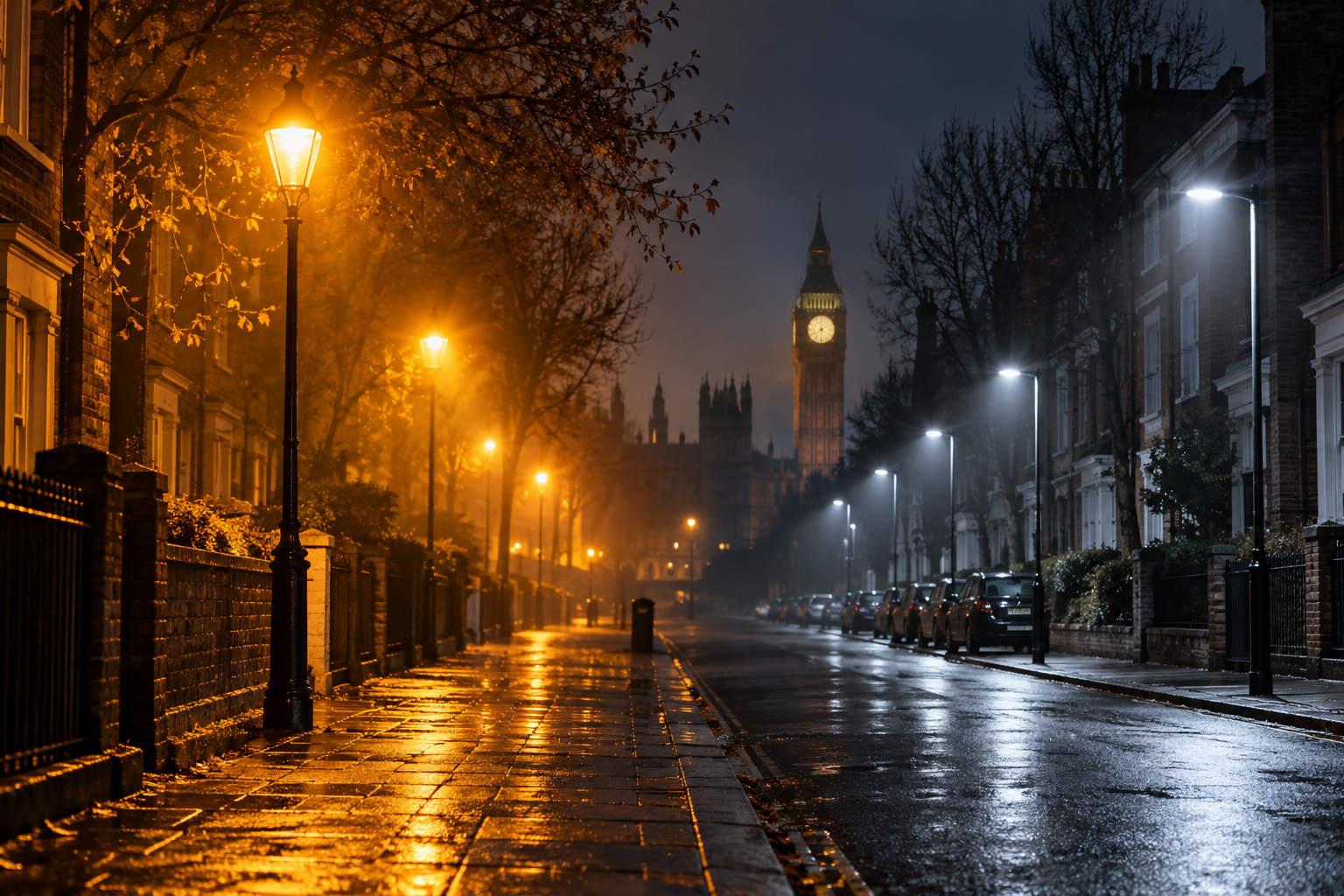
The pavement turned amber. Brickwork acquired a warm orange glow. Mist and drizzle caught the light and seemed to hang visibly in the air. Residential streets could have an almost dreamlike quality. Even an otherwise ordinary road sometimes looked strangely inviting.
Then, gradually, the colour changed.
Across London and much of Britain, traditional high-pressure sodium (HPS) streetlights have increasingly been replaced by LEDs. There are excellent practical reasons for the transition. LEDs can use less electricity, last longer, be dimmed electronically and direct their light much more precisely. They can also provide much better colour recognition, which has advantages for pedestrians, drivers and CCTV.
From an engineering perspective, LED streetlighting is an extraordinary improvement.
But something else changed with it.
The streets stopped looking quite so warm.
The Strange Comfort of Sodium Light
High-pressure sodium lighting has an extremely distinctive appearance. Rather than producing balanced white light, it is dominated by warm yellow and orange wavelengths.
Its colour rendering is poor by modern standards. Under sodium lighting, blues, greens and reds can become difficult to distinguish accurately. Human faces look unusual. Cars can appear to be different colours from what they actually are.
Yet the same technological deficiency created an extraordinarily powerful atmosphere.
Sodium light compressed the visual world into variations of amber, brown, gold and shadow.
In an old London street—with brick terraces, wet pavement, trees, fog and Victorian architecture—the effect could be beautiful.
And perhaps part of the reason is remarkably ancient.
A Streetlight That Looked a Little Like Fire
There is an obvious visual similarity between sodium lighting and firelight.
Candles, fireplaces and campfires all produce predominantly warm-looking illumination. High-pressure sodium is not spectrally identical to fire, of course, but psychologically the resemblance is difficult to miss.
That raises an intriguing question.
Could humans actually be predisposed to find warm light comforting?
There is a plausible biological argument, although it shouldn’t be exaggerated into a simple evolutionary story.
Humans and our ancestors have had a relationship with fire extending extraordinarily far into prehistory. Archaeological evidence for hominin fire use reaches back hundreds of thousands of years and potentially much further, although precisely when fire became habitual remains debated. Recent evidence from Barnham in Suffolk indicates that hominins were deliberately making fire around 400,000 years ago. Other archaeological evidence of hominin interaction with fire extends considerably further back.
Fire transformed human life.
It provided warmth, protection, cooking and illumination. Crucially, it also created a place around which people could gather after sunset.
For enormous stretches of human existence, meanwhile, the basic lighting cycle was nothing like that of a modern city.
Day meant sunlight.
Night meant darkness, moonlight—and eventually fire.
Your Eyes Know When It Is Night
Light does more than allow us to see.
It also communicates with the biological systems controlling our circadian rhythms.
Specialised cells in the retina containing the photopigment melanopsin contribute to regulating the body’s internal clock. This system is particularly sensitive to shorter-wavelength light in roughly the blue-cyan portion of the spectrum.
Exposure to sufficiently intense light at night can therefore influence circadian timing and melatonin production. The effect depends on considerably more than simply whether a lamp is “blue” or “yellow”: intensity, spectrum, duration, timing and previous light exposure all matter.
Nevertheless, there is a meaningful biological distinction between warm, low-blue evening illumination and blue-rich white illumination.
The natural environment itself contains a similar transition. Bright daylight provides powerful broad-spectrum illumination, whereas the visual environment after sunset becomes dramatically darker.
For most of human history, nobody walked from a sunlit afternoon into a world filled with thousands of powerful white electric lights.
The modern illuminated city is, biologically speaking, an extremely recent invention.
But Biology Isn’t the Whole Story
We should be careful here.
It would be tempting to say that warm streetlights feel comfortable simply because our prehistoric ancestors sat around campfires.
Human psychology is rarely that straightforward.
Much of our response to warm light is almost certainly cultural and learned as well.
Think about the environments in which warm lighting is deliberately used today.
A fireplace.
A candlelit restaurant.
A traditional pub.
A living room in the evening.
A bedside lamp.
A hotel lounge.
Restaurants and homes routinely use warm lighting precisely because people associate it with intimacy and relaxation.
Now consider where colder, brighter white illumination is commonly encountered.
Hospitals.
Offices.
Car parks.
Warehouses.
Supermarkets.
Security installations.
The distinction isn’t universal, but the associations are powerful.
Warm light says: settle in.
Cold, bright light often says: stay alert.
When sodium streetlighting disappeared, therefore, cities didn’t merely exchange one lamp technology for another. In many places they changed the psychological language of the nighttime environment.
Why LEDs Won Anyway
There are very good reasons cities embraced LEDs.
An LED luminaire can direct light toward the pavement and road far more precisely than many older lighting systems. That means less electricity can be wasted illuminating places where light isn’t required.
LEDs are highly efficient, have long service lives and can be electronically controlled. Councils can dim them during periods of low traffic rather than operating every streetlight at full output throughout the night.
Their white light also has an enormous practical advantage over sodium: colour rendering.
Under sodium illumination, colour information is severely compromised. Under a good-quality white LED, a pedestrian’s clothing, a vehicle, road markings and surrounding objects can be distinguished much more accurately.
That can also make LED illumination considerably more useful to colour CCTV cameras.
In other words, the move to LEDs wasn’t irrational.
The mistake is assuming that efficiency is the only quality worth designing for.
LED Doesn’t Have to Mean Cold
This is perhaps the most important part of the discussion.
An LED is not inherently cold white.
LED streetlights can be manufactured at many different correlated colour temperatures.
A 4000K LED can appear relatively neutral or cool. A 3000K LED is noticeably warmer. At around 2700K the appearance begins approaching familiar warm domestic illumination, while approximately 2200K LEDs can produce an extremely warm amber character.
Some British authorities already recognise this.
Dorset Council’s streetlighting specification, for example, calls for warm-white LEDs no higher than 2700K in several environmental zones, ideally lower, while other UK lighting guidance recommends 3000K or below and specifically identifies the 2200–2700K range as an option where warmer, low-blue lighting is appropriate.
Even the City of London’s lighting strategy recognises colour temperature as part of urban character. Its guidance describes using different colour temperatures according to the character and function of a place, including warmer illumination for historic streets and public spaces.
That is a much more sophisticated approach than simply asking:
Which lamp produces the required lux for the least electricity?
The better question is:
What should this place feel like at night?
What We Lost Wasn’t Necessarily the Lamp
There is another reason old sodium-lit London is difficult to reproduce.
The characteristic atmosphere didn’t come entirely from the colour of the bulb.
Older luminaires often scattered considerably more light into their surroundings. Sodium light hitting mist, drizzle, low cloud and airborne moisture produced the famous orange glow that once hung above many British towns and cities.
Modern LED luminaires can control their beams much more tightly.
From the perspective of light pollution, astronomy and energy efficiency, that is often an improvement.
But aesthetically, something disappears.
The old streetlight illuminated not merely the road but sometimes the air itself.
On a wet London evening, that difference can be enormous.
When Bad Colour Rendering Became Beautiful
There is an irony here.
One of the greatest technical disadvantages of sodium lighting may also have contributed to its charm.
Its poor colour rendering unified everything.
Brick, pavement, trees, parked cars and human faces were all pushed toward the same limited palette. The street became less colourful but perhaps more visually coherent.
Modern LEDs restore information.
You can see that the parked car is blue, the jacket is red and the front door is green.
Technically, this is superior illumination.
Aesthetically, however, accuracy isn’t always beauty.
A black-and-white photograph contains less colour information than a modern digital photograph. That does not make the black-and-white photograph artistically inferior.
Something similar can happen with lighting.
The sodium lamp distorted reality.
But it distorted it beautifully.
The Broader Problem With the Modern City
Streetlighting illustrates a much larger tension within modern society.
We have become extraordinarily good at optimising things that can be measured.
Energy consumption.
Lumens.
Maintenance intervals.
Visibility.
Operating costs.
Component lifespan.
Carbon emissions.
All of these measurements matter.
But human beings also experience qualities that are considerably harder to place in a spreadsheet:
Comfort.
Atmosphere.
Beauty.
Mystery.
Familiarity.
A sense of place.
A feeling that somewhere belongs to people rather than merely functioning efficiently around them.
Modernisation frequently produces genuine improvements while unintentionally removing these less measurable qualities.
A railway station becomes cleaner and brighter but somehow less grand.
A pub becomes safer and easier to maintain but loses its fireplace and dark wooden interior.
A high street becomes more accessible and functional while acquiring the same paving, signage and furniture as every other high street.
And a street becomes cheaper and more efficiently illuminated while losing the golden light that once made it unmistakably itself.
Perhaps Progress Doesn’t Have to Look White
The answer isn’t to reinstall inefficient old sodium lamps throughout London.
Technology has moved on.
The more interesting possibility is to use modern technology with a better understanding of human beings.
LEDs give lighting designers extraordinary control. They can determine intensity, direction, timing and colour far more precisely than previous generations could.
That should make it possible to create cities that are simultaneously efficient and atmospheric.
Residential streets do not necessarily require the same lighting character as major traffic junctions.
Historic districts do not necessarily need to look like railway platforms.
Pedestrian areas could use warmer light than major roads.
Lighting could become dimmer and warmer as the night progresses.
And perhaps urban planners should begin treating darkness itself as something worth designing rather than simply something to eliminate.
Some UK authorities are already moving toward warmer LEDs, demonstrating that the choice is not simply between old-fashioned sodium and harsh modern lighting.
A City Is Something We Feel
There is a tendency to discuss infrastructure as though humans experience cities through specification sheets.
We don’t.
We experience a city through rain reflecting from the pavement.
Through the colour of brick at dusk.
Through shadows beneath trees.
Through the glow coming from a pub window.
Through the walk home late at night.
And through the colour of the streetlight above us.
Perhaps that is why some people miss London’s old sodium lamps despite knowing perfectly well that LEDs are technologically superior.
They aren’t necessarily nostalgic for inefficient light bulbs.
They are nostalgic for an atmosphere.
There may be something culturally learned in that feeling. There may even be something considerably older—an association between warm light, darkness, shelter and the extraordinarily long relationship between humans and fire.
We should be cautious about claiming we can separate those influences neatly.
But perhaps we don’t need to.
The important lesson is simpler.
Efficiency tells us how well a streetlight works. It does not tell us what it feels like to live beneath it.
The best cities of the future should understand both.
Leave a Reply