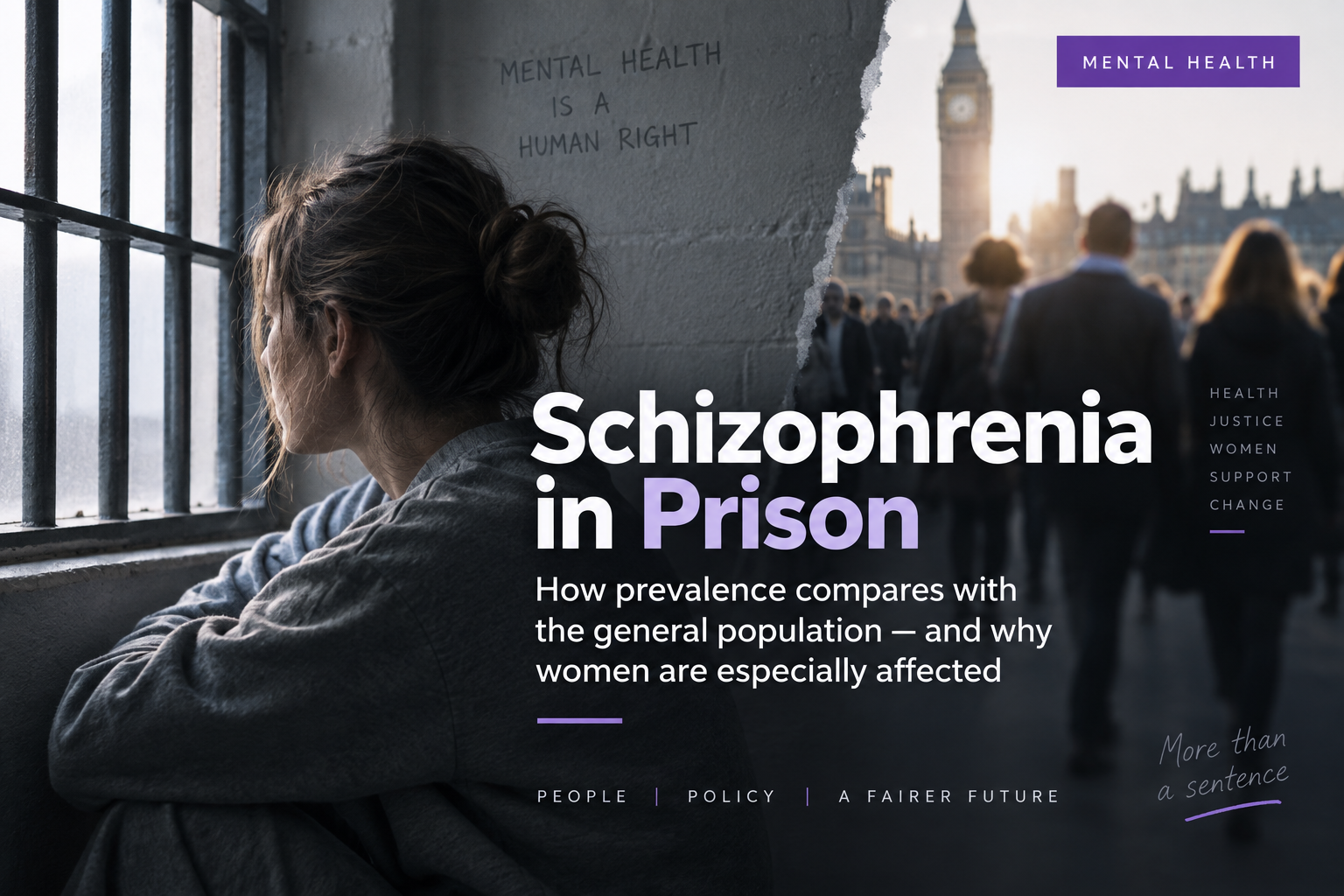
Mental Health & Criminal Justice
Schizophrenia in Prison: How Prevalence Compares with the General Population — and Why Women Are Especially Affected
Severe mental illness is substantially over-represented in prisons. The disparity is particularly pronounced among women, who make up only a small proportion of the prison population but experience exceptionally high levels of mental ill-health, trauma and self-harm.
The headline finding
The gap between prisons and the wider population is substantial. In the major Office for National Statistics study of psychiatric morbidity among prisoners in England and Wales, approximately 14% of women in prison had experienced a functional psychosis during the previous year. Within the clinically interviewed group, approximately 13% were identified as having schizophrenia or a delusional disorder.
By comparison, psychotic disorders affect well below 1% of adults living in ordinary households. The latest Adult Psychiatric Morbidity Survey for England estimates past-year psychotic disorder at approximately 0.5% of adults overall, including approximately 0.6% of women.
Caution: the 14% prison figure and contemporary 0.6% community figure come from different surveys conducted in different periods. They illustrate the scale of the disparity but should not be treated as a precise like-for-like calculation of risk.
How do prisoners compare with people outside prison?
| Population / measure | Reported prevalence | What the figure means |
|---|---|---|
| Women in prison | 14% | Functional psychosis during the previous year in the landmark ONS England & Wales prison survey. |
| Men on remand | 10% | Functional psychosis during the previous year. |
| Sentenced men | 7% | Functional psychosis during the previous year. |
| Women in the general population | 0.6% | Recent pooled estimate of past-year psychotic disorder among women living in private households in England. |
| Adults overall in the general population | 0.5% | Recent pooled estimate of past-year psychotic disorder among adults in England. |
Although differences in study design prevent a simple mathematical comparison, the conclusion is difficult to miss: psychotic illness is many times more common among people in prison than among people living in the community, and historically the highest prison rates have been found among women.
Women in prison: a particularly vulnerable population
Women make up only a small minority of people held in prisons in England and Wales, but their mental-health needs are disproportionately high. Contemporary prison data continue to show this pattern. Recent Prison Reform Trust figures report that almost three-quarters of surveyed women in prison say that they have mental-health problems.
Research comparing male and female prisoners has also repeatedly found higher levels of mental-health need and greater psychiatric comorbidity among women. A 2019 UK prison study, for example, found that women reported significantly higher levels of mental-health need than men and were more likely to screen positively for multiple disorders.
Why the female prison population requires particular attention
The issue is not simply the number of women diagnosed with a particular psychiatric condition. Women entering custody frequently have overlapping needs involving severe mental illness, depression and anxiety, substance dependence, histories of trauma and abuse, self-harm, unstable housing and disrupted family relationships. These conditions can interact, making both diagnosis and treatment more complex.
Schizophrenia specifically
Schizophrenia is a severe, long-term mental-health condition that can affect a person’s thoughts, perceptions, emotions and behaviour. Symptoms may include hallucinations, delusions, disorganised thinking, reduced motivation and difficulties with everyday functioning.
The most frequently cited schizophrenia-specific evidence for female prisoners in England and Wales comes from the ONS psychiatric morbidity research. In its clinical assessment of women prisoners, approximately 13% were identified as having a schizophrenic or delusional disorder. Approximately 3% were classified specifically with schizophrenia, while the wider 13% category included other delusional disorders.
This distinction matters. Statements such as “14% of women prisoners have schizophrenia” are not supported by this dataset. The 14% figure relates to functional psychosis as a whole, not schizophrenia alone.
Is this still a problem today?
The most detailed national diagnostic study of schizophrenia among women prisoners is now old, which is itself an important limitation in the evidence base. However, newer information does not suggest that serious mental illness has ceased to be a major prison-health issue.
A recent analysis of mental-health caseloads covering around three-quarters of English prisons found that psychosis accounted for approximately 22% of the primary problems among patients on prison mental-health caseloads. This figure must not be interpreted as saying that 22% of all prisoners have psychosis: it describes people already receiving or identified for mental-health services. Nevertheless, it demonstrates the continuing demand that psychotic illness places on prison mental-health teams.
Recent surveys have also found that approximately 74% of women in prison report having mental-health problems, compared with 56% of men surveyed. Women consequently remain a group with particularly complex health and social-care needs.
Why is severe mental illness over-represented in prisons?
There is no single explanation. Prison populations are not randomly selected sections of society. Many of the social and health factors associated with contact with the criminal-justice system also overlap with factors associated with poor mental health.
- Social disadvantage: poverty, insecure housing and homelessness are disproportionately represented among people entering custody.
- Trauma and abuse: histories of violence, neglect, domestic abuse and sexual abuse are common among women who enter the criminal-justice system.
- Substance use: drug and alcohol dependence can coexist with schizophrenia and other psychotic disorders, complicating both symptoms and treatment.
- Breakdown of community support: people with severe mental illness may reach the criminal-justice system after difficulties obtaining stable housing, treatment or social support.
- Remand and crisis: prisons can receive people who are acutely mentally unwell while they are awaiting trial or assessment.
- The prison environment itself: isolation, uncertainty, disrupted relationships, sleep difficulties and the stresses of incarceration may aggravate existing psychiatric symptoms.
Trauma, self-harm and women
Looking only at schizophrenia risks overlooking the broader context in which severe mental illness occurs. Women in prison are also disproportionately affected by trauma and self-harm.
Recent prison statistics show that women account for a strikingly disproportionate share of self-harm incidents despite representing only around 4% of the prison population in England and Wales. This does not mean schizophrenia causes self-harm, but it illustrates the exceptionally high level of distress and complex need within the female estate.
For women with psychosis or schizophrenia, these overlapping vulnerabilities can make continuity of care particularly important. A prison sentence or period on remand can interrupt housing, family support, benefits, community psychiatric care and established therapeutic relationships.
Prison or healthcare?
The high prevalence of severe mental illness in custody raises a fundamental question: are some people with serious psychiatric disorders being dealt with primarily through the criminal-justice system when healthcare and community-based intervention would sometimes be more appropriate?
This is particularly relevant to women because many are imprisoned for relatively low-level or non-violent offending and because a significant proportion of the female prison population is held on remand. Prison Reform Trust research has highlighted cases in which severely mentally unwell women have entered custody while in crisis, including concerns about the historical use of prison as a place of safety.
Effective responses therefore extend beyond providing medication after somebody arrives in prison. They include early identification, court diversion and liaison services, timely psychiatric assessment, access to psychological treatment, transfer to appropriate hospital care where necessary, safe accommodation and continuity of treatment after release.
What should we conclude?
The central finding is clear: severe mental illness and psychotic disorders are substantially over-represented in prisons compared with the community, and women in prison show an especially high burden of mental-health need.
The classic national research found functional psychosis in around 14% of women prisoners and schizophrenia or delusional disorder in around 13% of the clinically assessed female sample. Contemporary population research, by contrast, places past-year psychotic disorder below 1% among women living in private households.
The precise figures should be interpreted cautiously because diagnostic definitions and research methods have changed over time. What has not disappeared is the underlying disparity. More recent studies and prison-health data continue to find exceptionally high levels of mental illness among people in custody and greater levels of need among women.
For policy, this suggests that schizophrenia and psychosis in prisons cannot be treated solely as issues of prison management. They are also questions of public health, social inequality, trauma, access to psychiatric services, diversion from custody and continuity of care.
A note on UK figures
Criminal justice and health systems differ across England and Wales, Scotland and Northern Ireland. The most robust national prison figures cited in this article relate primarily to England and Wales, while some later research is described as UK prison research. It is therefore more accurate to describe these figures by jurisdiction rather than assuming a single prevalence rate applies uniformly to every prison in the United Kingdom.
Sources and further reading
- Office for National Statistics / O’Brien et al. — Psychiatric Morbidity among Women Prisoners in England and Wales. Landmark national research measuring psychosis, schizophrenia, personality disorder and other psychiatric morbidity among women prisoners.
- NHS England Digital. — Adult Psychiatric Morbidity Survey: Survey of Mental Health and Wellbeing, England, 2023/24 — Chapter 12: Psychotic Disorder.
- Tyler, N., Miles, H. L., Karadag, B. & Rogers, G. (2019). — An updated picture of the mental health needs of male and female prisoners in the UK: prevalence, comorbidity, and gender differences. Social Psychiatry and Psychiatric Epidemiology, 54, 1143–1152. DOI: 10.1007/s00127-019-01690-1.
- Prison Reform Trust. — Health in Prison. Current overview of mental-health needs within prisons in England and Wales.
- Durcan, G. / Centre for Mental Health (2023). — Prison mental health services in England, 2023: Prison and young offender institution mental health needs analysis.
- Prison Reform Trust (2025–2026). — Publications concerning women in prison, remand, mental health, self-harm and approaches to reducing women’s imprisonment.
Leave a Reply