Abstract
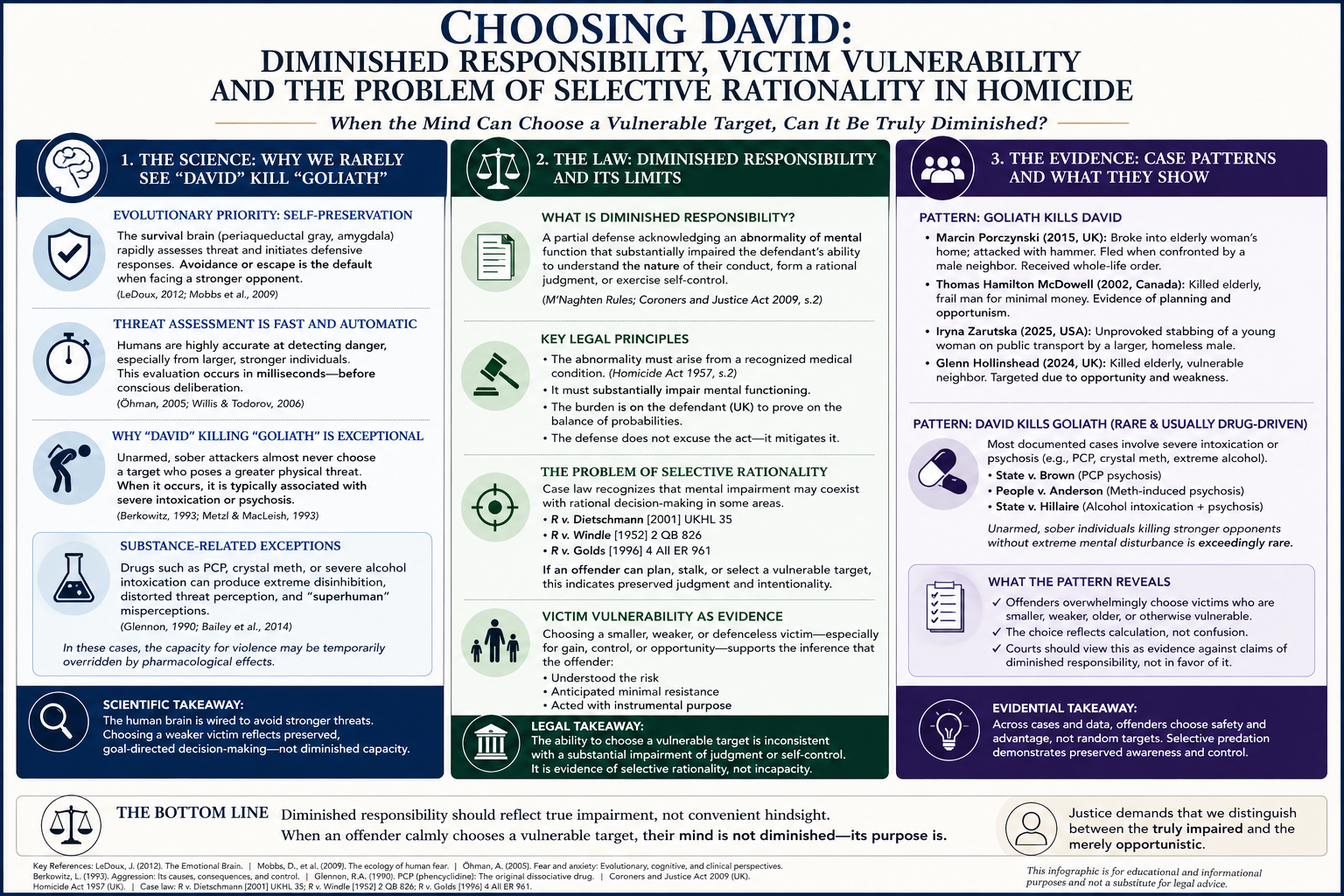
The partial defence of diminished responsibility asks one of criminal law’s most difficult questions: when does mental disorder diminish responsibility for an intentional killing sufficiently to reduce murder to manslaughter?
This article considers a comparatively neglected evidential problem. What significance should be attached to an offender who, while allegedly suffering a substantial impairment of rational judgment or self-control, nevertheless appears capable of distinguishing dangerous people from vulnerable ones?
Cases in which a physically capable offender attacks a smaller, weaker, isolated or otherwise vulnerable victim can create an uncomfortable apparent contradiction. The offender may behave irrationally in deciding that somebody must be attacked, yet apparently rationally in selecting a person least capable of resisting. Conversely, some exceptional offenders experiencing severe mental disturbance behave with little apparent regard for their own safety, attacking stronger opponents, rescuers or strangers, exposing themselves to traffic or serious injury, or otherwise displaying a striking breakdown in ordinary threat avoidance.
This article calls the problem selective rationality.
It argues that choosing a vulnerable victim cannot, by itself, disprove diminished responsibility. Severe mental illness is compatible with retained practical abilities, and English law does not require an offender to be irrational in every sphere of thought. Nevertheless, evidence of threat discrimination, victim selection, planning, avoidance of stronger resistance and other self-protective conduct may legitimately bear upon the statutory questions of whether the defendant’s ability to form a rational judgment or exercise self-control was substantially impaired.
The argument is tested against R v Byrne, R v Golds, the killings committed by Marcin Porczynski and Thomas McDowell, and the unusually disorganised behaviour of Sabina Eriksson before and after her killing of Glenn Hollinshead. The article also considers the killing of Iryna Zarutska, while emphasising that current competency proceedings in the United States cannot properly be equated with English diminished responsibility.
Its ultimate argument is modest but important: vulnerability-sensitive behaviour should be treated as evidence about impairment, not as a substitute for psychiatric diagnosis and not as an automatic bar to diminished responsibility.
1. The uncomfortable question
Imagine two defendants.
The first believes, as a consequence of psychosis, that certain strangers are evil and must be killed. He approaches one potential victim but retreats when confronted by a large and physically imposing man. Shortly afterwards he encounters a substantially smaller person, attacks and kills her, then flees when police arrive.
The second defendant experiences an equally severe psychosis but behaves very differently. He attacks a person considerably larger than himself with his bare hands, continues despite being injured, attacks people attempting to help him, runs into moving traffic and makes no apparent effort to escape detection.
Both defendants may be profoundly mentally ill.
But are their respective behaviours equally informative about their capacities for rational judgment and self-control?
The instinctive answer may be no.
The first offender appears capable of evaluating physical danger, modifying behaviour accordingly and exploiting comparative vulnerability. The second appears to have suffered a much broader collapse of ordinary threat appraisal and self-preservation.
Yet criminal law should be cautious about that intuition.
It is tempting to reason backwards from apparently purposeful behaviour to mental normality. That inference can be profoundly misleading. A person suffering from schizophrenia may hold bizarre delusional beliefs while retaining the ability to cross a road safely, recognise a police officer, operate a telephone, unlock a door or run from somebody threatening him.
Mental functioning is not necessarily all-or-nothing.
The question therefore is not:
“If the offender could recognise a weaker victim, how could he possibly have diminished responsibility?”
It is instead:
“What evidential significance, if any, should vulnerability-sensitive behaviour have when deciding whether the particular capacities identified by the law were substantially impaired?”
That distinction is fundamental.
2. What diminished responsibility actually requires
Diminished responsibility in England and Wales is governed by section 2 of the Homicide Act 1957, substantially reformulated by section 52 of the Coroners and Justice Act 2009.
A defendant must establish an abnormality of mental functioning arising from a recognised medical condition. That abnormality must substantially impair the defendant’s ability to do one or more of three things:
- understand the nature of his conduct;
- form a rational judgment; or
- exercise self-control.
The abnormality must additionally provide an explanation for the killing by causing, or significantly contributing to, the defendant’s conduct.
The burden of establishing diminished responsibility rests upon the defendant on the balance of probabilities.
The modern test therefore does not ask the scientifically imprecise question whether an offender was simply “mad”. Nor does diagnosis alone determine criminal responsibility.
The law asks a more functional question: what did the recognised condition substantially impair?
This distinction becomes particularly important when an offender’s behaviour displays a mixture of the rational and irrational.
A delusion might provide an utterly irrational reason for attacking someone while leaving intact the practical capacity to determine how, where or against whom an attack can most safely be carried out.
That possibility creates the problem of selective rationality.
3. R v Byrne: rationality and control are separable
The intellectual ancestry of the modern defence includes R v Byrne [1960] 2 QB 396.
Patrick Byrne strangled a young woman and mutilated her body. Psychiatric evidence described abnormal sexual impulses which he had extreme difficulty controlling. The Court of Criminal Appeal held that the former statutory concept of “abnormality of mind” extended beyond intellectual understanding and encompassed the ability to exercise willpower over physical conduct.
The importance of Byrne extends beyond its disturbing facts.
It demonstrates that criminal responsibility cannot be assessed simply by asking whether an offender possessed some rational capacity.
A person might know what he is doing, appreciate aspects of its wrongfulness and nevertheless possess a severely impaired capacity to control himself.
The modern legislation effectively disaggregates these capacities. Understanding conduct, rational judgment and self-control are expressly identified rather than submerged within a general assessment of “mental responsibility”.
That structure is an immediate difficulty for any simplistic vulnerability-selection theory.
If an offender selects a physically weaker victim, that might demonstrate practical judgment. It does not necessarily demonstrate unimpaired self-control.
Likewise, avoiding a physically dangerous opponent might demonstrate intact appreciation of immediate physical risk while telling us considerably less about the rationality of a psychotic belief which produced the desire to attack in the first place.
The relevant capacities overlap, but they are not identical.
4. R v Golds: “substantial” must mean something
The modern Supreme Court authority of R v Golds [2016] UKSC 61 provides particularly important support for treating observable behaviour seriously.
The Supreme Court emphasised that the statutory requirement of substantial impairment represents a genuine threshold. The existence of some impairment does not automatically establish diminished responsibility.
More importantly for the present argument, the Court recognised that circumstances such as pre-planning and meticulous preparation may provide grounds for rejecting expert opinion that self-control was substantially impaired.
That observation has significant implications.
If planning may constitute behavioural evidence relevant to the degree of impairment, there is no obvious conceptual reason why other forms of purposeful behaviour must be excluded.
Consider:
avoiding a person capable of overpowering the offender;
waiting until a victim is alone;
selecting an isolated victim;
abandoning an attempted attack when resistance appears;
choosing a substantially less physically capable victim shortly afterwards;
obtaining a weapon before returning;
concealing evidence;
or immediately changing behaviour when police arrive.
None proves sanity.
None necessarily disproves substantial impairment.
But neither should such behaviour automatically be treated as irrelevant merely because psychiatric evidence establishes the presence of a recognised disorder.
Indeed, the Sentencing Council’s guideline for manslaughter by reason of diminished responsibility separately recognises targeting a victim because of actual or perceived vulnerability as a factor capable of increasing culpability.
The criminal law therefore already acknowledges that vulnerability-sensitive conduct can tell us something important about culpability.
The unresolved question is how much it should tell us about impairment itself.
5. The Porczynski problem
The killing of Nicola Cross by Marcin Porczynski provides a particularly difficult example.
Porczynski was suffering from paranoid schizophrenia. Evidence before the court indicated that he had been hearing voices and believed children needed to be “freed” from mistreatment. He wandered around his neighbourhood asking whether houses contained children.
On 14 September 2015 he attempted to enter homes in Hemel Hempstead.
After police had encountered and released him, Porczynski returned to the area carrying a small knife. He initially smashed the patio door of the wrong house. A male occupant confronted him and demanded to know what he was doing.
Porczynski ran away.
Shortly afterwards he smashed his way into the neighbouring Cross household.
Inside was 37-year-old Nicola Cross with her two children. Porczynski obtained a larger knife from the kitchen, went upstairs and fatally stabbed Cross as she attempted to prevent him reaching her children.
His plea to manslaughter by reason of diminished responsibility was accepted. He was suffering from paranoid schizophrenia and was subsequently detained indefinitely in a secure psychiatric hospital.
The case creates precisely the evidential problem considered in this article.
One possible interpretation is deeply troubling.
Porczynski encountered resistance from an adult man and retreated. He subsequently entered another home occupied by a woman and young children and committed lethal violence.
Viewed superficially, that sequence looks like elementary threat discrimination:
dangerous resistance → retreat; weaker resistance → attack.
But that interpretation should not be converted into a factual conclusion the evidence cannot establish.
Porczynski may not have consciously compared the physical characteristics of potential victims at all. His behaviour may instead have reflected the changing content of his delusions, immediate circumstances, accessibility of children, fear, surprise or any number of factors inaccessible to an observer.
More importantly, even successful threat discrimination would not prove that his schizophrenia was somehow inoperative.
The case instead illustrates a narrower proposition.
Severe psychosis and retained self-protective decision-making can coexist.
That fact should prevent two opposite errors.
The first is assuming that purposeful conduct disproves psychosis.
The second is assuming that a diagnosis of psychosis renders purposeful conduct irrelevant to the statutory assessment of substantial impairment.
Both propositions are too strong.
6. McDowell: when diminished responsibility is rejected
Thomas Hamilton McDowell provides a useful contrast.
McDowell killed Andreas Hinz in 2002 after meeting him in a Camden bar. Hinz was strangled and his body subsequently dismembered.
McDowell admitted the killing and advanced manslaughter on the basis of diminished responsibility. The prosecution rejected the plea.
At trial the Crown characterised him as a controlled and predatory psychopath who knew what he was doing. A jury unanimously convicted him of murder.
The case demonstrates an important limitation upon psychiatric evidence.
The presence of serious personality pathology does not determine the legal conclusion.
Behaviour before, during and after a homicide remains relevant because diminished responsibility is ultimately a legal judgment informed by — but not surrendered to — psychiatry.
McDowell therefore provides a useful comparison with Porczynski.
Both cases involve defendants for whom psychiatric abnormality was important. Their legal outcomes were nevertheless different because the existence of abnormality and the legal question of substantial impairment are not synonymous.
7. Sabina Eriksson: the opposite pattern
If Porczynski raises the question of preserved threat discrimination, Sabina Eriksson presents something approaching its behavioural opposite.
In May 2008, Sabina Eriksson and her identical twin Ursula displayed extraordinarily dangerous behaviour on the M6 motorway.
Their conduct included repeatedly entering fast-moving traffic. Both suffered serious collisions. Sabina resisted police and continued behaving irrationally.
After later encountering 54-year-old Glenn Hollinshead in Stoke-on-Trent, she accepted his offer of accommodation.
She subsequently stabbed him to death.
Her behaviour afterwards was scarcely more self-protective. Witnesses saw her striking herself with a hammer before she jumped approximately 40 feet from a bridge onto the A50.
Eriksson pleaded guilty to manslaughter by reason of diminished responsibility. The prosecution accepted the plea.
This case is valuable because the surrounding behaviour looks strikingly different from calculated vulnerability selection.
Running into motorway traffic is difficult to reconcile with ordinary self-preservation. So is serious self-injury. Jumping from a bridge while fleeing provides further evidence of profoundly abnormal danger appraisal.
Hollinshead was an adult male and Eriksson a woman. But the case should not be exaggerated into a perfect “David kills Goliath” example.
Eriksson used a knife.
A weapon can radically alter a physical power imbalance. Consequently the homicide itself does not establish that a physically weaker, unarmed offender irrationally attacked a much stronger opponent.
Nevertheless, her broader behaviour is highly significant.
Where Porczynski’s conduct can be read as containing elements of danger avoidance, Eriksson’s behaviour provides dramatic evidence of danger indifference.
That distinction may be more useful than the sex or physical size of either victim.
8. The elusive true “David versus Goliath” homicide
The original hypothesis underlying this article began with an observation:
cases in which an offender attacks a smaller, weaker or more vulnerable victim appear intuitively common, whereas cases in which an unarmed, sober and substantially weaker offender spontaneously attacks and kills a much stronger person appear much harder to identify.
If such a case occurred during severe psychosis, it might appear particularly compelling evidence of radically impaired threat assessment.
But there is presently an important evidential difficulty.
The literature does not appear to contain a sufficiently developed dataset comparing the relative height, weight, strength and weapon status of psychotic homicide offenders and their victims.
Consequently, it would be irresponsible to claim that “David almost never attacks Goliath”.
That proposition remains a hypothesis.
More importantly, research into stranger homicide during psychosis complicates any assumption that psychotic offenders characteristically select physically vulnerable women.
A major study of stranger homicide during psychosis reported that stranger victims were mostly adult males.
A 2022 Finnish study examining 389 psychotic homicide offenders responsible for 414 homicides found 40 complete-stranger victims — approximately 9.7 per cent. Including victims known for less than 24 hours raised the proportion to 13.3 per cent.
A systematic review and meta-analysis published in 2026 examined 1,438 psychotic homicide perpetrators and identified 177 stranger victims. Its pooled estimate was approximately 12.7 per cent.
These findings matter.
Sensational stranger killings involving mentally ill defendants can dominate public perception, but they are not representative of homicide committed during psychosis as a whole.
Nor does the available evidence establish a general rule that psychotic offenders preferentially attack physically weaker strangers.
The David-and-Goliath hypothesis therefore remains a question worthy of empirical investigation, rather than an established criminological fact.
9. Self-preservation without the “lizard brain”
There is an attractive evolutionary explanation for vulnerability-sensitive offending.
Humans, like other animals, possess powerful systems for detecting threats and avoiding injury. An offender who retreats from a physically formidable opponent but attacks a weaker person may therefore appear to demonstrate that some primitive survival mechanism remains perfectly functional despite an asserted mental disorder.
Popular discussion sometimes attributes this to the “reptilian” or “lizard” brain.
That terminology should be avoided.
The older triune-brain model, in which evolution supposedly placed a rational human brain on top of a mammalian emotional brain and an ancient reptilian survival brain, does not accurately describe contemporary neuroscience.
Threat processing emerges from interacting neural systems. Mental illness likewise does not simply switch the rational brain off while leaving an autonomous reptilian survival computer underneath.
A more defensible concept is preserved threat discrimination.
An offender may possess:
- distorted beliefs about why another person is dangerous;
- impaired reasoning about moral or social reality;
- hallucinations influencing conduct;
while simultaneously retaining:
- recognition that a larger opponent presents greater immediate physical danger;
- the ability to flee;
- the ability to conceal himself;
- the capacity to use tools;
- awareness that police represent a threat to his liberty;
- and the ability to modify behaviour when circumstances change.
Psychosis does not necessarily abolish every domain of rational cognition simultaneously.
This is precisely why selective rationality deserves attention.
10. Rationality about means versus rationality about ends
The central distinction can be expressed philosophically as one between ends and means.
Suppose a psychotic defendant believes:
A supernatural force has ordered me to rescue children from demons disguised as their parents.
The end is delusionally generated.
The defendant then decides:
I cannot enter that house because the large man inside will overpower me. I will go next door instead.
The means may be instrumentally rational.
The defendant can therefore reason rationally within an irrational premise.
This phenomenon is hardly unique to psychosis. Human beings routinely reason competently from false premises.
If:
A is believed to be true,
and
if A were true, B would logically follow,
a person may reason impeccably from A to B even though A is completely false.
Consequently, successful victim selection does not necessarily establish unimpaired rational judgment in the legal sense.
But it does establish something.
It demonstrates that certain capacities for instrumental reasoning, risk assessment and behavioural adaptation survived.
The legal question should be how that surviving capacity relates to the particular impairment alleged by the defence.
11. A proposed concept: vulnerability-sensitive conduct
Rather than treating relative physical strength as a new legal test, courts could conceptualise a broader category of vulnerability-sensitive conduct.
Relevant behaviour might include evidence that the defendant:
- abandoned an attack when confronted with unexpectedly strong resistance;
- preferentially approached victims perceived as physically weaker;
- waited for potential protectors to leave;
- deliberately isolated the victim;
- armed himself after discovering that an intended victim could resist;
- changed targets following resistance;
- selected circumstances minimising personal danger;
- stopped or changed behaviour immediately upon the arrival of police;
- took sophisticated steps to avoid identification or apprehension.
No single factor establishes normal mental functioning.
Their cumulative significance could nevertheless be considerable.
The important question would remain statutory:
What does this behaviour tell the fact-finder about the defendant’s ability to form rational judgments or exercise self-control at the relevant time?
This approach would be consistent with Golds.
If meticulous preparation can provide a rational evidential basis for questioning substantial impairment, sophisticated vulnerability-sensitive conduct should at least be capable of doing the same.
12. Vulnerability selection should not become a pseudo-diagnostic test
There is an obvious danger in the argument.
Jurors could begin reasoning:
He chose a small woman rather than a large man; therefore he cannot have been seriously mentally ill.
That conclusion would be scientifically unjustified and legally wrong.
The proposed approach must therefore distinguish diagnosis from functional impairment.
Target selection should never be used by lay fact-finders to diagnose or exclude schizophrenia, bipolar disorder, psychotic depression or another recognised medical condition.
Instead, once expert evidence establishes the relevant condition, observable conduct can assist the jury in deciding the separate legal questions concerning its functional consequences.
The distinction is subtle but essential:
Bad inference:
“He avoided danger, therefore he wasn’t psychotic.”
Potentially legitimate inference:
“He avoided danger through apparently sophisticated reasoning. How does that behaviour affect the claim that his capacity for rational judgment or self-control was substantially impaired?”
The psychiatrist and jury answer different questions.
Psychiatry identifies and explains pathology.
Criminal law determines responsibility.
13. Drugs, violence and apparent fearlessness
Another complication concerns intoxication.
Popular culture contains numerous stories of people intoxicated with phencyclidine (PCP), methamphetamine or other stimulants displaying extraordinary aggression, apparent insensitivity to pain or reckless confrontation with much larger opponents.
Some of this mythology exceeds the evidence.
Nevertheless, PCP intoxication can produce severe agitation, psychosis, analgesia and dangerously disorganised behaviour. Published clinical literature includes homicide and severe self-injury associated with PCP intoxication.
Amphetamine use is likewise associated at population level with increased risks of psychosis and violence.
Such cases complicate the David-and-Goliath hypothesis because apparently irrational disregard for physical danger need not result from an underlying psychiatric disorder capable of founding diminished responsibility. Acute intoxication may provide an alternative explanation.
For that reason, the theoretically cleanest test case would be unusually specific:
a sober, unarmed, substantially physically weaker offender who, while suffering a recognised mental disorder, initiates lethal violence against a substantially stronger victim despite an obvious physical disadvantage.
A well-documented case meeting all those conditions would provide an unusually powerful test of the relationship between mental disorder and self-preservation.
No sufficiently documented English authority meeting every one of those conditions has been identified for this article.
That absence must not be mistaken for proof that such events do not occur.
It identifies a gap in the evidence.
14. The killing of Iryna Zarutska: an important warning about comparative law
The 2025 killing of Iryna Zarutska aboard a Charlotte, North Carolina light-rail train has inevitably entered public discussion about severe mental illness and apparently unprovoked homicide.
But it should not presently be described as a diminished-responsibility case.
DeCarlos Brown Jr has been charged with Zarutska’s killing. In June 2026 a federal judge found him incompetent to stand trial at that time and ordered treatment. Public reporting records a history of schizophrenia and bizarre beliefs.
Competency to stand trial, however, concerns the defendant’s present ability to understand proceedings and assist his lawyers.
It does not determine his criminal responsibility at the time of the killing.
Nor is North Carolina’s law equivalent to the partial defence of diminished responsibility operating in England and Wales.
The case therefore illustrates an important methodological warning.
Terms such as:
mental illness,
psychosis,
incompetency,
insanity,
diminished capacity,
and diminished responsibility
are not interchangeable.
A responsible comparative analysis must identify precisely which legal doctrine is operating in each jurisdiction.
At the time of writing, Brown’s competency finding cannot establish what legal effect, if any, his mental condition will ultimately have upon criminal responsibility for Zarutska’s death.
15. A spectrum of behavioural organisation
The argument can now be reformulated without relying on physical size alone.
At one end of a hypothetical spectrum lies highly organised, vulnerability-sensitive violence:
threat encountered → danger assessed → stronger resistance avoided → weaker opportunity selected → attack executed → detection avoided.
At the opposite end lies globally disorganised violence:
danger ignored → stronger opponents attacked → serious injury disregarded → rescuers attacked → escape opportunities ignored → self-injury or extreme physical risk undertaken.
Porczynski contains behavioural features potentially closer to the first pattern.
Eriksson contains extraordinary features of the second.
McDowell demonstrates that fact-finders can reject diminished responsibility where psychiatric abnormality coexists with evidence interpreted as controlled or predatory conduct.
But this spectrum should not become an alternative statutory defence.
It is an evidential framework.
The ultimate question remains whether the recognised medical condition substantially impaired one or more of the capacities Parliament identified.
16. Why victim vulnerability matters morally as well as medically
There is also a social-justice dimension.
The criminal law properly seeks to avoid punishing severely mentally disordered offenders as though their choices were entirely unimpaired.
But justice operates in more than one direction.
Victims who are selected because they are isolated, elderly, disabled, physically weaker or otherwise vulnerable possess an equal claim to legal recognition.
There is something morally uncomfortable about a system that might treat sophisticated exploitation of vulnerability as irrelevant once psychiatric abnormality has been established.
English sentencing law implicitly recognises the problem. The Sentencing Council’s diminished-responsibility manslaughter guideline provides that culpability may be increased where an offender targeted a victim because of actual or perceived vulnerability.
That principle deserves greater theoretical attention.
If exploitation of vulnerability matters when determining culpability after diminished responsibility has succeeded, it is reasonable at least to ask whether the behaviour producing that vulnerability-sensitive selection tells us anything about the degree of functional impairment before the defence succeeds.
The answer will sometimes be no.
Sometimes it may be highly significant.
The law should permit the question to be asked.
17. Self-critique: objections to the argument
A theory concerned with mental illness and violence must be particularly willing to expose its own weaknesses.
17.1 Physical size is a crude proxy for vulnerability
A smaller person is not necessarily weaker.
Age, fitness, disability, fighting experience, surprise, weapons, environment and numerical advantage may matter considerably more than height or body mass.
The phrase “David and Goliath” is therefore useful rhetorically but inadequate scientifically.
The better concept is perceived vulnerability or resistance, not physical size alone.
17.2 The hypothesis risks hindsight bias
After a homicide, observers know which encounter became fatal.
It becomes tempting to construct a rational sequence retrospectively.
An offender who runs from one house and attacks somebody in another may appear to have “selected” the second victim when no conscious comparison occurred.
Courts would need affirmative evidence of discrimination rather than merely imposing a narrative upon chaotic behaviour.
17.3 Psychosis is not global irrationality
This is the strongest objection.
A person can be profoundly psychotic while retaining numerous ordinary abilities.
Recognising that a large angry man represents physical danger therefore does not establish that the psychotic process made an insignificant contribution to homicide.
The argument of this article consequently cannot support an automatic exclusion rule.
17.4 Instrumental rationality is not moral rationality
A defendant can efficiently pursue an insane objective.
Choosing the safest method of obeying a hallucinated divine command does not make the command rational.
Evidence of rational means must therefore be related carefully to the precise statutory capacity said to be impaired.
17.5 Self-preservation varies among healthy people
People without mental illness sometimes fight stronger opponents.
They may do so through anger, loyalty, desperation, miscalculation, courage or impulsivity.
Conversely, choosing weaker opponents can reflect cowardice or opportunism without telling us anything clinically meaningful.
Threat behaviour therefore has substantial individual variation.
17.6 Weapons distort physical comparisons
A knife, firearm or improvised weapon can instantly reverse a physical disadvantage.
Any empirical study of “David versus Goliath” homicide would have to control rigorously for weapon possession.
17.7 Substance use is a major confounder
Alcohol, stimulants and dissociative drugs can alter inhibition, pain perception, paranoia and threat assessment.
A serious empirical investigation would therefore require reliable toxicological evidence rather than assumptions based upon witness descriptions.
17.8 Reported cases are not a representative sample
Spectacular stranger murders attract disproportionate media coverage.
Most homicide involving psychosis does not resemble the highly publicised cases discussed here.
The empirical literature demonstrates that stranger homicide by people with psychosis remains uncommon.
Any theory derived primarily from exceptional cases risks selection bias.
17.9 The argument could inadvertently stigmatise mental illness
The overwhelming majority of people experiencing psychosis do not commit homicide.
People with serious mental illness are also themselves disproportionately vulnerable to violence.
Discussing psychosis predominantly through notorious killings can reinforce an inaccurate association between schizophrenia and predatory violence.
That risk requires explicit acknowledgement.
The purpose of this analysis is therefore not to identify mentally ill people as dangerous. It is to examine the much narrower population in which homicide has already occurred and diminished responsibility has become a legal issue.
17.10 Behaviour may be easier to interpret than it really is
The greatest methodological danger is epistemic confidence.
A person running away appears afraid.
A person selecting an isolated victim appears calculating.
A person jumping from a bridge appears indifferent to survival.
Those interpretations may often be reasonable.
But external behaviour does not provide transparent access to internal cognition.
Psychiatric evidence remains indispensable.
18. What evidence would actually test the hypothesis?
The argument presented here ultimately requires empirical testing.
A useful study would examine a substantial cohort of homicide offenders subjected to forensic psychiatric assessment and code:
- offender sex, age, height and approximate weight;
- victim sex, age, height and approximate weight;
- disability or frailty;
- weapons possessed by each party;
- intoxication and toxicology;
- relationship between offender and victim;
- psychotic symptoms at the time;
- recognised psychiatric diagnosis;
- evidence of previous encounters immediately preceding the homicide;
- abandonment of attacks following resistance;
- attempts to isolate victims;
- behaviour when confronted by police or bystanders;
- escape and concealment behaviour;
- self-injury and objectively dangerous conduct;
- psychiatric opinion concerning rational judgment and self-control;
- whether diminished responsibility was raised;
- whether prosecutors accepted it;
- and the eventual verdict.
Researchers could then ask a question considerably more precise than “do mad killers choose weak victims?”
They could ask:
Among homicide offenders with comparable psychiatric diagnoses, is vulnerability-sensitive target selection associated with forensic assessments of greater preserved rational judgment or behavioural control?
A second question could examine the opposite phenomenon:
Are attacks undertaken despite extreme physical disadvantage associated with more severe contemporaneous psychotic disorganisation, after controlling for weapons and intoxicants?
At present, those propositions should be treated as hypotheses.
That is not a weakness in itself.
It is how empirical research begins.
19. Conclusion
Diminished responsibility exists because criminal responsibility cannot always be reduced to the binary proposition that an offender either knew what he was doing or did not.
Mental disorder can impair human agency without destroying it.
That insight is humane and legally necessary.
But partial impairment creates an equally difficult question: how much agency remained?
Observable behaviour matters to that inquiry.
An offender who plans, adapts, retreats from danger, exploits vulnerability and modifies conduct according to the likelihood of resistance may reveal surviving capacities for instrumental judgment and behavioural control.
Those capacities do not disprove mental illness.
They do not necessarily disprove diminished responsibility.
But neither should they disappear from the analysis.
The converse is equally important. Behaviour demonstrating extraordinary indifference to personal danger — attacking despite overwhelming disadvantage, repeatedly exposing oneself to lethal hazards or engaging in severe self-injury — may provide unusually persuasive behavioural corroboration of profound mental disorganisation.
The metaphor of David and Goliath is therefore ultimately too simple.
The relevant distinction is not strong victim versus weak victim.
It is preserved versus impaired threat-sensitive decision-making.
The law should resist two equally dangerous shortcuts.
It should not conclude that because an offender behaved purposefully, he could not have been profoundly mentally ill.
Nor should it conclude that because an offender was profoundly mentally ill, purposeful and vulnerability-sensitive behaviour tells us nothing about the degree to which his rational judgment or self-control survived.
Diminished responsibility is a doctrine about degrees of impaired agency.
Evidence of surviving agency belongs within that inquiry.
The challenge is to determine its significance without mistaking behaviour for diagnosis, intuition for neuroscience, or a compelling hypothesis for an established empirical fact.
References
Cases
R v Byrne [1960] 2 QB 396 (CCA).
R v Golds [2016] UKSC 61.
Legislation and official guidance
Coroners and Justice Act 2009, s 52.
Homicide Act 1957, s 2.
Crown Prosecution Service, Homicide: Murder, Manslaughter, Infanticide and Causing or Allowing the Death or Serious Injury of a Child or Vulnerable Adult, section on diminished responsibility.
Sentencing Council, Manslaughter by Reason of Diminished Responsibility: Definitive Guideline (effective 1 October 2019).
Research literature
Nielssen O, Bourget D, Laajasalo T, Liem M, Labelle A, Häkkänen-Nyholm H, Koenraadt F and Large M, ‘Homicide of Strangers by People with a Psychotic Illness’ (2011) 37 Schizophrenia Bulletin 572–579.
Ojansuu I and others, ‘Psychosis and the Risk of Stranger Homicides’ (2022) 3 Schizophrenia Bulletin Open, sgac021.
‘Systematic Review of Stranger Homicides by Psychotic Individuals’ (2026) 52 Schizophrenia Bulletin. The meta-analysis included 13 studies comprising 1,438 psychotic homicide perpetrators and reported a pooled stranger-homicide proportion of 12.7 per cent.
Mackay RD, ‘What’s Happening with the Reformed Diminished Responsibility Plea?’ (2021) 72 Northern Ireland Legal Quarterly 225.
Case-study and contemporary reporting
Independent Police Complaints Commission, investigation concerning Hertfordshire Constabulary’s contact with Marcin Porczynski before the death of Nicola Cross (2017).
ITV News Anglia, reporting of Porczynski’s sentencing and psychiatric evidence, 19 December 2016.
Press Association, ‘Psychopath Faces Life for Killing Trainee Rabbi’, The Guardian, 30 September 2004 (Thomas McDowell/Andreas Hinz).
RTÉ News, ‘Woman Jailed for UK Stabbing’, 26 November 2009 (Sabina Eriksson/Glenn Hollinshead).
WFAE, ‘DeCarlos Brown Jr. Found Incompetent to Stand Trial in Killing of Iryna Zarutska’, 9 June 2026.
Author’s note on terminology and scope
This article uses individual homicide cases to explore questions of criminal responsibility, not to suggest that people experiencing schizophrenia or other psychotic disorders are generally violent. Stranger homicide associated with psychosis is rare, and sensational cases should not be treated as representative of people living with serious mental illness.
“David and Goliath” is used only as a shorthand for situations involving conspicuous disparities in perceived physical vulnerability. It is not proposed as a clinical concept or legal test.
The concept of “selective rationality” used here is likewise analytical rather than diagnostic. Further empirical research would be required before any relationship between vulnerability-sensitive target selection and preserved rational judgment could properly be asserted.
Leave a Reply