What came first: the law or the lawyer?
The law.
There. Mystery solved.
Thank you for reading.
Unfortunately, having answered the question in considerably less time than it takes to get through to the Single Justice Service, I now find myself with an entire blog post still to write.
So perhaps we should investigate.
Because the more interesting question isn’t simply which came first. It’s how we arrived at a world in which ordinary people may need specialist assistance just to understand the rules governing their own lives.
Who settled disputes before lawyers existed?
Who decided whether someone had stolen a goat?
Who determined whether a field belonged to one farmer or another?
And if somebody committed murder, who had the authority to decide what happened next?
Today, we imagine justice taking place inside a courtroom, involving a judge, barristers, solicitors, evidence, witnesses and a considerable quantity of paperwork.
But these features didn’t arrive together.
The history of law is, in many ways, the history of societies trying to solve the same problems with increasingly elaborate machinery.
Let’s start at the beginning.
1. Ancient Mesopotamia: The Law Before the Lawyer

Approximately 2000–500 BCE
Thousands of years before anybody could qualify as a solicitor, the inhabitants of ancient Mesopotamia were already arguing about property, debts, inheritance, marriage and compensation for injuries.
Human nature, it seems, has remained remarkably consistent.
The famous Code of Hammurabi, produced in Babylon during the eighteenth century BCE, is one of the best-known surviving collections of ancient laws.
It dealt with subjects ranging from commercial transactions to family obligations and physical injuries.
But we shouldn’t imagine it functioning like a modern statute book, consulted by barristers in a courtroom.
Ancient Mesopotamian justice operated through rulers, officials, judges, elders and local institutions. Written contracts, witnesses and sworn statements could play important roles in resolving disputes.
There were people knowledgeable about legal practices, including scribes who prepared documents, but there was no modern profession divided into solicitors and barristers.
If you had a dispute, you might appear before local authorities and present your account.
You didn’t necessarily need a lawyer.
You did, however, need to understand the social hierarchy.
Ancient legal systems often distinguished between people according to status. The penalties and protections available to one person were not necessarily available to another.
So although law existed, equality before the law was far from guaranteed.
This reveals something important.
The earliest legal systems were not simply machines for delivering justice. They were also instruments for organising society and preserving authority.
Law came first.
Fairness was still a work in progress.
2. Classical Athens: The Citizens Become the Court

Fifth and fourth centuries BCE
Now we travel to Athens, where the ancient Greeks developed a particularly interesting approach to justice.
Instead of relying entirely on a professional judiciary, classical Athens used large juries of citizens.
And by large, I mean genuinely large.
Some cases were heard by hundreds of jurors.
Imagine trying to persuade five hundred people that your neighbour had stolen your goat.
You would certainly want to prepare your speech.
In Athens, litigants were generally expected to present their own cases.
There were no barristers in the modern English sense, although professional speechwriters, known as logographers, could prepare arguments for people who could afford their services.
In other words, you couldn’t necessarily hire somebody to stand up and argue for you, but you might hire somebody to write something impressive for you to say.
An early version of outsourcing, perhaps.
The system reflected Athenian ideas about citizen participation, but we must be careful with the word citizen.
Women, enslaved people and many residents who lacked citizenship were excluded from equal participation in the political and judicial system.
Democracy had arrived, but its membership policy was rather restrictive.
Still, Athens gives us an interesting stage in the evolution of law.
The people deciding cases weren’t necessarily professional legal experts.
They were members of the civic community.
And the people presenting arguments weren’t necessarily lawyers.
They were the people involved in the dispute.
That raises a question which still matters today:
Should understanding and participating in justice be an ordinary civic responsibility, or something reserved for specialists?
3. Ancient Rome: The Lawyer Begins to Emerge

Approximately 200 BCE–400 CE
Rome complicates the story.
Which, given what Roman law eventually became, seems appropriate.
As Roman society expanded, so did the complexity of its legal arrangements.
There were disputes over contracts, property, inheritance, citizenship, commercial transactions and the responsibilities of public officials.
And increasingly, people developed specialised knowledge about how those rules worked.
Roman jurists studied and interpreted legal principles. Advocates helped people present arguments. Patrons could assist clients in navigating legal and political institutions.
These weren’t identical to modern solicitors and barristers, but we can begin to recognise familiar professional functions.
Somebody understands the rules.
Somebody else has a problem.
The person with the problem seeks assistance from the person who understands the rules.
The legal profession begins to take shape.
And with it comes a rather interesting development.
The more sophisticated the law becomes, the more valuable legal expertise becomes.
That can be a good thing.
Specialists can challenge unfair accusations, interpret complicated rules and help people defend their rights.
But specialisation also creates dependence.
A system designed to organise society can gradually become difficult for ordinary members of that society to navigate without professional help.
Rome didn’t invent that problem.
It certainly helped demonstrate how far legal complexity could develop.
4. Medieval London: When the City Became Its Own Legal System
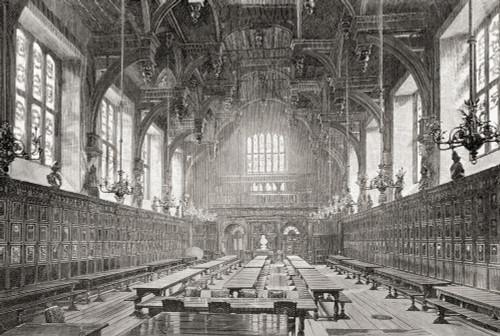
Approximately the twelfth to fifteenth centuries
Let’s travel to London, several centuries before anybody could telephone HMCTS and spend half the morning listening to hold music.
Medieval London was already a complicated place.
Merchants traded goods. Landlords collected rents. Apprentices learned trades. Families argued over inheritance. People accused one another of theft, assault and other offences.
Somebody had to settle these disputes.
And there wasn’t one convenient institution called The Legal System into which every problem could be deposited.
London had its own civic institutions, including the Court of Husting, whose history stretches back to the Anglo-Saxon period.
By the Middle Ages, the City’s aldermen, sheriffs and other officials exercised important judicial and administrative responsibilities.
The Court of Husting became particularly associated with matters involving property and inheritance.
Other courts handled different categories of dispute.
There were also royal courts, local customs, ecclesiastical jurisdictions and developing common-law procedures.
If that sounds like overlapping institutional responsibilities, that’s because it was.
Some aspects of medieval London are beginning to sound uncomfortably familiar.
Enter Newgate and the Old Bailey
Newgate became one of London’s most notorious prisons.
The area around it would eventually become closely associated with the Old Bailey and the administration of criminal justice.
But we should be careful not to imagine today’s Central Criminal Court simply transported backwards into medieval London.
The modern building didn’t exist.
Nor did the modern Crown Court.
The courts, their jurisdictions and their procedures developed over centuries.
The surviving published Old Bailey Proceedings begin in 1674, well after the medieval period.
Nevertheless, the underlying problem remained consistent.
London needed institutions capable of hearing accusations, settling disputes, determining guilt and enforcing judgments.
And as the rules became more elaborate, people who understood those rules became increasingly valuable.
By medieval times, England had already developed recognisable legal practitioners, and the Inns of Court became important centres of legal education and professional life.
The lawyer had well and truly arrived.
The law, meanwhile, was becoming a career.
5. London Today: The Old Bailey and the Price of Complexity

Twenty-first century
Now let’s return to London in 2026.
Walk along the Old Bailey in the City of London and you’ll find the Central Criminal Court, crowned by a golden figure of Justice holding her sword and scales.
The present courthouse opened in 1907, although criminal trials in the area have a much longer history.
In 1834, the Old Bailey was formally established as the Central Criminal Court.
Today, serious criminal cases are heard there under an extensive framework of legislation, evidence rules, procedural safeguards and rights of appeal.
Judges direct proceedings and interpret the law.
Barristers present cases and challenge evidence.
Solicitors advise clients and prepare cases.
Juries determine questions of fact in trials where they are required.
And defendants have legal protections that would have been unfamiliar, or entirely unavailable, in many earlier societies.
That is progress worth recognising.
We shouldn’t romanticise ancient courts simply because their procedures were less complicated.
A simpler system isn’t necessarily a fairer one.
The development of legal safeguards has helped protect people from arbitrary punishment, unreliable accusations and abuses of authority.
But there’s an uncomfortable complication.
Have We Made Justice Too Complicated to Navigate?
In ancient Athens, a citizen might be expected to stand up and argue his own case.
In medieval London, disputes could be handled by civic officials familiar with local customs.
Today, even identifying the correct court, prosecuting authority or procedure can require specialist knowledge.
I recently spent several hours contacting government departments in an attempt to trace historical court proceedings associated with MS90 endorsements recorded against me.
Eventually, an enforcement team supplied account references.
The Single Justice Service then asked for identifying information, including the prosecuting authority and offence date.
Reasonable questions, perhaps.
Except that those are among the details I am trying to establish.
I am asking the system to identify the proceedings.
The system is asking me to identify the proceedings so that it can assist.
There’s something almost historically poetic about it.
Thousands of years ago, people could bring disputes before elders.
Today, I have an account reference, an email address and six questions to answer.
And I’m still trying to find the court record.
The Old Bailey’s Digital Irony
Here’s something particularly interesting.
The Old Bailey Proceedings Online provides searchable accounts of nearly 198,000 criminal trials from 1674 to 1913.
Researchers, historians and members of the public can explore centuries of London’s criminal justice history from a computer.
The Open University was among the institutions involved in developing this remarkable digital resource.
Think about that.
We can search accounts of criminal trials conducted in London during the seventeenth century.
Yet tracing the records of a much more recent case can still involve several telephone calls, different departments and a degree of investigative persistence.
There may be perfectly legitimate reasons for that difference, including privacy restrictions, fragmented record systems and the different purposes for which the information was collected.
A historical public archive is not the same thing as a live court administration system.
Nevertheless, the contrast is striking.
It demonstrates what thoughtful digitisation can achieve.
And it invites us to ask why navigating current administrative processes can sometimes feel more difficult than exploring the distant past.
So, What Came First?
The law.
We established that at the beginning.
But the journey from ancient Mesopotamia to the Old Bailey reveals something more interesting.
Lawyers didn’t invent the need for justice.
They emerged as societies developed increasingly elaborate rules, institutions and methods of resolving disputes.
And legal specialisation brought genuine benefits.
It created expertise, improved representation and helped develop procedures intended to protect people from unfair treatment.
But it also contributed to a world in which understanding the law, and sometimes even locating the right part of the legal system, can become a specialist task.
That leaves us with a question for the present.
Have we made justice more sophisticated without always making it more accessible?
Perhaps the next great improvement to the legal system won’t involve inventing another rule.
Perhaps it will involve making the rules, the records and the institutions easier for ordinary people to understand.
After all, the law existed before lawyers.
And presumably, somewhere along the way, people managed to settle disputes without being asked to provide a case reference they were contacting the court to obtain.
The law came first. The lawyer came later. And somewhere along the way, we invented the help desk.
Leave a Reply