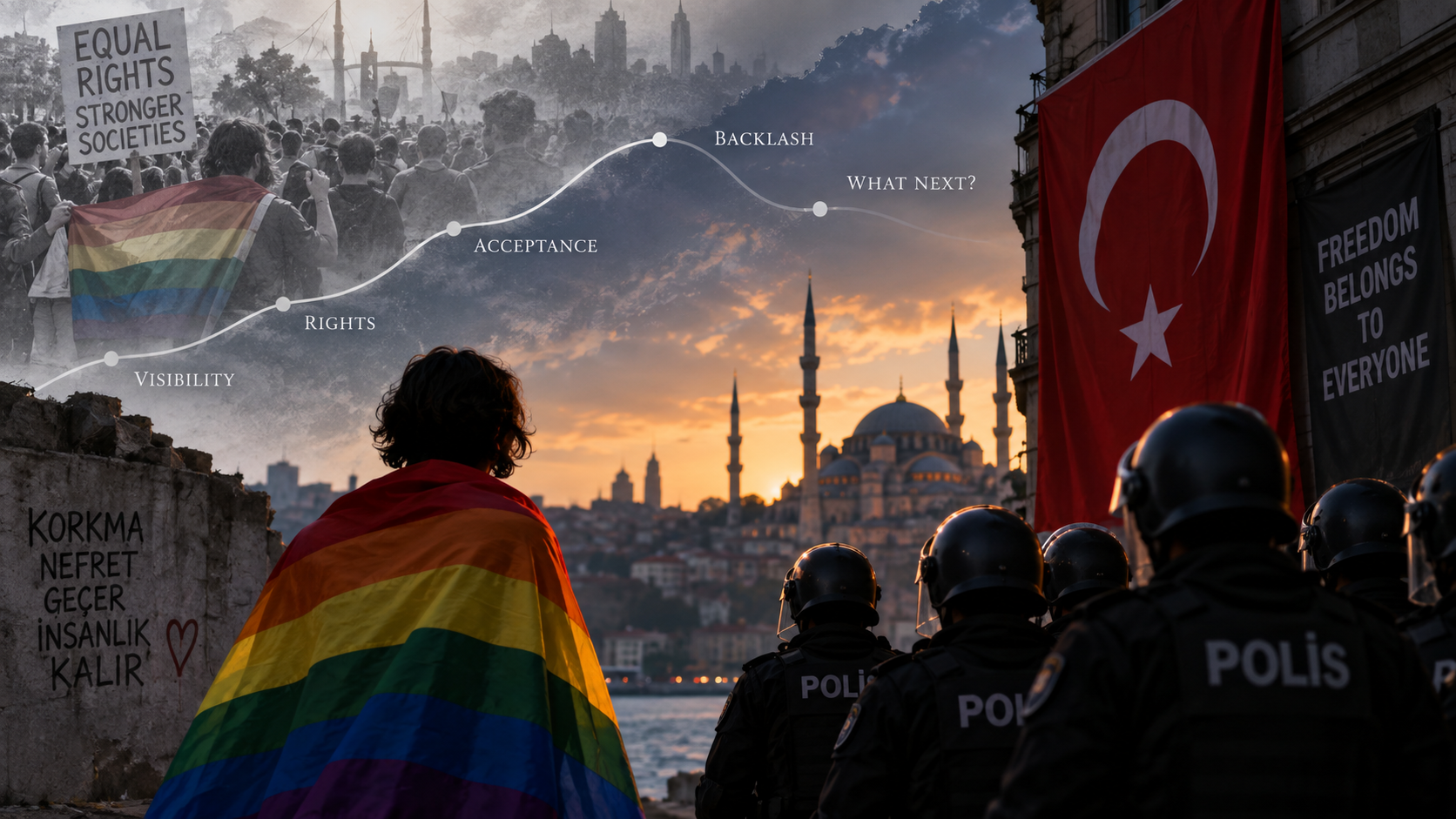
It is tempting to imagine social progress as a straight line. A society becomes more tolerant, laws become more liberal, previously marginalised people become more visible, and eventually an old prejudice recedes into history.
The reality is considerably messier.
The recent crackdown on LGBT people and organisations in Turkey provides a striking example. In September 2026, Turkish authorities launched a nationwide operation targeting LGBT organisations, activists and some businesses and venues. According to Justice Minister Akın Gürlek, investigations encompassed 162 suspects, nine associations and 13 businesses across 15 provinces. Police raided association offices and other premises, websites and social-media accounts were blocked, and dozens of people were detained or jailed pending trial. Authorities described the operation as “My Family is Safe” and said it was intended to protect children, the family and public order. Human-rights organisations and the Council of Europe’s Commissioner for Human Rights have strongly criticised the crackdown and questioned the use of such justifications for restrictions on civil society and expression.
The events did not emerge from nowhere. Istanbul Pride has been banned since 2015, and LGBT demonstrations have repeatedly encountered bans, arrests and police intervention. During 2025, which President Recep Tayyip Erdoğan’s government designated the “Year of the Family,” authorities adopted further measures criticised by human-rights organisations as targeting LGBT people. Human Rights Watch reported restrictions on terminology concerning sexual orientation and gender identity and continuing censorship and restrictions on Pride events.
The September 2026 operation nevertheless represents a significant escalation. Raids extended beyond demonstrations into the organisational infrastructure of LGBT civil society and reportedly included nightlife venues and other workplaces. Access restrictions affected LGBT organisations and media, while subsequent demonstrations against the raids themselves resulted in further detentions.
At first sight, developments like these appear to contradict the idea that LGBT acceptance has advanced over the past several decades.
But that contradiction disappears once we abandon the idea that historical change must move smoothly in one direction.
Progress has more than one timescale
Imagine a society’s level of LGBT acceptance represented by a hypothetical sequence:
20 → 30 → 45 → 60 → 70 → 62 → 65
Someone looking at the entire period sees an enormous long-term increase.
Someone living through the fall from 70 to 62 experiences a genuine reversal.
Neither person is mistaken.
This is an important distinction because phrases such as “LGBT rights are advancing” can accidentally trivialise what happens during periods of regression. Someone whose organisation has been raided, whose demonstration has been prohibited or who has been detained does not experience their situation as an insignificant wobble on an upward graph.
The backward movement is real.
What remains uncertain is whether it represents a lasting change in historical direction.
Progress creates things that are difficult to completely undo
Social change is not simply a collection of laws.
It also changes institutions, expectations, relationships and people’s understanding of what is normal.
Consider what happens when LGBT people become increasingly visible. More people discover that a sibling, colleague, child, neighbour or friend is gay or transgender. Organisations form. Communities acquire physical spaces and cultural traditions. Lawyers develop expertise. Journalists begin covering LGBT issues. Political arguments that once seemed almost unimaginable become familiar.
A government can change legislation or close an organisation considerably faster than it can erase all of those social consequences.
This creates something resembling a ratchet—but an imperfect one.
The ratchet can slip backwards. Sometimes it can slip very far. Rights that seemed secure can disappear, organisations can be dismantled and public attitudes can deteriorate.
Yet society does not necessarily return to precisely the place from which it started.
Turkey demonstrates this paradox particularly vividly. The very existence of established LGBT organisations, Pride traditions, community venues, advocacy networks and public protests against repression demonstrates how much social infrastructure developed before the current crackdown. The government’s ability to restrict that infrastructure is evidence of regression; the infrastructure’s existence in the first place is evidence of an earlier transformation.
Those two realities can coexist.
Backlash can actually be evidence that something changed
There is another uncomfortable feature of social change: backlash frequently occurs because a previously marginal phenomenon has become sufficiently visible to provoke organised opposition.
That does not mean backlash is secretly beneficial. Repression can cause enormous harm, and there is no historical law saying that its victims will eventually prevail.
But it does mean that backlash and previous progress are not opposites in quite the way they initially appear.
A movement can progress from being largely invisible, to visible, to institutionally established—and consequently become important enough that opponents organise specifically against it.
Turkey’s official rhetoric is revealing in this respect. The current campaign has been explicitly framed around protecting “family” and children. Authorities say the measures concern obscenity, prostitution, child protection and public order; rights organisations argue that these concepts are being used to suppress legitimate LGBT civil society and expression.
Whichever interpretation one adopts, the political conflict itself demonstrates that LGBT visibility has become an established question in Turkish public life rather than something society simply never discusses.
But there is no guaranteed happy ending
This is where the metaphor of “winning little battles until the war is won” becomes dangerous.
History has no automatic victory condition.
A backlash can last five years. It can last fifty. Institutions can disappear. Generations can grow up under different social conditions. A sufficiently sustained reversal can eventually destroy some of the cultural and institutional gains that initially seemed difficult to undo.
Nor does every LGBT issue necessarily travel in the same direction. Acceptance of gay and lesbian relationships, same-sex marriage, freedom of association, transgender healthcare, legal recognition of gender, education and questions surrounding children can follow quite different political trajectories.
There is therefore no single dial labelled LGBT progress that moves neatly forwards and backwards.
There are dozens of interacting dials.
History looks different depending on where you stand
Perhaps the most useful way of thinking about all this is to imagine history operating simultaneously at three scales.
At the scale of days and months, there are raids, demonstrations, court decisions, elections and policy changes.
At the scale of years, societies experience political cycles: liberalisation, reaction, polarisation, consolidation and sometimes renewed liberalisation—or further restriction.
And at the scale of generations, much deeper transformations can become visible.
The mistake is assuming that movement at one scale tells us automatically what is happening at another.
Turkey in September 2026 is experiencing a substantial crackdown on LGBT civil society. Calling that merely a temporary bump would go beyond what the evidence can tell us. Nobody yet knows how far the campaign will go, how long it will last, or what its enduring consequences will be.
But neither does the crackdown erase the historical process that preceded it.
That gives us a more nuanced version of the idea that began this discussion:
Progress is cumulative, but it is not inevitable.
Each period of liberalisation changes the society in which the next conflict occurs. Some of those changes survive subsequent reversals; others do not. Consequently, when another period of change begins, it may begin from a different baseline than the one before it.
History therefore resembles neither a triumphant march forward nor an endless circle.
It is closer to a long, irregular path: advances, reactions, settlements, renewed conflicts and occasionally profound reversals—while underneath them, slower changes in culture and institutions may continue accumulating.
Turkey’s current crackdown belongs to the backward-moving part of that story.
Whether it eventually becomes a temporary reversal within a longer transformation, or the beginning of a much deeper and more durable change in direction, can only be answered by what happens next.
Leave a Reply