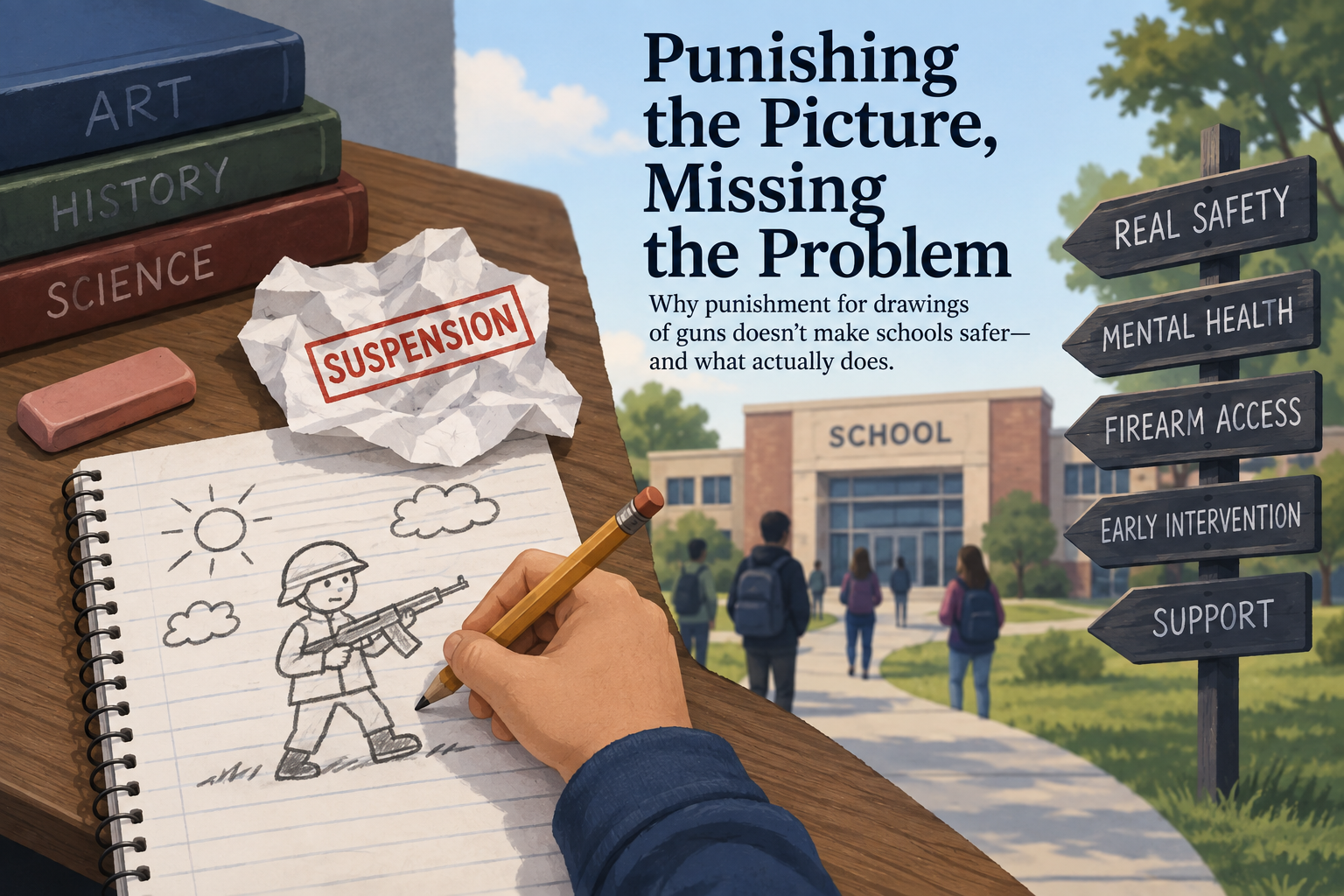
When I was a child in an American school (Forsyth County, GA), I once drew a cartoon that included a gun. I was fascinated by guns at the time—not because I wanted to hurt anyone, but because, like plenty of children, I found certain machines, weapons, vehicles, and military imagery interesting. For that drawing, I received two days of in-school suspension.
Looking back, what strikes me is not simply that the punishment was excessive. It is how little it had to do with preventing actual gun violence.
American schools have an entirely legitimate responsibility to take threats seriously. A student who communicates an intention to shoot someone, brings a weapon to school, attempts to obtain a weapon for an attack, or exhibits other concrete behavior indicating preparation for violence presents a fundamentally different situation from a child who draws a fictional gun. Treating these things as equivalent does not necessarily make a school more vigilant. It can make the school less capable of distinguishing a genuine danger from ordinary childhood expression.
That distinction matters because the United States has a real firearm-violence problem affecting young people. Firearm injuries became the leading cause of death among Americans ages 1–19 in 2020 and 2021 when homicide, suicide, and unintentional firearm deaths are considered together. The causes of that problem are complicated, but punishing children for images of guns is a remarkably indirect response to it.
There is also reason to question the broader disciplinary philosophy behind such punishment. The American Psychological Association’s review of school zero-tolerance policies found little evidence supporting the assumptions behind those policies. The available evidence tended to contradict the idea that rigid, mandatory punishments make schools safer. The APA instead recommended graduated discipline, consideration of context, and reserving the most serious consequences for the most serious behavior.
This does not mean that a disturbing drawing should always be ignored. Context matters enormously. A drawing accompanied by a specific threat against classmates is different from a cartoon battle. A student repeatedly expressing a desire to murder someone is different from a student sketching a soldier holding a rifle. The sensible question is therefore not simply, “Does this picture contain a gun?” It is, “What does this behavior tell us about this particular student, in this particular context?”
That is much closer to the philosophy behind behavioral threat assessment. Rather than assuming that a particular image, interest, personality trait, or superficial characteristic identifies a future attacker, threat assessment examines behavior and circumstances: Has a threat actually been made? Is it credible? Has the student taken steps toward carrying it out? Is there an underlying conflict or crisis that needs intervention? What information do teachers, parents, counselors, and others have?
Research and guidance developed in response to school shootings have specifically warned against simplistic profiling. School attacks are rare enough, and potential “warning signs” broad enough, that crude checklists can identify large numbers of harmless students while still failing to identify genuine danger. The U.S. Secret Service’s National Threat Assessment Center has instead advocated comprehensive programs focused on identifying and assessing concerning behavior and intervening before violence occurs.
That approach also recognizes an uncomfortable truth: prevention requires considerably more work than punishment.
Giving a child detention or suspension because there is a gun in his drawing is administratively easy. Understanding why a particular student has made a serious threat, investigating whether the student has access to firearms, communicating with parents, addressing bullying or interpersonal conflicts, providing appropriate mental-health or behavioral support, and evaluating whether a threat is progressing toward violence are much harder tasks.
But those harder tasks are the ones more closely connected to the danger schools are supposedly trying to prevent.
Research into school-associated violent deaths illustrates why. The CDC has reported that firearms used in school-associated homicides and suicides frequently came from the perpetrator’s home or from friends or relatives. It has also found that perpetrators sometimes communicated warning signals before attacks. Those facts point toward questions of firearm access, threatening behavior, communication, intervention, and adult awareness—not toward the mere existence of firearm imagery in a child’s notebook.
There is another potential cost to treating harmless expression as dangerous behavior. Schools need students to report genuine concerns. An effective safety system depends upon students trusting adults enough to tell them when a classmate makes a credible threat or appears to be preparing for violence. A disciplinary culture that treats every reference to violence as an offense risks blurring the distinction between students who need punishment, students who need help, students who require investigation, and students who have done nothing dangerous at all.
None of this requires schools to become indifferent to threatening material. Quite the opposite. Schools should take potentially threatening behavior seriously enough to investigate its meaning rather than mechanically reacting to its imagery.
A picture can sometimes be evidence. It should not automatically be a verdict.
The larger mistake is confusing visible symbols of America’s gun culture with the causes of America’s gun violence. A gun drawn on a sheet of paper is conspicuous and easy for an institution to prohibit. The conditions associated with actual violence—access to firearms, credible threats, escalating behavior, interpersonal crises, failures of communication, and missed opportunities for intervention—are considerably more difficult to address.
School safety policy should therefore be judged by what it accomplishes, not by how uncompromising it appears.
If punishing a child for drawing a cartoon gun cannot be shown to reduce the likelihood of violence, then the punishment should not be defended merely because it demonstrates that the institution “takes guns seriously.” Taking gun violence seriously means directing attention toward measures that can actually identify and reduce danger.
America does not suffer from a shortage of condemnation of gun violence. It suffers from gun violence itself.
The appropriate response is not to become less vigilant. It is to become more discriminating about what vigilance means: distinguishing expression from intent, fascination from preparation, and an image of violence from evidence that violence may actually occur.
A school that can make those distinctions is not being soft on violence. It is concentrating its attention where it matters.
Leave a Reply